Agile CRM vs Bitrix24 (2026): Which CRM Wins for You?
Agile CRM vs Bitrix24, compared head-to-head on pricing, features, automation, and fit. See which all-in-one CRM actually matches your team in 2026.
Choosing between Agile CRM and Bitrix24 usually comes down to one question: do you want a lightweight, sales-first CRM that stays out of your way, or a sprawling business suite that tries to run your whole company? Both call themselves "all-in-one," but they mean very different things by it.
This is a neutral, feature-by-feature breakdown to help you pick the right one for your team in 2026 — without the marketing gloss from either vendor.
TL;DR#
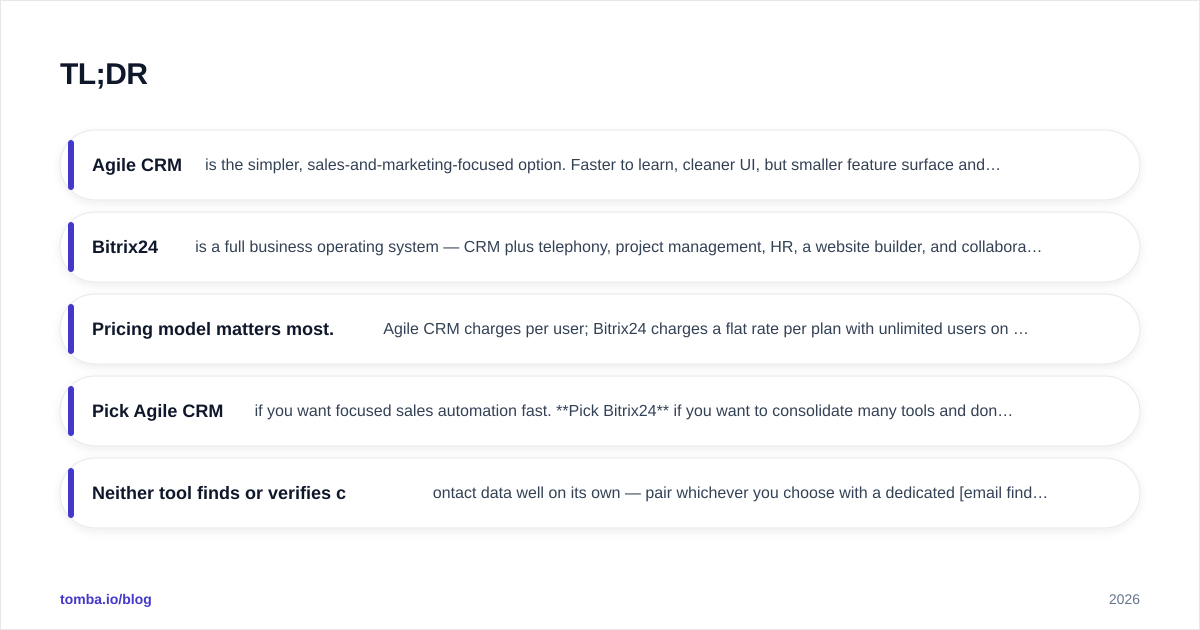
- Agile CRM is the simpler, sales-and-marketing-focused option. Faster to learn, cleaner UI, but smaller feature surface and a free tier capped at 10 users.
- Bitrix24 is a full business operating system — CRM plus telephony, project management, HR, a website builder, and collaboration tools. More powerful, steeper learning curve.
- Pricing model matters most. Agile CRM charges per user; Bitrix24 charges a flat rate per plan with unlimited users on paid tiers — a huge cost lever once you pass ~10 seats.
- Pick Agile CRM if you want focused sales automation fast. Pick Bitrix24 if you want to consolidate many tools and don't mind complexity.
- Neither tool finds or verifies contact data well on its own — pair whichever you choose with a dedicated email finder so your pipeline starts with reachable leads.
What is Agile CRM?#
Agile CRM is a sales, marketing, and service platform aimed at small and mid-sized businesses. Its pitch is "all-in-one" in the lightweight sense: contact management, deal pipelines, email marketing, basic helpdesk, and marketing automation in a single, relatively simple interface.
The appeal is focus. You get a visual deal pipeline, appointment scheduling, email tracking, and a workflow builder without wading through modules you'll never touch. Teams that find Salesforce overwhelming and just want to track deals and run email campaigns tend to like it.
The trade-off is depth and scale. Agile CRM's free plan supports up to 10 users and 1,000 contacts, and paid tiers are priced per user, per month. That per-seat model is comfortable for a 5-person team and painful for a 40-person one.
What is Bitrix24?#
Bitrix24 is a much broader platform — closer to a business operating system than a CRM. Alongside the CRM you get project and task management, group chat and video calls, a built-in phone system (telephony), document storage, an HR/intranet layer, and even a drag-and-drop website and landing-page builder.
Its standout commercial feature is the pricing model: paid plans are flat-rate per plan with a fixed user cap, not per individual seat in the way Agile CRM works. A growing team can add people without the bill scaling linearly with headcount.
The cost is complexity. Bitrix24 has a famously dense interface and a real learning curve. You're adopting a suite, and suites take time to configure, roll out, and get a whole team comfortable with.
Agile CRM vs Bitrix24: side-by-side comparison#
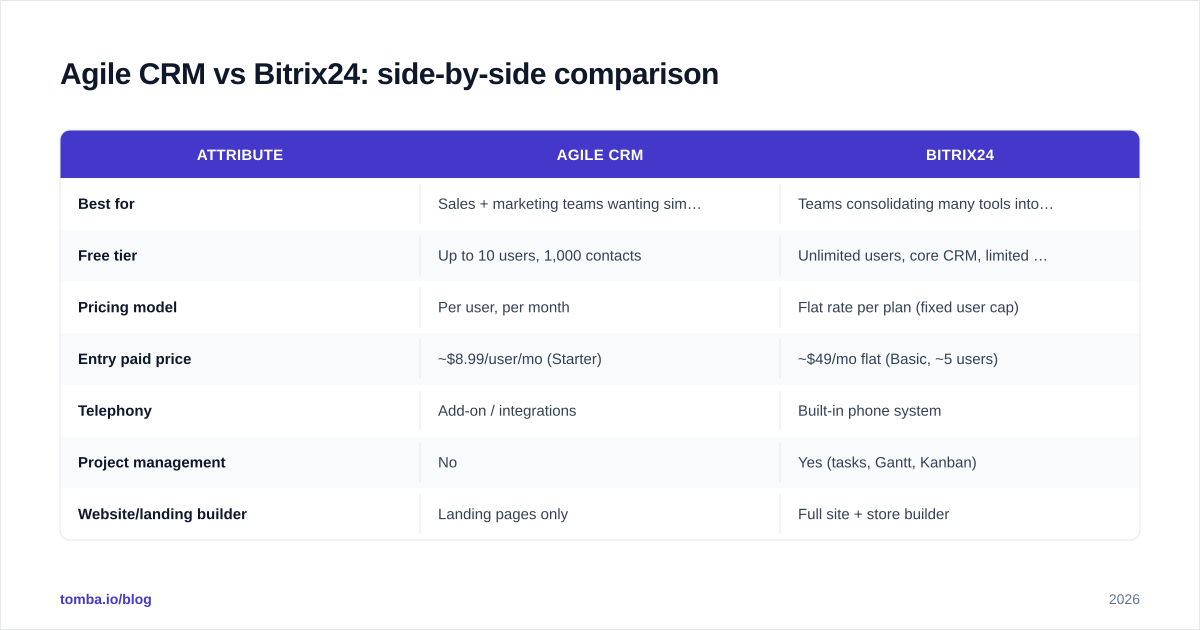
Here's the head-to-head on the attributes that usually decide the call. Treat published vendor pricing as a starting point — both run frequent promotions, and Bitrix24's tiers shift more often than Agile CRM's.
| Attribute | Agile CRM | Bitrix24 |
|---|---|---|
| Best for | Sales + marketing teams wanting simplicity | Teams consolidating many tools into one suite |
| Free tier | Up to 10 users, 1,000 contacts | Unlimited users, core CRM, limited storage |
| Pricing model | Per user, per month | Flat rate per plan (fixed user cap) |
| Entry paid price | ~$8.99/user/mo (Starter) | ~$49/mo flat (Basic, ~5 users) |
| Telephony | Add-on / integrations | Built-in phone system |
| Project management | No | Yes (tasks, Gantt, Kanban) |
| Website/landing builder | Landing pages only | Full site + store builder |
| Marketing automation | Strong, visual workflows | Present but less polished |
| Learning curve | Low | High |
| Support reputation | Responsive on paid tiers | Mixed; depends on tier |
Which is better for pricing and value?#
The honest answer: it depends entirely on your headcount and what you'd otherwise buy separately.
Agile CRM wins on simplicity and low entry cost. A small team with a handful of seats pays little, and you're only paying for CRM and marketing — no padding from modules you won't use. But because it's per-user, the cost climbs in a straight line as you hire.
Bitrix24 wins on consolidation economics. If Bitrix24's flat-rate plan replaces your CRM and your project tool and your phone system and your intranet, the effective cost per tool drops fast. The flat, capped-user model is the single biggest reason fast-growing teams choose it — you're not punished for adding people.
The break-even logic is straightforward: count your seats and list the tools Bitrix24 could replace. Below ~10 users with no need for the suite, Agile CRM is usually cheaper and simpler. Above that, or when you'd consolidate three-plus tools, Bitrix24 typically pulls ahead on total cost of ownership. For broader context on how CRM pricing models stack up across the market, G2's CRM category is a useful neutral reference.
Which is better for features and automation?#
Different philosophies, so match the tool to the job.
If your bottleneck is sales and marketing execution — pipelines, email sequences, lead scoring, campaign automation — Agile CRM's focused toolset is easier to set up and arguably cleaner for that specific workflow. Its visual automation builder is approachable, and you won't get lost.
If your bottleneck is operational sprawl — sales talking to one tool, delivery in another, calls in a third — Bitrix24's integrated suite is the stronger play. Built-in telephony alone (call from inside the CRM, auto-log calls, record them) is something Agile CRM only achieves through third-party add-ons. Bitrix24 also brings real project management, which Agile CRM simply doesn't have.
A useful gut check: write down the five tools your team opens every day. If three or more of them are non-CRM (chat, tasks, calls, files), Bitrix24's consolidation is compelling. If four of the five are sales and marketing, Agile CRM's focus is the better fit. As you map this out, keep your sales process and pipeline stages in mind — the CRM that models your actual stages with least friction is the one your reps will actually update.

What do both tools get wrong about data?#
Here's the gap neither vendor emphasizes: a CRM is only as good as the contacts inside it. Both Agile CRM and Bitrix24 are excellent at managing relationships and terrible, by design, at sourcing them. They assume the email addresses and phone numbers are already correct.
In practice they rarely are. Lead lists decay roughly 22–30% a year as people change jobs, and bouncing into a dead inbox quietly damages your sender reputation — which then hurts every campaign you run from that CRM. Garbage in, garbage out, except the garbage also poisons your deliverability.
That's why teams using either platform pair it with a dedicated data layer:
- A domain search to pull the right contacts at a target company before they ever hit the CRM.
- An email verifier to scrub addresses before import, so bounces never reach your sending domain.
- A bulk email finder for list-building at scale ahead of an outbound push.
Get the data right at the front door and both Agile CRM and Bitrix24 perform noticeably better, because their automation finally runs on contacts that actually exist.
Which should you choose?#
Decide by the shape of your team, not the length of the feature list.
Choose Agile CRM if:
- You're a small-to-mid sales and marketing team (roughly under 10–15 seats).
- You want fast onboarding and a clean interface over maximum capability.
- Your needs are squarely CRM + email marketing, not project management or telephony.
- Per-user pricing is acceptable because your headcount is stable.
Choose Bitrix24 if:
- You want to consolidate CRM, projects, chat, calls, and files into one platform.
- You're scaling and need flat-rate pricing that doesn't punish hiring.
- You have the patience (and ideally an admin) to configure a dense suite properly.
- Built-in telephony and project management are genuine requirements, not nice-to-haves.
There's no universal winner. Agile CRM is the better focused tool; Bitrix24 is the better platform. The mistake is buying Bitrix24's breadth when you only needed Agile CRM's focus — or outgrowing Agile CRM's per-seat math when Bitrix24 would have scaled for less.
Before you commit, run a two-week trial of both with the same five real deals. The platform your reps actually keep updated wins, regardless of what the spec sheet says. Either way, review the full Tomba pricing options for the data layer that will sit in front of whichever CRM you pick — and if you're weighing alternatives more broadly, vendor-neutral roundups on Capterra are worth a scan.
Start your pipeline with data that's actually reachable#
Whichever CRM you land on, it inherits the quality of the contacts you feed it. The Tomba Email Finder finds and verifies professional email addresses by name, domain, or company — so the leads entering Agile CRM or Bitrix24 are real, current, and safe to email. Start free with 25 searches a month, confirm the accuracy on your own target accounts, and let your CRM do what it's good at: closing the deals, not chasing dead inboxes.
// get started
Find, verify and enrich your first contacts today
Start on the free plan with 25 searches a month, then scale when your team is ready.
Free plan · No credit card required · GDPR & CCPA
// about the author