Agile CRM vs Ontraport 2026: Which CRM Actually Wins?
Agile CRM vs Ontraport, compared head-to-head on pricing, automation, and fit. See which all-in-one CRM is right for your SMB sales team in 2026.
Choosing between Agile CRM and Ontraport usually comes down to one question: do you want a cheap, sales-first CRM that scales by seat, or a marketing-heavy automation platform that charges by contacts and capability? Both promise "all-in-one," but they solve different problems. This breakdown cuts through the marketing copy so you can pick the one that fits how your team actually sells.
TL;DR#
- Agile CRM is the budget pick: free for up to 10 users, paid tiers priced per user, and a strong sales+contact management core with light marketing automation.
- Ontraport is the automation-and-marketing pick: priced by contacts (not seats), with deep visual campaign builders, native payments, and membership/landing-page tooling.
- Pick Agile CRM if you're a small sales team that wants pipeline, telephony, and email tracking without per-contact bills.
- Pick Ontraport if marketing automation, e-commerce, and lifecycle campaigns drive your revenue more than rep-led selling.
- Neither tool finds or verifies prospect emails well — pair whichever you choose with a dedicated email finder to keep the database clean.
What is Agile CRM?#
Agile CRM is an all-in-one customer relationship management platform aimed at small and mid-sized businesses. Its core is sales: contact management, deal pipelines, telephony, appointment scheduling, and email tracking, with marketing automation and a basic helpdesk bolted on.
The headline draw is price. Agile CRM offers a genuinely usable free plan for up to 10 users, then charges per user per month as you grow. For a small team that mostly needs a place to track contacts, log calls, and move deals through stages, it covers the basics without a steep learning curve. If you're unsure what a CRM should even do, Agile is a low-risk place to learn the ropes.
The tradeoff: depth. Agile's automation, reporting, and email design tools are functional but shallow compared to a dedicated marketing platform. You'll outgrow them if campaigns become a primary revenue engine.
What is Ontraport?#
Ontraport is a business automation and CRM platform built for marketers, coaches, course creators, and e-commerce sellers. Where Agile leads with sales, Ontraport leads with marketing: visual campaign automation, landing pages, forms, membership sites, and native payment processing all live inside one system.
Pricing is the structural difference. Ontraport charges by the number of contacts in your database and the feature tier, not by user seats. That model rewards small teams with large audiences and punishes large teams with small, high-value lists. A two-person agency nurturing 20,000 subscribers fits Ontraport's pricing beautifully; a 30-rep outbound team with 3,000 accounts does not.
Ontraport's automation is its crown jewel. The visual campaign map lets you build multi-step, multi-channel sequences (email, SMS, tasks, postcards) with branching logic that Agile simply can't match out of the box.
Agile CRM vs Ontraport: the core comparison#
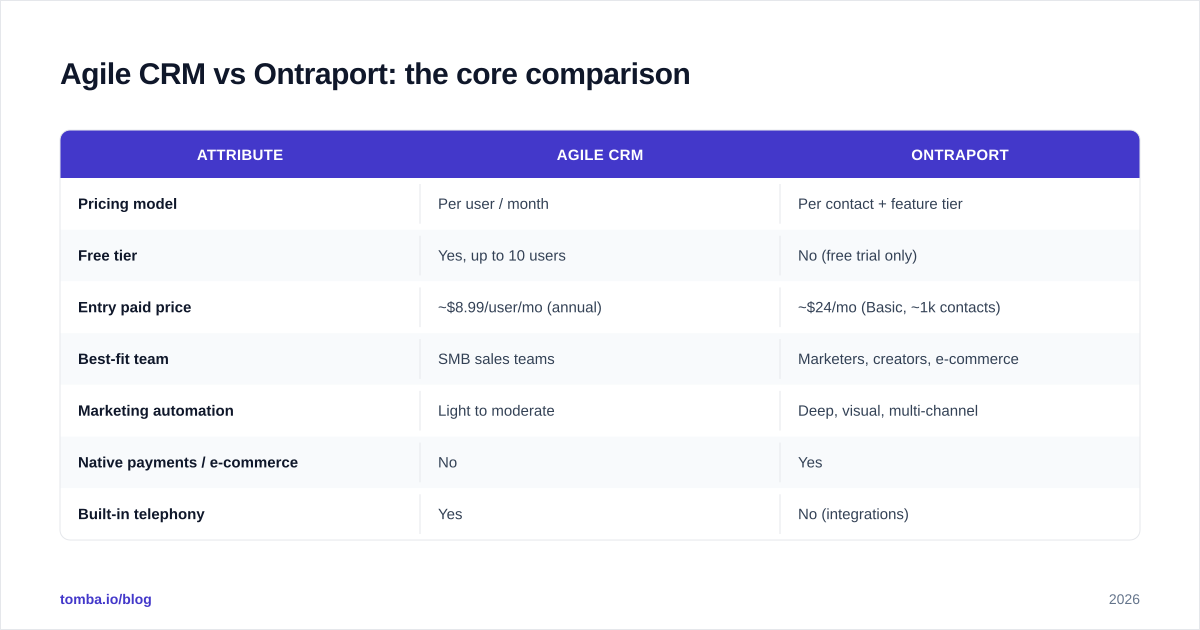
Here's the head-to-head on the attributes that actually drive a buying decision. Pricing is approximate and based on publicly listed plans in 2026, so confirm current numbers on each vendor's site before you commit.
| Attribute | Agile CRM | Ontraport |
|---|---|---|
| Pricing model | Per user / month | Per contact + feature tier |
| Free tier | Yes, up to 10 users | No (free trial only) |
| Entry paid price | ~$8.99/user/mo (annual) | ~$24/mo (Basic, ~1k contacts) |
| Best-fit team | SMB sales teams | Marketers, creators, e-commerce |
| Marketing automation | Light to moderate | Deep, visual, multi-channel |
| Native payments / e-commerce | No | Yes |
| Built-in telephony | Yes | No (integrations) |
| Landing pages / membership sites | Basic | Robust |
| Learning curve | Low | Moderate to high |
| Reporting depth | Moderate | Strong (revenue attribution) |
The pattern is clear: Agile wins on price and sales tooling for seat-based teams; Ontraport wins on automation depth, marketing, and monetization for audience-driven businesses.
Is Agile CRM cheaper than Ontraport?#
Yes, in most scenarios, especially for small teams. Agile CRM's free tier and low per-user pricing make it one of the cheapest entry points in the CRM market. A four-person team can run on the free plan indefinitely if their needs stay basic.
But "cheaper" flips at scale and depends on your shape:
- Small team, big list: Ontraport can win, because you pay for contacts and a couple of seats, not 15 user licenses.
- Big team, modest list: Agile is far cheaper, since you never pay a contact-volume premium.
- Heavy automation needs: Ontraport's price buys capability you'd otherwise stitch together from three or four separate tools.
Run your real numbers. A team that ignores the pricing model and just compares sticker prices on the entry tier will get a misleading answer. Compare your projected user count and contact volume against each vendor's published rate cards: Agile CRM and Ontraport.
Which has better marketing automation?#
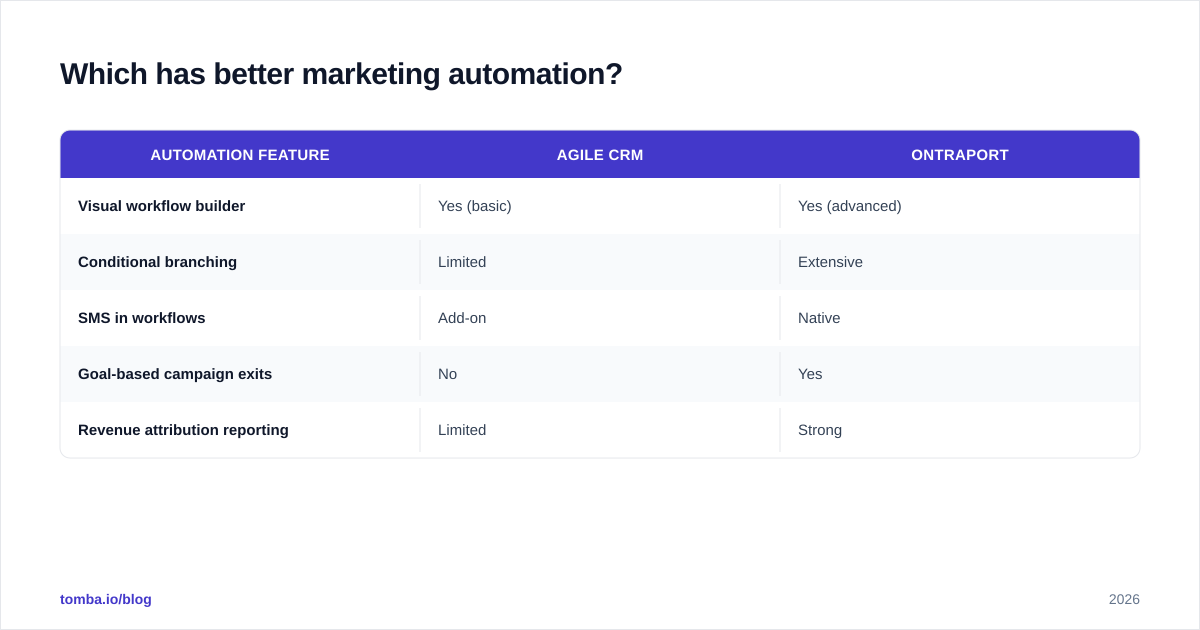
Ontraport, clearly. This is the single biggest functional gap between the two.
Ontraport's visual campaign builder lets you design lifecycle journeys with conditional branches, wait steps, goal-based exits, and multi-channel touches in a single canvas. Combined with native payments and membership tooling, you can run an entire funnel, from first opt-in to upsell, without leaving the platform. For a deeper primer on the category, see this overview of sales automation.
Agile CRM does offer marketing automation, including a visual workflow designer, email campaigns, web pop-ups, and landing pages. It's adequate for nurture sequences and basic drip campaigns. But the branching logic, reporting, and channel breadth are noticeably thinner. If marketing automation is a "nice to have," Agile is fine. If it's the engine of your business, Ontraport earns its higher price.
| Automation feature | Agile CRM | Ontraport |
|---|---|---|
| Visual workflow builder | Yes (basic) | Yes (advanced) |
| Conditional branching | Limited | Extensive |
| SMS in workflows | Add-on | Native |
| Goal-based campaign exits | No | Yes |
| Revenue attribution reporting | Limited | Strong |
Which is better for sales teams?#
Agile CRM, if your motion is rep-led outbound or inbound calling. Built-in telephony, call recording, two-way email sync, appointment scheduling, and deal pipelines are first-class citizens. The per-user pricing also aligns with how sales orgs grow, you add a seat when you hire a rep.
Ontraport can run a sales process, and its automation can do impressive lead routing and follow-up. But it wasn't designed seat-first, and large sales teams feel the contact-based pricing as a tax. If you're scaling a phone-heavy SDR team, Agile's model and telephony are the more natural fit.
That said, both tools share the same blind spot: they manage contacts you already have; they don't find new ones. Neither will reliably source a decision-maker's verified work email from a company name. That job belongs to a dedicated prospecting layer.
How do they handle data quality and prospecting?#
This is where most CRM comparisons stop short. A CRM is only as good as the contact data inside it, and both Agile CRM and Ontraport assume that data arrives clean. It rarely does.
Common gaps you'll hit with either platform:
- No native email finding. You can't type a name and company and get a verified email back.
- No verification at import. Bad addresses flow straight into your database, hurting deliverability and inflating contact counts (which, on Ontraport, literally costs you money).
- Decay over time. Roughly a quarter of B2B contact data goes stale each year as people change jobs.
The fix is to bolt a sourcing-and-cleaning layer onto whichever CRM you pick. Tools like data enrichment fill missing fields, and an email verifier strips invalid addresses before they pollute your pipeline. On Ontraport specifically, verifying before import has a direct ROI, because every junk contact you keep out is contact-quota you don't pay for.
Which integrates better with the rest of your stack?#
Both offer broad integration libraries and APIs, plus connections through
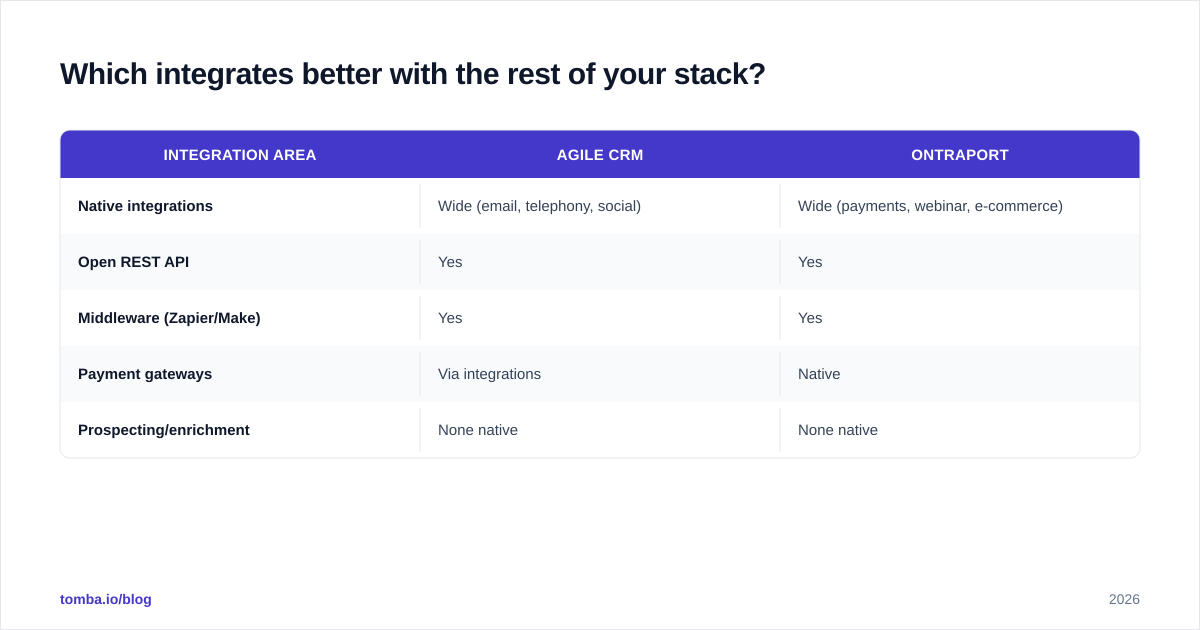
Zapier-style middleware, so most common tools are reachable from either side.
| Integration area | Agile CRM | Ontraport |
|---|---|---|
| Native integrations | Wide (email, telephony, social) | Wide (payments, webinar, e-commerce) |
| Open REST API | Yes | Yes |
| Middleware (Zapier/Make) | Yes | Yes |
| Payment gateways | Via integrations | Native |
| Prospecting/enrichment | None native | None native |
For verified third-party feedback before you commit, browse user reviews on G2 and weigh the patterns, not the outliers. Pay attention to comments about support responsiveness and onboarding time; those are the two areas where SMB CRM buyers most often report regret.
Agile CRM vs Ontraport: pros and cons#
Agile CRM, pros: Free tier for up to 10 users, low per-user pricing, strong sales and telephony features, gentle learning curve, all-in-one for SMBs.
Agile CRM, cons: Shallow marketing automation, limited reporting depth, support quality varies, can feel dated next to newer tools.
Ontraport, pros: Best-in-class visual automation, native payments and membership sites, contact-based pricing favors lean teams with big lists, strong revenue reporting.
Ontraport, cons: No free tier, steeper learning curve, contact-based pricing penalizes large teams, weaker for phone-led sales motions.
Which should you choose?#
Decide on two axes: how you make money and how your costs scale.
- Choose Agile CRM if rep-led selling drives revenue, you want telephony and pipelines, you have many users but a modest contact list, and budget is tight. The free tier alone makes it worth trialing.
- Choose Ontraport if marketing automation, courses, memberships, or e-commerce drive revenue, you have a lean team and a large audience, and you'll actually use the deep campaign tooling you're paying for.
If you're torn, run both free trials with your real workflow, not a demo dataset. Import a sample of your contacts, build one campaign or pipeline you'd genuinely use, and see which platform makes that specific task painless. The "all-in-one" label is identical on both; the daily experience is not.
Close the data gap whichever CRM you pick#
Here's the honest takeaway: Agile CRM and Ontraport are both solid at managing relationships, and neither is built to find them. The fastest way to make either platform pay off is to feed it accurate, verified contacts from day one.
That's exactly where Tomba Email Finder fits. Find professional email addresses by name, company, or domain, verify them before they hit your CRM, and stop paying Ontraport's per-contact rate for addresses that bounce. Start free with 25 searches a month, then scale on a plan that matches your volume, check the current Tomba pricing (Starter $49/mo, Growth $99/mo, Pro $249/mo). Clean data in, real pipeline out, no matter which CRM wins your evaluation.
// get started
Find, verify and enrich your first contacts today
Start on the free plan with 25 searches a month, then scale when your team is ready.
Free plan · No credit card required · GDPR & CCPA
// about the author