Agile CRM vs Zoho CRM 2026: Pricing, Features & Verdict
Agile CRM vs Zoho CRM compared head-to-head: pricing, automation, integrations, and which CRM actually fits your sales team in 2026.
Choosing between Agile CRM and Zoho CRM usually comes down to one question: do you want an all-in-one tool that stays cheap and simple, or a platform you can grow into for the next decade? Both promise to organize contacts, automate follow-ups, and close more deals. They get there very differently.
This comparison breaks down pricing, automation, integrations, data quality, and real-world fit so you can pick the one that matches how your team actually sells — not the one with the louder marketing page.
TL;DR — Agile CRM vs Zoho CRM at a glance#
- **
Zoho CRM** wins on depth, ecosystem, and scalability. If you expect to add users, channels, or AI features over time, it is the safer long-term bet.
- Agile CRM wins on simplicity and bundled marketing tools at a low entry price. It suits small teams that want sales, marketing, and helpdesk in one window.
- Pricing: Both offer free tiers. Zoho scales from roughly $14 to $52/user/month; Agile runs from free to about $79.99/user/month.
- Automation: Zoho's workflow engine and Zia AI are more powerful; Agile's automation is friendlier for non-technical users.
- The catch both share: A CRM is only as good as the contact data inside it. Neither tool is a strong native email-finding or enrichment engine — you'll want a dedicated email finder feeding clean records in.
What is Agile CRM?#
Agile CRM is an all-in-one platform built for small businesses that don't want to stitch together three or four separate tools. It combines sales CRM, marketing automation, and a service/helpdesk module under one login and one bill.
The pitch is consolidation. Instead of paying for a CRM, an email marketing tool, and a support desk, you get landing pages, email campaigns, web popups, telephony, and ticketing alongside your deal pipeline. For a five-person company, that bundle is genuinely appealing — fewer integrations to babysit, one vendor to call.
The trade-off is ceiling. Agile CRM is excellent at being simple, but it was not designed to run a 200-rep sales org with complex territories, custom modules, and multi-layered approval flows. You can read more about how it positions itself on the official Agile CRM site.
What is Zoho CRM?#
Zoho CRM is the sales-and-customer module inside Zoho's much larger suite of 50+ business apps. It's used by companies ranging from solo founders to enterprises with thousands of seats, and it's one of the most widely deployed CRMs on the market.
Where Agile bundles marketing and support into the CRM, Zoho takes the opposite approach: the CRM stays focused on sales, and you bolt on separate Zoho apps (Campaigns, Desk, Books, Analytics) as you need them. That modularity is why Zoho scales so well — you only turn on what you use, and everything shares one data layer.
Zoho also leans hard into AI. Its assistant, Zia, handles lead scoring, anomaly detection, deal predictions, and natural-language queries. You can compare verified user reviews on G2's Zoho CRM listing to see how that plays out in practice.
How do Agile CRM and Zoho CRM compare on pricing?#
Pricing is where the philosophical difference becomes concrete. Agile front-loads marketing features into a flat per-user price;
Zoho spreads capability across tiers so small teams pay less and large teams unlock more.
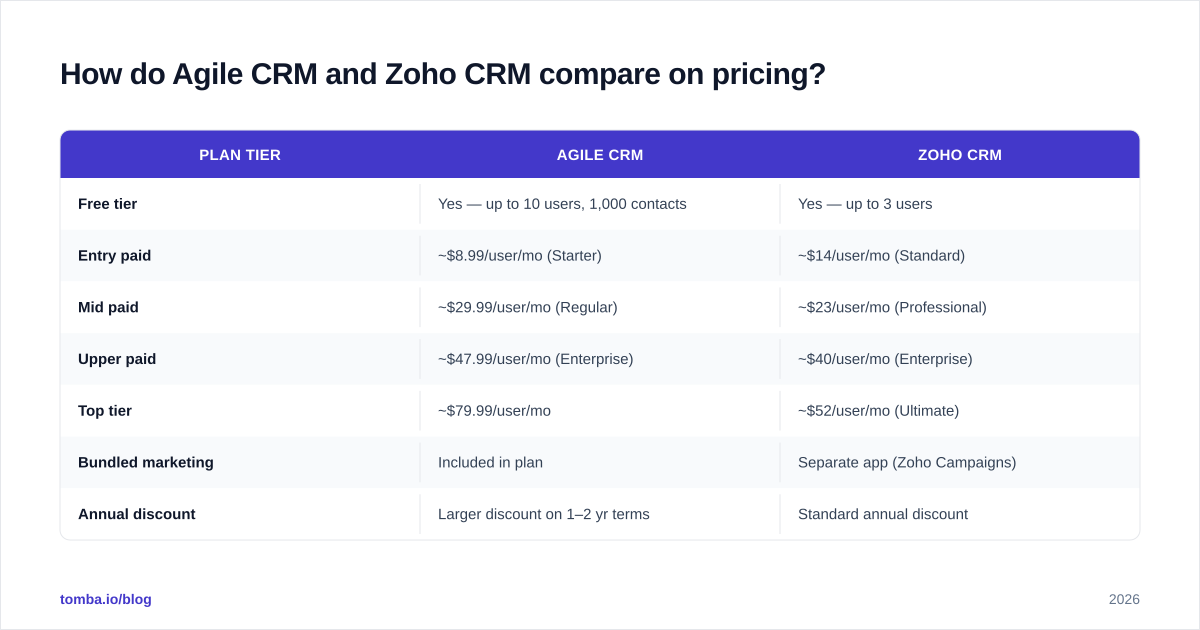
| Plan tier | Agile CRM | Zoho CRM |
|---|---|---|
| Free tier | Yes — up to 10 users, 1,000 contacts | Yes — up to 3 users |
| Entry paid | ~$8.99/user/mo (Starter) | ~$14/user/mo (Standard) |
| Mid paid | ~$29.99/user/mo (Regular) | ~$23/user/mo (Professional) |
| Upper paid | ~$47.99/user/mo (Enterprise) | ~$40/user/mo (Enterprise) |
| Top tier | ~$79.99/user/mo | ~$52/user/mo (Ultimate) |
| Bundled marketing | Included in plan | Separate app (Zoho Campaigns) |
| Annual discount | Larger discount on 1–2 yr terms | Standard annual discount |
A few honest notes. Agile CRM's headline prices look cheaper at the entry level, and its free tier is generous (10 users vs Zoho's 3). But Agile's feature gates are aggressive — telephony, advanced automation, and higher contact limits push you up the ladder fast. Zoho's per-feature pricing tends to be more predictable as you scale, and the Ultimate tier still costs less per seat than Agile's top plan.
For teams that want marketing automation inside the CRM, Agile's bundle can be cheaper than buying Zoho CRM plus Zoho Campaigns. For teams that just want a strong sales CRM, Zoho's Standard and Professional tiers are the better value.
Which has better sales automation and AI?#
Zoho is the stronger automation platform; Agile is the easier one to set up.
Zoho's workflow engine supports multi-step automations, conditional logic, scheduled functions, and custom Deluge scripts for advanced users. Layer Zia AI on top and you get predictive lead scoring, best-time-to-contact suggestions, and anomaly alerts when a usually-active deal goes quiet. For a revenue team that wants to systematize its sales automation, Zoho gives you more levers.
Agile CRM's automation is visual and approachable. The drag-and-drop campaign builder lets a non-technical marketer wire up "if contact opens email, then add tag and assign task" flows in minutes. It covers the common cases well. What it lacks is the depth — complex branching, scripting, and AI-driven forecasting are either limited or absent.
Rule of thumb: if your automation needs fit on a whiteboard, Agile handles them comfortably. If they need a flowchart with a dozen branches, choose Zoho.
How do they compare on integrations and ecosystem?#
This is
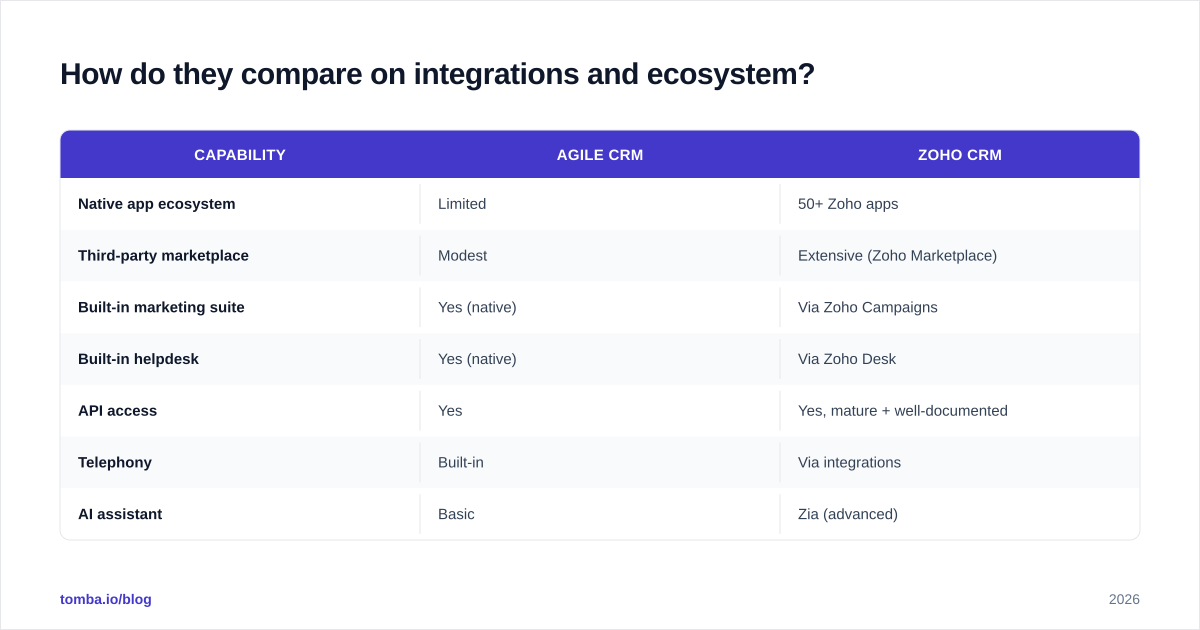
Zoho's clearest structural advantage.
| Capability | Agile CRM | Zoho CRM |
|---|---|---|
| Native app ecosystem | Limited | 50+ Zoho apps |
| Third-party marketplace | Modest | Extensive (Zoho Marketplace) |
| Built-in marketing suite | Yes (native) | Via Zoho Campaigns |
| Built-in helpdesk | Yes (native) | Via Zoho Desk |
| API access | Yes | Yes, mature + well-documented |
| Telephony | Built-in | Via integrations |
| AI assistant | Basic | Zia (advanced) |
Agile CRM's strength is that the integrations you most need — email, telephony, helpdesk — are already inside the product. You don't connect them; they're just there. For a small team, that "batteries included" design removes a lot of setup friction.
Zoho's strength is that almost anything you'll ever need either exists as a Zoho app or as a marketplace connector. The downside is assembly: you're often turning on and configuring multiple apps to match what Agile gives you in one. If you already use tools like HubSpot or Salesforce elsewhere in the org, note that both CRMs play in that wider ecosystem too — and Tomba's own HubSpot integration and Salesforce integration show how third-party data tools bridge across them.
Which CRM is better for data quality and prospecting?#
Here's the part most comparison posts skip: neither Agile CRM nor Zoho CRM is built to find contacts. They're built to store and manage them.
Both will happily hold whatever data you pour in — and both will happily rot if that data is stale. CRMs don't validate that an email still works, they don't fill in a missing direct dial, and they don't tell you the prospect changed jobs six months ago. That's not a knock on either tool; it's just not their job.
This is where a dedicated sourcing and enrichment layer matters. Before a contact ever lands in your pipeline, you want to:
- Confirm the email is real with an email verifier so bounces don't wreck your sender reputation.
- Fill gaps — title, company, direct phone — with contact enrichment.
- Pull every reachable address at a target account using domain search.
Plug a tool like that into either CRM and the comparison stops being "Agile vs Zoho" and becomes "clean pipeline vs dirty pipeline" — which matters far more to your close rate than which CRM logo is on the dashboard.
What are the pros and cons of each?#
Agile CRM — pros
- All-in-one: sales, marketing, and helpdesk in one tool
- Generous free tier (up to 10 users)
- Low entry pricing and a gentle learning curve
- Built-in telephony and email campaigns
Agile CRM — cons
- Limited scalability for larger or complex orgs
- Weaker AI and advanced automation
- Smaller integration marketplace
- Feature gates push you up tiers quickly
Zoho CRM — pros
- Deep customization, modules, and workflow automation
- Powerful Zia AI for scoring and forecasting
- Massive app ecosystem and mature API
- Strong value per seat as you scale
Zoho CRM — cons
- Steeper learning curve
- Marketing/helpdesk are separate paid apps
- Configuration overhead to match Agile's bundle
- Can feel heavy for a tiny team
Which CRM should you choose in 2026?#
Pick based on trajectory, not just today's headcount.
Choose Agile CRM if you're a small business (roughly 1–15 people) that wants sales, marketing, and support in one affordable tool, values simplicity over depth, and doesn't expect to outgrow a lightweight platform soon.
Choose Zoho CRM if you're scaling, need serious automation and AI, run multiple channels or teams, or want a CRM that can absorb new requirements for years without forcing a migration. Most growing B2B sales orgs land here.
If you're genuinely on the fence, weight it toward Zoho. The cost of switching CRMs later — data migration, retraining, lost history — almost always exceeds the savings from picking the cheaper tool today. Buy for where you'll be in two years.
Whatever you choose, remember the multiplier: the CRM organizes your pipeline, but the quality of the contacts in it decides your results. A mediocre CRM full of verified, enriched, reachable leads beats a world-class CRM full of bounced emails every single time. Compare full Tomba pricing to see how a sourcing layer fits alongside either platform.
Final verdict#
Agile CRM is the better bundle for small teams; Zoho CRM is the better platform for teams that intend to grow. Neither is wrong — they're optimized for different stages.
But both leave the same gap: finding and verifying the people you actually want to reach. That's the part that determines whether your outreach lands or bounces, and it's the one thing a CRM won't do for you.
Feed your CRM clean, verified, enriched contacts from day one. Start with the Tomba Email Finder — find professional email addresses by domain, name, or company, verify them before they hit your pipeline, and sync straight into Agile CRM, Zoho CRM, or whatever you choose next. The free tier gives you 25 searches a month to test it; paid plans start at $49/mo when you're ready to scale. Your CRM is only as good as the data you put in it — make that data count.
// get started
Find, verify and enrich your first contacts today
Start on the free plan with 25 searches a month, then scale when your team is ready.
Free plan · No credit card required · GDPR & CCPA
// about the author