Agile Education Marketing vs CuFinder: 2026 Data Showdown
One sells curated K-12 and higher-ed contact lists. The other is a live B2B data engine. Here's how Agile Education Marketing and CuFinder actually compare for 2026 outreach.
Choosing between Agile Education Marketing vs CuFinder? It comes down to one question. Do you want a ready-made education list, or a live engine to build any list yourself? Here is the short version.
TL;DR
- Agile Education Marketing is a vertical specialist: pre-built, compliance-screened lists of K-12 and higher-education contacts (teachers, principals, district admins, faculty). You buy access to a curated audience, not a self-serve search engine.
- CuFinder is a horizontal B2B data engine: real-time company and contact lookup, enrichment, and an API. It spans every industry, not just education.
- Pick Agile when education is your entire market and you need verified, opt-managed school data you can't easily assemble yourself.
- Pick CuFinder (or a finder like Tomba) when you sell across verticals, need fresh data on demand, and want to control cost-per-record instead of paying for a packaged list.
- Neither is a verification tool. Whatever you buy, run it through an email verifier before you send — list age is the #1 cause of bounces.
Agile Education Marketing vs CuFinder: what's the real difference?#
Short answer: they're not the same category of product, even though both end with "a spreadsheet of contacts."
Think of it like buying produce. Agile Education Marketing is a specialty grocer. It stocks one aisle — education. But everything on the shelf is inspected, labeled, and sourced for that audience. CuFinder is a wholesale market. It has huge range across every industry, and it is self-serve. You pay for what you pull, and you do your own quality checks at the door.
That difference drives every other decision. Agile sells you a curated audience. CuFinder sells you a capability to build any audience you want, education included.
If your go-to-market is "we sell SmartBoards to school districts" or "we run a teacher PD platform," a vertical list provider removes a lot of sourcing pain. If your go-to-market is "we sell project-management software to anyone with 50+ employees," a single-vertical list is mostly dead weight.
What is Agile Education Marketing?#
Agile Education Marketing (the brand that grew out of the old Quality Education Data heritage) is an education-focused data and marketing-services company. Its core asset is a maintained database of U.S. education contacts: public and private K-12 schools, districts, colleges, universities, and the administrators, teachers, and decision-makers inside them.
What you're paying for isn't raw scraping. It's:
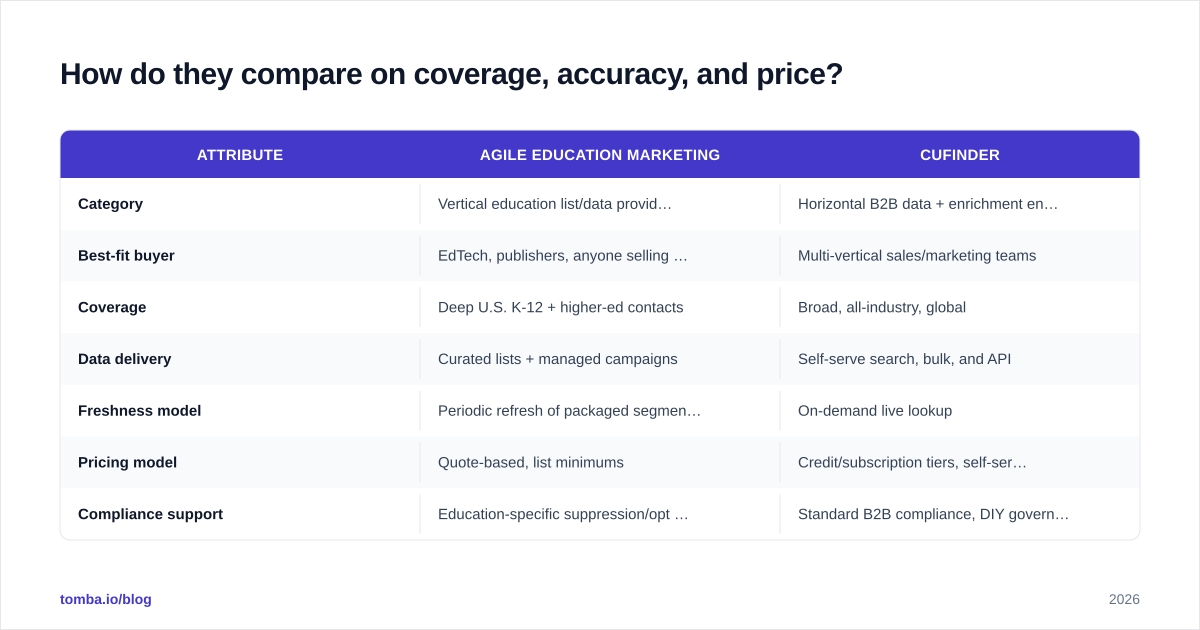
- Vertical depth. Role-level segmentation that generic B2B tools rarely get right — superintendent vs. curriculum director vs. classroom teacher vs. IT coordinator.
- List hygiene for a regulated audience. Education marketing touches minors-adjacent institutions and district procurement rules, so opt management and suppression matter more than in standard B2B.
- Done-for-you options. Agile leans toward managed campaigns, email deployment, and audience modeling, not just a data dump.
The trade-off: you're buying into one vertical at list-provider pricing, usually via quotes and minimums rather than a transparent per-credit menu. Check current reviews on G2 and Capterra before committing — packaged-list satisfaction depends heavily on how recently your specific segment was refreshed.
What is CuFinder?#
CuFinder is a horizontal B2B lead-generation and data-enrichment platform. Instead of selling you a fixed audience, it gives you tools to find and enrich contacts on demand: company search, email and phone lookup, prospecting filters, bulk enrichment, and an API for piping data into your own systems.
CuFinder's pitch is breadth and self-serve control:
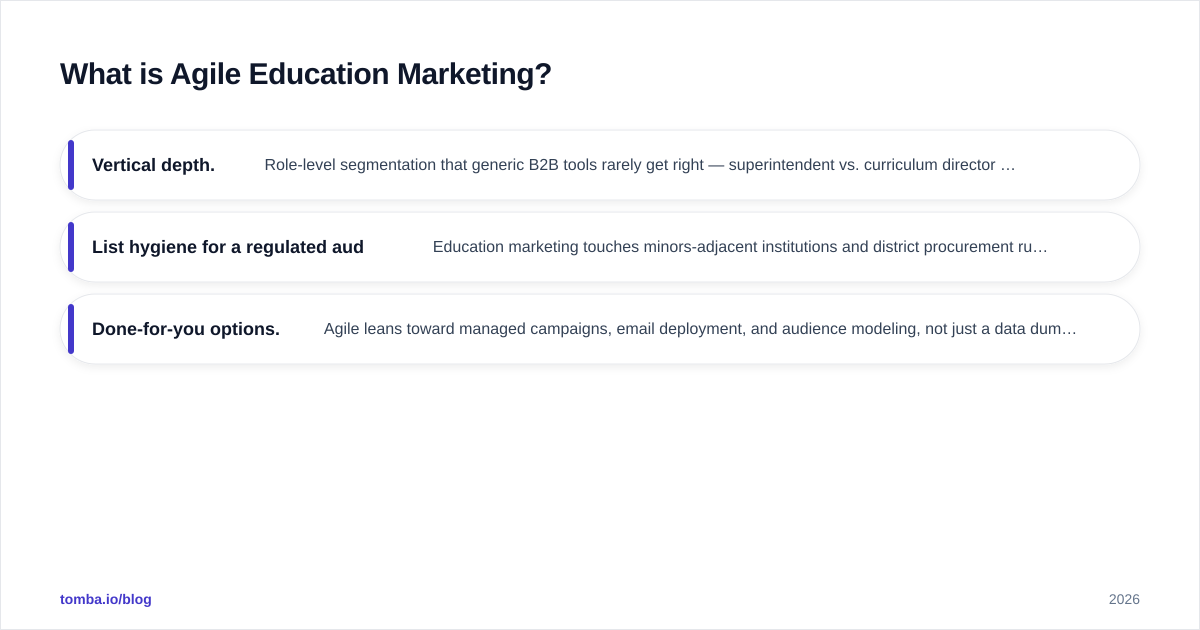
- Any industry. Education is one slice of a global, all-vertical database.
- Live lookup. You query when you need a record rather than buying a snapshot that ages on a shelf.
- API-first workflows. Enrich a CRM, hydrate inbound form fills, or build a pipeline that pulls fresh data automatically.
The trade-off is the mirror image of Agile's: CuFinder won't hand you a hand-curated, district-by-district education map with compliance services wrapped around it. You get raw capability and you assemble the audience yourself.
How do they compare on coverage, accuracy, and price?#
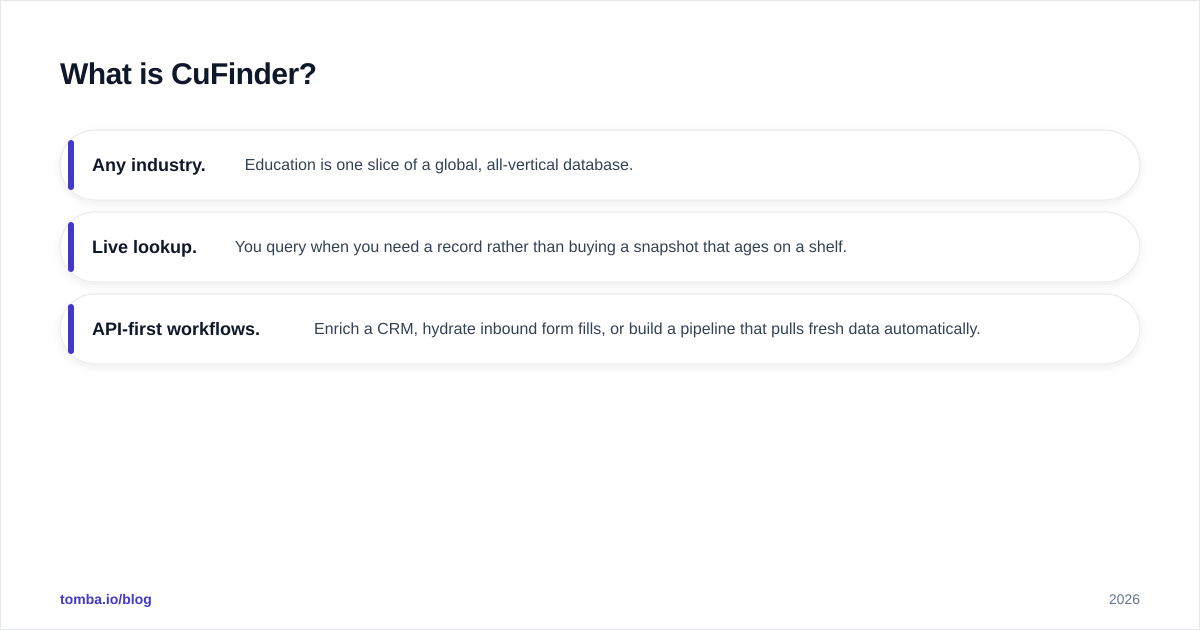
Here's the head-to-head. Treat the pricing column as directional — Agile is quote-based and CuFinder's tiers shift, so always confirm live numbers.
| Attribute | Agile Education Marketing | CuFinder |
|---|---|---|
| Category | Vertical education list/data provider | Horizontal B2B data + enrichment engine |
| Best-fit buyer | EdTech, publishers, anyone selling only to schools | Multi-vertical sales/marketing teams |
| Coverage | Deep U.S. K-12 + higher-ed contacts | Broad, all-industry, global |
| Data delivery | Curated lists + managed campaigns | Self-serve search, bulk, and API |
| Freshness model | Periodic refresh of packaged segments | On-demand live lookup |
| Pricing model | Quote-based, list minimums | Credit/subscription tiers, self-serve |
| Compliance support | Education-specific suppression/opt management | Standard B2B compliance, DIY governance |
| Verification built in? | Limited — confirm per order | Limited — verify before sending |
Two honest caveats apply to both vendors.
First, no provider is 100% accurate, and accuracy decays fastest in education because teachers and administrators churn every academic year. A list that was 95% deliverable in August can drift badly by the following spring.

Second, coverage breadth and accuracy trade off against each other. A vertical provider can be more accurate inside its niche precisely because it ignores everything else. A horizontal engine wins on flexibility but you should sample before you trust a segment. That's why accuracy benchmarks only matter relative to your exact target — a tool that's excellent for SaaS contacts may be thin on rural school districts, and vice versa.
)
Is Agile Education Marketing better than CuFinder?#
Only if education is the whole business — not a segment of it.
Agile wins when:
- 100% of your pipeline lives in schools, districts, or campuses.
- You need role-precise targeting (curriculum buyers vs. IT vs. business office) that generic firmographics flatten.
- Compliance, suppression, and opt management for the education vertical are a real risk you'd rather outsource.
- You'd rather buy a campaign-ready audience than build and maintain one.
CuFinder wins when:
- You sell across multiple industries and education is one of several.
- You want transparent, self-serve, pay-for-what-you-pull economics instead of list minimums.
- You're building automated workflows — CRM enrichment, inbound hydration, API pipelines.
- You'd rather control freshness with live lookups than inherit a vendor's refresh cadence.
Most teams that think they need a vertical list actually need a flexible engine plus disciplined verification — because their "education" segment is really "education plus adjacent EdTech vendors plus a few enterprise accounts," and a single-vertical list can't cover that spread.
Where does an email finder like Tomba fit in this comparison?#
As the build-your-own-list path that sits between a packaged vertical list and a broad data subscription.
If you already know the schools, districts, or companies you want to reach, you don't necessarily need to buy a whole audience or a whole platform subscription. You need to turn a list of domains into verified contacts — and that's exactly what a focused email finder does.
A typical lean workflow looks like this:
- Build a target list of institution domains (district sites, university departments, EdTech companies).
- Run domain search to pull the contacts and email patterns for each domain.
- Enrich the records you keep with data enrichment to add titles, departments, and firmographics.
- Verify everything before the first send so seasonal churn doesn't torch your sender reputation.
This is also the most cost-predictable path. Instead of a five-figure list contract or a broad seat-based subscription, you pay per record you actually need. Tomba's published pricing runs from a Free tier (25 searches/month) to Starter at $49/month, Growth at $99/month, and Pro at $249/month — useful as a transparent benchmark when a list vendor sends you a custom quote with no public number to compare against.

The point isn't that one approach always wins. It's that "buy a packaged education list" and "subscribe to a broad B2B engine" are not the only two options. For a lot of EdTech and B2B teams, "build a precise list from known domains and verify it" is cheaper, fresher, and fully under your control.
)
What about compliance and deliverability?#
This is where education marketing punishes shortcuts harder than normal B2B.
Schools and districts have procurement rules, public-records sensitivities, and high staff turnover. Three things matter regardless of which vendor you pick:
- Suppression and opt-out hygiene. Agile's vertical specialization is genuinely valuable here. If you go the horizontal route, you own this governance yourself — don't skip it.
- Verification cadence. Education contacts churn on the academic calendar. Re-verify before every major campaign, not once a year. A quick pass through an email verifier catches the retirements, role changes, and closed mailboxes that accumulate over a school year.
- Sender reputation. Mailing a stale education list is one of the fastest ways to rack up bounces and spam complaints. Reputation damage outlasts any single campaign.
No data vendor — vertical or horizontal — removes your responsibility to verify and warm up properly. They get you the addresses. Deliverability is still on you.
A simple decision rule#
Use this to cut through the noise:
- Education is your only market, and you want a done-for-you audience with compliance support → Agile Education Marketing.
- You sell across verticals and want self-serve, API-driven, pay-as-you-go data → CuFinder.
- You have known target domains and want maximum freshness at predictable cost → build the list yourself with an email finder, then verify.
Most teams land on a hybrid: a flexible finder for the long tail of accounts they discover week to week, plus a specialist source only for the segments where vertical depth genuinely pays for itself.
The bottom line#
Agile Education Marketing and CuFinder solve different problems that look similar from a distance. Agile is a curated, compliance-aware audience for the education vertical. CuFinder is a broad, self-serve engine for building any audience across industries. So the Agile Education Marketing vs CuFinder choice is simple. It depends on how concentrated your market is. It also depends on how much control over freshness and cost you want.
If your real need is turning a known list of school, campus, or company domains into verified, ready-to-send contacts — without a list contract or a broad seat-based subscription — start with the Tomba Email Finder. Find emails by domain, name, or company, enrich what you keep, and verify before you send. Run a few of your target districts through the Free tier first and compare the results against any quote a list vendor gives you. Letting the data prove itself on your own accounts beats trusting a glossy coverage claim every time.
Ready to find emails that actually work?
Join 150,000+ professionals who stopped guessing and started sending. Free credits on signup — no credit card required.
Get the Tomba newsletter
Practical outbound tactics and product updates — once every two weeks.
About the author