Agile Education Marketing vs DealSignal: 2026 Comparison
Agile Education Marketing owns the K-12 and higher-ed niche; DealSignal sells verified B2B data at scale. Here's which contact-data vendor fits your 2026 pipeline.
TL;DR
- Agile Education Marketing is a niche specialist: deep, permission-based contact data on K-12 schools, districts, and higher-ed institutions in the U.S. If education is your only market, its depth is hard to beat.
- DealSignal is a horizontal B2B data platform: on-demand verified contacts and accounts across every industry, with re-verification at the point of delivery and strong intent/enrichment options.
- Pick Agile when your entire ICP lives inside education; pick DealSignal when you sell across verticals and need verified records on demand.
- Neither is a self-serve email finder. If you mostly need to find and verify work emails by name or domain on a credit budget, a tool like Tomba is a cheaper, faster layer that complements either vendor.
- Verification is the real differentiator in 2026 — stale records quietly destroy deliverability long before you notice the bounce rate.
What are Agile Education Marketing and DealSignal?#
The short version: Agile Education Marketing is a vertical data provider for the education market, and DealSignal is a horizontal B2B data platform for everyone else. They get lumped into the same "buy a contact list" conversation, but they solve different problems.
Agile Education Marketing (often just "Agile") has spent two decades building the deepest commercially available database of U.S. educators — teachers, principals, superintendents, district administrators, and higher-ed faculty and staff. Its data is segmented by grade level, subject, district size, funding, and role, which matters enormously if you sell curriculum, edtech, or facilities services into schools. You can review its positioning on the Agile Education Marketing site.
DealSignal takes the opposite approach. It's an industry-agnostic platform that assembles contact and account records on demand and — this is the key part — re-verifies each record at the moment you request it, rather than serving you whatever was last scraped months ago. It layers on firmographic, technographic, and intent signals so you can build targeted lists across any vertical.
So the decision isn't "which is better" in the abstract. It's "which shape of problem do you have."
How do they compare on data coverage and accuracy?#
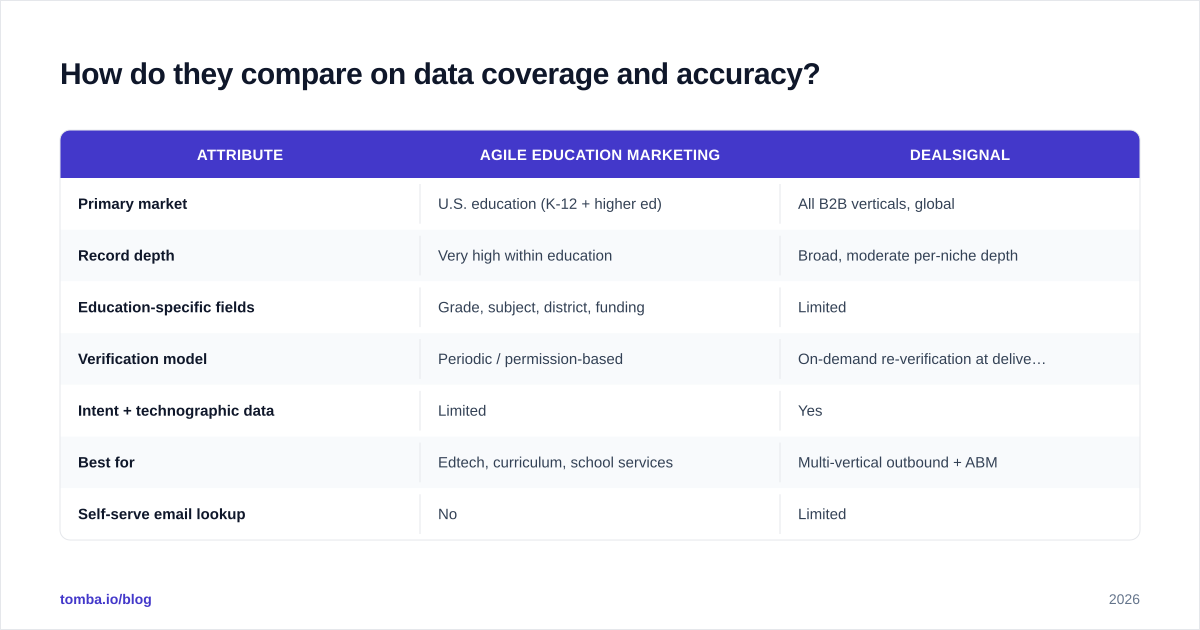
Coverage is where the two diverge hardest. Agile goes a mile deep into one vertical; DealSignal goes a mile wide across all of them.
If your target is "every middle-school science teacher in Texas districts with more than 5,000 students," Agile can build that segment with attributes a general database simply doesn't carry. A horizontal provider knows someone is a "teacher" — it rarely knows their subject, grade band, or district funding tier.
DealSignal's advantage is breadth plus freshness. Because it verifies on demand, the email and phone you receive were checked recently rather than pulled from a cache. For multi-vertical teams, that on-demand model usually beats a static list that decays the day it's exported. Roughly 25–30% of B2B contact data goes stale every year as people change jobs, so "when was this verified" is a sharper question than "how many records do you have."
| Attribute | Agile Education Marketing | DealSignal |
|---|---|---|
| Primary market | U.S. education (K-12 + higher ed) | All B2B verticals, global |
| Record depth | Very high within education | Broad, moderate per-niche depth |
| Education-specific fields | Grade, subject, district, funding | Limited |
| Verification model | Periodic / permission-based | On-demand re-verification at delivery |
| Intent + technographic data | Limited | Yes |
| Best for | Edtech, curriculum, school services | Multi-vertical outbound + ABM |
| Self-serve email lookup | No | Limited |
You can read unfiltered buyer feedback for both on G2 and Capterra before committing — vendor coverage claims and real-world match rates rarely line up perfectly.
Which one is more accurate in practice?#
Accuracy depends less on the vendor's headline number and more on how often the data is re-checked against reality. This is the single most important line in this post.
A list with 10 million records and a "95% accurate" badge tells you nothing if that 95% was measured at the moment of collection and the file is now eight months old. DealSignal's point-of-delivery verification directly attacks this decay problem, which is why it tends to score well on deliverability-sensitive campaigns. Agile's accuracy within education is strong because its sources are specialized and permission-based, but like any periodically refreshed database, segments age between updates.
Whichever you choose, treat the vendor's accuracy claim as a starting point, not gospel. The practical move is to run any purchased list through an independent email verifier before your first send. A second verification pass catches role accounts, traps, and contacts who churned since the file was built — and it protects your sender reputation, which is far more expensive to repair than to maintain. Understanding where vendors source records (and how often) is worth a look at how a provider documents its data sources.
How does pricing work for each?#
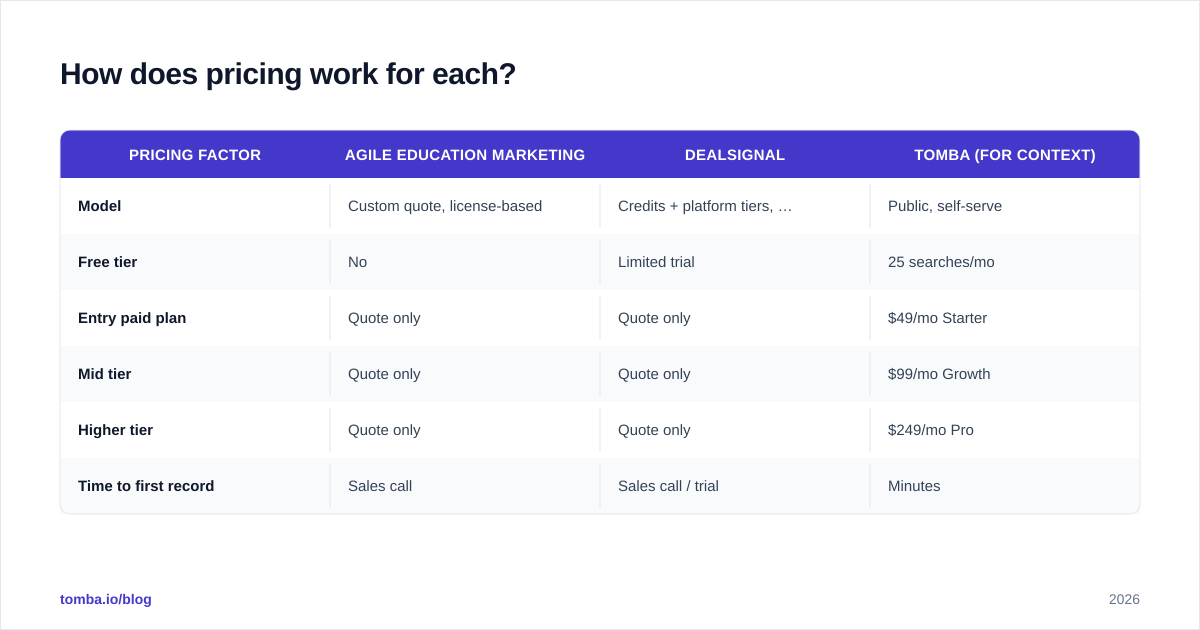
Both are quote-based enterprise products, not credit-card-and-go tools. Neither publishes a transparent self-serve price list, and that's the friction point for smaller teams.
Agile Education Marketing prices by list size, segmentation complexity, and licensing terms (one-time use vs. multi-use vs. annual subscription to a data feed). Education lists are often licensed per-deployment, so re-using the same file repeatedly can require a higher tier.
DealSignal prices on credits and platform access, scaling with the number of verified records and which enrichment/intent layers you turn on. On-demand verification costs more per record than a static dump, but you're paying for freshness rather than volume.
| Pricing factor | Agile Education Marketing | DealSignal | Tomba (for context) |
|---|---|---|---|
| Model | Custom quote, license-based | Credits + platform tiers, custom | Public, self-serve |
| Free tier | No | Limited trial | 25 searches/mo |
| Entry paid plan | Quote only | Quote only | $49/mo Starter |
| Mid tier | Quote only | Quote only | $99/mo Growth |
| Higher tier | Quote only | Quote only | $249/mo Pro |
| Time to first record | Sales call | Sales call / trial | Minutes |
That last column is the honest caveat: if you don't need a full managed data contract, a transparent self-serve finder gets you contacts today without a procurement cycle. You can compare published Tomba pricing against the "request a quote" wall both Agile and DealSignal put up.
Is Agile Education Marketing better than DealSignal?#
Only if you sell into education and nowhere else. That's the clean rule.
Agile wins decisively when your total addressable market is schools and universities. The segmentation depth, the permission-based sourcing tuned for an industry with strict outreach norms, and the role-level targeting are things a horizontal provider can't replicate without that vertical investment. Selling a reading-intervention platform to elementary schools? Agile.
DealSignal wins the moment your ICP spills outside education — SaaS, manufacturing, healthcare, finance, or a mix. Its breadth, on-demand verification, and intent signals make it the safer backbone for a multi-vertical outbound or account-based marketing motion. You'd rather have fresh, verified data across every segment than deep data in one you don't fully sell to.
There's also a third answer neither vendor likes: for many teams, the real need is just finding and verifying specific people at known companies, on demand, without a contract. That's a different tool category entirely.
When should you use an email finder instead of a data vendor?#
Use a finder when you know who or where you're targeting and just need the contact, not a managed list. Use a data vendor when you need someone else to build, segment, and maintain a large universe of records for you.
The two models aren't rivals — they stack. A common 2026 setup looks like this:
- Vendor for the universe. Buy a segmented base from Agile (education) or DealSignal (everything else) to define your market.
- Finder for the precision adds. When a rep finds a specific prospect on LinkedIn or a company site that isn't in the list, use an email finder to grab the verified work email in seconds.
- Verifier as the gate. Run everything — purchased or found — through email verification before it touches your sequencer.
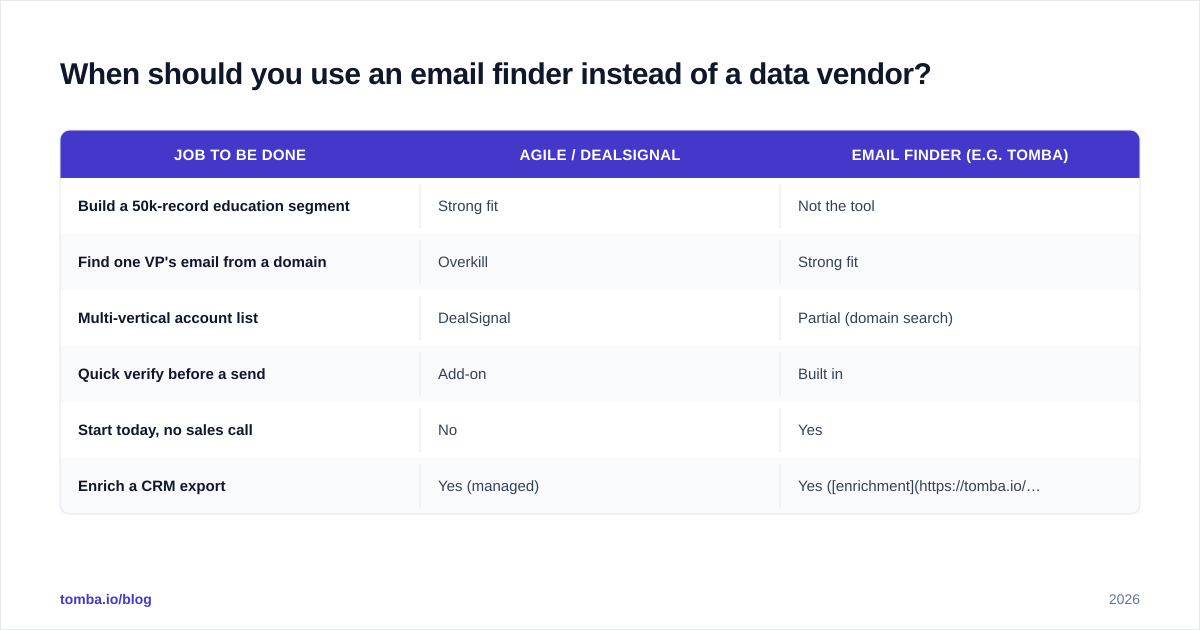
This is where a self-serve tool earns its place. Here's how the three roles actually differ:
| Job to be done | Agile / DealSignal | Email finder (e.g. Tomba) |
|---|---|---|
| Build a 50k-record education segment | Strong fit | Not the tool |
| Find one VP's email from a domain | Overkill | Strong fit |
| Multi-vertical account list | DealSignal | Partial (domain search) |
| Quick verify before a send | Add-on | Built in |
| Start today, no sales call | No | Yes |
| Enrich a CRM export | Yes (managed) | Yes (enrichment) |
The pattern: data vendors own scale and segmentation; finders own speed and precision. Teams that treat them as either/or usually overpay for one or under-serve the other.
What about deliverability and compliance?#
Both vendors give you data; neither guarantees your emails land. Deliverability is downstream of how you use the data, not just how clean it arrives.
Education outreach in particular carries heightened sensitivity — student-adjacent data and institutional email policies mean Agile's permission-based sourcing is a genuine compliance asset. For broad B2B, DealSignal's compliance posture and re-verification reduce the odds of hitting dead or trap addresses.
But the universal rules apply regardless of vendor:
- Verify before you send, every time, even on "verified" purchased data.
- Warm up new sending domains and keep volume gradual.
- Honor opt-outs and regional regulations (GDPR, CAN-SPAM, and education-specific norms).
- Watch bounce rate as an early-warning signal — a creeping bounce rate means your data is decaying faster than your refresh cadence.
A purchased list is a liability if you send to it blind. The verification step is cheap insurance against the expensive problem of a burned sending domain.
The verdict: which should you choose in 2026?#
Match the tool to the shape of your market, then add a finder for precision.
- Choose Agile Education Marketing if education is your whole world. Nothing else gives you grade-, subject-, and district-level targeting with sourcing built for the sector's norms.
- Choose DealSignal if you sell across verticals and value fresh, on-demand verified records plus intent signals over raw record count.
- Add a self-serve email finder in either case for the daily reality of finding and verifying specific contacts without a procurement cycle.
The thread tying all three together is verification. The vendor with the freshest data wins the campaign, and the team that re-verifies before sending wins the inbox.
If your day-to-day is finding and confirming work emails — by name, by company, or in bulk — start with the Tomba Email Finder. It runs on transparent, self-serve pricing (a free tier with 25 searches/month, then $49/mo Starter), pairs finding with built-in verification, and slots cleanly alongside whichever managed data vendor you pick. Use Agile or DealSignal to define the universe; use Tomba to hit the exact people in it without waiting on a sales call.
// get started
Find, verify and enrich your first contacts today
Start on the free plan with 25 searches a month, then scale when your team is ready.
Free plan · No credit card required · GDPR & CCPA
// about the author