Agile Education Marketing vs DiscoverOrg (2026 Compared)
DiscoverOrg folded into ZoomInfo and Agile Education Marketing only covers schools. Here's how the two data platforms stack up in 2026, and what to reach for when neither one fits your list.
You typed two product names into the same search box and got back two very different companies. That is the first thing to know about comparing Agile Education Marketing vs DiscoverOrg: they were never really competitors. One sells contact data for schools and districts. The other sold sales intelligence to every industry, then disappeared into a larger brand. Pick the wrong one and you either pay for an education database you can't use, or chase a product that no longer ships under that name.
This guide untangles the two, shows where each one actually wins, and explains what to do when your real problem is just finding and verifying a clean list of contacts.
TL;DR#
- Agile Education Marketing is a niche data and marketing-services provider focused entirely on the U.S. education market (K-12, higher ed, and early childhood). If you are not selling to schools, it is not for you.
- DiscoverOrg was a broad B2B sales-intelligence platform. It merged with ZoomInfo in 2019, and the DiscoverOrg brand has since been folded into ZoomInfo. You can't buy "DiscoverOrg" as a standalone product in 2026.
- They overlap almost nowhere. Choosing between them is really choosing between education-only depth and general B2B breadth.
- Both are heavyweight, contract-based platforms. Neither is a fit if you just need to find verified emails for a specific list of companies.
- For most teams doing targeted outbound, a self-serve email finder plus a verifier covers the job at a fraction of the commitment.
What is Agile Education Marketing?#
Agile Education Marketing is a data and marketing company that specializes in one vertical: education. It maintains contact records for teachers, principals, superintendents, district administrators, and higher-ed staff across the United States, and pairs that data with done-for-you services like email campaigns, list rentals, and audience targeting.
Think of it as a specialist clinic rather than a general hospital. If your buyer is a curriculum director in a mid-size school district, Agile has spent years mapping exactly those roles, including the messy org structures that make education such a hard market to sell into. That depth is the whole pitch. You are paying for records that a generic B2B database tends to get wrong, like which of the seventeen people at a district actually approve software purchases.
The trade-off is obvious. Outside of education, the database has nothing for you. There is no "switch to manufacturing" toggle. You are buying access to schools, and that is the entire product.
You can see the company's current positioning on the official Agile Education Marketing site. Note how much of the page is about services (campaign execution, data hygiene, audience strategy) rather than raw self-serve data access. That is a signal about how you buy: through a sales conversation and a contract, not a credit-card signup.
What is DiscoverOrg, and where did it go?#
DiscoverOrg was a B2B sales and marketing intelligence platform known for human-verified org charts, direct-dial phone numbers, and "scoops" (timely buying-signal intel). For years it was a premium alternative to scraped databases because real researchers checked the records.
Here is the part that breaks most comparison articles: DiscoverOrg merged with ZoomInfo in February 2019. The combined company kept the ZoomInfo brand, and DiscoverOrg's data and features were absorbed into the ZoomInfo platform. If you go looking for DiscoverOrg today, you land on ZoomInfo. The technology lives on; the standalone product does not.
So when you evaluate "DiscoverOrg" in 2026, you are really evaluating ZoomInfo's enterprise sales-intelligence suite. That matters for pricing, contracts, and support, because everything now runs through ZoomInfo's go-to-market motion, not a separate DiscoverOrg team.
How do Agile Education Marketing and DiscoverOrg compare?#
Because one is vertical and one is horizontal (and one no longer exists under its own name), a feature grid is the clearest way to see the gap. Here is the honest side-by-side.
| Attribute | Agile Education Marketing | DiscoverOrg (nowZoomInfo) |
|---|---|---|
| Primary market | U.S. education only (K-12, higher ed, early childhood) | All B2B industries |
| Core asset | Education contacts + role mapping | Verified org charts, direct dials, intent/scoops |
| Standalone product in 2026 | Yes | No — merged into ZoomInfo |
| Buying model | Sales-led, contract + services | Sales-led, annual platform contract |
| Self-serve signup | No | No |
| Done-for-you campaigns | Yes (list rental, email execution) | Partial (platform + add-ons) |
| Best for | EdTech and education suppliers | Mid-market to enterprise multi-vertical sales |
| Typical commitment | Annual / project-based | Annual seat-based contract |
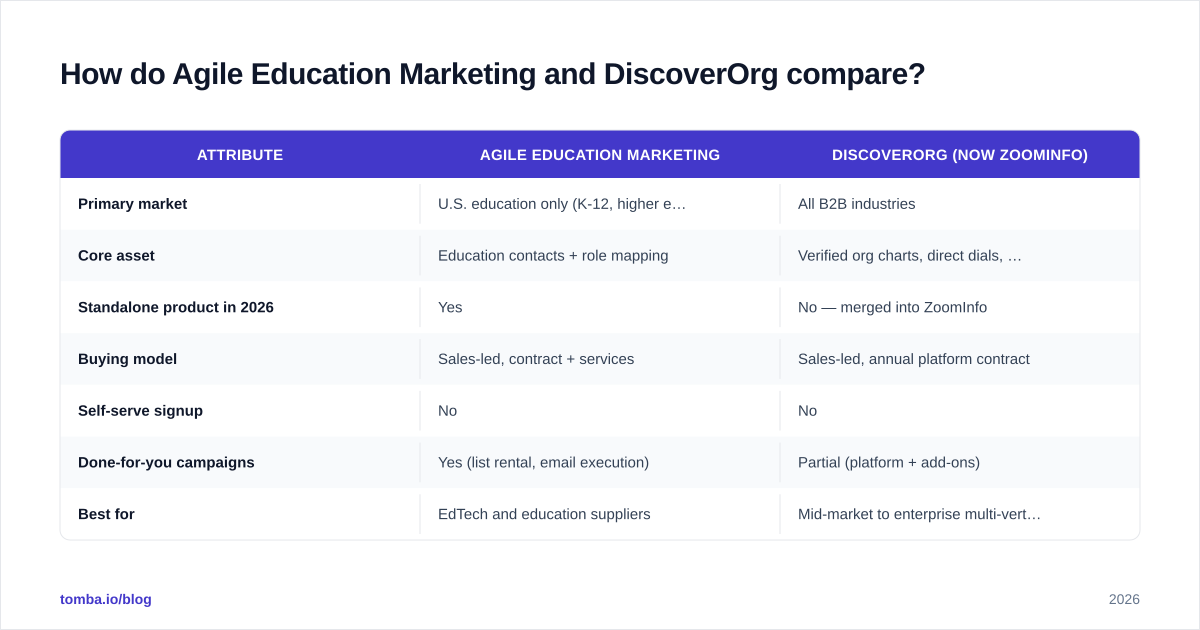
The pattern is clear. Both are top-of-funnel data engines you commit to, not tools you dip into for a single campaign. The difference is reach: Agile goes deep on one vertical, ZoomInfo (the DiscoverOrg you'd actually buy) goes wide across all of them.
If your account list spans education and other industries, neither single tool covers you cleanly. You would either run Agile for the schools and something broader for the rest, or accept that a general platform's education data is shallower than a specialist's.
Which one has better data accuracy?#
Accuracy depends on what you measure. For education-specific records, Agile Education Marketing almost certainly has the edge, because a focused team maintaining a narrow dataset can keep up with role changes that a general crawler misses. School staff turn over on a predictable academic calendar, and a vertical specialist builds for that rhythm.
For everything else, the DiscoverOrg lineage inside ZoomInfo is the stronger bet. The original DiscoverOrg reputation was built on human-verified data, and ZoomInfo continues to combine machine collection with verification at a scale no education-only vendor matches. You can sanity-check both vendors' current reputations on third-party review sites like G2, where buyers post unfiltered notes about bounce rates and stale records.
But here is the catch that applies to every large database, vertical or horizontal: bought data decays the moment it is delivered. People change jobs, districts restructure, and direct dials get reassigned. A record that was accurate at export can be wrong by the time your sequence sends. That is why serious outbound teams treat any purchased list as a starting point and run a verification pass before sending. Even the best database benefits from a fresh email verification check at send time.
What do Agile Education Marketing and DiscoverOrg cost?#
Neither publishes transparent pricing, and that is the most important pricing fact about both. Expect a discovery call, a custom quote, and an annual contract.
| Cost factor | Agile Education Marketing | DiscoverOrg /ZoomInfo |
|---|---|---|
| Public price list | No | No |
| Entry commitment | Project or annual | Annual platform contract |
| Pricing driver | Data volume + services | Seats + data credits + modules |
| Free tier | No | No (limited trials only) |
| Quote required | Yes | Yes |
| Typical buyer | Marketing teams in EdTech | RevOps / sales ops at scale |
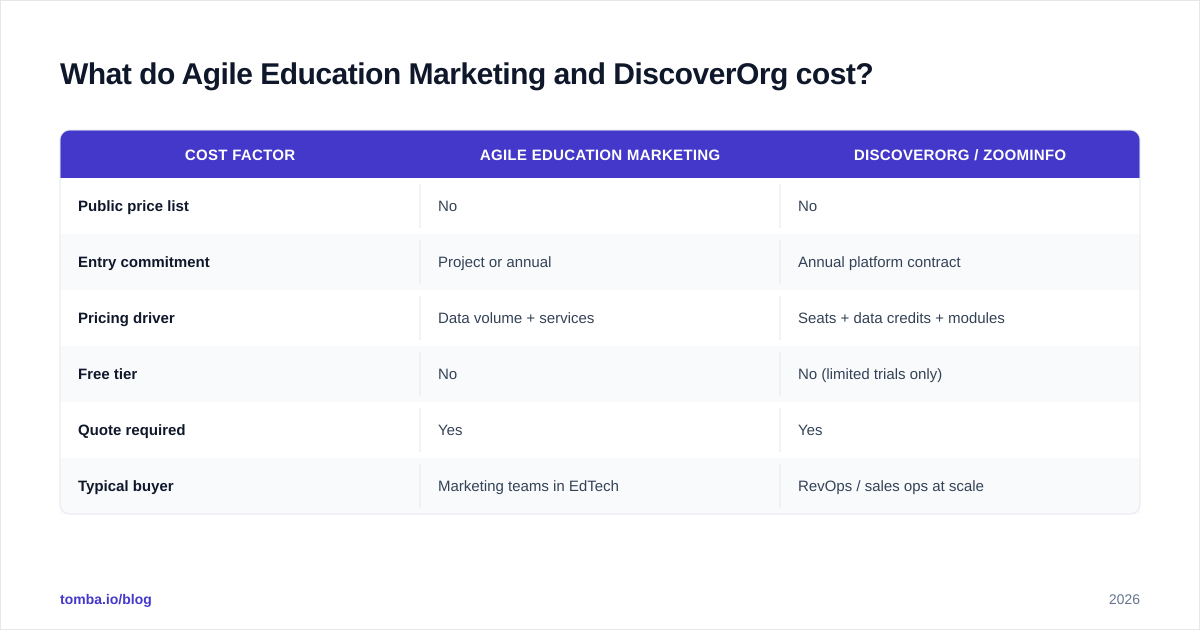
For ZoomInfo specifically, public reporting and buyer reviews put realistic annual contracts well into five figures once you add seats and data modules. Agile's education programs are quote-based and scale with the size of your audience and how much campaign execution you hand off. The honest summary: both are budget-line decisions that need sign-off, not tools you expense quietly.
If that level of commitment feels heavy for your actual need (a clean list of decision-makers at a defined set of accounts) it probably is. Compare those custom quotes against transparent, self-serve Tomba pricing before you sign anything: Free at 25 searches a month, Starter at $49/mo, Growth at $99/mo, and Pro at $249/mo, with no sales call required to start.
Which should you choose?#
Match the tool to the shape of your market, not to the brand recognition.
Choose Agile Education Marketing if you sell to schools and only schools. EdTech vendors, curriculum publishers, school-supply companies, and anyone whose total addressable market is the U.S. education system will get records and segmentation a generalist can't match. The done-for-you campaign services are a real plus if you don't have an in-house email team.
Choose ZoomInfo (the DiscoverOrg you'd actually buy) if you sell across multiple industries at mid-market or enterprise scale, you need org charts and direct dials, and you have the budget and RevOps maturity to operate a large platform. The intent data and integrations pay off when you have a team big enough to act on them.
Choose neither if your job is more focused than "buy a whole market." If you already know the companies you want and just need verified contacts at those companies, a heavyweight database is overkill. This is where a domain search approach wins: feed it a company domain, get back the people and patterns, verify, and move. You can read about where the data comes from before you trust it, which is more transparency than either incumbent offers up front.
A practical hybrid many teams land on: use a specialist or broad database for discovery and firmographics, then run a data enrichment and verification layer to keep the records send-ready. The database tells you who exists; the finder-and-verifier makes sure the email actually lands.
Is there a simpler alternative to both?#
Yes, if your bottleneck is contact data rather than market mapping. The reason both Agile and DiscoverOrg/
ZoomInfo feel oversized for many teams is that they bundle services, intent, and analytics you may never touch, and they price for the whole bundle.
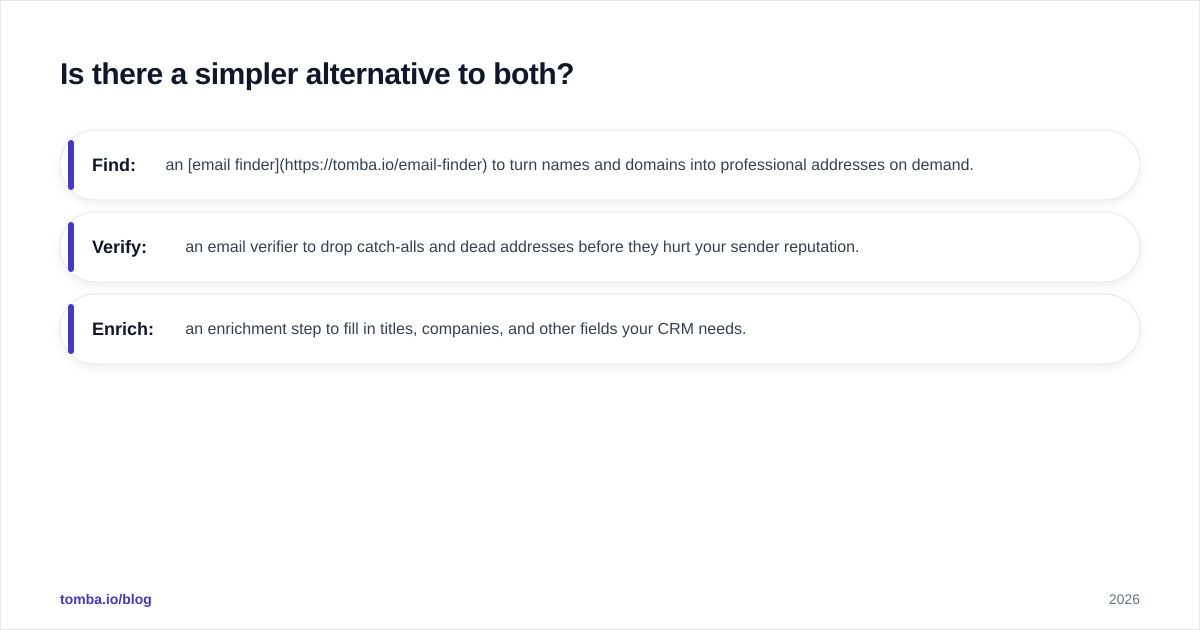
A leaner stack looks like this:
- Find: an email finder to turn names and domains into professional addresses on demand.
- Verify: an email verifier to drop catch-alls and dead addresses before they hurt your sender reputation.
- Enrich: an enrichment step to fill in titles, companies, and other fields your CRM needs.
You get most of the outcome of a big database (verified, send-ready contacts) without the annual contract, the seat minimums, or the discovery call. For an education-only motion, you still might want Agile's depth. For broad B2B at enterprise scale, ZoomInfo earns its keep. For everyone in between, a self-serve finder plus verifier is the faster, cheaper path to a clean list.
The deciding question is not "Agile or DiscoverOrg." It is "do I need to rent a market, or do I need to find specific people?" Answer that honestly and the right tool picks itself.
The bottom line#
Agile Education Marketing and DiscoverOrg were never two versions of the same thing. Agile is a living, education-only specialist. DiscoverOrg is a retired brand whose data now ships inside ZoomInfo. If you sell to schools, Agile is the obvious specialist. If you sell broadly at scale, ZoomInfo carries the DiscoverOrg legacy. And if you mostly need verified emails for accounts you already know, you don't need either contract.
Start where the friction actually is. If finding and confirming the right contact is your real blocker, skip the year-long commitment and try the Tomba Email Finder free, 25 searches a month, no sales call. Find the people, verify the addresses, and spend your budget on outreach instead of a database you half-use.
// get started
Find, verify and enrich your first contacts today
Start on the free plan with 25 searches a month, then scale when your team is ready.
Free plan · No credit card required · GDPR & CCPA
// about the author