Agile Education Marketing vs Findymail: 2026 Strategy Guide
Agile education marketing is a go-to-market methodology; Findymail is a lead-data tool. Here's how they actually compare in 2026 — and why you likely need both, not one.
TL;DR
- "Agile education marketing vs Findymail" is a category mismatch: one is a go-to-market methodology (iterative campaigns, short feedback loops, ICP-led experiments), the other is a contact-data tool (an email finder for outbound).
- You don't pick between them. Agile education marketing is the operating system; Findymail (or an alternative) is one plug-in that feeds it leads.
- Findymail is solid for verified B2B emails, but it's narrow — no domain-wide discovery, thin enrichment, and pricing that climbs fast on credits.
- If you want the data layer that agile marketing needs without a single-purpose tool, a platform like Tomba Email Finder covers finding, verifying, and enriching in one place.
- Below: a clear framework, a feature-by-feature table, and guidance on what to buy for an education-sector or B2B growth team in 2026.
Most teams searching this comparison are really asking two questions at once: "How should we run marketing?" and "Which tool gets us contacts?" Let's separate them, then show where they meet.
What is agile education marketing?#
Agile education marketing is the application of agile principles — short cycles, continuous testing, tight feedback loops — to marketing for schools, edtech companies, training providers, and education-adjacent B2B sellers.
Think of it like a kitchen that tastes the sauce every few minutes instead of cooking the whole meal blind and serving it cold. Instead of planning one big annual campaign, an agile team ships a small experiment (a webinar invite, a course-launch sequence, an outbound play to district decision-makers), measures it within days, and doubles down on what works.
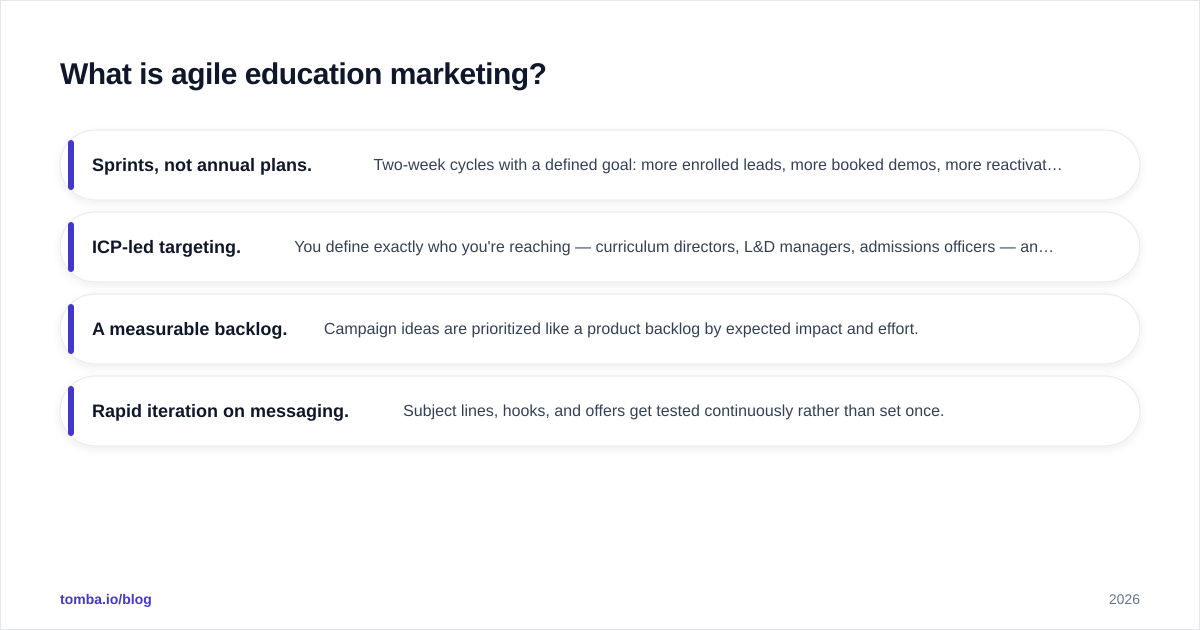
In practice, agile education marketing means:
- Sprints, not annual plans. Two-week cycles with a defined goal: more enrolled leads, more booked demos, more reactivated alumni.
- ICP-led targeting. You define exactly who you're reaching — curriculum directors, L&D managers, admissions officers — and build lists around that, not spray-and-pray.
- A measurable backlog. Campaign ideas are prioritized like a product backlog by expected impact and effort.
- Rapid iteration on messaging. Subject lines, hooks, and offers get tested continuously rather than set once.
It is a way of working. It does not, by itself, produce a single verified email address. That's where tooling enters.
What is Findymail?#
Findymail is a B2B email-finding and verification tool. You give it a name and a company (or pull contacts from LinkedIn / Sales Navigator), and it returns a business email it claims is deliverable, with built-in verification so you bounce less.
It is genuinely good at its one job: turning a known prospect into a verified email for outbound. It's popular with cold-email and lead-gen operators who live in LinkedIn and want clean lists that won't wreck their sender reputation.
But "one job" is the operative phrase. Findymail is a point solution. It doesn't run your campaigns, doesn't manage your pipeline, and offers limited enrichment beyond the email itself. Compared head-to-head with a methodology, it's like comparing a power drill to the blueprint for the house. You need the blueprint to know where to drill — and you need the drill to actually build.
That's why "agile education marketing vs Findymail" is the wrong framing. The right question is: what data tool should plug into your agile motion?
Is agile education marketing better than Findymail?#
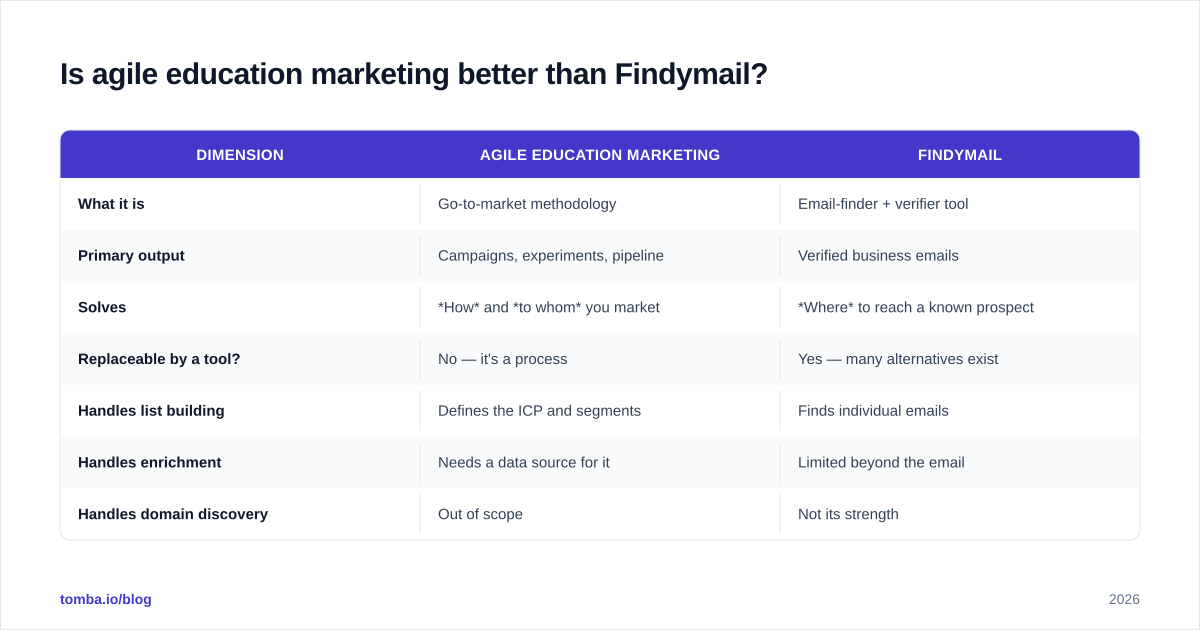
Neither is "better" — they operate at different layers. But here's how they line up so you can see why they're complementary, not competitive.
| Dimension | Agile education marketing | Findymail |
|---|---|---|
| What it is | Go-to-market methodology | Email-finder + verifier tool |
| Primary output | Campaigns, experiments, pipeline | Verified business emails |
| Solves | How and to whom you market | Where to reach a known prospect |
| Replaceable by a tool? | No — it's a process | Yes — many alternatives exist |
| Handles list building | Defines the ICP and segments | Finds individual emails |
| Handles enrichment | Needs a data source for it | Limited beyond the email |
| Handles domain discovery | Out of scope | Not its strength |
| Typical cost | Team time + tooling stack | Credit-based subscription |
| Works without the other | Stalls — no contacts to act on | Works, but you're flying blind |
The takeaway: agile education marketing tells you who matters and what to test. A finder like Findymail (or an alternative) executes the contact-discovery step inside that motion. Remove the methodology and your tool produces busywork; remove the tool and your methodology has no fuel.

Where does Findymail fall short for agile teams?#
Agile motions are demanding on a data layer because you're constantly opening new segments, testing new ICPs, and needing fresh contacts fast. A single-purpose finder hits friction here in a few predictable ways.
1. No domain-wide discovery. Agile teams often start from a target account ("we want into this district / this edtech company"), not a named person. You want every relevant contact at a domain. A pure finder optimized for "name + company → email" makes this clunky. Tools with true domain search let you pull the whole org chart's reachable contacts in one query.
2. Thin enrichment. A verified email is step one. To personalize at scale — the heart of agile messaging tests — you want job title, seniority, department, company size, and social profiles attached. Standalone finders leave you stitching that together elsewhere. A platform with data enrichment hands it back in one payload.
3. Credit economics that punish experimentation. Agile means lots of small tests, which means lots of lookups. Credit-metered tools can get expensive precisely when you're being most agile. You end up rationing experiments to save credits — the opposite of the methodology.
4. Single channel. Education and B2B outreach increasingly need phone and LinkedIn alongside email. If your finder only does email, you're back to a multi-tool stack. (Compare with options that bundle a phone finder and LinkedIn finder.)
None of this makes Findymail a bad tool. It makes it a narrow one — which is fine if email-only point-finding is all you need, and limiting if you're running a full agile motion.
What should plug into an agile education marketing motion?#
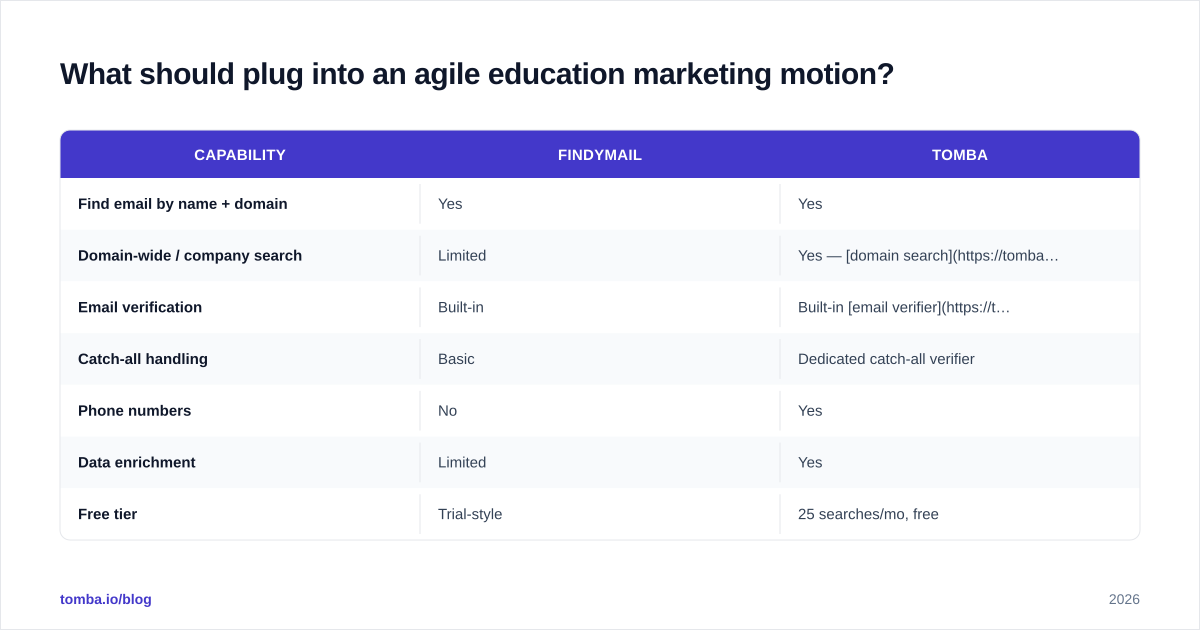
The data layer for an agile team should match the methodology's demands: broad discovery, deep enrichment, multi-channel, and pricing that doesn't penalize iteration. Here's how a consolidated platform compares to a point finder.
| Capability | Findymail | Tomba |
|---|---|---|
| Find email by name + domain | Yes | Yes |
| Domain-wide / company search | Limited | Yes — domain search |
| Email verification | Built-in | Built-in email verifier |
| Catch-all handling | Basic | Dedicated catch-all verifier |
| Phone numbers | No | Yes |
| Data enrichment | Limited | Yes |
| Free tier | Trial-style | 25 searches/mo, free |
| Entry paid plan | Credit bundle | $49/mo Starter |
| API + integrations | Yes | API, Sheets, HubSpot, |
Zapier |
If you only ever convert a known LinkedIn lead into an email, a focused finder is enough. But agile education marketing rarely stays that narrow — you'll open new account segments, need enrichment for personalization, and want phone for high-value district or enterprise deals. A consolidated platform reduces the tool-switching tax.
For pricing transparency, the Tomba pricing page lays out a free tier (25 searches/month), Starter at $49/mo, Growth at $99/mo, and Pro at $249/mo — useful when you're modeling cost-per-experiment. If you're specifically weighing the two, the Findymail alternative breakdown goes deeper on parity.
How do the two work together in a real sprint?#
Here's the integration in concrete terms — a two-week agile education marketing sprint targeting curriculum directors at mid-size school districts.
Day 1–2 — Define and discover. The team locks the ICP (curriculum directors, districts of 5k–25k students, in three target states). Instead of hand-collecting contacts, they run domain-wide discovery on a target list of district websites and pull every reachable decision-maker, then verify in bulk. This is the step a finder owns — and where broader bulk lead generation beats one-at-a-time lookups.
Day 3–4 — Enrich and segment. Each contact gets title, seniority, and department attached so messaging can be tailored. Directors get a different hook than superintendents.
Day 5–8 — Ship and test. Two subject-line variants and two offers go out across a small batch. Replies and meeting bookings are tracked daily.
Day 9–10 — Read results, reallocate. The winning variant scales; the loser is killed. New segments enter the backlog for next sprint.
Notice the tool only appears in days 1–4. The methodology governs the whole sprint. That's the relationship in one picture: agile education marketing is the loop; the finder is one station inside it. You can swap the finder; you can't swap the loop.
For teams already living in a CRM, wiring the data step into the HubSpot integration or pulling contacts straight into Google Sheets keeps the sprint friction-free.
Which should you invest in first?#
Invest in the methodology first, tool second — but buy them in the same week.
If you have a team running campaigns with no clear ICP, no testing cadence, and no measurement, buying any finder just gets you better fuel for a car with no steering wheel. Establish the agile motion: define the ICP, set the sprint cadence, instrument your funnel. Industry resources like the HubSpot marketing blog and peer reviews on G2 are good for benchmarking how other teams structure this. (For the methodology's roots, agile software development is the lineage the marketing version borrows from.)
Once the motion exists, the data tool stops being a "nice email finder" and becomes the throughput multiplier — because now every contact it returns feeds a measured experiment.
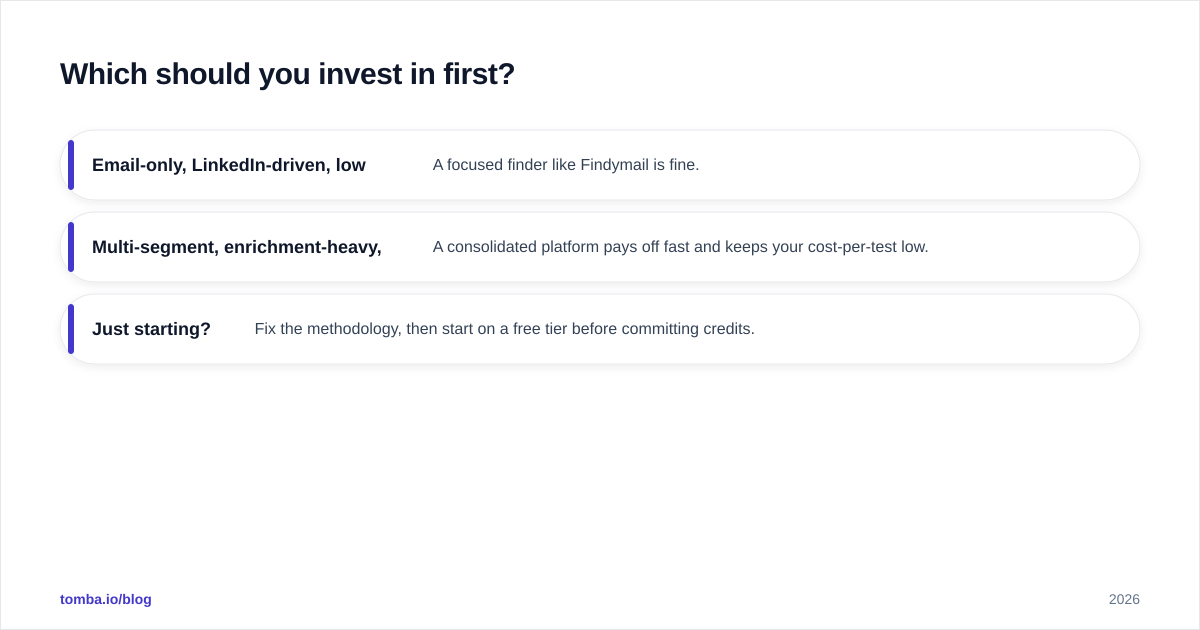
Decision shortcut:
- Email-only, LinkedIn-driven, low volume? A focused finder like Findymail is fine.
- Multi-segment, enrichment-heavy, phone + email, lots of experiments? A consolidated platform pays off fast and keeps your cost-per-test low.
- Just starting? Fix the methodology, then start on a free tier before committing credits.
The honest verdict#
"Agile education marketing vs Findymail" resolves the moment you see the layers: a methodology and a tool aren't rivals. The real choice is which data tool deserves a seat in your agile motion — and that comes down to whether you need a single-purpose email finder or a platform that also does domain search, enrichment, phone, and verification without a credit cliff.
If you're building or scaling an agile education marketing motion in 2026 and want the data layer to keep up with how fast you test, start with the Tomba Email Finder. You get domain-wide discovery, built-in verification, and enrichment in one place — plus a free tier of 25 searches a month so you can validate the fit before your first paid sprint. Define the loop, plug in the data, and let every experiment run on contacts you can actually trust.
Ready to find emails that actually work?
Join 150,000+ professionals who stopped guessing and started sending. Free credits on signup — no credit card required.
Get the Tomba newsletter
Practical outbound tactics and product updates — once every two weeks.
About the author