Agile Education Marketing vs Generect: 2026 Data Guide
Choosing between Agile Education Marketing and Generect? One sells education contact data; the other builds fresh B2B lead lists on demand. Here's how they compare on accuracy, coverage, pricing, and which fits your 2026 GTM motion.
You are comparing two very different data companies that get lumped together because both promise "better leads." They are not substitutes. Agile Education Marketing is a vertical specialist that licenses contact data for the U.S. education market — teachers, principals, district administrators, higher-ed staff. Generect is a horizontal B2B lead-generation engine that builds fresh, ICP-filtered prospect lists across any industry on demand. Picking the wrong one wastes a quarter of pipeline.
TL;DR#
- Agile Education Marketing = deep, compliant, niche data for selling into schools and universities. Best if education is your entire market.
- Generect = broad, on-demand B2B lead lists with real-time enrichment. Best for general SaaS, agencies, and outbound teams targeting many verticals.
- They overlap only if you sell to education but also need wider B2B reach — in which case you may want both, or a flexible tool that does either.
- Pricing models differ sharply: Agile is license/list-based and quote-driven; Generect is credit/subscription-based and self-serve.
- If your real bottleneck is "find and verify the right email for a named person," a focused email finder plus data enrichment often beats buying either list outright.
What is Agile Education Marketing?#
Agile Education Marketing (now part of the Agile Education brand under Market Data Retrieval / Dun & Bradstreet education data lineage) is a specialist provider of education contact lists and audience data. Its database covers K-12 schools, districts, colleges, and the people inside them — by role, subject taught, grade level, enrollment size, funding, and geography.
The pitch is precision in one vertical. If you sell classroom software, school furniture, ed-tech, or higher-ed services, generic B2B databases drown you in irrelevant contacts. Agile's data is built and maintained against education-specific sources, and it markets multichannel reach: postal, email, and digital audience targeting for the same education segments.
You can review how buyers rate it on G2 and on the company's own site at agileeducationmarketing.com. The trade-off is scope: outside education, the dataset is not the point.
What is Generect?#
Generect is a horizontal B2B lead-generation platform. Instead of selling you a pre-packaged niche list, it builds prospect lists to your Ideal Customer Profile — job title, industry, company size, tech stack, location — and enriches them with verified work emails and other contact points, often in near real time. You can see its positioning at generect.com.
The model is closer to a data faucet than a data warehouse. You describe who you want, Generect returns matching contacts with enrichment, and you push them into your sequencer or CRM. That flexibility is the appeal for agencies and SaaS teams who change targets every campaign.
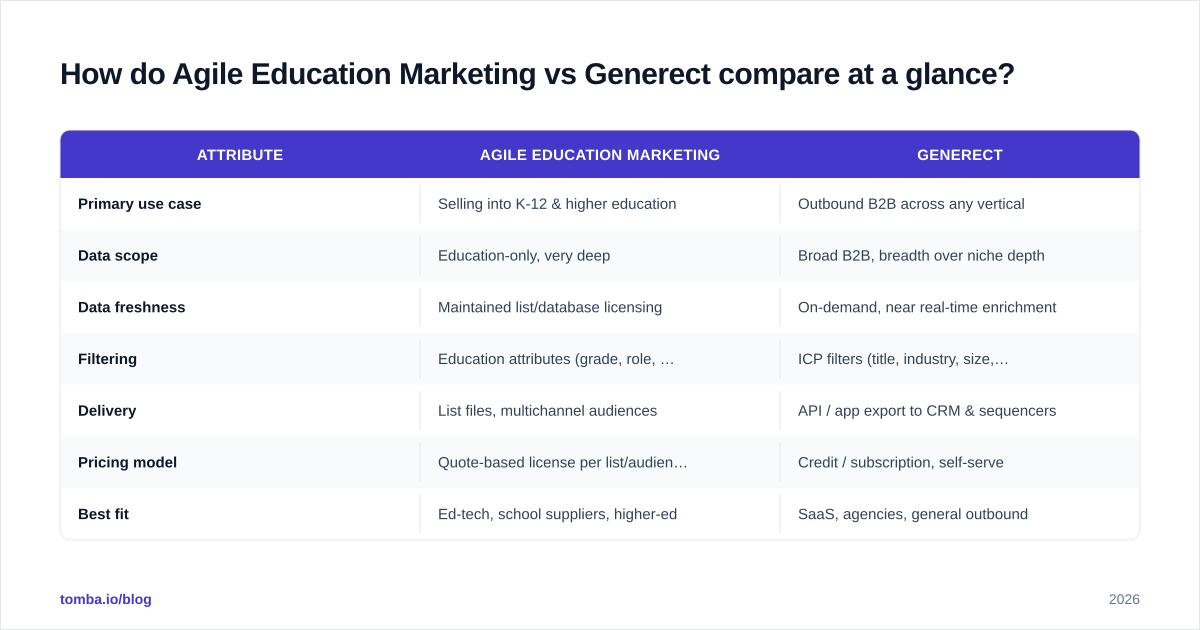
How do Agile Education Marketing vs Generect compare at a glance?#
The honest framing: this is vertical depth versus horizontal flexibility. One is a scalpel for education; the other is a general-purpose lead machine.
| Attribute | Agile Education Marketing | Generect |
|---|---|---|
| Primary use case | Selling into K-12 & higher education | Outbound B2B across any vertical |
| Data scope | Education-only, very deep | Broad B2B, breadth over niche depth |
| Data freshness | Maintained list/database licensing | On-demand, near real-time enrichment |
| Filtering | Education attributes (grade, role, district) | ICP filters (title, industry, size, tech) |
| Delivery | List files, multichannel audiences | API / app export to CRM & sequencers |
| Pricing model | Quote-based license per list/audience | Credit / subscription, self-serve |
| Best fit | Ed-tech, school suppliers, higher-ed | SaaS, agencies, general outbound |
| Compliance angle | Education-specific, opt-in audiences | Standard B2B enrichment compliance |

Which one has better data accuracy?#
Neither wins universally — accuracy depends on what you are measuring. Agile's strength is fielded accuracy inside education: a contact tagged "6th-grade science teacher, Title I district, Texas" is hard to replicate from a general database. Generect's strength is freshness and breadth: it pulls and verifies contacts close to the moment you request them, so role changes and job churn hurt you less than a static licensed file.
The failure modes differ too. A licensed education list can decay between refreshes — teachers move districts, administrators retire. A broad on-demand engine can return plausible-but-wrong matches when your ICP filters are loose. Whichever route you choose, run the output through an email verifier before you send. Verifying first protects your sender reputation and keeps bounce rates low, which matters more than any vendor's headline accuracy claim.
If you regularly buy lists from multiple sources, a bulk email finder and verification pass is the cheapest insurance you can run before a campaign.
How does pricing compare for Agile Education Marketing vs Generect?#
Expect two different buying experiences. Agile Education Marketing is quote-driven: you scope an audience (segment, channel, volume) and get a license price, often with usage terms on how many times you can deploy the list. That suits large, planned campaigns into education but is heavier for small, iterative outbound.
Generect leans self-serve and recurring: credits or a subscription that you spend building lists as you go. That fits teams running many small campaigns who value turning data on and off.
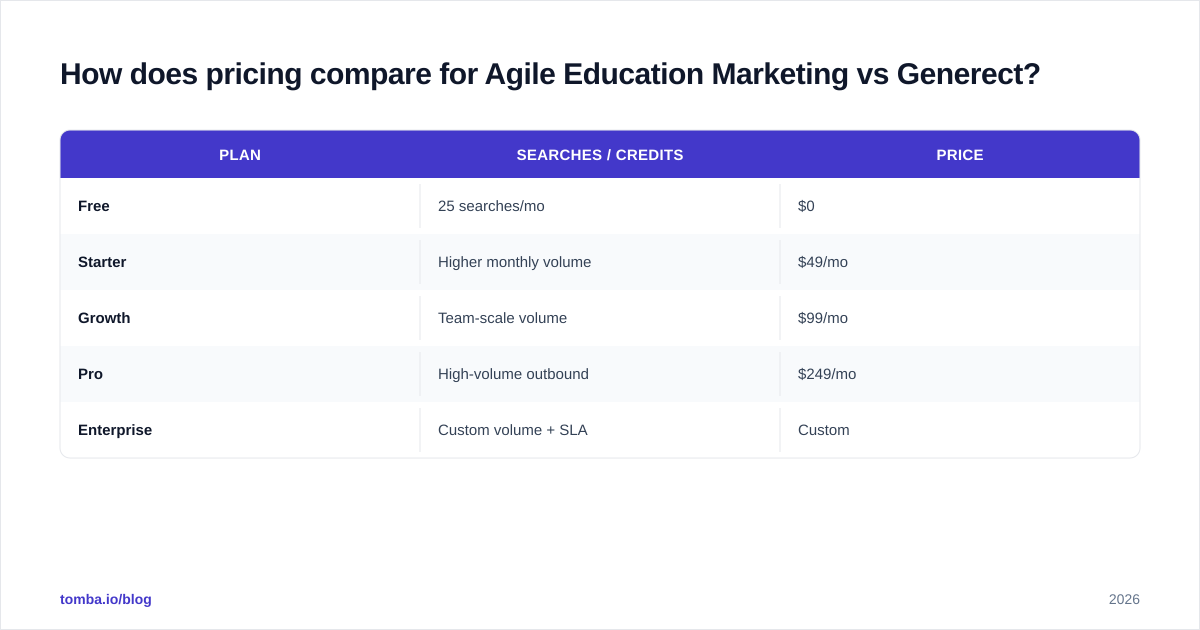
For reference, here is how a focused finder-plus-verifier stack like Tomba prices against those models — useful if your real need is targeted contact discovery rather than buying a whole audience. See full Tomba pricing for current tiers.
| Plan | Searches / Credits | Price |
|---|---|---|
| Free | 25 searches/mo | $0 |
| Starter | Higher monthly volume | $49/mo |
| Growth | Team-scale volume | $99/mo |
| Pro | High-volume outbound | $249/mo |
| Enterprise | Custom volume + SLA | Custom |
The takeaway: if you only need a few hundred verified contacts per month, a per-search tool is far cheaper than a licensed education audience or a heavy lead-gen subscription. If you need 50,000 verified ed-tech buyers for a national push, the specialist license earns its price.
Which should you choose for 2026?#
Match the tool to the motion, not the marketing.
- Choose Agile Education Marketing if education is your market — you sell to schools, districts, or higher-ed and need defensible, segment-rich audiences for multichannel campaigns. The depth pays for itself when generic data would force you to filter out 90% of contacts.
- Choose Generect if you sell across verticals, change ICPs frequently, or run an agency serving many clients. On-demand list building and API delivery fit a fast, iterative outbound team better than a licensed file.
- Choose a finder + verifier + enrichment stack (the Tomba approach) if your bottleneck is precision — you already know the companies or people and just need accurate, verified contact details without buying an entire audience. Tools like domain search and a maintained B2B database cover this without a quote call.
A simple decision process#
The cleanest way to decide is to map your motion before you talk to any vendor.
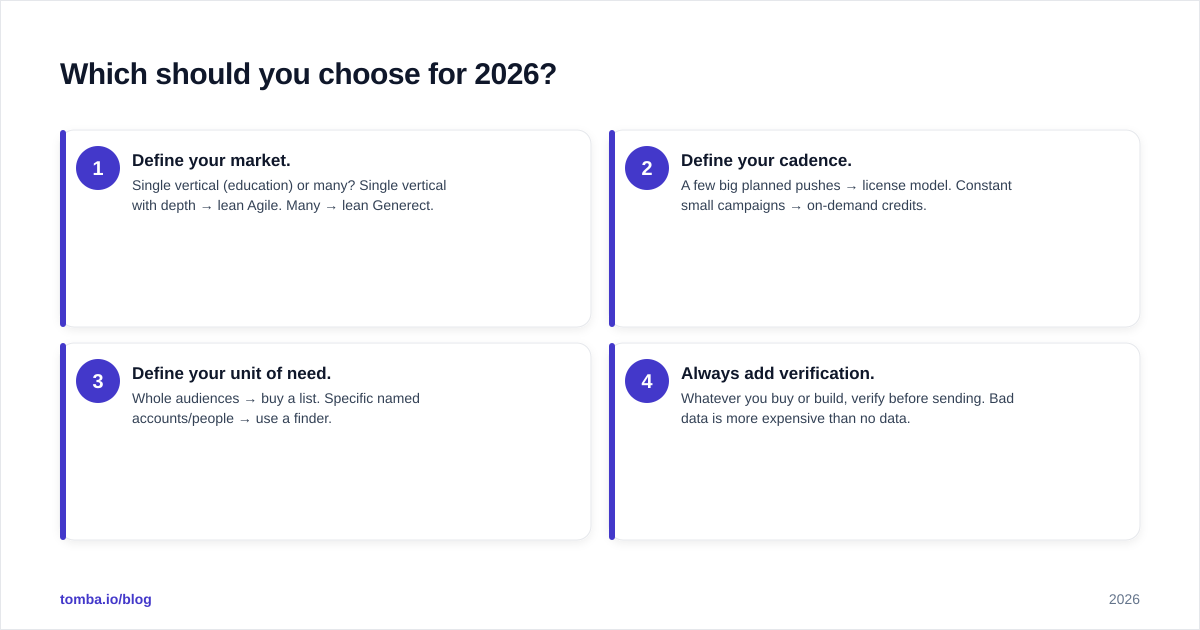
- Define your market. Single vertical (education) or many? Single vertical with depth → lean Agile. Many → lean Generect.
- Define your cadence. A few big planned pushes → license model. Constant small campaigns → on-demand credits.
- Define your unit of need. Whole audiences → buy a list. Specific named accounts/people → use a finder.
- Always add verification. Whatever you buy or build, verify before sending. Bad data is more expensive than no data.
Can you use them together?#
Yes, and many teams do. A common pattern: license education data from a specialist for the core vertical, then use a horizontal engine or a finder to expand into adjacent buyers the niche file misses — district IT, procurement, board members. The risk is duplicate spend and overlapping contacts, so deduplicate and verify the merged set.
This is where a flexible layer helps. After combining sources, run the list through enrichment and verification, push clean records into your CRM via native integrations, and only then load your sequencer. You get the specialist's depth and the generalist's reach without sending to stale or duplicate addresses. For analyst context on the broader B2B data landscape and how buyers evaluate providers, Gartner maintains useful market guidance on sales intelligence and data vendors.
Frequently asked questions#
Is Agile Education Marketing better than Generect? Not in general — it is better for education. If your entire pipeline is schools and universities, its depth wins. For anything broader, Generect's flexibility is the stronger fit.
Does Generect cover the education vertical? It can return education contacts because it is horizontal, but it will not match a specialist's segment granularity (grade level, subject, funding status). For light education targeting it is fine; for a dedicated ed-tech motion, a specialist is safer.
What about data compliance? Both operate in B2B data, which carries real obligations. Education data adds extra sensitivity. Confirm opt-in status, sourcing, and regional rules (CAN-SPAM, GDPR where relevant) directly with each vendor before buying — and always keep verification logs.
Do I still need an email verifier if the data is "verified"? Yes. Vendor verification has a shelf life. A pre-send verification pass on the actual list you are about to mail is the single highest-ROI step in deliverability.
The bottom line#
Agile Education Marketing and Generect solve different problems: vertical depth in education versus horizontal, on-demand B2B reach. Don't pick the one with the louder pitch; pick the one that matches your market, cadence, and unit of need — and verify everything before you send.
If what you actually need is to find and confirm the right contact at a specific company — without committing to a licensed audience or a heavyweight subscription — start with the Tomba Email Finder. Search by name, company, or domain, get verified professional emails, and enrich them in the same flow. It pairs cleanly with whichever data vendor you choose, and the free tier lets you test accuracy on your own target accounts before you spend a dollar on lists.
// get started
Find, verify and enrich your first contacts today
Start on the free plan with 25 searches a month, then scale when your team is ready.
Free plan · No credit card required · GDPR & CCPA
// about the author