Agile Education Marketing vs GetProspect: 2026 Data Showdown
Agile Education Marketing sells curated K-12 and higher-ed lists; GetProspect finds emails across any industry. Here's which B2B data engine fits your pipeline in 2026.
Choosing between Agile Education Marketing and GetProspect is really a choice between two philosophies of B2B data. One sells you a finished, vertical-specific contact list. The other hands you a live engine to build any list you want. Pick wrong and you either overpay for coverage you can't use, or you burn weeks assembling data a specialist could have handed you on day one.
This guide breaks down what each tool actually does, where the data comes from, how pricing works in 2026, and the specific scenarios where each one wins.
TL;DR#
- Agile Education Marketing is a vertical data provider focused exclusively on the U.S. education market — K-12 schools, districts, colleges, and the administrators inside them. Buy it when education is your entire addressable market.
- GetProspect is a horizontal email finder and lead-generation platform that works across every industry, pulling emails from domains, LinkedIn, and company names.
- They are not true substitutes: one is a curated list seller, the other is a self-serve discovery tool.
- Accuracy works differently for each — pre-verified static records vs. on-demand verification at lookup time.
- If you sell across multiple verticals, a general-purpose email finder gives you far more flexibility per dollar than a single-industry list.
What is Agile Education Marketing?#
Agile Education Marketing (now operating under the Agile/MDR education-data umbrella) is a specialist data company that sells contact databases for the U.S. education sector. Think principals, superintendents, IT directors, curriculum buyers, deans, and procurement staff across public and private institutions.
Their core value is depth in one place. Instead of a generic "title = teacher" guess, they map the education hierarchy: grade levels, enrollment size, funding data, district boundaries, and the specific decision-makers attached to each institution. If you sell SmartBoards, curriculum software, cafeteria services, or campus safety systems, that vertical context is genuinely hard to replicate with a horizontal tool.
The trade-off: you are buying a list. The data is curated, segmented, and sold by record or by license, and it only covers education. Outside that vertical, Agile gives you nothing.
What is GetProspect?#
GetProspect is a horizontal email-finding and lead-generation platform. You give it a name and a company domain, a LinkedIn URL, or a company name, and it returns a business email address with a confidence/verification status. It also offers a Chrome extension, bulk search, a small built-in database, and CRM-style list management.
GetProspect doesn't care what industry you're in. It's built to find contacts anywhere — SaaS, manufacturing, agencies, real estate, and yes, education too. The data is generated on demand from public web signals and pattern matching rather than pre-packaged into vertical lists.
The trade-off runs the opposite direction: GetProspect has breadth but no vertical curation. It won't tell you a district's enrollment or which administrator owns the edtech budget. It tells you the email.
How do their data models actually differ?#
This is the heart of the comparison, so it's worth being concrete.
Agile Education Marketing = curated, static, vertical. A team compiles and maintains records about education institutions and the people in them. You purchase a slice of that database. The records are rich (firmographics specific to education) but they're a snapshot — accurate as of the last refresh, and they decay as people change jobs.
GetProspect = generated, on-demand, horizontal. There's no pre-built "list" you're buying. You query, the engine searches public sources and email patterns, verifies the result, and returns it. Coverage is theoretically unlimited across industries, but data quality depends on how much public signal exists for that specific person.
In practice, this means Agile is better when your whole market is education and you want segmentation you didn't have to build. GetProspect is better when your targets are scattered across industries and you need to find specific people one query at a time.
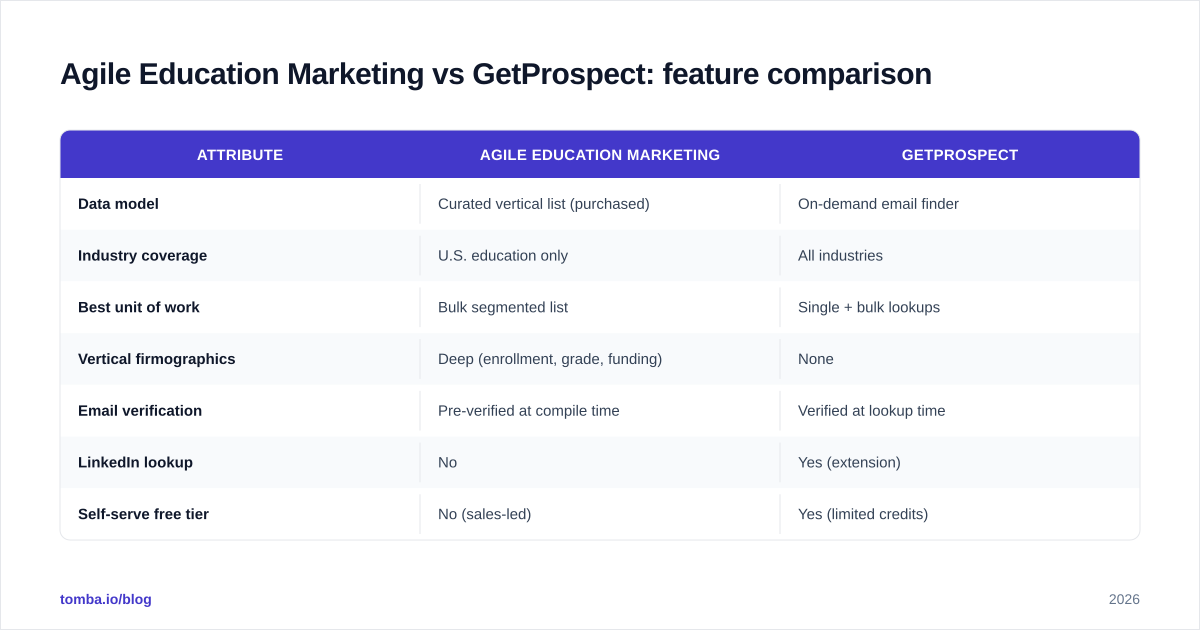
Agile Education Marketing vs GetProspect: feature comparison#
| Attribute | Agile Education Marketing | GetProspect |
|---|---|---|
| Data model | Curated vertical list (purchased) | On-demand email finder |
| Industry coverage | U.S. education only | All industries |
| Best unit of work | Bulk segmented list | Single + bulk lookups |
| Vertical firmographics | Deep (enrollment, grade, funding) | None |
| Email verification | Pre-verified at compile time | Verified at lookup time |
| LinkedIn lookup | No | Yes (extension) |
| Self-serve free tier | No (sales-led) | Yes (limited credits) |
| Typical buyer | Edtech / education vendors | Any B2B SDR / marketer |
| API access | Limited / enterprise | Yes |
| Pricing transparency | Quote-based | Public tiered plans |
The pattern is clear: Agile wins on vertical depth, GetProspect wins on flexibility, transparency, and self-serve access.
)
Which one is more accurate?#
Accuracy depends on what you're measuring, and the two tools fail in different ways.
Agile's records are pre-verified when the database is compiled, so on day one a freshly licensed list is clean. The risk is time decay — education has high turnover at the start of each school year, and a list purchased in March looks very different by September. You're trusting the vendor's refresh cadence.
GetProspect verifies at the moment you query, so the result reflects current public signals. The risk is coverage gaps — for a low-profile contact with little web presence, the engine may return a guessed pattern with lower confidence, or nothing at all.
The honest takeaway: for a stable, well-documented education contact, Agile's curated record is often more complete. For a freshly-changed role or a contact outside education, an on-demand finder that re-verifies is safer. Whichever route you choose, run results through a dedicated email verifier before you send — no single source should be your only quality gate. You can sanity-check vendor claims against third-party reviews on G2 and Capterra.
How does pricing compare in 2026?#
Agile Education Marketing uses quote-based pricing. You contact sales, describe your target segments, and get a price tied to record count and license terms (one-time vs. annual, single-use vs. multi-use). This is normal for vertical list vendors but means no quick self-serve start and no published numbers to anchor on.
GetProspect uses public tiered subscriptions built around monthly credits, with a free tier to test before you pay. That transparency makes it easy to budget and scale up or down.
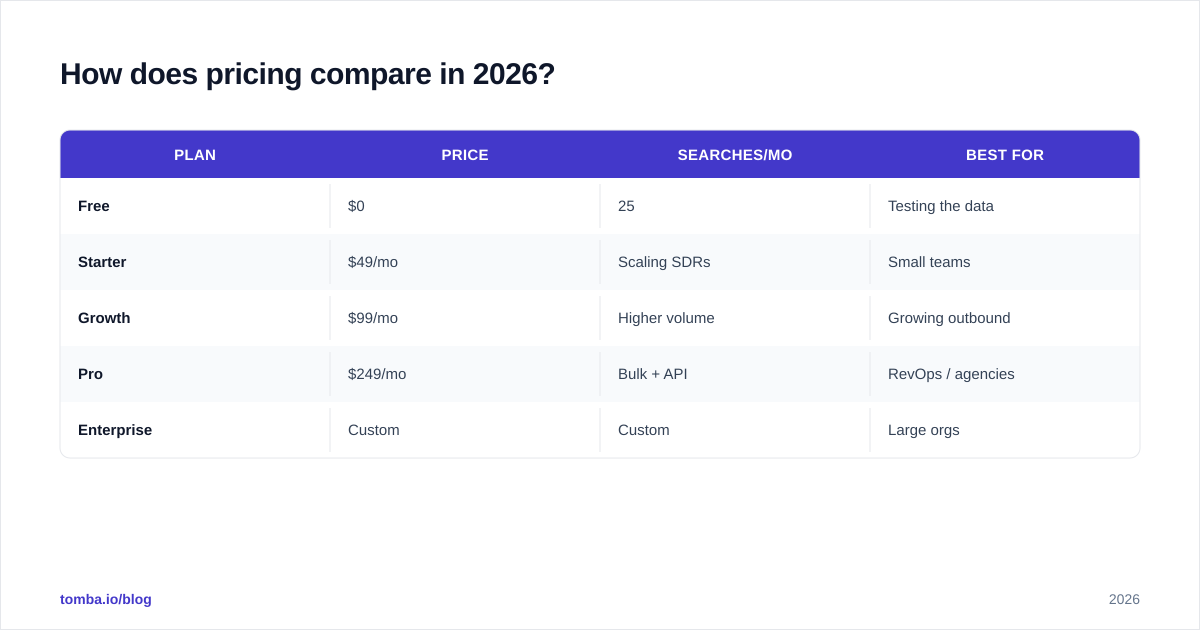
If pricing transparency and the ability to start small matter to you, the horizontal model is friendlier. For reference, here's how a transparent, credit-based competitor in the email-finding space structures plans — Tomba's published pricing is a useful benchmark:
| Plan | Price | Searches/mo | Best for |
|---|---|---|---|
| Free | $0 | 25 | Testing the data |
| Starter | $49/mo | Scaling SDRs | Small teams |
| Growth | $99/mo | Higher volume | Growing outbound |
| Pro | $249/mo | Bulk + API | RevOps / agencies |
| Enterprise | Custom | Custom | Large orgs |
Compared with a quote-only vertical list, a credit model lets you pay for exactly the lookups you use and stop when the campaign ends.
When should you choose Agile Education Marketing?#
Choose Agile if education is your entire business. The clearest signals:
- You sell to schools, districts, or higher-ed institutions and nothing else.
- You need segmentation you can't easily build yourself — enrollment bands, Title I status, grade levels, district size.
- You want a finished list delivered, not a tool to operate.
- You have budget for a vendor relationship and don't need self-serve.
In that scenario, paying a specialist for curated vertical depth saves real time. Recreating district-level firmographics with a horizontal tool would be slow and incomplete.
)
When should you choose GetProspect (or a horizontal finder)?#
Choose a horizontal email finder if your targets aren't confined to one vertical, or if you value control and transparency:
- You sell across multiple industries, or your ICP spans many sectors.
- You prospect from LinkedIn and want to enrich profiles on the fly.
- You want a free tier to test before committing.
- You need an email finder API to wire data into your own systems.
- You'd rather build precise, fresh lists per campaign than buy a static file.
For most modern outbound teams, this flexibility is the deciding factor. A vertical list locks you into one market; a finder scales with wherever your pipeline goes next.
What about a third option that does both depth and breadth?#
The Agile-vs-GetProspect framing assumes you must trade vertical depth for horizontal reach. You don't have to fully accept that.
A horizontal platform with strong enrichment can approximate vertical depth when you combine the finder with firmographic data enrichment and a domain search that maps every contact at a target institution. You won't get education-specific fields like enrollment out of the box, but you will get current, verified contacts across any institution — schools included — without a per-vertical license.
For teams that sell into education and other markets, this hybrid usually wins: one tool, one bill, one workflow, and a B2B database you can query against any industry instead of buying a new list every time you enter a new vertical.
Here's the decision logic in one table:
| Your situation | Best fit |
|---|---|
| Only sell to U.S. education | Agile Education Marketing |
| Sell across many verticals | Horizontal email finder |
| Need education + other markets | Horizontal finder + enrichment |
| Want free tier / self-serve | GetProspect or Tomba |
| Need deep edu firmographics | Agile Education Marketing |
| Need LinkedIn + API + bulk | GetProspect or Tomba |
The verdict#
There's no universal winner — there's a winner for your motion. Agile Education Marketing is the right call when education is the whole game and curated vertical depth is worth a quote-based license. GetProspect is the right call when you need breadth, transparency, and self-serve flexibility across industries. The two only look like competitors from a distance; up close they solve different problems.
If your targets live outside a single vertical — or if you want to test data quality before you spend a dollar — start with a horizontal finder. The Tomba Email Finder gives you 25 free searches a month, verification built in, LinkedIn and domain lookups, bulk processing, and an API, with public pricing that starts at $49/mo on Starter. Run a few of your hardest education contacts through it, compare the results against any vendor quote you're weighing, and let the data decide. You can always layer in a specialist list later — but most teams find that a flexible finder covers far more of the pipeline than they expected.
// get started
Find, verify and enrich your first contacts today
Start on the free plan with 25 searches a month, then scale when your team is ready.
Free plan · No credit card required · GDPR & CCPA
// about the author