Agile Education Marketing vs Kaspr: 2026 Data Comparison
Agile Education Marketing sells curated K-12 and higher-ed lists; Kaspr pulls live B2B contacts off LinkedIn. Here's which data source actually fits your pipeline in 2026 — and where a verification layer beats both.
You are evaluating two very different data sources that happen to land on the same shortlist: Agile Education Marketing, a curated list provider for the education sector, and Kaspr, a LinkedIn-first contact finder for general B2B prospecting. They solve adjacent problems with opposite philosophies. Picking wrong wastes budget and fills your CRM with contacts you can't actually reach.
TL;DR#
- Agile Education Marketing is purpose-built for K-12, higher-ed, and education-adjacent audiences. If you sell to teachers, administrators, or district decision-makers, its curated lists go deeper than any general tool.
- Kaspr is a LinkedIn-centric prospecting tool. It surfaces phone numbers and emails in real time as you browse profiles, which suits broad B2B outbound across industries.
- They are not direct competitors. One sells audiences; the other sells moment-of-need lookups.
- Both share the same weak spot: data decays fast, and neither guarantees the address still resolves on send day.
- The reliable pattern in 2026 is to treat either as a sourcing layer and run a separate verification pass before you email — which is where a tool like Tomba fits.
What is Agile Education Marketing?#
Agile Education Marketing is a specialist data and marketing-services company focused entirely on the education vertical. Think of it as a publisher of audience lists rather than a self-serve lookup tool. You tell them the segment — say, "curriculum directors at public school districts with 5,000+ students in the Midwest" — and they supply a compiled, licensed list with postal, email, and sometimes phone fields.
The strength is depth in a niche that general B2B databases handle badly. Education has its own org structures (districts, ESUs, departments, grade bands, Title I status) that horizontal providers flatten or miss. Agile models those attributes explicitly, which is why agencies and ed-tech vendors lean on it for account-based and direct-mail campaigns.
The trade-off is the delivery model. Lists are compiled and licensed, often for a defined campaign window or usage count. That's a different motion than a rep pulling one contact mid-prospecting. You can read more about their positioning on their G2 profile.
What is Kaspr?#
Kaspr is a B2B contact-data tool best known for its Chrome extension. You open a LinkedIn profile, click the extension, and Kaspr reveals the person's phone numbers and email addresses, then lets you push them into your CRM or sequencing tool. It also offers bulk enrichment and a workflow layer for outreach.
Kaspr is horizontal — it doesn't care whether you're selling to a SaaS CTO or a hospital procurement lead. Its value is speed at the point of intent: you found someone worth contacting, and you want their details now. That makes it popular with SDR teams running high-volume LinkedIn-sourced outbound.
The catch is the same one every LinkedIn-scraping tool carries. Coverage is strong for active, complete profiles in well-represented regions and thinner everywhere else. Mobile numbers in particular vary widely by geography, and email guesses still need checking before they're safe to send.
Wait — let me reposition that. The point stands: a number that surfaced six months ago is not the same asset as one confirmed today.
Agile Education Marketing vs Kaspr: how do they compare?#
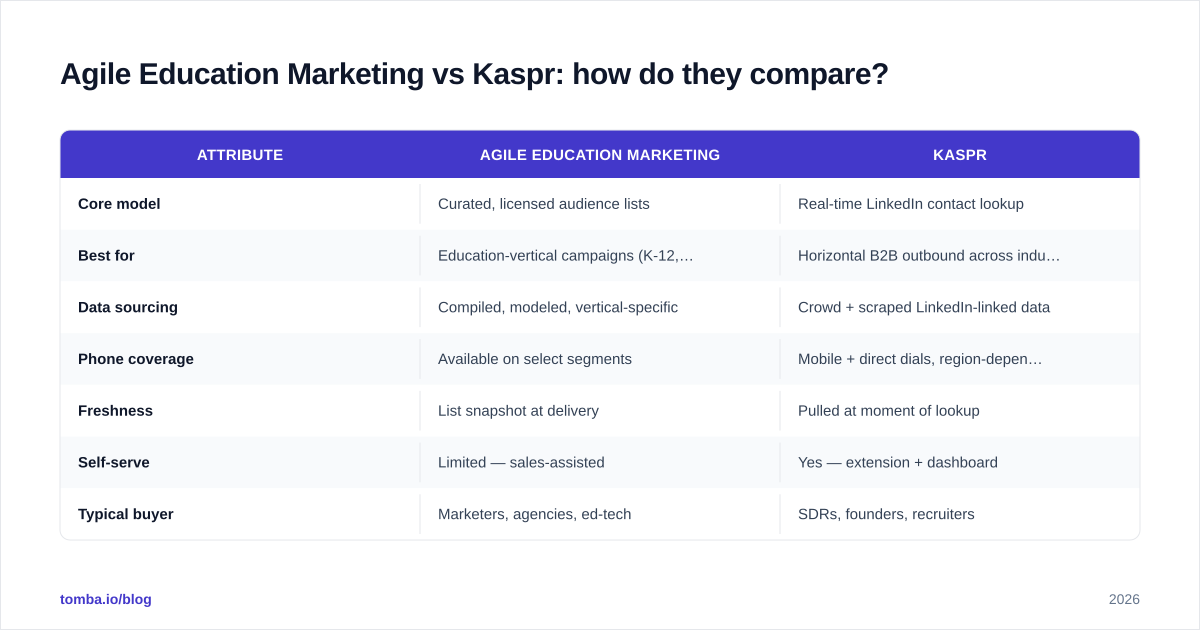
Here's the honest side-by-side. Read it as "different jobs," not "better/worse."
| Attribute | Agile Education Marketing | Kaspr |
|---|---|---|
| Core model | Curated, licensed audience lists | Real-time LinkedIn contact lookup |
| Best for | Education-vertical campaigns (K-12, higher ed) | Horizontal B2B outbound across industries |
| Data sourcing | Compiled, modeled, vertical-specific | Crowd + scraped LinkedIn-linked data |
| Phone coverage | Available on select segments | Mobile + direct dials, region-dependent |
| Freshness | List snapshot at delivery | Pulled at moment of lookup |
| Self-serve | Limited — sales-assisted | Yes — extension + dashboard |
| Typical buyer | Marketers, agencies, ed-tech | SDRs, founders, recruiters |
| Verification included | Not a core feature | Basic, not send-grade |
| Pricing model | Custom list licensing | Credit-based subscription |
The decisive question is rarely "which has more records." It's "does the shape of the data match how my team works?" A direct-mail-heavy ed-tech campaign wants Agile's segmentation. A rep living inside LinkedIn Sales Navigator wants Kaspr's one-click reveal.
Which one fits your sales motion?#
Use this quick decision framework instead of comparing feature lists line by line.
Choose Agile Education Marketing if:
- Your total addressable market is the education sector and nothing else.
- You run campaigns at the audience level — direct mail, batch email, ABM list loads — not one contact at a time.
- You need education-specific firmographics (district size, grade band, public vs private) that horizontal tools don't carry.
Choose Kaspr if:
- You prospect across many industries and education is just one slice.
- Your reps work profile-by-profile inside LinkedIn and want details in the flow.
- You value self-serve speed over curated, campaign-ready segments.
Choose neither as your only layer if:
- Deliverability is a KPI you're measured on. Both give you raw contacts; neither hands you a clean, send-safe list. That gap is the whole reason a verification step exists.
Why does data freshness decide the winner?#
Because every contact record starts decaying the moment it's created. B2B data ages out at roughly 22–30% per year as people change jobs, companies rebrand, and inboxes get deactivated. In education specifically, churn spikes on an academic calendar — staff turnover, retirements, and reassignments cluster around the school year.
That hits both tools, differently:
- Agile's lists are a snapshot. A list licensed in August can carry summer staffing changes that haven't propagated yet. The data is well-modeled but it's still a point-in-time photo.
- Kaspr's lookups are fresher at the moment of reveal, but "fresh from LinkedIn" isn't the same as "the inbox is live." Profiles lag real life too, and a personal Gmail scraped years ago may no longer be monitored.
So the smarter benchmark isn't "who had the right email last quarter." It's "what percentage of records bounce when I actually send." Neither vendor optimizes for that number — they optimize for coverage. You close the gap yourself with a email verifier pass right before send. Verification typically strips out the 5–15% of addresses that would have bounced and tanked your sender reputation.
If you want the underlying definitions, this overview of email deliverability explains why a single bad batch can throttle an entire domain.
What does each one cost?#
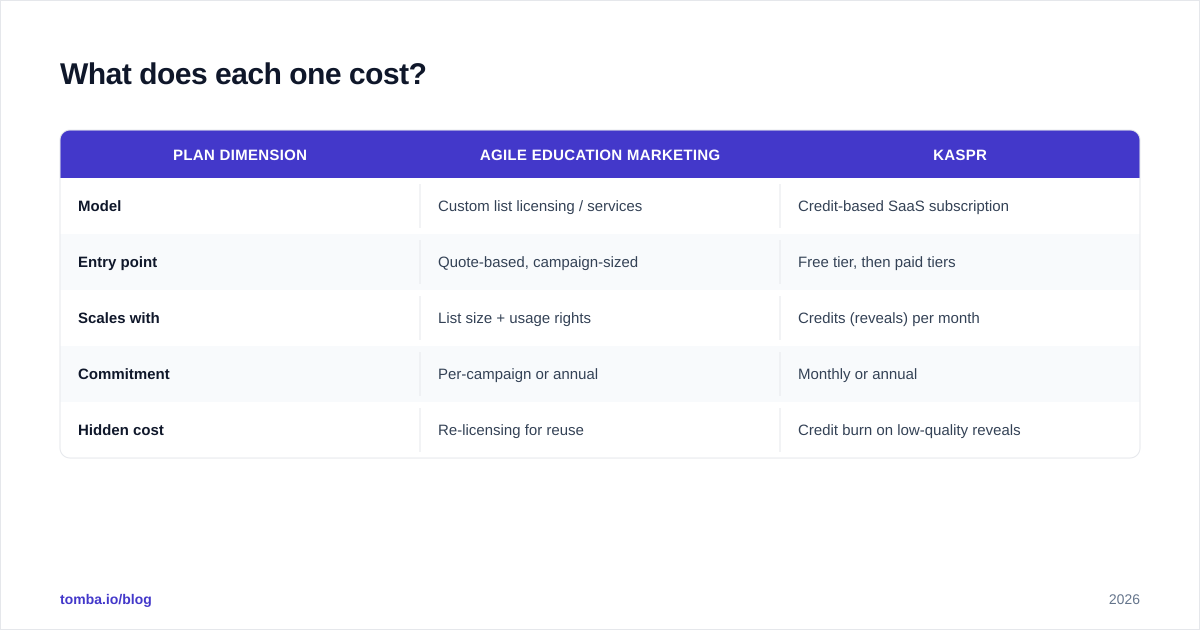
Pricing is where the two models diverge hardest, so compare structure, not just headline numbers.
| Plan dimension | Agile Education Marketing | Kaspr |
|---|---|---|
| Model | Custom list licensing / services | Credit-based SaaS subscription |
| Entry point | Quote-based, campaign-sized | Free tier, then paid tiers |
| Scales with | List size + usage rights | Credits (reveals) per month |
| Commitment | Per-campaign or annual | Monthly or annual |
| Hidden cost | Re-licensing for reuse | Credit burn on low-quality reveals |
Agile's spend tracks the size and reuse rights of the audience you license; it's a marketing-budget line item. Kaspr's spend tracks how many contacts your reps reveal; it's a sales-tooling line item. A team buying Agile to do per-rep lookups will overpay, and a team buying Kaspr to assemble a 40,000-record education mailing will burn credits fast and still miss the vertical depth.
Whichever you pick, budget a small amount on top for verification — it's cheaper than the deliverability damage a dirty list causes. You can see how a usage-based pricing model looks on the verification side; Tomba starts free (25 searches/month) and runs $49/mo on the Starter tier.
Can you just use one tool for everything?#
Short answer: not cleanly, because they don't overlap enough. But you also don't want a sprawling stack. The practical middle path is a two-layer setup.
- Sourcing layer — pick the tool that matches your audience. Education-only and list-driven? Agile. Horizontal and rep-driven? Kaspr.
- Quality layer — run everything through verification and enrichment before it touches a sequence. This is vendor-neutral and catches the decay both sourcing tools leave behind.
This is where a horizontal finder-plus-verifier earns its place. If your prospecting drifts outside education — or you simply want to confirm and fill gaps in a list you already bought — an email finder that works by domain and name covers the long tail Kaspr's LinkedIn-only model misses. Pair it with data enrichment to backfill firmographics and a phone finder when direct dials matter, and you've got a quality layer that's independent of whichever sourcing vendor you chose.
Which should you actually buy in 2026?#
Decide on audience first, motion second, and treat verification as non-optional.
- Pure education play, campaign-led: Agile Education Marketing is the specialist and it earns the premium. Validate the list on arrival before mailing.
- Broad B2B, rep-led, LinkedIn-heavy: Kaspr's reveal workflow keeps reps moving. Verify reveals before sequencing so credits aren't wasted on bounces.
- Mixed motion or deliverability-sensitive: Use either as sourcing and standardize on a verification + enrichment layer underneath both. That layer is what protects your sender reputation regardless of where the contact came from.
Compare both tools against real reviews on G2 or Capterra before committing — usage patterns vary enough that a peer in your exact vertical is worth more than any spec sheet.
The contacts you source are only as valuable as the inboxes that still accept them. Source with the specialist that fits your audience, then clean and confirm with the Tomba Email Finder and verifier before a single message goes out — start on the free tier, prove the bounce rate drops, and scale from there. That's the version of "Agile Education Marketing vs Kaspr" where you don't have to pick a loser, because the verification layer makes whichever you choose actually deliver.
// get started
Find, verify and enrich your first contacts today
Start on the free plan with 25 searches a month, then scale when your team is ready.
Free plan · No credit card required · GDPR & CCPA
// about the author