Agile Education Marketing vs Leadzenai: 2026 Lead Gen Guide
Agile Education Marketing and Leadzenai solve lead generation from opposite ends — one is a done-for-you agency motion, the other a self-serve data engine. Here's how they compare on pricing, data, and fit.
TL;DR
- Agile Education Marketing is a managed, agency-style motion built around the education vertical — curated audience data, campaign execution, and human-run targeting for schools, districts, and EdTech buyers.
- Leadzenai is a self-serve B2B data and lead intelligence platform — you log in, pull contacts, enrich records, and run your own outbound.
- They aren't really the same product. One sells outcomes (campaigns delivered), the other sells raw capability (data you operate yourself).
- Pick the agency motion if you lack an in-house SDR/ops team and want education-specific reach. Pick the self-serve tool if you have operators and want control plus lower per-lead cost at scale.
- Either way, the bottleneck is the same: verified, deliverable contact data. A dedicated layer like Tomba's email finder often outperforms both for accuracy on the records that matter.
What is the real difference between Agile Education Marketing and Leadzenai?#
The short version: you're comparing a service to a tool. That distinction drives every other decision.
Think of it like getting from one city to another. Agile Education Marketing is hiring a car service — someone else owns the vehicle, plans the route, and drives. Leadzenai is renting the car yourself — cheaper per mile, full control of the route, but you're the one behind the wheel. Neither is "better." They fit different teams.
Agile Education Marketing centers on the education sector. Its value proposition is vertical depth: audience lists segmented by role (superintendents, curriculum directors, IT decision-makers), institution type (K-12, higher-ed, district), and intent signals specific to academic buying cycles. The work is largely done for you — list building, campaign setup, and execution sit with the provider.
Leadzenai (leadzen.ai) is a horizontal B2B prospecting platform. It gives you a searchable contact and company database, enrichment, and basic outreach tooling across industries. You operate it. There's no "education desk" doing the targeting — you build the filters and run the plays.
So the first question isn't "which is better" — it's "do I want to buy a result or buy a capability?"
How do Agile Education Marketing and Leadzenai compare head to head?#
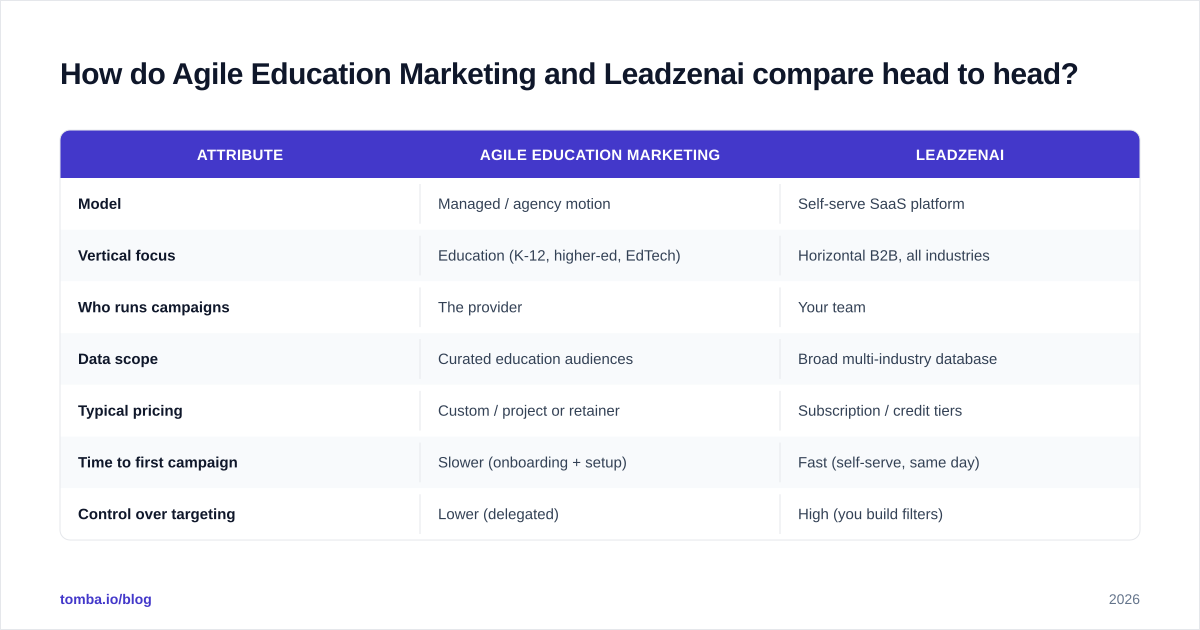
Here's the practical breakdown across the attributes that actually change your pipeline.
| Attribute | Agile Education Marketing | Leadzenai |
|---|---|---|
| Model | Managed / agency motion | Self-serve SaaS platform |
| Vertical focus | Education (K-12, higher-ed, EdTech) | Horizontal B2B, all industries |
| Who runs campaigns | The provider | Your team |
| Data scope | Curated education audiences | Broad multi-industry database |
| Typical pricing | Custom / project or retainer | Subscription / credit tiers |
| Time to first campaign | Slower (onboarding + setup) | Fast (self-serve, same day) |
| Control over targeting | Lower (delegated) | High (you build filters) |
| Per-lead cost at scale | Higher | Lower |
| Best for | Teams without in-house ops | Teams with SDRs/RevOps |
| Data accuracy responsibility | Provider-managed | Yours to verify |
The pattern that emerges: Agile Education Marketing trades cost and control for convenience and vertical precision. Leadzenai trades hand-holding for speed, control, and unit economics. If your total addressable market is education, the curated angle is genuinely useful. If you sell across industries — or want to scale outbound without a retainer — the self-serve engine wins on flexibility.
Which one gives you better data accuracy?#
Neither wins by default — and this is the trap most buyers fall into.
A managed agency should deliver clean lists because that's part of the service, but you're trusting a black box. A self-serve database gives you transparency into every record, but accuracy varies and verification is your job. In both cases, the failure mode is identical: contacts that bounce, decay, or were never deliverable.
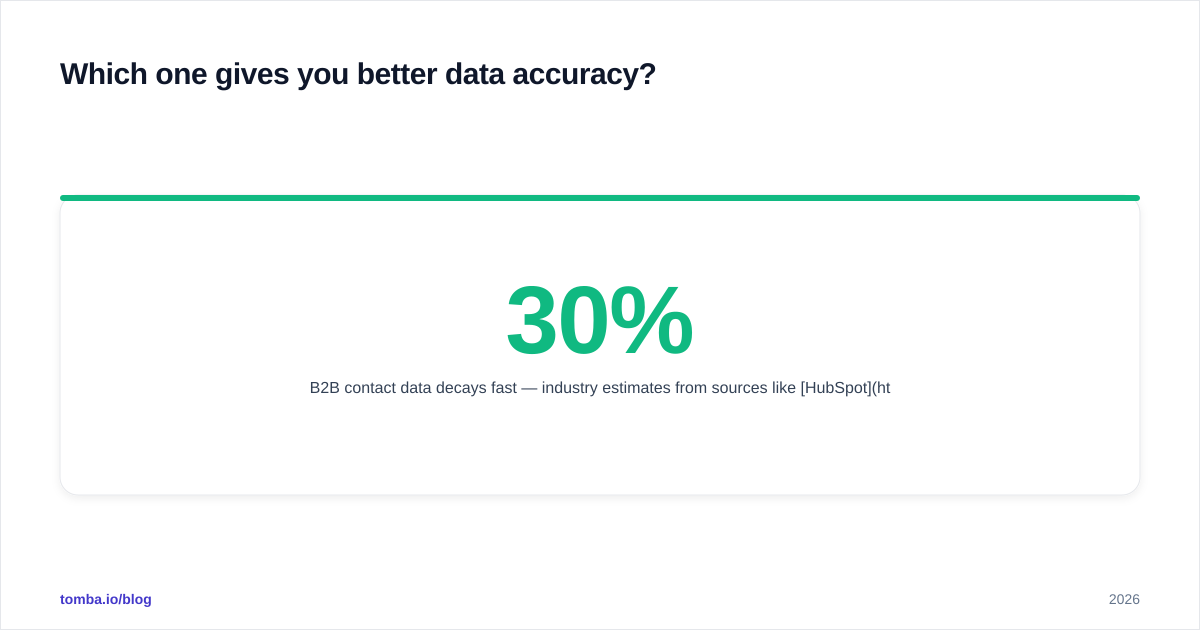
B2B contact data decays fast — industry estimates from sources like HubSpot put annual database decay around 22–30% as people change roles. That means a list that was 95% accurate in January can drop below 80% by year-end without active maintenance. Education has its own wrinkle: staff turnover at institutions spikes around academic-year boundaries, so "verified in spring" can mean "stale by fall."
This is why a dedicated verification and discovery layer matters regardless of which platform you choose. Running prospects through an email verifier before sending — and using data enrichment to fill gaps — does more for deliverability than picking the "right" vendor. If you're working education domains specifically, domain search lets you pull and validate the email pattern for a district or university directly, instead of trusting a list you can't audit.
The honest takeaway: treat both Agile Education Marketing and Leadzenai as a starting dataset, not a finished one. Verify before you send.
What does each one cost?#
This is where the agency-vs-tool split gets sharpest.
Agile Education Marketing follows an agency pricing logic — custom quotes, often a retainer or per-campaign fee, scoped to deliverables. You're paying for execution time and curated access, so the number is higher and less predictable. The upside: it's bundled outcome pricing, not à la carte.
Leadzenai follows SaaS logic — tiered subscriptions and/or credits, published or quote-on-request, scaling with seats and data volume. Per-lead cost drops as you scale because you're operating the machine yourself.
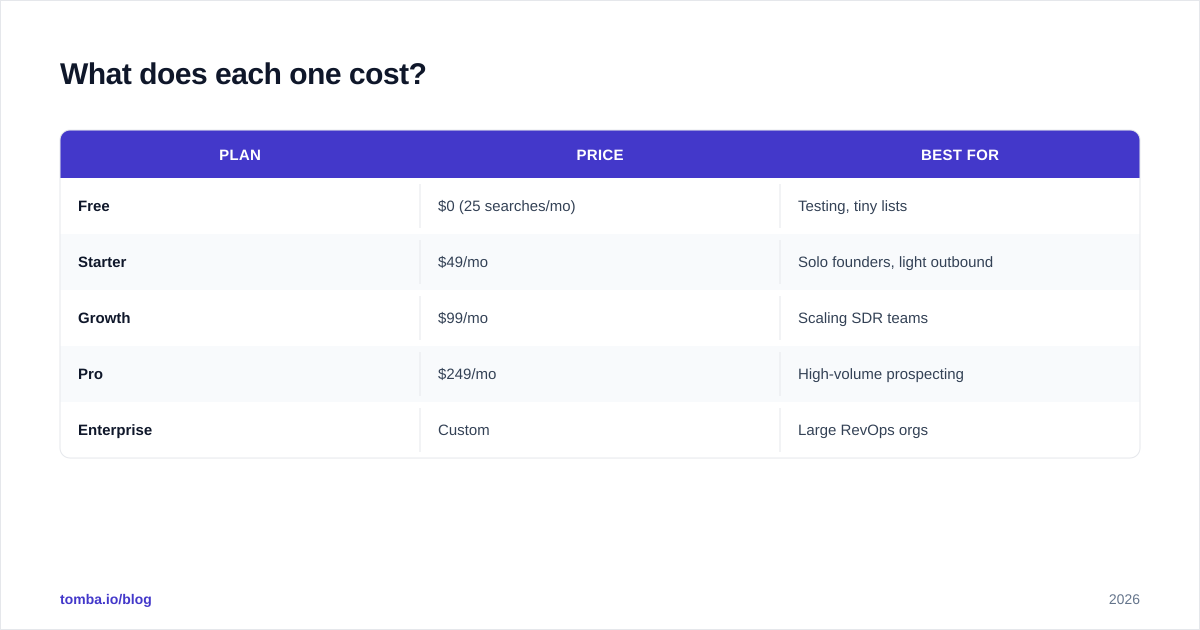
For comparison, a transparent self-serve data stack is easy to model. Tomba's pricing, for example, runs:
| Plan | Price | Best for |
|---|---|---|
| Free | $0 (25 searches/mo) | Testing, tiny lists |
| Starter | $49/mo | Solo founders, light outbound |
| Growth | $99/mo | Scaling SDR teams |
| Pro | $249/mo | High-volume prospecting |
| Enterprise | Custom | Large RevOps orgs |
The lesson isn't "Tomba is cheapest." It's that self-serve pricing is legible — you can forecast cost per 1,000 verified contacts. Agency pricing is opaque by design. If predictability matters to your finance team, that's a real factor.
When should you choose the agency motion?#
Choose Agile Education Marketing (or any managed, vertical agency) when:
- Your entire market is education and you'd otherwise spend months learning the segment's roles and buying cycles.
- You have no in-house outbound team — no SDRs, no RevOps, nobody to operate a tool.
- You want outcomes, not infrastructure. You'd rather approve a campaign than build one.
- Compliance and brand sensitivity are high and you want a human accountable for targeting.
The trade-off you're accepting: higher cost, slower iteration, and less visibility into the underlying data. You're renting expertise, which is a legitimate thing to buy — just know that's what you're buying.
When should you choose the self-serve platform?#
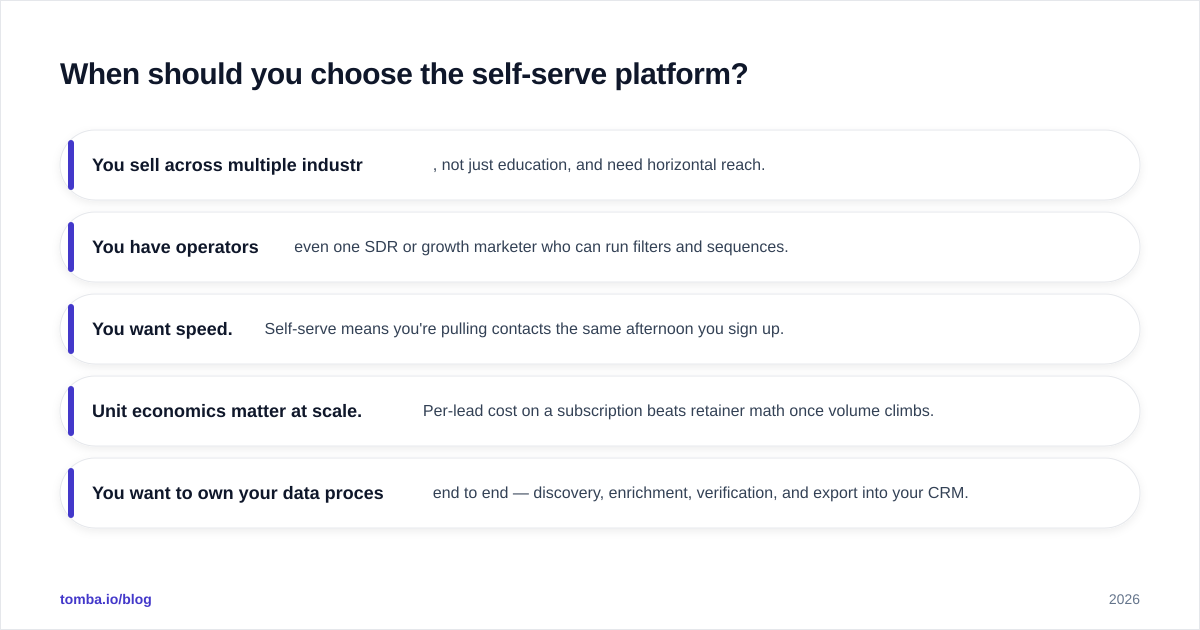
Choose Leadzenai (or a comparable self-serve stack) when:
- You sell across multiple industries, not just education, and need horizontal reach.
- You have operators — even one SDR or growth marketer who can run filters and sequences.
- You want speed. Self-serve means you're pulling contacts the same afternoon you sign up.
- Unit economics matter at scale. Per-lead cost on a subscription beats retainer math once volume climbs.
- You want to own your data process end to end — discovery, enrichment, verification, and export into your CRM.
The trade-off here is responsibility. No one is curating for you, and data accuracy is on your team. That's manageable with the right verification layer — and it's why most modern outbound teams pair a database with a dedicated finder and verifier rather than relying on a single source.
For teams going this route, building the stack from composable parts often beats a monolithic platform. A focused email finder, a bulk email finder for list-scale work, and the Tomba API for automation give you the same capability as an all-in-one tool, usually with better per-record accuracy and a price you can predict.
What about a hybrid approach?#
The most pragmatic answer for many teams is: don't pick exclusively.
A common high-performing setup looks like this:
- Use a vertical agency for the hardest 10% — the named accounts where education-specific nuance and human judgment genuinely move deals.
- Run a self-serve data engine for the other 90% — the volume prospecting where speed and unit cost win.
- Layer verification across both so nothing hits a mailbox unvalidated.
This mirrors how mature RevOps teams think about revenue operations generally: buy outcomes where expertise is scarce, build capability where scale is the goal. You can validate any vendor's claims through third-party reviews on G2 or Capterra before committing — both list managed services and self-serve tools with real customer feedback.
The connective tissue in a hybrid model is clean data. Whether a lead comes from an agency list or your own database pull, it should pass through the same verification gate before a rep ever touches it.
How do you evaluate either option before buying?#
Run the same five-question test on both Agile Education Marketing and Leadzenai:
- Coverage: Does it actually have the roles and institutions you sell to? Ask for a sample on your target accounts, not a generic demo list.
- Accuracy: What's the verified-deliverable rate? Demand a number, then spot-check it yourself with an email verifier.
- Freshness: How often is data re-validated? Education turnover punishes stale lists hardest.
- Control: Can you adjust targeting mid-flight, or are you locked to a scoped campaign?
- Total cost per verified lead: Not per record — per record that's real, reachable, and in-segment.
That last metric is the one that matters. A cheap list that's 60% deliverable is more expensive than a pricier list that's 95% deliverable, once you account for wasted send volume and sender-reputation damage. Always do the math on verified leads, not raw count.
The bottom line#
Agile Education Marketing and Leadzenai aren't really rivals — they're two answers to two different questions. If you want a vertical expert to run education campaigns for you, the agency motion fits. If you want a fast, controllable, cost-efficient engine you operate yourself, the self-serve platform fits. Most scaling teams end up somewhere in between.
What doesn't change is the dependency underneath both: accurate, deliverable contact data. That's the layer worth owning no matter which model you choose.
Start with the data. Before you commit to a retainer or a subscription, validate your target accounts directly with the Tomba Email Finder — find professional emails by name, company, or domain, verify them on the spot, and benchmark any vendor's "accuracy" claim against ground truth. The free tier gives you 25 searches a month to test it on your real list, and paid plans start at $49/mo when you're ready to scale. Buy outcomes or build capability — but verify the data either way.
// get started
Find, verify and enrich your first contacts today
Start on the free plan with 25 searches a month, then scale when your team is ready.
Free plan · No credit card required · GDPR & CCPA
// about the author