Agile Education Marketing vs ListKit: 2026 Data Comparison
Agile Education Marketing sells curated education-sector lists; ListKit builds self-serve B2B prospecting data. Here's which fits your 2026 pipeline — and where a live email finder beats both.
TL;DR
- Agile Education Marketing is a managed data provider built for one vertical: K-12 and higher-education institutions. You buy curated lists and append services, usually through a sales conversation.
- ListKit is a self-serve B2B prospecting platform with verified emails and phone numbers, ICP filters, and a credit-based subscription aimed at cold-email and outbound teams.
- They are not really the same product. One is a vertical data house; the other is a horizontal, do-it-yourself list builder.
- Pick Agile if education is your entire market and you want done-for-you data. Pick ListKit if you run multi-industry outbound and want to pull lists yourself in minutes.
- Neither solves deliverability for you. Whatever list you buy, re-verify it and keep records fresh — that's where a live tool like a dedicated email verifier earns its keep.
What is Agile Education Marketing?#
Agile Education Marketing is a specialist data and marketing-services company focused entirely on the education sector. Think superintendents, principals, district administrators, college deans, faculty, and procurement contacts across K-12 and higher education in the United States. Instead of giving you a search tool, Agile typically sells you a deliverable: a targeted list, a data append, or a multichannel campaign built around their education database.
The model is closer to a traditional list broker than a SaaS app. You describe your audience — say, "technology directors at districts with more than 5,000 students" — and their team scopes the count, the fields, and the price. You can read more on their official site at agile-ed.com.
This vertical focus is the entire pitch. Education is a notoriously hard market to prospect because titles are non-standard, addresses change with the school year, and a lot of the best contacts live on .edu or district domains that generic databases handle poorly. A provider that lives and breathes that one market tends to have deeper, cleaner coverage there than a horizontal tool.
What is ListKit?#
ListKit is a self-serve B2B data platform built for outbound and cold-email teams. You log in, set your ideal customer profile with filters (industry, title, company size, technology, location), and pull a list of verified contacts — emails and, on higher tiers, phone numbers — that you can export or push straight into your sending tool.
It is horizontal, not vertical. ListKit doesn't care whether you sell to dentists, SaaS founders, or logistics managers; the filters are the same. The product is popular with agencies and founders running high-volume cold email because it bundles triple-verified emails with the workflow of building and exporting a list quickly. Pricing is a credit-based subscription rather than a per-project quote.
The trade-off is the mirror image of Agile's. ListKit gives you speed, control, and breadth across every industry, but it does not pretend to be a domain expert in any single vertical. For a market as quirky as education, that genericness can show up as missing roles or stale .edu records.

Agile Education Marketing vs ListKit: how do they compare?#
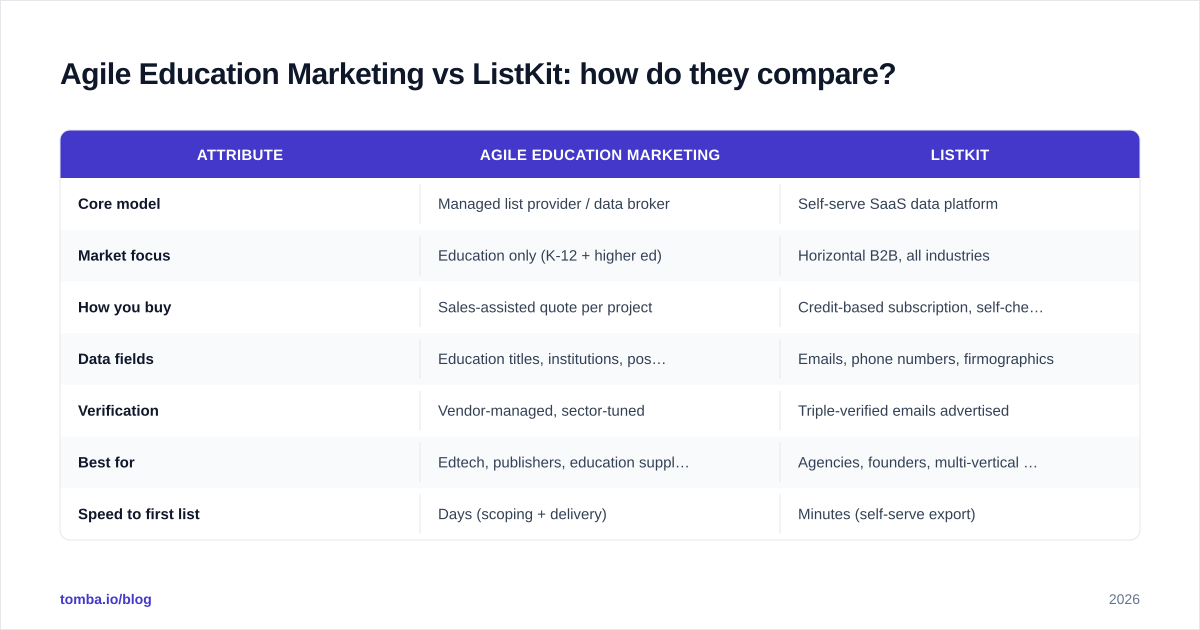
The fastest way to see the difference is side by side. The two tools optimize for different buyers, so "better" depends entirely on what you sell and how you want to work.
| Attribute | Agile Education Marketing | ListKit |
|---|---|---|
| Core model | Managed list provider / data broker | Self-serve SaaS data platform |
| Market focus | Education only (K-12 + higher ed) | Horizontal B2B, all industries |
| How you buy | Sales-assisted quote per project | Credit-based subscription, self-checkout |
| Data fields | Education titles, institutions, postal + email | Emails, phone numbers, firmographics |
| Verification | Vendor-managed, sector-tuned | Triple-verified emails advertised |
| Best for | Edtech, publishers, education suppliers | Agencies, founders, multi-vertical outbound |
| Speed to first list | Days (scoping + delivery) | Minutes (self-serve export) |
| Geographic strength | Primarily US education | Broad, US-heavy B2B |
| Phone data | Available via append | Included on higher tiers |
| Typical buyer team | Marketing / demand gen | SDR / cold-email / agency |
A quick analogy: Agile Education Marketing is a tailor who only makes suits for one profession and knows every measurement by heart. ListKit is a well-stocked department store where you grab what you need off the rack and walk out fast. Neither is wrong — it depends on whether you need the fit or the speed.
For independent reviews of ListKit's data quality and workflow, G2 is a reasonable third-party starting point before you commit to a plan.
Which one is better for your use case?#
Choose Agile Education Marketing if education is your whole business. If you sell curriculum, edtech software, school furniture, assessment tools, or publishing into K-12 and higher ed, a vertical specialist will usually out-cover a generic database on the contacts that matter. You're also buying their team's help — scoping audiences, appending missing fields, and running multichannel (email plus direct mail) campaigns that horizontal tools don't touch.
Choose ListKit if you run broad, high-volume outbound. Agencies juggling many clients, or founders prospecting across several industries, get more value from a self-serve tool that lets them build a fresh list for each campaign without a sales call. The credit model rewards teams who know their ICP and want to move fast.
There's also a hybrid reality most teams land on. You buy a vertical list from a specialist for your core market, run horizontal tools for adjacent experiments, and then layer your own enrichment and verification on top of both. That last layer is where data quality is won or lost — which brings us to the part neither vendor fully owns.
How accurate is the data you're buying?#
Here's the uncomfortable truth about any purchased list: it starts decaying the moment it's exported. B2B contact data goes stale at roughly 2-2.5% per month as people change jobs, companies rebrand, and inboxes get deactivated. In education specifically, the churn spikes every summer when staff rotate between buildings and districts.
So the right question isn't only "whose data is most accurate today?" It's "how do I keep it accurate after purchase?" Both Agile and ListKit advertise verification, but verification done at the vendor's timestamp is not the same as verification done the day you send.
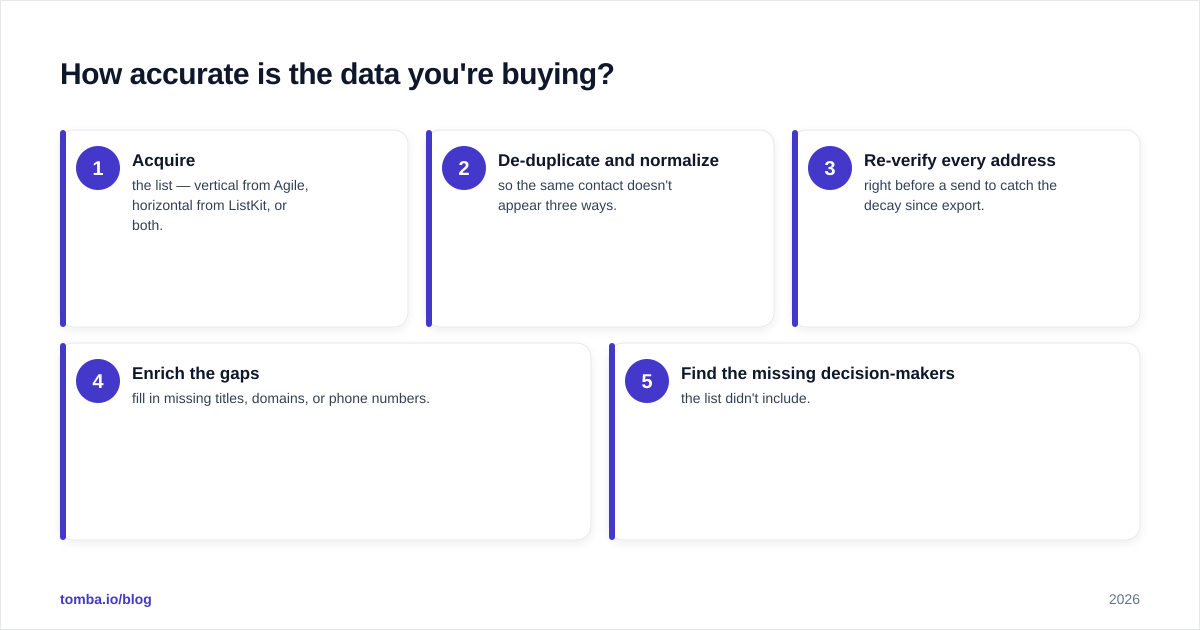
A practical workflow looks like this:
- Acquire the list — vertical from Agile, horizontal from ListKit, or both.
- De-duplicate and normalize so the same contact doesn't appear three ways.
- Re-verify every address right before a send to catch the decay since export.
- Enrich the gaps — fill in missing titles, domains, or phone numbers.
- Find the missing decision-makers the list didn't include.
Steps 3 through 5 are tool-agnostic and arguably matter more than which vendor you started with. This is where a live finder-and-verifier stack pays off regardless of where the list came from.
Where does a live email finder fit in?#
A static list is a snapshot; a live finder is a camera you can use any time. When a purchased list comes back with gaps — a principal whose email bounced, a new VP who joined last month, a district that wasn't in the original file — you don't want to wait for another data order. You want to look it up on demand.
That's the role of a real-time email finder: give it a name and a domain (including tricky .edu and district domains), and it returns the most likely professional address with a confidence score. Pair it with domain search to pull every known contact at a specific institution, and you can rebuild or extend a stale list without buying a whole new one.
The verification side matters just as much. Before any campaign, run the full list — purchased plus self-found — through an email verifier to strip catch-alls, role accounts, and dead boxes. High bounce rates don't just waste sends; they damage your sender reputation and drag down every future campaign's email deliverability.
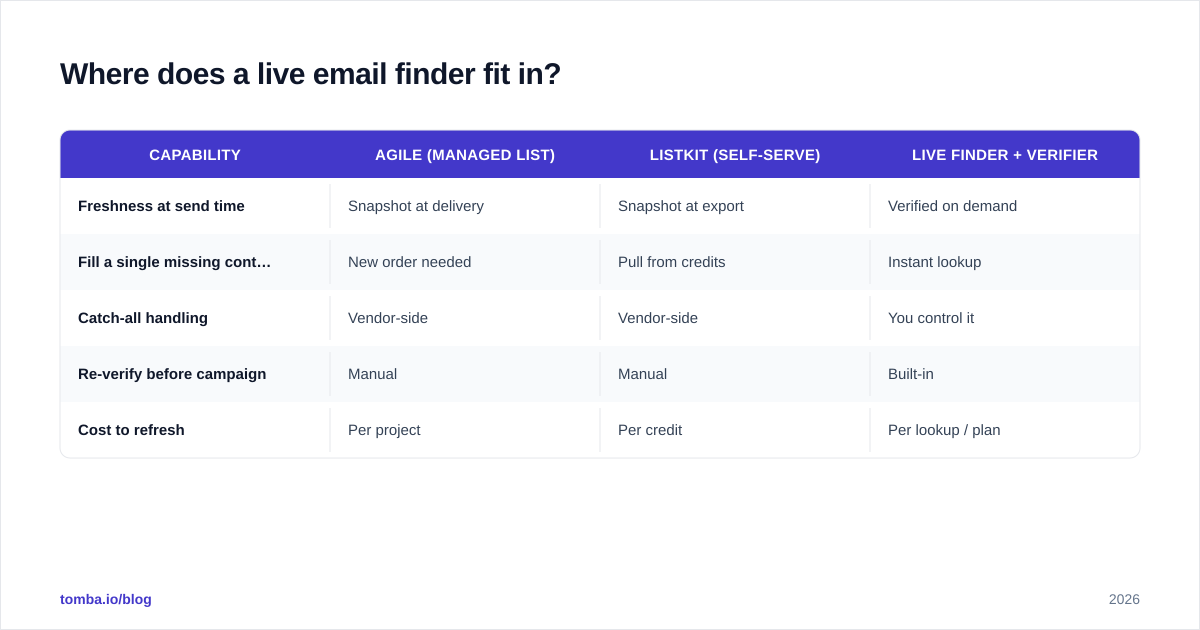
Below is how the three approaches stack up on the dimensions that actually drive replies.
| Capability | Agile (managed list) | ListKit (self-serve) | Live finder + verifier |
|---|---|---|---|
| Freshness at send time | Snapshot at delivery | Snapshot at export | Verified on demand |
| Fill a single missing contact | New order needed | Pull from credits | Instant lookup |
| Catch-all handling | Vendor-side | Vendor-side | You control it |
| Re-verify before campaign | Manual | Manual | Built-in |
| Cost to refresh | Per project | Per credit | Per lookup / plan |
None of this replaces a good vertical or horizontal data source — it protects the investment you already made in one.
What does it cost?#
Pricing is where the two vendors diverge hardest. Agile Education Marketing uses a quote-based model: cost depends on list size, selects, and whether you add append or campaign services, so you talk to sales for a number. ListKit uses a subscription with credits, which makes budgeting predictable but ties your volume to your plan tier. Always confirm current numbers on each vendor's own pricing page, since both change.
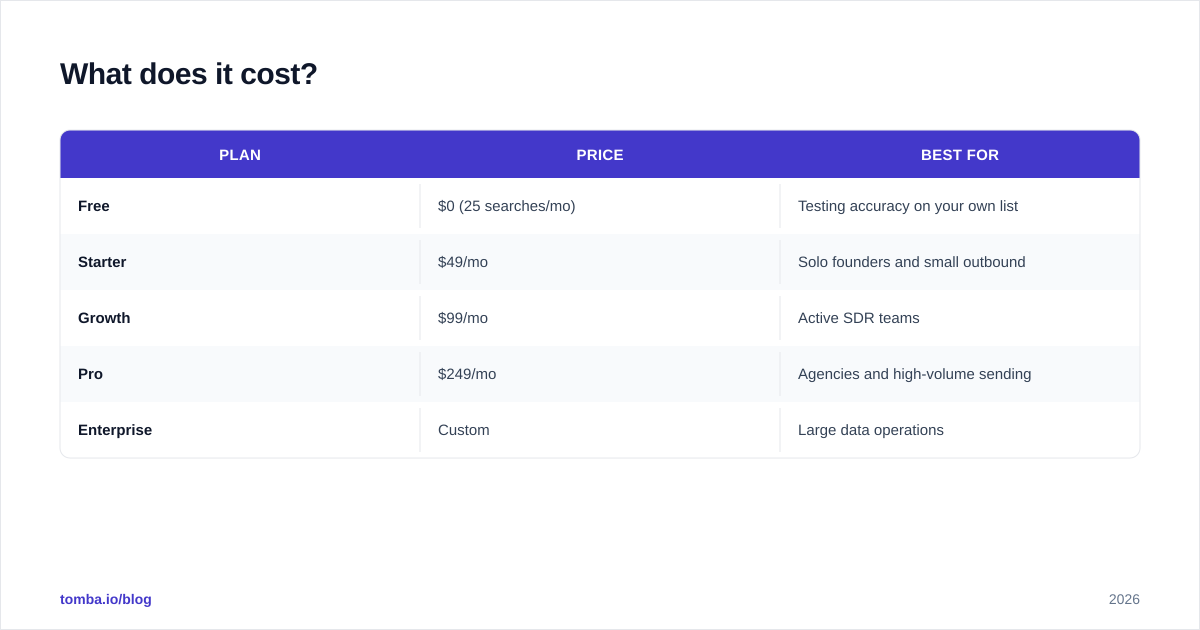
For the verification-and-finding layer, here's where transparent, published pricing helps. Tomba's plans are public, so you can budget the "keep it fresh" layer precisely:
| Plan | Price | Best for |
|---|---|---|
| Free | $0 (25 searches/mo) | Testing accuracy on your own list |
| Starter | $49/mo | Solo founders and small outbound |
| Growth | $99/mo | Active SDR teams |
| Pro | $249/mo | Agencies and high-volume sending |
| Enterprise | Custom | Large data operations |
You can see the full breakdown on the Tomba pricing page. The point isn't to swap out Agile or ListKit — it's to add a predictable, verifiable layer on top so you stop paying for bounces.
How should you actually decide?#
Strip away the feature lists and the decision comes down to three questions:
- Is education your only market? If yes, lean Agile. A vertical specialist's coverage of
.eduand district contacts is hard to beat with a horizontal tool, and the done-for-you service saves your team time. - Do you run outbound across many industries and want control? If yes, lean ListKit. Self-serve, credit-based access fits agencies and founders who build a new list per campaign.
- Do you need data to stay accurate after you buy it? Always yes. This is the layer both static models leave to you, and it's the one that decides whether your emails land.
Most teams that scale outbound end up using more than one source plus their own verification. The list vendor gets you the raw audience; your finding-and-verification stack keeps that audience reachable month after month. Treat the purchase as the start of the workflow, not the end of it.
You can also enrich whatever you buy — appending missing firmographics, social profiles, and phone numbers — with data enrichment so a thin list becomes a complete record before it ever reaches a rep.
The bottom line#
Agile Education Marketing and ListKit solve different problems. Agile is a vertical data house for the education market, sold as a managed service. ListKit is a horizontal, self-serve B2B platform for fast, multi-industry list building. Choose based on your market and how hands-on you want to be — not on which brand sounds bigger.
But whichever you pick, remember that purchased data is a depreciating asset. The teams that win in 2026 are the ones who treat buying as step one and verification, enrichment, and on-demand finding as the steps that protect the spend.
Ready to keep every list deliverable? Start with the Tomba Email Finder to fill the gaps your purchased data misses, verify before you send, and stop burning sender reputation on stale addresses. The free tier gives you 25 searches a month to test accuracy on your own list — no sales call required.
Ready to find emails that actually work?
Join 150,000+ professionals who stopped guessing and started sending. Free credits on signup — no credit card required.
Get the Tomba newsletter
Practical outbound tactics and product updates — once every two weeks.
About the author