Agile Education Marketing vs SalesIntel: 2026 Data Guide
Agile Education Marketing sells education-vertical audience data; SalesIntel sells human-verified B2B contacts and intent. Here's how the two actually compare in 2026 — and when to skip both.
Choosing a B2B data vendor is rarely a fair fight, because the two names on your shortlist are often built for different jobs. Agile Education Marketing and SalesIntel are a textbook example: one is a vertical specialist that lives and breathes the education market, and the other is a horizontal, human-verified contact and intent platform aimed at any B2B sales team. Picking between them on price alone is how teams end up with a beautiful database they can't use.
This guide breaks down what each provider is actually good at, where the data comes from, how coverage and accuracy differ, and which scenarios justify one over the other. It also covers the option most "X vs Y" posts ignore: building your own targeted list with a self-serve finder instead of buying a static one.
TL;DR#
- Agile Education Marketing is a vertical data and marketing-services provider focused on the U.S. education market — K-12, higher ed, district administrators, faculty, and ed-tech buyers.
- SalesIntel is a horizontal B2B data platform known for human-verified contacts, technographics, and buyer intent across most industries.
- Pick Agile Education Marketing if education is your entire market and you want done-for-you list builds and email deployment.
- Pick SalesIntel if you sell across verticals and need verified direct dials, intent signals, and CRM enrichment at scale.
- If you mostly need accurate emails for a defined target list, a self-serve tool like Tomba's email finder is often cheaper and fresher than either annual contract.
Who are Agile Education Marketing and SalesIntel?#
Agile Education Marketing is a specialist that sells access to the education vertical. Think of it as a publisher with a very specific newsstand: instead of "all of B2B," it curates contacts and audiences for schools, districts, colleges, universities, and the companies that sell into them. Beyond raw lists, it offers marketing services — email deployment, audience modeling, and campaign execution — so a vendor selling classroom software can reach curriculum directors without assembling the audience themselves. You can review their positioning on the official Agile Education Marketing site.
SalesIntel is a horizontal B2B data platform. Its headline differentiator is human verification: a research team re-checks contact records on a cycle, which is meant to push accuracy higher than purely automated databases. On top of contact and company data, SalesIntel layers technographics (what tools a company uses) and buyer intent (which accounts are researching your category right now). Their product details live on the official SalesIntel site.
The analogy that helps: Agile Education Marketing is a tailor who only makes school uniforms and will also press and deliver them. SalesIntel is a well-stocked department store with a quality-control desk. Both sell clothing; only one of them is the obvious choice if every customer you have is a school.
How do they compare at a glance?#
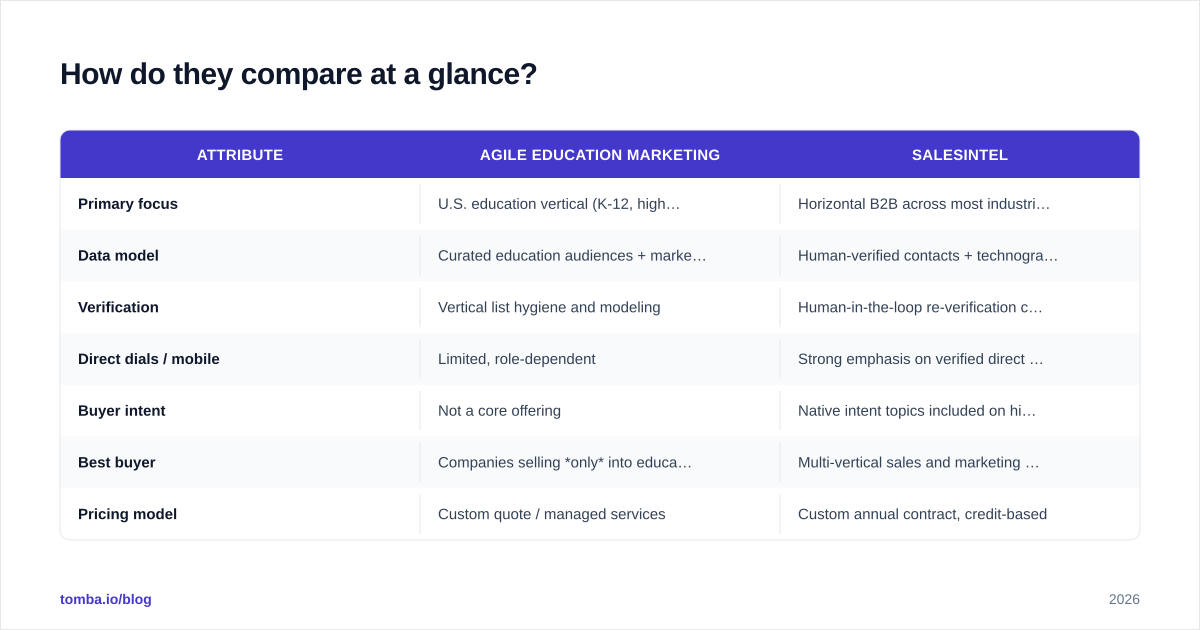
The fastest way to see the split is feature by feature. Note that both vendors price by quote rather than a public self-serve tier, so the rows below reflect typical packaging rather than a published rate card.
| Attribute | Agile Education Marketing | SalesIntel |
|---|---|---|
| Primary focus | U.S. education vertical (K-12, higher ed, ed-tech) | Horizontal B2B across most industries |
| Data model | Curated education audiences + marketing services | Human-verified contacts + technographics + intent |
| Verification | Vertical list hygiene and modeling | Human-in-the-loop re-verification cycle |
| Direct dials / mobile | Limited, role-dependent | Strong emphasis on verified direct dials |
| Buyer intent | Not a core offering | Native intent topics included on higher tiers |
| Best buyer | Companies selling only into education | Multi-vertical sales and marketing teams |
| Pricing model | Custom quote / managed services | Custom annual contract, credit-based |
| Self-serve free tier | No | No |
If your reaction to that table is "I only sell to school districts," Agile Education Marketing already looks like the better tool. If your reaction is "we sell to schools and hospitals and SaaS companies," SalesIntel's horizontal coverage and intent data start to earn their keep.

Which one has better data accuracy?#
Accuracy depends on what you're measuring, and the two vendors optimize for different things.
SalesIntel's pitch is built around human verification. Automated databases decay fast — people change jobs, companies rebrand, and direct dials get reassigned. A research team that re-touches records on a schedule is designed to slow that decay, especially for phone numbers, which are notoriously hard to keep current. If verified direct dials are central to your motion (think outbound calling teams), this is the meaningful difference.
Agile Education Marketing's accuracy story is vertical depth. A general database might list a "Director" at a school district with a generic role. A specialist is more likely to model the audience correctly — distinguishing a curriculum director from a technology coordinator from a superintendent — because those distinctions are the entire product. Within education, that contextual accuracy can beat a broader provider that treats schools as just another industry code.
Neither vendor publishes a third-party-audited accuracy percentage you should take at face value. Treat any "95% accurate" claim — from anyone — as a starting hypothesis to test on a sample, not a guarantee. For background on why contact data degrades, Gartner's research on data quality is a useful primer, and peer reviews on G2 give you unfiltered accuracy complaints from real users.
The practical move: before signing either contract, request a sample of 100–200 records that match your exact target profile, then run them through an independent email verifier. Measuring the real bounce rate yourself beats trusting any marketing number.
When should you choose Agile Education Marketing?#
Choose Agile Education Marketing when education is the whole business, not a segment. Specific signals that point this direction:
- Your buyers are administrators, faculty, district decision-makers, or procurement staff in schools and colleges.
- You want managed services — audience building plus email deployment — rather than a raw data feed your team has to operate.
- Your campaigns hinge on education-specific attributes (grade levels, enrollment size, public vs. private, funding cycles) that a horizontal database won't model well.
- You'd rather hand off list creation and execution than train a SDR team on database tooling.
The trade-off is concentration. A vertical specialist is the wrong tool the moment your market expands beyond education, and managed-services pricing tends to assume you're outsourcing execution, not just buying data you'll run yourself.
When should you choose SalesIntel?#
Choose SalesIntel when you need breadth, verified phone coverage, and intent across more than one industry. Signals:
- You sell into multiple verticals and can't tolerate a single-industry database.
- Outbound calling matters, so verified direct dials and mobile numbers carry real value.
- You want to prioritize accounts by buyer intent — reaching out while a company is actively researching your category.
- You're enriching a CRM at scale and want technographic filters (target every account running a specific competitor's tool).
The trade-off is that horizontal coverage in any single niche may be shallower than a specialist's. For a deep-education campaign, SalesIntel might return fewer correctly-classified district contacts than Agile Education Marketing — the classic generalist-versus-specialist tension. SalesIntel is also an annual commitment, so it suits teams with steady, year-round data needs rather than one-off projects. If that lock-in gives you pause, it's worth scanning Clearbit and SalesIntel alternatives before committing.
Is there a better option than buying a static list?#
For many teams, yes — and it's the option neither vendor leads with: build the exact list you need on demand instead of licensing a pre-packaged one.
Both Agile Education Marketing and SalesIntel sell you a database. That model has two structural weaknesses. First, static lists decay from the moment you receive them — every month, a chunk of contacts changes jobs. Second, you pay for coverage you may never use; a horizontal license bills you for industries you don't sell into, and a vertical license assumes you never leave the niche.
A self-serve finder flips the model. You start from your actual target accounts — a list of school districts, a set of companies running a specific tech stack, a conference attendee list — and pull current, verified contacts only for those domains. No annual minimum, no paying for the other 95% of the database.
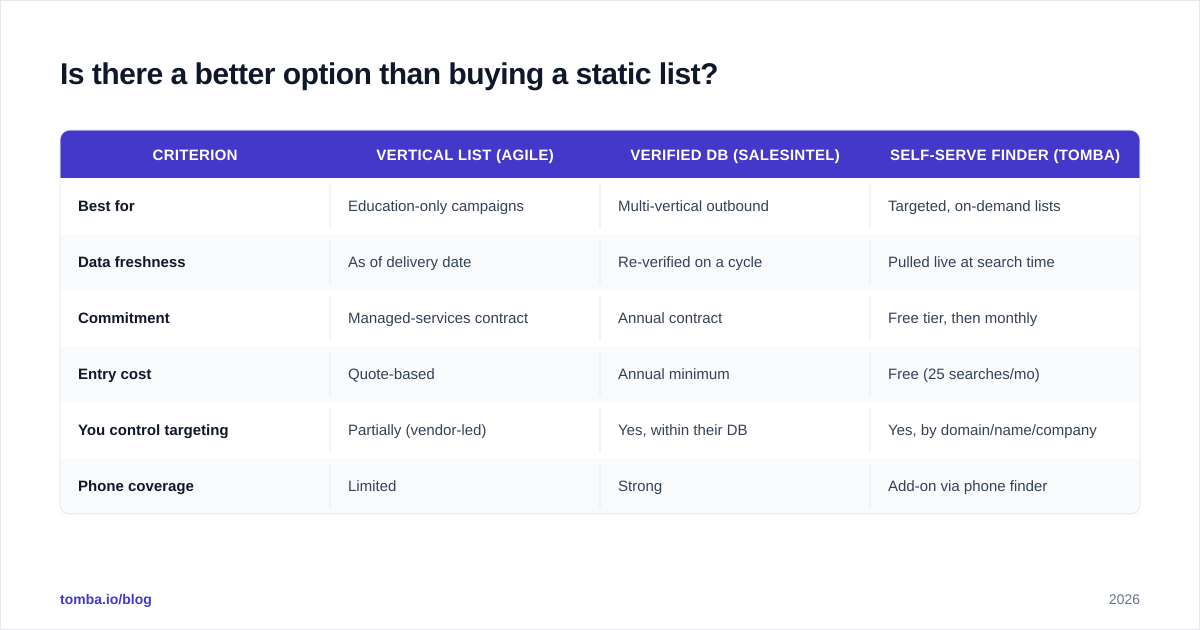
Here's how the three approaches stack up for a typical mid-market team:
| Criterion | Vertical list (Agile) | Verified DB (SalesIntel) | Self-serve finder (Tomba) |
|---|---|---|---|
| Best for | Education-only campaigns | Multi-vertical outbound | Targeted, on-demand lists |
| Data freshness | As of delivery date | Re-verified on a cycle | Pulled live at search time |
| Commitment | Managed-services contract | Annual contract | Free tier, then monthly |
| Entry cost | Quote-based | Annual minimum | Free (25 searches/mo) |
| You control targeting | Partially (vendor-led) | Yes, within their DB | Yes, by domain/name/company |
| Phone coverage | Limited | Strong | Add-on via phone finder |
With Tomba's domain search, you feed in a school district's or company's website and get the verified email patterns and named contacts behind it. Pricing is transparent and self-serve — a free tier with 25 searches a month, then Starter at $49/mo, Growth at $99/mo, and Pro at $249/mo — so you can test it on real targets before committing a dollar. Full Tomba pricing is public, which is itself a contrast with the quote-only model of both data vendors. You can also pull from a maintained B2B database when you'd rather browse than search domain by domain.
This isn't a knock on either incumbent. If you genuinely need a fully managed education campaign, Agile Education Marketing does something a finder doesn't. If you need verified direct dials across ten industries plus intent, SalesIntel is purpose-built for that. But a large share of "we need a data vendor" requests are really "we need accurate emails for these 800 accounts" — and that job doesn't require an annual contract.
How do you actually decide?#
Run your situation through three questions, in order:
- Is your market only education? If yes, Agile Education Marketing is a serious contender and a horizontal tool will underperform on vertical accuracy. If no, eliminate it now.
- Do you need verified phone numbers and intent across multiple verticals? If yes, SalesIntel's model fits and the annual cost is likely justified. If you mostly need email, keep going.
- Is your real need "accurate contacts for a defined target list"? If yes, start with a self-serve finder, prove the bounce rate on your own targets, and only graduate to a full data contract when volume and channel needs (phone, intent) genuinely demand it.
The most expensive mistake here isn't picking the "wrong" vendor — it's buying a heavyweight contract for a lightweight job. Test before you commit. Pull a sample, verify it independently, and measure real-world deliverability against your own send infrastructure rather than a slide deck.
The bottom line#
Agile Education Marketing and SalesIntel aren't really competitors; they're answers to different questions. Agile wins when education is your entire world and you want execution handled for you. SalesIntel wins when you need verified, multi-vertical coverage with direct dials and intent. And for the very common middle case — "I just need current, accurate emails for these specific accounts" — a self-serve finder beats both on cost, freshness, and control.
If that middle case is you, start free with the Tomba Email Finder. Find professional email addresses by domain, name, or company, verify them on the spot, and build the exact list you need without signing an annual contract. Run it on 25 of your real target accounts this week, check the bounce rate yourself, and let the data — not a sales pitch — make the decision.
// get started
Find, verify and enrich your first contacts today
Start on the free plan with 25 searches a month, then scale when your team is ready.
Free plan · No credit card required · GDPR & CCPA
// about the author