Agile Education Marketing vs SMARTE Goals: 2026 Playbook
Agile sprints or SMARTE goals? Here's how education marketing teams choose the right framework in 2026 — and why the smartest teams quietly run both at once.
TL;DR
- Agile education marketing is a process — short sprints, fast feedback, constant reprioritization. SMARTE goals are a target-setting standard — Specific, Measurable, Achievable, Relevant, Time-bound, and Evaluated. They answer different questions.
- Agile wins when your enrollment funnel, channels, or audience shift fast (new program launches, paid-channel volatility, application-season crunch). SMARTE wins when leadership needs predictable, defensible targets.
- The false choice is "pick one." High-performing education marketing teams in 2026 set SMARTE goals at the quarter level and execute them in Agile sprints at the week level.
- The real risk isn't the framework — it's dirty contact data. Both models break when your prospect list is full of bounced or unverified emails.
- This guide gives you a side-by-side comparison, a decision matrix, and a hybrid operating model you can copy.
What is Agile education marketing?#
Agile education marketing is borrowing the software-team idea of working in short, repeatable cycles and applying it to how a school, university, bootcamp, or edtech company markets its programs.
Think of it like coaching a sports team during the season instead of writing one rigid playbook in August. You run a play (a sprint), watch what the opponent does (the data), and adjust at the next huddle (the retro). You don't wait until the season ends to learn you were wrong.
In practice, Agile marketing teams work in 1–2 week sprints, hold short daily standups, pull work from a prioritized backlog, and review results in a retrospective before planning the next cycle. The methodology grew out of the Agile software movement and now has its own community and manifesto; HubSpot's overview of agile marketing is a solid primer on the rituals.
For an admissions or enrollment team, that might look like:
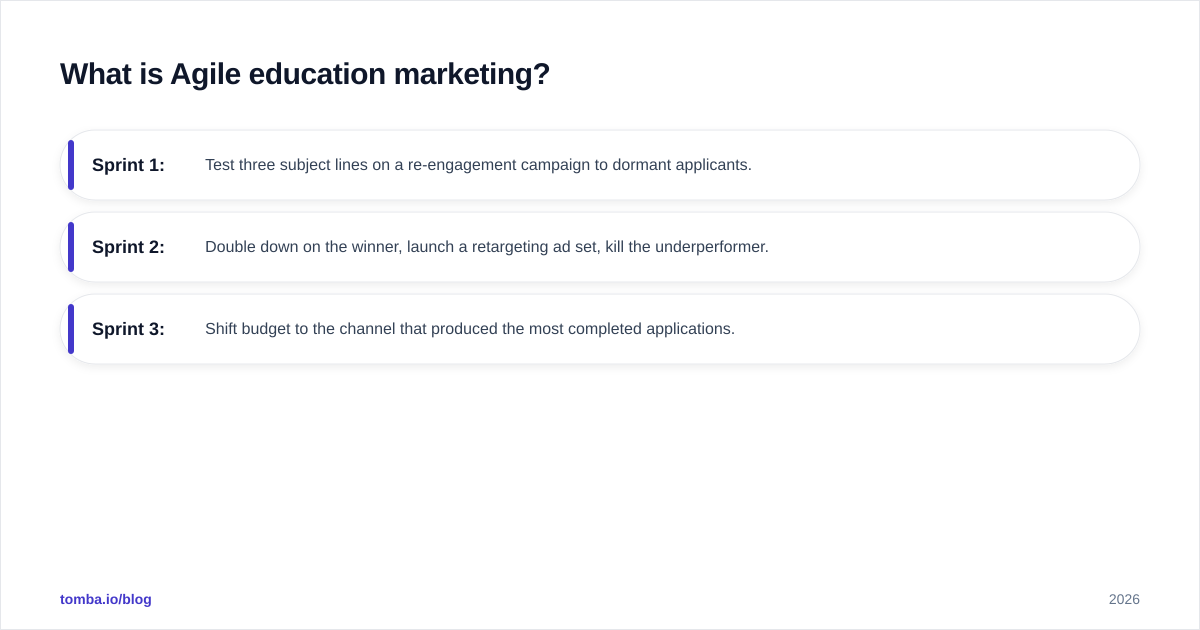
- Sprint 1: Test three subject lines on a re-engagement campaign to dormant applicants.
- Sprint 2: Double down on the winner, launch a retargeting ad set, kill the underperformer.
- Sprint 3: Shift budget to the channel that produced the most completed applications.
The point is speed of learning, not speed of activity.
What are SMARTE goals?#
SMARTE goals are an extension of the classic SMART goal-setting criteria, with an added E for Evaluated (and sometimes Ethical). It's a quality checklist for the targets you set, not a way of working.
The original SMART acronym — Specific, Measurable, Achievable, Relevant, Time-bound — has been a management staple for decades (see the SMART criteria entry on Wikipedia for the history). SMARTE bolts on a final step that forces you to review and adjust the goal after a defined checkpoint.
A weak goal: "Get more applicants this year."
A SMARTE goal: "Increase completed undergraduate applications from 4,200 to 4,800 (Measurable, Achievable) for the Fall 2026 intake (Time-bound) through paid search and email nurture (Specific, Relevant), with a mid-cycle review in March to evaluate pacing (Evaluated)."
The difference is that the second version can be defended to a dean, tracked on a dashboard, and corrected before it's too late.

Agile education marketing vs SMARTE: what's the actual difference?#
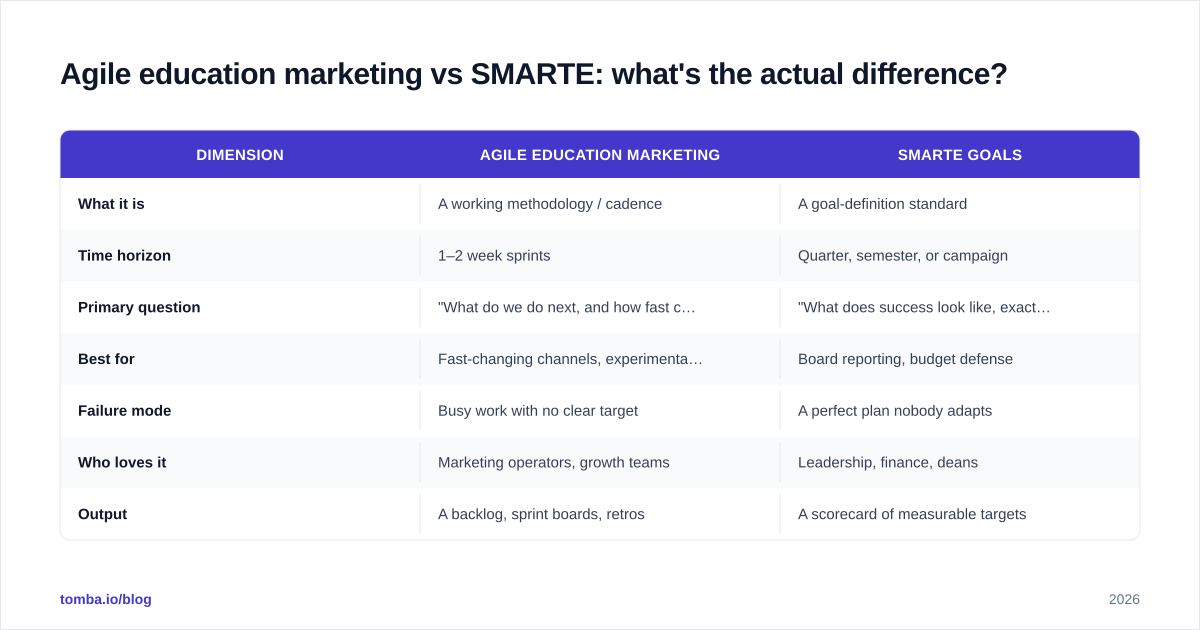
Here's the core conclusion: they are not competitors. One is a cadence for doing the work; the other is a standard for defining the win. Confusing them is like arguing whether a recipe or a kitchen timer makes the better dinner.
| Dimension | Agile education marketing | SMARTE goals |
|---|---|---|
| What it is | A working methodology / cadence | A goal-definition standard |
| Time horizon | 1–2 week sprints | Quarter, semester, or campaign |
| Primary question | "What do we do next, and how fast can we learn?" | "What does success look like, exactly?" |
| Best for | Fast-changing channels, experimentation | Board reporting, budget defense |
| Failure mode | Busy work with no clear target | A perfect plan nobody adapts |
| Who loves it | Marketing operators, growth teams | Leadership, finance, deans |
| Output | A backlog, sprint boards, retros | A scorecard of measurable targets |
| Data dependency | High — needs fast, clean feedback | High — needs accurate baselines |
Notice the last row. Both frameworks assume your underlying data is trustworthy. An Agile sprint that optimizes against bounced-email metrics is optimizing against noise. A SMARTE goal built on an inflated, unverified list sets a baseline you can never honestly hit.
Is Agile better than SMARTE for education marketing?#
No — and asking the question that way is the trap. The better question is "which one am I missing right now?"
You probably need more Agile if:
- Your team writes an annual plan and then ignores it by October.
- Application-season spikes catch you flat-footed every year.
- You can't remember the last time you killed an underperforming campaign mid-flight.
- Decisions wait for a monthly meeting that's always too late.
You probably need more SMARTE if:
- Your standups are energetic but nobody can say what "winning the quarter" means.
- Leadership keeps asking "are we on track?" and you don't have a number.
- Different team members would describe the goal differently.
- You optimize tactics endlessly but never tie them to enrollment outcomes.
Most education marketing teams I see lean too far one way. Agency-trained growth marketers over-index on Agile motion and under-define the goal. Traditional institutional teams over-index on rigid annual SMARTE plans and never adapt. The fix is the hybrid below.
How do you combine Agile and SMARTE into one operating model?#
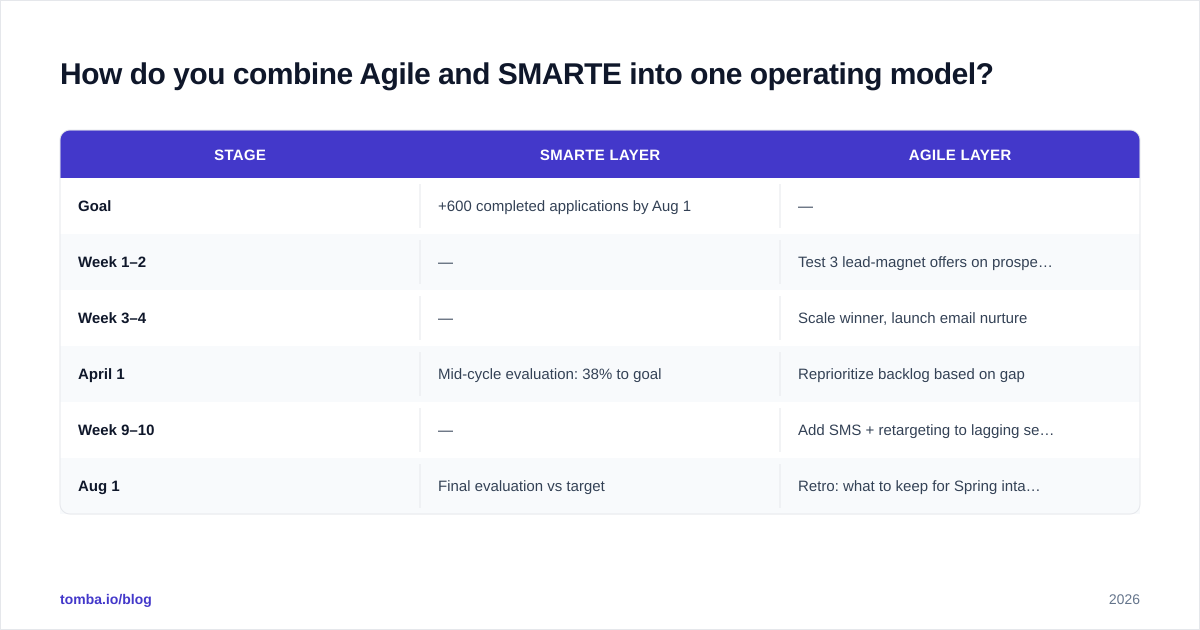
Set the destination with SMARTE. Drive there with Agile. Here's the layered model:
Layer 1 — Quarter (SMARTE): Leadership and marketing agree on 2–4 SMARTE goals per intake cycle. Example: "Lift the application-completion rate from 61% to 70% by the May 1 deadline, evaluated at the April 1 checkpoint."
Layer 2 — Sprint (Agile): The team breaks each SMARTE goal into a backlog of experiments and ships them in two-week sprints. Each sprint pulls the highest-leverage item toward the quarter goal.
Layer 3 — Daily (Agile): Standups surface blockers fast. The most common blocker in education marketing? "We don't have verified contact details for this segment yet."
This is where go-to-market discipline meets data discipline. Strong revenue operations practice treats the contact database as the engine both layers run on. If you want the wider context on aligning targets, channels, and tooling, Gartner's marketing research is a useful external benchmark for how mature teams structure this.
A worked example: a Fall 2026 enrollment push#
| Stage | SMARTE layer | Agile layer |
|---|---|---|
| Goal | +600 completed applications by Aug 1 | — |
| Week 1–2 | — | Test 3 lead-magnet offers on prospect list |
| Week 3–4 | — | Scale winner, launch email nurture |
| April 1 | Mid-cycle evaluation: 38% to goal | Reprioritize backlog based on gap |
| Week 9–10 | — | Add SMS + retargeting to lagging segment |
| Aug 1 | Final evaluation vs target | Retro: what to keep for Spring intake |
The SMARTE goal never changes mid-quarter. The path to it changes every sprint. That's the whole trick.
Where does data quality decide the winner?#
Both frameworks quietly depend on one thing: reaching real humans. You cannot run an honest A/B test on a sprint, and you cannot evaluate a SMARTE goal, if a third of your outreach never lands.
Education marketing has a specific data problem. Prospective students change emails constantly — a high-schooler's personal address, a parent's address, a future university address. Corporate-training and edtech B2B teams chase decision-makers whose work emails churn with every job change. That decay quietly poisons both your sprint metrics and your quarterly baseline.
Three concrete failure points:
- Inflated baselines. If your "10,000-contact" list is really 6,800 reachable people, your SMARTE goal's denominator is fiction.
- Noisy sprint signals. A subject-line test looks like a loser when the real issue is that 25% of the segment bounced. You kill a good play for the wrong reason.
- Deliverability drag. High bounce rates hurt sender reputation, which suppresses the very campaigns you're sprinting on.
The fix is unglamorous but decisive: build outreach on verified contacts. Use an email finder to source accurate professional addresses for B2B and partner outreach, run lists through an email verifier before every sprint, and enrich leads so segmentation is based on real attributes, not guesses. Clean data is the substrate both Agile and SMARTE run on.
What does each framework get wrong on its own?#
Agile without SMARTE becomes motion theater. Teams feel productive — boards full of tickets, busy standups — but six months in, nobody can show enrollment moved. Velocity is not progress if it isn't pointed at a target.
SMARTE without Agile becomes a beautiful plan in a drawer. The goal is perfectly worded, signed off in January, and never revisited until the post-mortem reveals it was unrealistic by March. The "E" for Evaluated is supposed to prevent this, but without an Agile cadence there's no mechanism to actually act on the evaluation.
The two cover each other's blind spots. SMARTE gives Agile a finish line. Agile gives SMARTE a steering wheel.
How do you start with limited time and budget?#
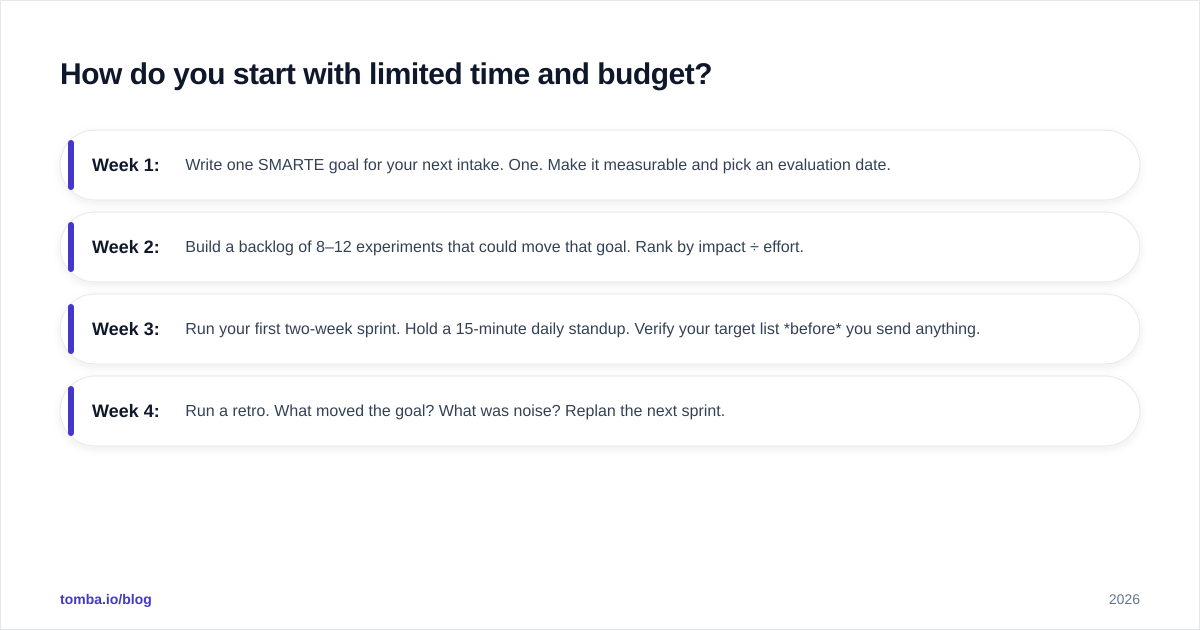
Don't boil the ocean. A four-week rollout:
- Week 1: Write one SMARTE goal for your next intake. One. Make it measurable and pick an evaluation date.
- Week 2: Build a backlog of 8–12 experiments that could move that goal. Rank by impact ÷ effort.
- Week 3: Run your first two-week sprint. Hold a 15-minute daily standup. Verify your target list before you send anything.
- Week 4: Run a retro. What moved the goal? What was noise? Replan the next sprint.
Repeat until the evaluation date, then assess the SMARTE goal honestly. You'll learn more about your funnel in one cycle than a year of static planning delivered.
Frequently asked questions#
Is SMARTE just SMART with extra letters? Mostly yes — the added "E" (Evaluated, sometimes Ethical) is the meaningful upgrade, because it forces a scheduled review instead of a set-and-forget target. For education and edtech, the ethical reading also matters when marketing to minors and their families.
Can a small admissions team really do Agile? Yes. Agile scales down better than it scales up. A two-person team running weekly sprints with a shared backlog already captures most of the benefit. You don't need certified scrum masters.
Which framework should appear in our marketing OKRs? SMARTE goals map cleanly onto OKRs and board reporting. Agile is how you hit those OKRs. Put SMARTE in the OKR doc; run Agile in the team's day-to-day.
Doesn't constant reprioritization confuse stakeholders? Only if you reprioritize the goal. The SMARTE target stays fixed for the quarter; you reprioritize tactics. Communicating that distinction to leadership is half the battle.
The bottom line#
Stop framing it as agile education marketing vs SMARTE. The teams that win in 2026 don't choose — they set SMARTE goals to define the destination and run Agile sprints to get there, with verified contact data underneath both. The framework debate is a distraction from the thing that actually moves enrollment: reaching real people, learning fast, and steering toward a number everyone agreed on.
Whichever cadence you adopt, your sprints and your scorecard are only as honest as your contact list. Start there. Tomba's Email Finder helps education and edtech marketing teams source accurate, verified professional emails by name, domain, or company — so your next sprint optimizes against real signal and your next SMARTE goal sits on a baseline you can defend. Try it free, and check the Tomba pricing tiers when you're ready to scale outreach across an intake season.
Ready to find emails that actually work?
Join 150,000+ professionals who stopped guessing and started sending. Free credits on signup — no credit card required.
Get the Tomba newsletter
Practical outbound tactics and product updates — once every two weeks.
About the author