AI B2B Lead Generation in 2026: The Complete Playbook
AI has rewired how B2B teams find, score, and reach buyers. Here is how AI B2B lead generation actually works in 2026 — the stack, the framework, and the metrics that matter.
TL;DR
- AI B2B lead generation means using machine learning to find, score, enrich, and prioritize buyers — not just blasting a bigger list faster.
- The biggest wins come from three layers working together: data (who exists), signals (who is in-market now), and routing (who gets worked first).
- AI does not replace your reps. It removes the 60-70% of prospecting time spent on research, list cleaning, and guessing intent.
- A clean, verified contact base is the floor. AI scoring on top of bad data just ranks garbage faster.
- Start narrow: one ICP, one intent signal, one enrichment source. Scale the parts that move reply rate and pipeline, not vanity volume.
If you have watched the lead-gen category for the last two years, you already know the pitch: "AI finds your perfect customers automatically." Most of that is marketing. But underneath the noise, something real changed. The combination of cheap inference, large contact graphs, and intent data has made it genuinely possible to spend less time on research and more time on conversations. This guide explains how AI B2B lead generation works in 2026, what is hype, and how to build a stack that actually produces pipeline.
What is AI B2B lead generation?#
AI B2B lead generation is the use of machine learning and large language models to automate the discovery, scoring, enrichment, and prioritization of business buyers. Instead of a rep manually building a list, researching each company, and guessing who is ready to talk, models do the heavy pattern-matching and the human steps in for judgment and relationship.
Think of it like the difference between a paper map and a navigation app. The paper map (a static lead list) shows every road. The navigation app (AI) knows which roads are open right now, where the traffic is, and the fastest route to your destination. Both get you there in theory. Only one accounts for live conditions.
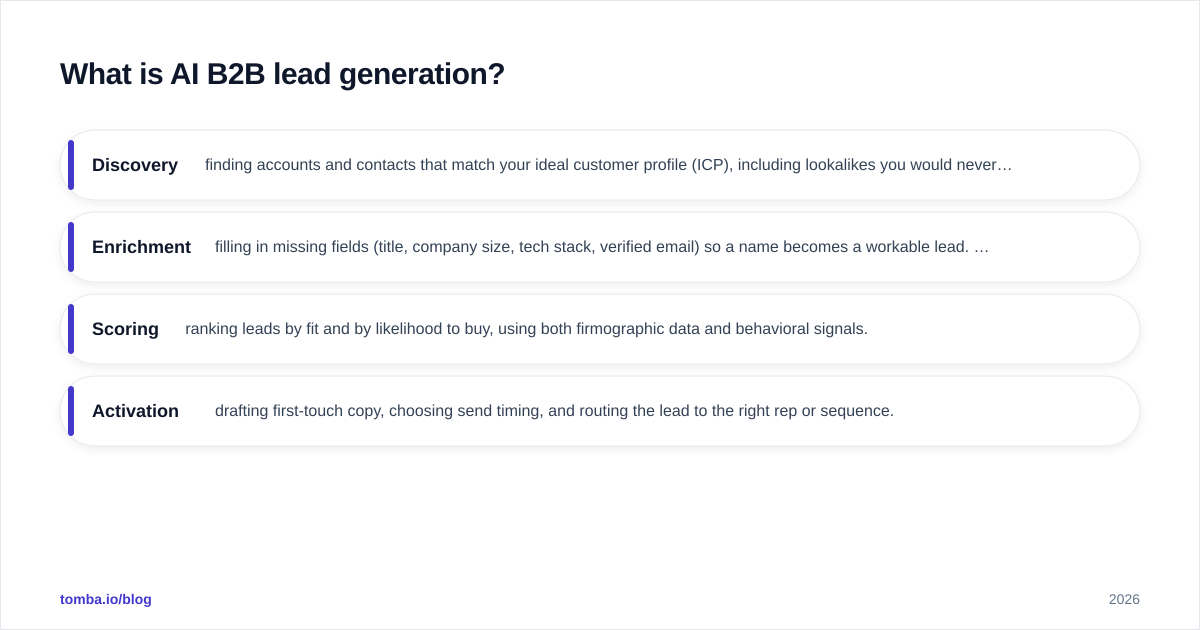
Concretely, AI shows up in four places across the funnel:
- Discovery — finding accounts and contacts that match your ideal customer profile (ICP), including lookalikes you would never have searched for.
- Enrichment — filling in missing fields (title, company size, tech stack, verified email) so a name becomes a workable lead. This is where data enrichment earns its keep.
- Scoring — ranking leads by fit and by likelihood to buy, using both firmographic data and behavioral signals.
- Activation — drafting first-touch copy, choosing send timing, and routing the lead to the right rep or sequence.
The trap is treating AI as a single magic button. It is a set of layers, and the weakest layer caps the whole system.
How is AI lead generation different from traditional lead gen?#
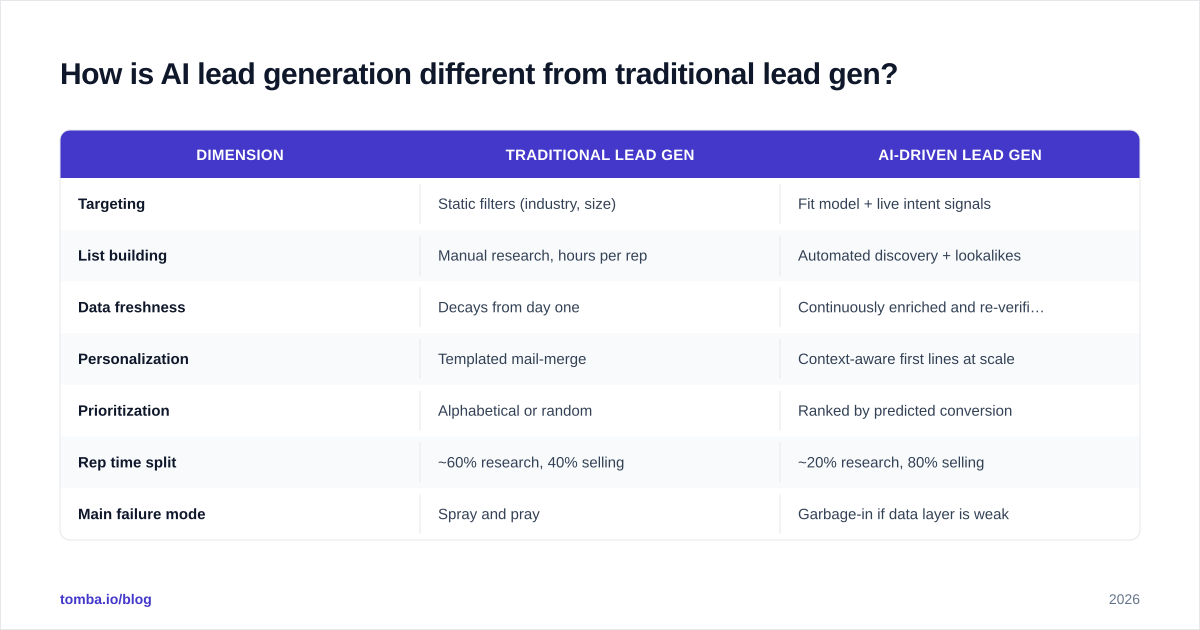
The short version: traditional lead gen optimizes for volume; AI lead gen optimizes for timing and fit. A traditional motion buys a list of 10,000 contacts and emails all of them. An AI motion starts with the same universe but answers a harder question first — which 400 of these are showing buying behavior this week, and what should we say to them?
Here is the practical contrast.
| Dimension | Traditional lead gen | AI-driven lead gen |
|---|---|---|
| Targeting | Static filters (industry, size) | Fit model + live intent signals |
| List building | Manual research, hours per rep | Automated discovery + lookalikes |
| Data freshness | Decays from day one | Continuously enriched and re-verified |
| Personalization | Templated mail-merge | Context-aware first lines at scale |
| Prioritization | Alphabetical or random | Ranked by predicted conversion |
| Rep time split | ~60% research, 40% selling | ~20% research, 80% selling |
| Main failure mode | Spray and pray | Garbage-in if data layer is weak |
Notice the last row. AI does not fix bad inputs — it amplifies them. If your contact data is stale and unverified, an AI score just sorts your dead leads into a confident-looking order. That is why the teams seeing real gains invest in clean, verified contacts before they invest in fancier models. A reliable email verifier and deliverability hygiene do more for output than swapping one scoring model for another.
What does an AI B2B lead generation stack look like?#
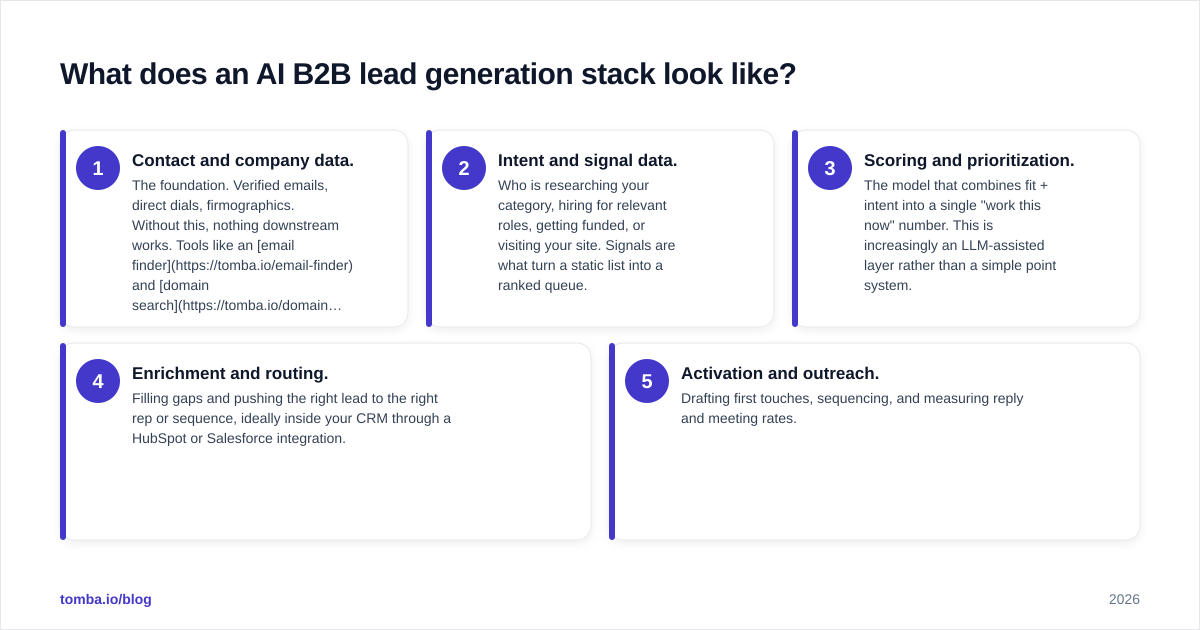
A working stack in 2026 has five components. You do not need a separate vendor for each — many platforms bundle two or three — but you should be able to name what is doing each job.
- Contact and company data. The foundation. Verified emails, direct dials, firmographics. Without this, nothing downstream works. Tools like an email finder and domain search live here.
- Intent and signal data. Who is researching your category, hiring for relevant roles, getting funded, or visiting your site. Signals are what turn a static list into a ranked queue.
- Scoring and prioritization. The model that combines fit + intent into a single "work this now" number. This is increasingly an LLM-assisted layer rather than a simple point system.
- Enrichment and routing. Filling gaps and pushing the right lead to the right rep or sequence, ideally inside your CRM through a HubSpot or Salesforce integration.
- Activation and outreach. Drafting first touches, sequencing, and measuring reply and meeting rates.
The temptation is to chase the newest tool for every layer. Resist it. A coherent stack of three solid tools beats seven flashy ones you never fully configure.

How accurate is AI at identifying good leads?#
Accuracy depends almost entirely on data quality and signal relevance, not on the cleverness of the model. In practice, well-tuned fit scoring correlates strongly with win rate when two conditions hold: the training data reflects your actual closed-won customers, and the contact data is verified. When either breaks, accuracy collapses and reps stop trusting the scores — which is the real death of any scoring system.
A few honest caveats worth stating plainly:
- Intent data is probabilistic, not certain. A spike in category research means a higher chance of being in-market, not a guarantee. Treat it as a tiebreaker, not gospel.
- LLM-written research can hallucinate. If a model summarizes a prospect's "recent product launch," verify before you reference it in an email. A wrong detail is worse than no detail.
- Models drift. Your ICP in Q1 may not match Q4 after a pricing or segment change. Re-train or re-tune on fresh closed-won data quarterly.
The teams that win treat AI scores as a strong recommendation that a human can override, not an autopilot. According to research compiled by analysts at Gartner and practitioner data shared across communities like G2, the differentiator is rarely the algorithm — it is the discipline around inputs and feedback loops.
How do you build an AI lead generation workflow step by step?#
Start narrow and prove the loop before you scale it. Here is a sequence that works for most B2B teams.
Step 1 — Define one sharp ICP. Not "mid-market SaaS." Something like "Series B-C B2B SaaS, 50-300 employees, has a RevOps hire, uses HubSpot." The tighter the definition, the better every downstream model performs.
Step 2 — Build a verified seed list. Use domain search to pull contacts from target companies, then run them through verification. A list of 300 verified, in-ICP contacts beats 5,000 scraped maybes. This is also where bulk lead generation saves hours.
Step 3 — Layer one intent signal. Pick a single signal you can act on: hiring, funding, tech adoption, or site visits. One clean signal beats a dashboard of ten you ignore.
Step 4 — Score and rank. Combine fit (matches ICP) and signal (showing intent) into a simple tiered queue: A (work today), B (work this week), C (nurture). Resist over-engineering the math early.
Step 5 — Enrich the A tier. Add the context a rep needs — role, recent triggers, verified direct contact — before outreach, not during it. Push it into the CRM automatically.
Step 6 — Activate with relevant first touches. Use AI to draft, but have a human approve the first 50. You are training your own taste and the model's prompt at the same time.
Step 7 — Close the loop. Feed reply rate, meeting rate, and closed-won back into the score. This feedback loop is the entire point — without it, you have automation, not intelligence.
Which metrics actually prove AI lead gen is working?#
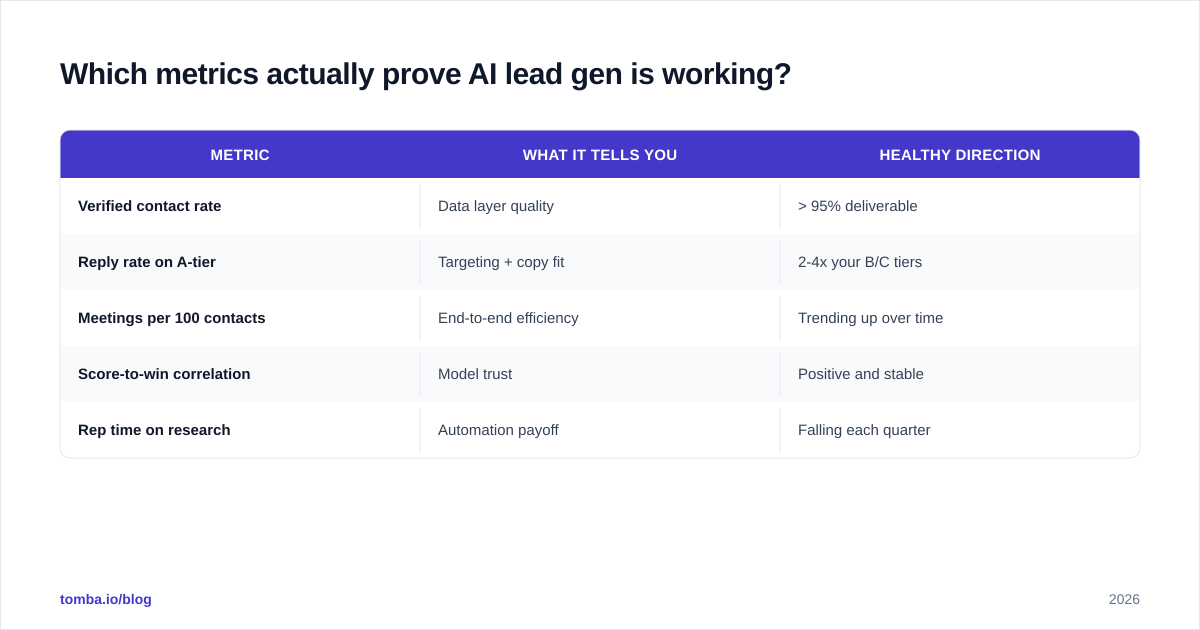
Ignore volume metrics in isolation. "We generated 12,000 leads" tells you nothing if 200 were real. Measure the funnel, not the top of it.
| Metric | What it tells you | Healthy direction |
|---|---|---|
| Verified contact rate | Data layer quality | > 95% deliverable |
| Reply rate on A-tier | Targeting + copy fit | 2-4x your B/C tiers |
| Meetings per 100 contacts | End-to-end efficiency | Trending up over time |
| Score-to-win correlation | Model trust | Positive and stable |
| Rep time on research | Automation payoff | Falling each quarter |
If your A-tier does not meaningfully out-reply your C-tier, your scoring is not working and no amount of AI copy will save it. Fix the model or the data before you scale spend. For deeper definitions, the Tomba B2B glossary breaks down terms like MQL and response rate without the fluff.
What are the common mistakes to avoid?#
- Buying lists and calling it AI. A purchased list run through a scoring model is still a purchased list. Start with verified, permissioned data.
- Over-personalizing the wrong thing. A perfectly researched email to someone with zero fit is wasted effort. Fit first, then personalization.
- Letting AI send unsupervised early. Review the first batches. Unsupervised sending at scale is how you torch your sender reputation and land in spam.
- Skipping verification to save credits. Bounces hurt deliverability far more than verification costs. This is the cheapest insurance in the stack.
- Chasing every new tool. Tool-hopping fragments your data and your team's attention. Pick a coherent stack and run it for two quarters before judging.
How much does AI lead generation cost?#
Costs vary widely, but the structure is consistent: you pay for data volume (searches, verifications, enrichments), and sometimes a platform fee on top. The mistake is optimizing for the lowest per-credit price instead of the lowest cost-per-meeting. A cheaper tool that returns unverified emails costs you more once you count bounced sends and burned domains.
For reference, transparent per-seat or per-credit pricing — like the published Tomba pricing tiers running from a free plan with 25 searches/month up to Pro at $249/mo — lets you model cost-per-lead before you commit. Whatever vendor you choose, insist on that transparency. If you cannot calculate cost-per-verified-contact, you cannot calculate ROI.
Is AI going to replace SDRs and lead gen teams?#
No — but it changes the job. AI removes the mechanical 60-70% of prospecting: list building, research, data cleaning, first-draft copy. What remains is the part humans are still better at: judgment about which accounts matter, genuine relationship building, handling nuance in a live conversation, and knowing when to ignore the model.
The honest framing is that AI raises the floor and the ceiling at once. The floor rises because even average reps now start their day with a ranked, enriched queue instead of a blank spreadsheet. The ceiling rises because top reps spend their freed hours on the 20 accounts that actually move the number. The reps who struggle are the ones who treated research busywork as their value. The ones who thrive treat AI as leverage. This shift mirrors the broader move toward sales automation that vendors like HubSpot have been documenting across the industry.
Where should you start?#
Start with the layer everything else depends on: clean, verified contact data. You can add intent signals, scoring models, and AI copy later, but none of them work on a foundation of stale or unverified emails. Get the data right, prove the loop on one tight ICP, then scale the parts that move reply rate and pipeline.
That is exactly where Tomba Email Finder fits. It gives you verified professional emails by name, domain, or company, with a built-in verifier and a free tier (25 searches/month) so you can test the data quality before committing — then scale through Starter at $49/mo or higher as your AI lead-gen motion proves out. Build the foundation first; let the AI layers earn their place on top of data you can trust. Start with a clean list, and every model downstream gets sharper.
Ready to find emails that actually work?
Join 150,000+ professionals who stopped guessing and started sending. Free credits on signup — no credit card required.
Get the Tomba newsletter
Practical outbound tactics and product updates — once every two weeks.
About the author