AI Cold Calling Bot in 2026: How It Works, Tools & ROI
AI cold calling bots can dial, talk, and book meetings without a human. Here's how they work in 2026, where they win, where they fail, and the data they need.
TL;DR
- An AI cold calling bot is software that dials prospects, speaks in a synthetic voice, follows a conversation script, and books or routes calls without a live rep on the line.
- The technology works in 2026 because three pieces finally matured: low-latency speech-to-text, conversational LLMs, and natural text-to-speech. Together they hold a real-time phone conversation.
- Bots win on volume, consistency, and qualification — not on complex, high-trust deals. Treat them as a top-of-funnel filter, not an account executive.
- Your results live or die on data quality. A bot dialing wrong or unverified numbers just automates failure faster.
- Compliance (TCPA, consent, disclosure) is the part most teams underestimate. Get it wrong and the cost dwarfs any productivity gain.
What is an AI cold calling bot?#
An AI cold calling bot is a voice agent that places outbound calls on its own. Think of it as an automated receptionist working in reverse: instead of answering, it calls out, introduces itself, asks qualifying questions, handles a few objections, and either books a meeting or transfers a warm prospect to a human.
The everyday analogy: it's the difference between a vending machine and a barista. A traditional auto-dialer is the vending machine — it connects a number to a human rep and does nothing else. An AI cold calling bot is the barista — it takes the order, makes small talk, and adapts when you change your mind, all without a person behind the counter.
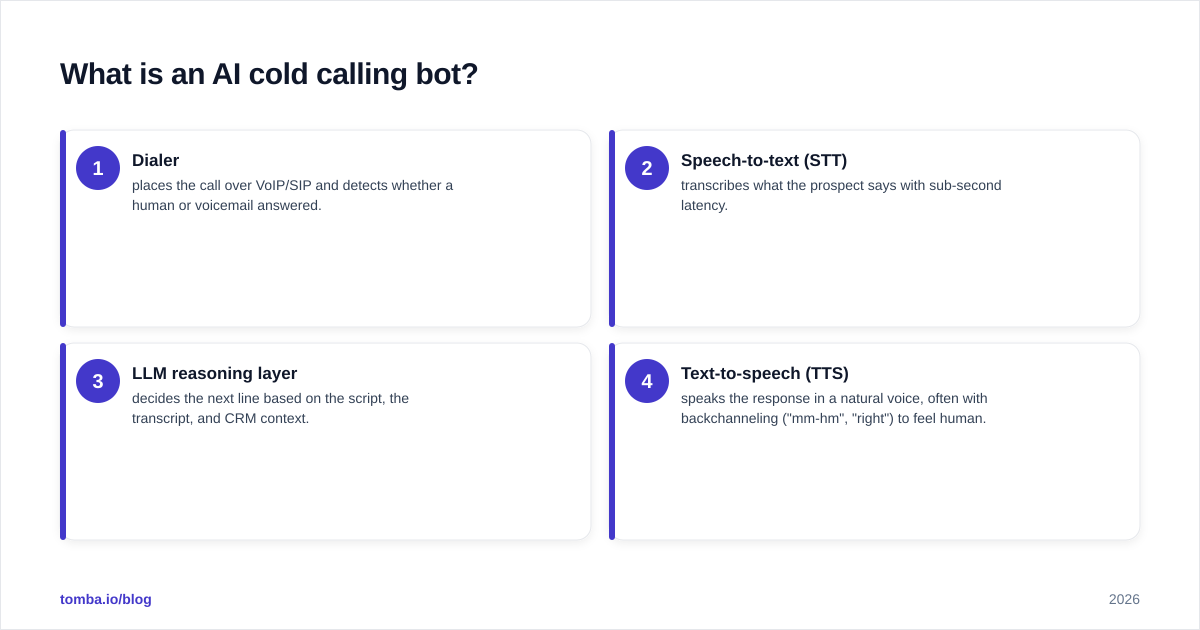
Technically, a modern bot chains four components in real time:
- Dialer — places the call over VoIP/SIP and detects whether a human or voicemail answered.
- Speech-to-text (STT) — transcribes what the prospect says with sub-second latency.
- LLM reasoning layer — decides the next line based on the script, the transcript, and CRM context.
- Text-to-speech (TTS) — speaks the response in a natural voice, often with backchanneling ("mm-hm", "right") to feel human.
The whole loop has to run in roughly 500–800 milliseconds, or the prospect notices the lag and hangs up. That latency budget is why these tools only became usable at scale in the last two years.
How does an AI cold calling bot actually work on a live call?#
Here's the conclusion first: the bot is running a state machine wrapped around an LLM, and most of the engineering goes into handling interruptions, silence, and voicemail — not the talking.
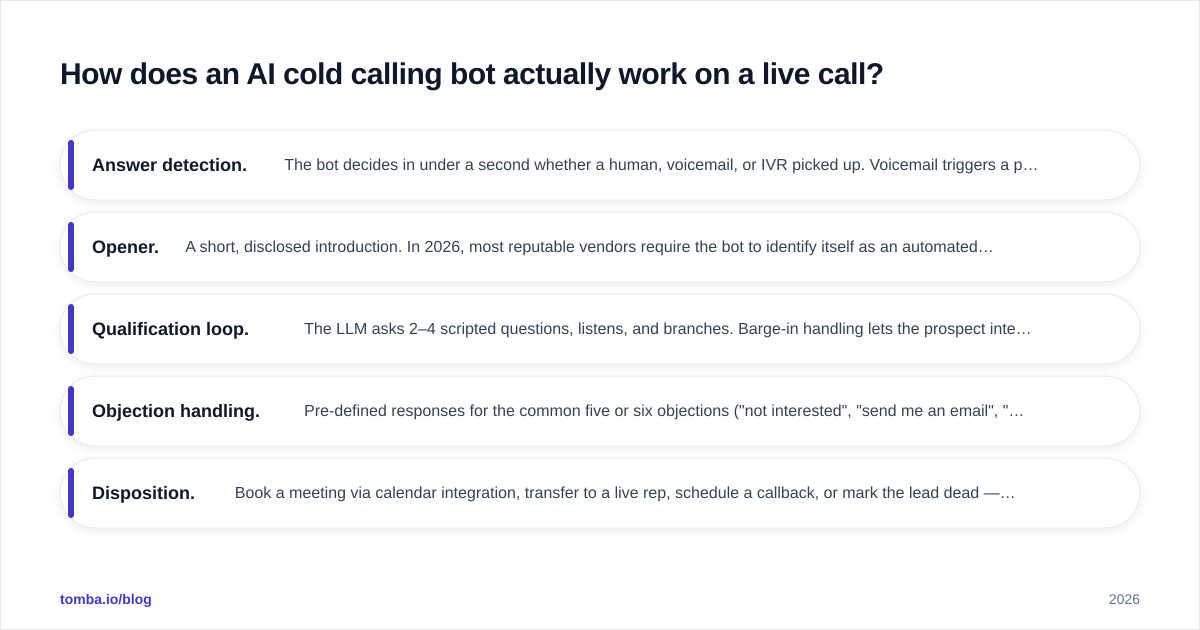
A typical call flow looks like this:
- Answer detection. The bot decides in under a second whether a human, voicemail, or IVR picked up. Voicemail triggers a pre-recorded or synthesized drop; IVR triggers navigation or a hang-up.
- Opener. A short, disclosed introduction. In 2026, most reputable vendors require the bot to identify itself as an automated assistant — both for compliance and because deception tanks trust the moment it's discovered.
- Qualification loop. The LLM asks 2–4 scripted questions, listens, and branches. Barge-in handling lets the prospect interrupt mid-sentence, which the bot must detect and yield to.
- Objection handling. Pre-defined responses for the common five or six objections ("not interested", "send me an email", "who is this"). Anything outside the playbook gets escalated or politely closed.
- Disposition. Book a meeting via calendar integration, transfer to a live rep, schedule a callback, or mark the lead dead — then write the outcome back to the CRM.
The bot never "thinks" like a salesperson. It pattern-matches against a script you designed. That's the most important mental model: an AI cold calling bot is only as good as the playbook and the data you feed it.
Are AI cold calling bots better than human SDRs?#
No — and that framing misleads teams into bad buys. The right question is "what should a bot do, and what should a human do?" They're complementary, not interchangeable.
Bots beat humans on:
- Raw volume. A bot dials hundreds of numbers an hour without fatigue, and the 401st call sounds identical to the first.
- Consistency. No off-script rambling, no skipped qualification questions, no bad-mood Mondays.
- Cost per dial. Once configured, marginal cost per call is cents, not dollars.
- Instant speed-to-lead. A bot can call an inbound lead within seconds, 24/7.
Humans beat bots on:
- Complex discovery. Multi-threaded enterprise deals where the value is in reading nuance and building rapport.
- Improvisation. Genuinely novel objections or emotional conversations.
- Trust. Many buyers still want a human voice for anything above a low deal size.
The pragmatic 2026 setup is a relay race: the bot runs top-of-funnel qualification and books meetings, then a human closes. Used this way, bots don't replace your SDRs — they hand your SDRs a calendar full of pre-qualified conversations instead of a list of cold numbers.
What are the best AI cold calling bot tools in 2026?#
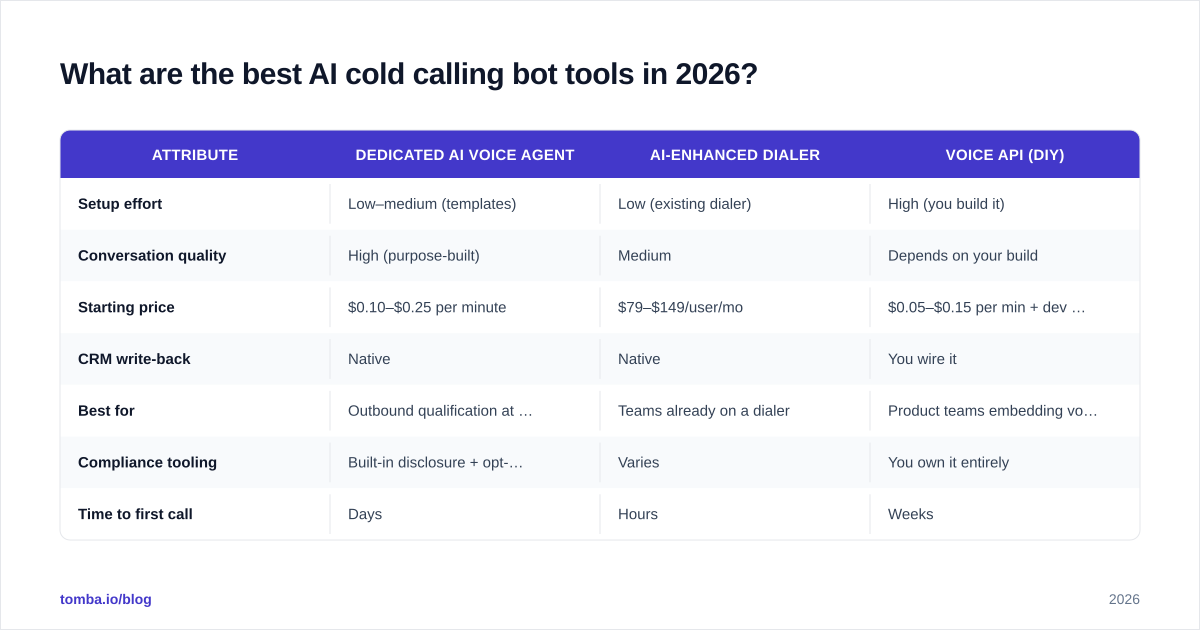
The market splits into three buckets: dedicated AI voice-agent platforms, dialers that bolted on AI, and developer-first voice APIs you assemble yourself. Here's a neutral comparison of representative categories.
| Attribute | Dedicated AI Voice Agent | AI-Enhanced Dialer | Voice API (DIY) |
|---|---|---|---|
| Setup effort | Low–medium (templates) | Low (existing dialer) | High (you build it) |
| Conversation quality | High (purpose-built) | Medium | Depends on your build |
| Starting price | $0.10–$0.25 per minute | $79–$149/user/mo | $0.05–$0.15 per min + dev cost |
| CRM write-back | Native | Native | You wire it |
| Best for | Outbound qualification at scale | Teams already on a dialer | Product teams embedding voice |
| Compliance tooling | Built-in disclosure + opt-out | Varies | You own it entirely |
| Time to first call | Days | Hours | Weeks |
A few honest caveats when you shortlist vendors on a site like G2 or Gartner Peer Insights: per-minute pricing looks cheap until you multiply by your dial volume and connect rate. A bot that talks to a voicemail for 20 seconds still bills you. Model total cost on connected, qualified conversations, not raw minutes.
Also weigh voice quality with your own ears, in your accent and your buyer's accent. Demo reels are cherry-picked. Run a pilot on 200 real numbers before signing anything annual.
How accurate and reliable are AI cold calling bots?#
Reliability is mostly a data problem, not a voice problem. The voice layer is good enough in 2026; the failure point is dialing the wrong person at the wrong number.
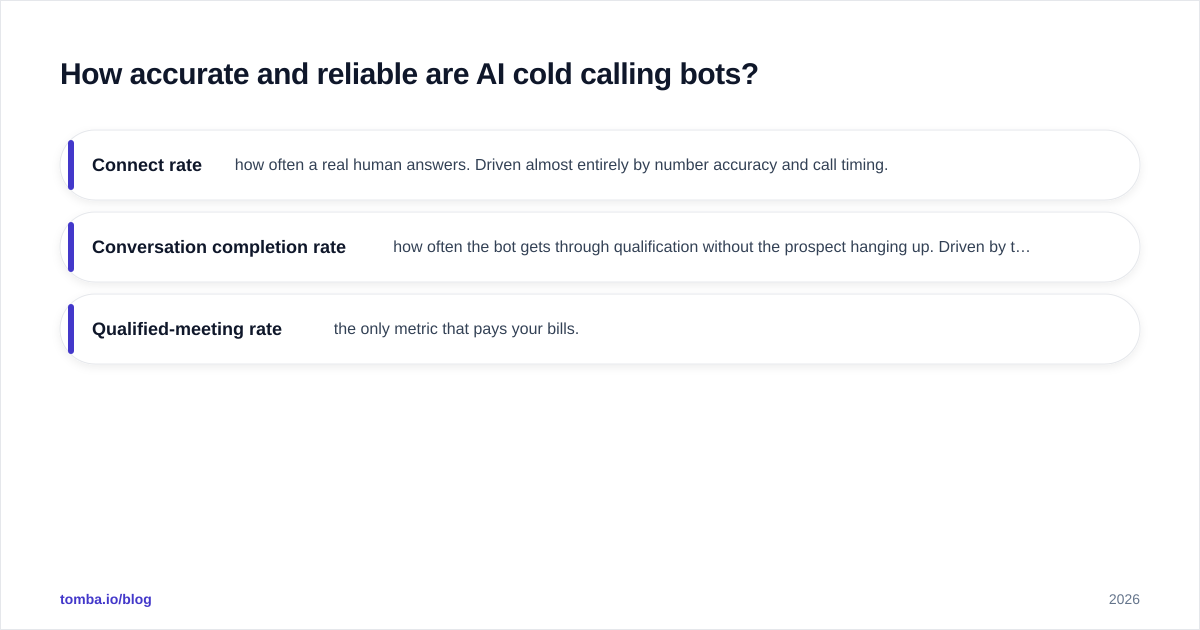
Three numbers determine whether a bot campaign works:
- Connect rate — how often a real human answers. Driven almost entirely by number accuracy and call timing.
- Conversation completion rate — how often the bot gets through qualification without the prospect hanging up. Driven by the opener and voice naturalness.
- Qualified-meeting rate — the only metric that pays your bills.
If your list is full of dead numbers, the smartest bot on earth posts a 4% connect rate and your cost-per-meeting explodes. This is why serious teams pair a bot with verified contact data and clean phone records. A phone validator step before the campaign filters out disconnected and invalid lines, and enriching your list with accurate B2B phone numbers raises the connect rate before the bot ever dials.

Garbage in, garbage out applies double here, because a bot scales the garbage. If you wouldn't trust a list with a human rep, don't unleash a bot on it — you'll just burn your numbers' reputation faster and trip more spam flags.
What about compliance, ethics, and TCPA risk?#
Conclusion first: compliance is the single biggest reason AI cold calling projects get shut down, and it's the part teams plan for last. Handle it before your first call.
Key obligations to research for your jurisdiction (this is not legal advice — talk to counsel):
- Consent and the TCPA. In the U.S., autodialed and pre-recorded/artificial-voice calls to certain numbers require prior express consent. AI-synthesized voices generally fall under artificial-voice rules. Read the FCC's guidance on robocalls and the TCPA before you scale.
- Disclosure. Several jurisdictions now require a bot to disclose that it's AI. Beyond the law, disclosure protects your brand — getting "caught" pretending to be human is a trust disaster.
- Do-not-call lists. Scrub against national and internal DNC registries on every run.
- Recording consent. Two-party-consent states require notifying the prospect that the call is recorded.
- Data handling. Call transcripts are personal data. Store and process them under GDPR/CCPA rules where applicable.
The ethical line most respected teams draw: use bots to qualify and route, always disclose, always honor opt-outs instantly, and never use voice cloning to impersonate a specific person. Short-term trickery costs long-term deliverability and reputation.
How do you set up an AI cold calling bot the right way?#
Here's a pragmatic rollout sequence that avoids the common ways these projects implode.
- Define one narrow use case. "Qualify inbound demo requests" or "re-engage stale MQLs." Don't boil the ocean on call one.
- Build the data foundation. Clean, verified, consented contact records with accurate direct-dial numbers. Enrich and validate before you import to the dialer.
- Write a tight script. 3–4 qualification questions, a disclosed opener, and pre-written responses to your top objections. Keep branches shallow.
- Pilot on 100–200 calls. Listen to every recording. Tune the opener and the barge-in behavior. This is where 80% of the quality gains happen.
- Wire CRM write-back and routing. Every disposition should land in your CRM, and qualified prospects should hit a human's calendar instantly.
- Set guardrails. Daily dial caps, time-of-day windows, instant opt-out handling, and an escalation path for anything off-script.
- Measure the right metric. Cost per qualified meeting, not minutes or dials.
For step 2, integration matters more than people expect. Pulling verified contacts and enriching them through tools like data enrichment and a reliable B2B database is what separates a bot that books meetings from one that dials disconnected numbers all afternoon.
When should you NOT use an AI cold calling bot?#
Skip the bot — or keep a human on the line — when:
- Your average deal size is high and buyers expect white-glove human contact from the first touch.
- Your sales motion depends on deep, improvised discovery rather than fixed qualification.
- You can't yet guarantee data accuracy or consent. Fix the data and compliance first.
- Your call volume is low enough that a single rep handles it comfortably. The setup overhead won't pay back.
Bots shine in high-volume, repeatable, qualification-heavy motions: inbound speed-to-lead, lead re-engagement, event follow-up, and simple appointment setting. Force them into complex enterprise selling and you'll get a polished tool doing the wrong job.
The bottom line#
An AI cold calling bot in 2026 is a genuinely useful top-of-funnel machine: it dials at superhuman volume, qualifies consistently, and hands humans warmer conversations. But it amplifies whatever you feed it. Point it at a clean, verified, consented list and it multiplies your pipeline. Point it at a stale, unverified list and it just fails faster and louder.
That's why the contact data is the real lever. Before you automate a single dial, make sure the names, companies, and numbers are accurate. Start by building a verified contact foundation with the Tomba Email Finder to source decision-maker contacts, layer in the phone finder for direct dials, and check the current Tomba pricing — the free tier gives you 25 searches a month to test the data quality before you commit a cent. Feed your bot great data, and it'll earn its keep. Feed it junk, and no amount of voice AI will save the campaign.
// get started
Find, verify and enrich your first contacts today
Start on the free plan with 25 searches a month, then scale when your team is ready.
Free plan · No credit card required · GDPR & CCPA
// about the author