AI Competitive Intelligence in 2026: A Practical Guide
AI competitive intelligence turns scattered signals into a real-time view of your market. Here is how to build a system that actually moves deals in 2026.
TL;DR
- AI competitive intelligence (CI) is the practice of using machine learning to collect, summarize, and route competitor and market signals in near real time — replacing the quarterly slide deck that was stale the day it shipped.
- The value is not "more data." It is faster, more reliable answers to three questions: who is winning deals against you, why, and what you should do this week.
- A working system has five layers: signal capture, enrichment, analysis, distribution (battlecards, alerts), and a feedback loop from won/lost deals.
- Tooling ranges from dedicated CI platforms (Crayon, Klue) to AI-native research stacks you assemble from data providers and LLMs. The right choice depends on whether you need a polished battlecard UI or raw, enrichable data.
- Garbage in, garbage out still rules. Accurate contact and firmographic data is the substrate — without it, your AI summaries are confident and wrong.
What is AI competitive intelligence?#
AI competitive intelligence is a research function with the slow parts automated. Think of an old-school analyst with a stack of newspapers, a highlighter, and a corkboard. The analyst clips relevant stories, connects them with string, and briefs the sales team once a quarter. AI competitive intelligence keeps the analyst's judgment but hands the clipping, sorting, and first-draft summarizing to models that never sleep.
Technically, it is a pipeline. Public and private signals — pricing-page changes, job postings, funding rounds, G2 reviews, product release notes, won/lost notes from your CRM — get ingested, deduplicated, classified, and summarized by large language models. The output lands where revenue teams already work: a Slack alert, an updated battlecard, a deal-room note.
The shift from traditional CI is one of latency and coverage. A human team can watch maybe ten competitors shallowly. An AI-assisted system can watch a hundred competitors across dozens of signal types, surface the 2% that matter, and let humans spend their time on interpretation instead of collection.
Why does AI competitive intelligence matter in 2026?#
Because buying cycles got noisier and shorter at the same time. Buyers self-educate through review sites and communities before they ever talk to you, and your competitors update positioning faster than any quarterly deck can track. According to Gartner research on B2B buying, the typical buyer spends only a small fraction of the journey with any single vendor's sales team — which means the moments you do get are decided by how well you understand the alternatives the buyer is weighing.
Three forces make AI the practical answer now:
- Signal volume exploded. There are more public touchpoints per competitor than a human can monitor. Models triage at a scale humans can't.
- LLMs got cheap and good at summarization. Turning a 40-page 10-K or a wall of review text into three bullet points is exactly what these models do well.
- Revenue teams expect real-time. A battlecard that updates when a competitor changes its pricing page beats one refreshed every March.
/blog/generated/memes/2026-06-04/ai-competitive-intelligence-meme-1.png
The risk cuts the other way too. If your competitors run AI CI and you don't, they are reacting to your moves within hours while you find out next quarter.
What are the core components of an AI CI system?#
Five layers, in order. Skip one and the system leaks value.
1. Signal capture. The raw inputs. External: competitor websites, pricing pages, job boards, news, funding databases, review platforms, ad libraries, app-store changelogs. Internal: CRM win/loss notes, support tickets, sales-call transcripts. The internal signals are the ones competitors can't see — guard them and use them.
2. Enrichment. Raw signals are messy. A job posting for "VP of Enterprise Sales" means more when you know the company's headcount, funding stage, and the decision-maker's contact details. This is where data enrichment turns a thin signal into an actionable one — attaching firmographics, technographics, and verified contacts so a signal becomes a lead you can act on.
3. Analysis. LLMs classify (is this a pricing change or a marketing refresh?), summarize (what changed and why it matters), and score (does this affect open deals?). The best systems prompt the model with your own positioning so the summary is framed as "what this means for us," not a neutral press release.
4. Distribution. Intelligence nobody reads is a cost center. Push to where reps live: a battlecard in the CRM, a Slack alert keyed to a deal, a weekly digest for leadership. Match the cadence to the audience.
5. Feedback loop. Won/lost outcomes feed back in. If you keep losing to Competitor X on integrations, the system should weight integration signals higher and prompt product about the gap. Without this loop, CI is a one-way broadcast instead of a learning system.
How do you build an AI competitive intelligence workflow?#
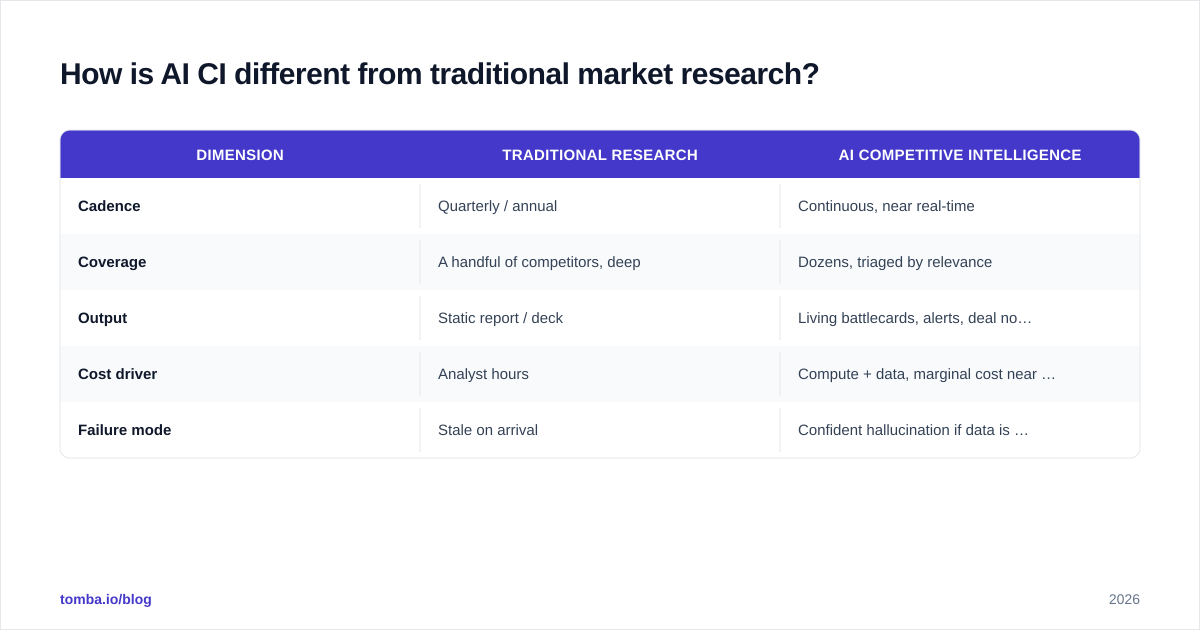
Start narrow and prove value before scaling. A practical sequence:
- Pick three competitors and three signal types. Resist watching everything. Pricing-page changes, new job postings, and G2 reviews are a strong starting trio because each maps to a clear action.
- Wire capture. Use scrapers or a CI platform for external signals; pull internal win/loss from your CRM via the Tomba API or your existing integration layer.
- Enrich every company-level signal. Attach the decision-maker, their verified email, and firmographics. A funding-round alert is interesting; a funding-round alert with the new VP of Ops' contact details is a meeting.
- Summarize with a house prompt. Give the model your positioning and ask for "so what for sales" output, not a recap.
- Route and measure. Send to Slack/CRM, then track whether reps open it and whether it shows up in won-deal notes. If not, fix the format before adding sources.
Treat the first 60 days as calibration. You are tuning what counts as signal versus noise for your market, and that judgment is the durable asset — the tools underneath will keep changing.
AI competitive intelligence tools compared#
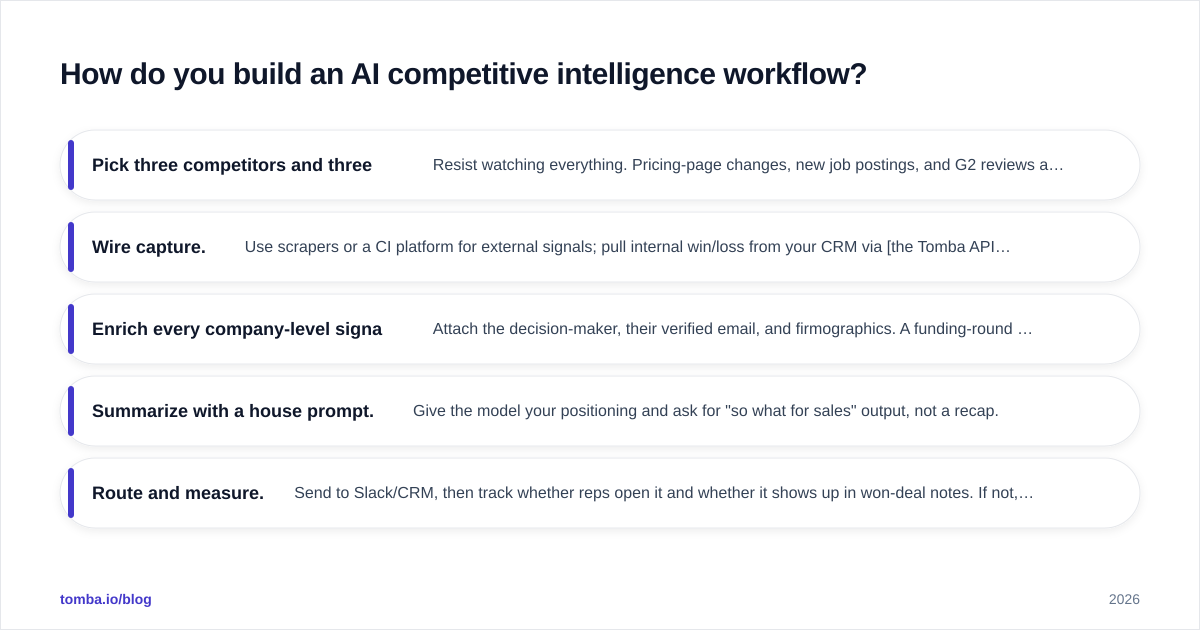
There is no single "best" tool; there is a best fit for whether you want a packaged battlecard product or a composable data-and-model stack you control. Here is how the main approaches line up.
| Approach | Best for | Strengths | Watch-outs | Typical entry cost |
|---|---|---|---|---|
| Dedicated CI platform (Crayon, Klue) | Enablement-led teams wanting polished battlecards | Turnkey UI, win/loss modules, Slack/CRM sync | Less flexible on custom signals; per-seat pricing scales fast | $$$ (custom/enterprise) |
| Review & sentiment monitoring (G2, Capterra alerts) | Tracking buyer perception | Direct voice-of-customer, comparison data | Narrow scope; one signal type | $–$$ |
| Data + enrichment layer (Tomba) | Teams building a custom pipeline | Verified contacts, firmographics, API-first, feeds any model | You assemble analysis/distribution yourself | $49/mo Starter |
| DIY LLM + scrapers | Technical RevOps teams | Maximum control, lowest marginal cost | Maintenance burden, no support, brittle scrapers | Engineering time |
| ABM/intent platforms (6sense, Demandbase) | Demand-gen-led orgs | Intent signals at account level | Heavy, expensive, overkill for pure CI | $$$$ |
Most teams end up with a hybrid: a CI platform for the battlecard layer, plus a dedicated enrichment source so every signal carries a real contact. If you are choosing an enrichment backbone, Tomba pricing starts at a Free tier (25 searches/mo), then Starter at $49/mo and Growth at $99/mo — modest next to enterprise CI seat costs.
/blog/generated/memes/2026-06-04/ai-competitive-intelligence-meme-2.png
How is AI CI different from traditional market research?#
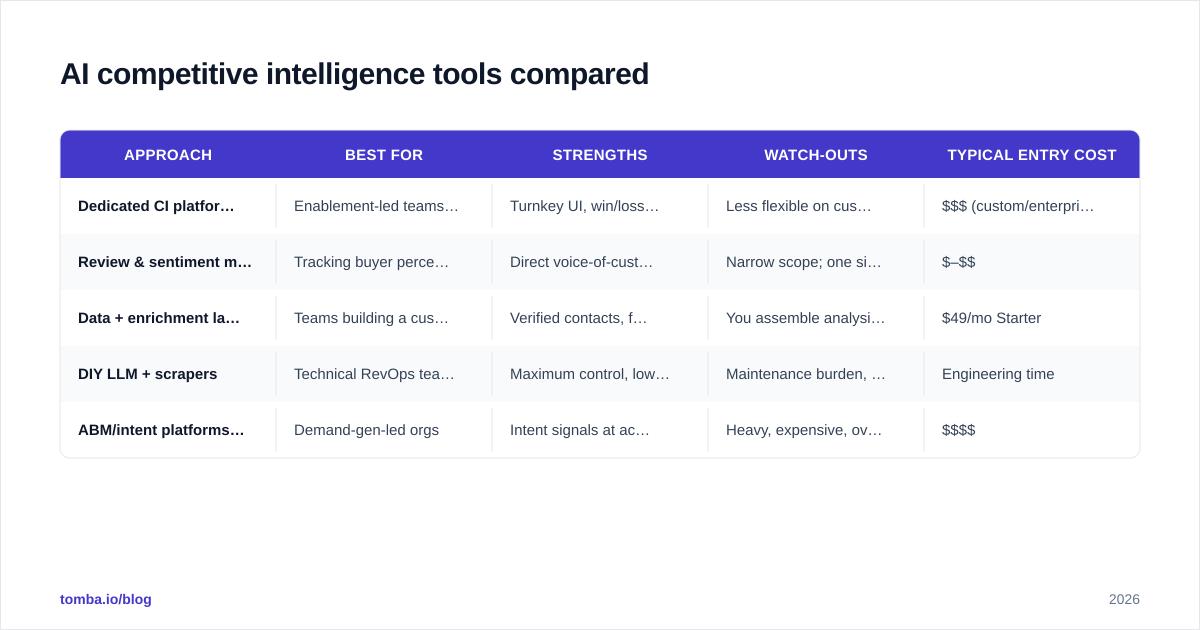
Traditional research answers "what was true last quarter." AI CI answers "what changed today and what should we do about it." The difference shows up in three dimensions.
| Dimension | Traditional research | AI competitive intelligence |
|---|---|---|
| Cadence | Quarterly / annual | Continuous, near real-time |
| Coverage | A handful of competitors, deep | Dozens, triaged by relevance |
| Output | Static report / deck | Living battlecards, alerts, deal notes |
| Cost driver | Analyst hours | Compute + data, marginal cost near zero |
| Failure mode | Stale on arrival | Confident hallucination if data is bad |
Notice the failure modes are different, not absent. Traditional research goes stale; AI CI can be wrong with conviction. That last row is the one that bites teams who skip verification. An LLM will happily summarize a competitor's "new SOC 2 certification" from a misread page. The guardrail is grounding every claim in a verifiable source and verifying the contacts and data you act on — which is why an email verifier and source-checking belong in the pipeline, not as an afterthought.
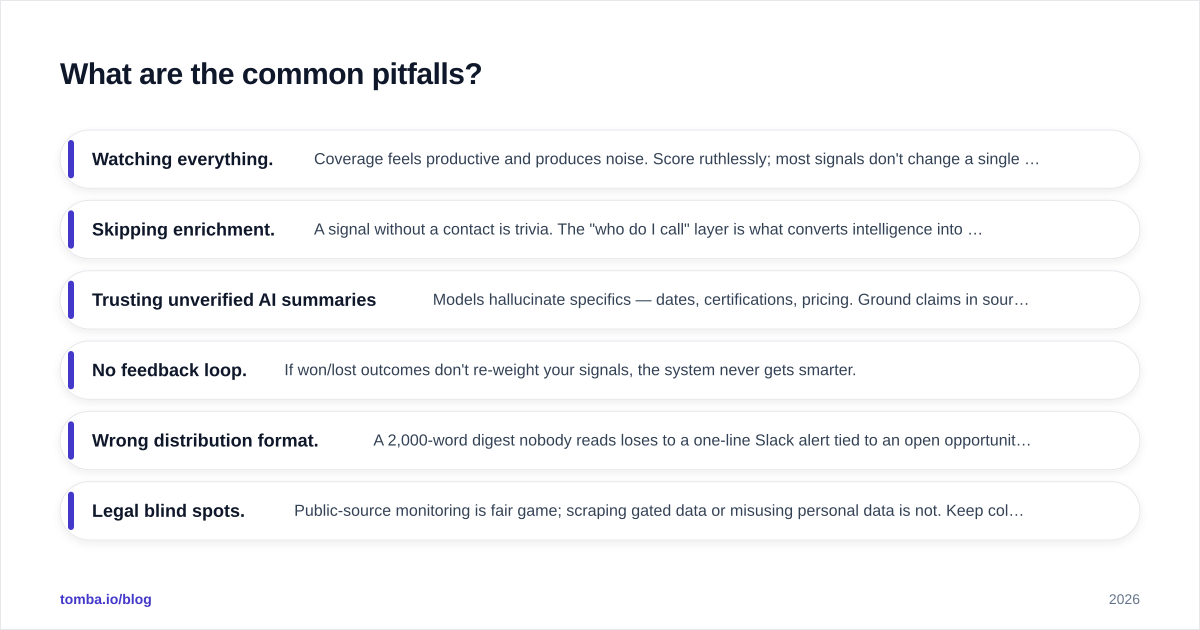
What are the common pitfalls?#
- Watching everything. Coverage feels productive and produces noise. Score ruthlessly; most signals don't change a single deal.
- Skipping enrichment. A signal without a contact is trivia. The "who do I call" layer is what converts intelligence into pipeline.
- Trusting unverified AI summaries. Models hallucinate specifics — dates, certifications, pricing. Ground claims in sources and verify the data you route to reps.
- No feedback loop. If won/lost outcomes don't re-weight your signals, the system never gets smarter.
- Wrong distribution format. A 2,000-word digest nobody reads loses to a one-line Slack alert tied to an open opportunity.
- Legal blind spots. Public-source monitoring is fair game; scraping gated data or misusing personal data is not. Keep collection to public and first-party sources and stay aligned with privacy regulations.
Avoid these and the system compounds. Each won deal teaches it, each enriched signal becomes a meeting, and the analyst's time goes to strategy instead of clipping.
How does data quality decide whether AI CI works?#
Conclusion first: your CI is only as good as the contact and firmographic data underneath it. A brilliant model summarizing thin data produces fluent, useless output.
Picture two alerts about the same funding round. The first says "Acme raised $20M Series B." The second says "Acme raised $20M Series B; their new VP of Revenue Operations is Dana Liu, dana@acme.com (verified), and they just posted three SDR roles in your territory." Same event, completely different value. The gap is enrichment and verification.
That is why the unglamorous layer — finding and verifying the right people behind a signal — quietly determines ROI. Tools like Tomba's domain search and email finder exist to populate that layer, attaching real, deliverable contacts to every company-level signal so your AI CI ends in a conversation instead of a chart.
Final take and where to start#
AI competitive intelligence in 2026 is less about a single magic tool and more about a disciplined pipeline: capture the right signals, enrich them with verified contacts, summarize with judgment, route to where reps work, and learn from outcomes. Start with three competitors and three signal types, prove the loop, then scale coverage.
When you reach the enrichment layer — the part that turns a competitor signal into a named, reachable buyer — the Tomba Email Finder is built for exactly that job: find professional email addresses by domain, name, or company, verify them, and pipe them into your CI workflow via API. Start on the free tier, wire it into your first three signals, and let every alert end with a contact you can actually call.
// get started
Find, verify and enrich your first contacts today
Start on the free plan with 25 searches a month, then scale when your team is ready.
Free plan · No credit card required · GDPR & CCPA
// about the author