AI Multi-Channel Prospecting in 2026: The Complete Playbook
AI multi-channel prospecting blends email, phone, and LinkedIn into one orchestrated sequence. Here is the 2026 framework, tool stack, and metrics that actually move reply rates.
TL;DR
- AI multi-channel prospecting orchestrates email, phone, LinkedIn, and SMS into one timed sequence, with AI handling research, personalization, and timing decisions.
- Single-channel outreach is dying: reply rates on email-only sequences keep falling, while coordinated multi-channel touches lift response rates 2-3x in most reported benchmarks.
- The real bottleneck is not the AI copy — it is clean, verified contact data feeding every channel. Garbage in, ghosted out.
- A working stack has four layers: data (find + verify), orchestration (sequencer), AI (research + drafting), and measurement (reply attribution).
- Start narrow: one ICP, three channels, verified data, and a tight feedback loop before you scale volume.
What is AI multi-channel prospecting?#
AI multi-channel prospecting is the practice of reaching a single prospect across several channels — email, phone, LinkedIn, sometimes SMS or direct mail — in a coordinated sequence where AI does the heavy lifting on research, message drafting, and send-timing decisions.
Think of it like a relay team instead of a single sprinter. One runner (email) can only cover so much ground before tiring out the prospect's patience. A relay hands the baton between channels so the message keeps moving forward without burning out any one lane. AI is the coach deciding who runs which leg and when.
Technically, three things separate this from old-school "spray and pray" sequencing:
- Per-prospect research — AI pulls signals (job changes, funding, tech stack, recent posts) and writes a relevant opener instead of a mail-merge token.
- Channel orchestration — the system decides the next best touch based on prior engagement, not a fixed calendar.
- Data-driven gating — touches only fire when contact data is verified, so you do not waste a phone call on a dead number or torch your domain on a bouncing email.
Why is single-channel outreach failing in 2026?#
Conclusion first: buyers ignore any one channel, but they are hard to avoid across three or four. Inbox saturation, spam filtering, and call-screening have each individually crushed single-channel conversion.
Email-only sequences that returned 5-8% reply rates a few years ago now commonly land in the 1-3% range as inboxes filter aggressively and buyers triage ruthlessly. Cold calling connect rates sit in the low single digits. LinkedIn acceptance and reply rates are decent but cap out fast because of weekly connection limits.
No single channel is healthy on its own. But when you stack them — a relevant email, a LinkedIn touch that references it, then a call that references both — you compound recognition. By the third channel the prospect has seen your name enough that the message reads as persistent and intentional rather than random. That recognition effect is the entire point of going multi-channel, and it is measurable in response rate lift.
How does an AI multi-channel sequence actually work?#
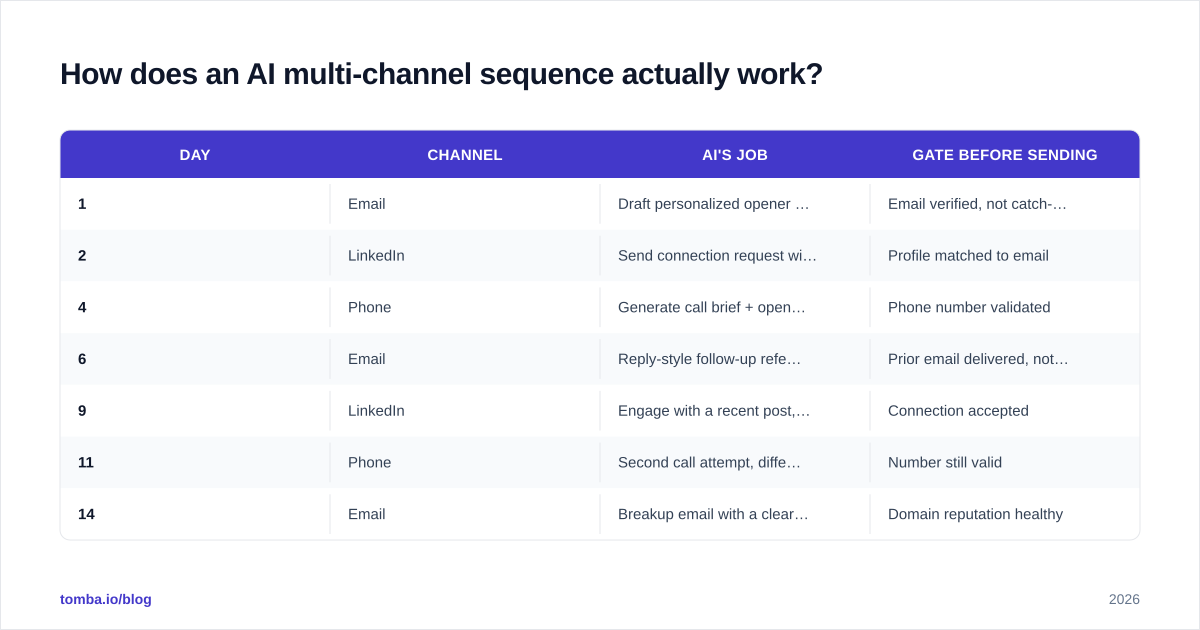
A good sequence is a script with branches, not a fixed drip. Here is a representative 14-day, three-channel cadence with AI at each decision point:
| Day | Channel | AI's job | Gate before sending |
|---|---|---|---|
| 1 | Draft personalized opener from research signal | Email verified, not catch-all risk | |
| 2 | Send connection request with context note | Profile matched to email | |
| 4 | Phone | Generate call brief + opener talk track | Phone number validated |
| 6 | Reply-style follow-up referencing value, not "bumping" | Prior email delivered, not bounced | |
| 9 | Engage with a recent post, then soft DM | Connection accepted | |
| 11 | Phone | Second call attempt, different time-of-day | Number still valid |
| 14 | Breakup email with a clear, low-friction ask | Domain reputation healthy |
The branching matters more than the steps. If the prospect opens the day-1 email twice but does not reply, AI can prioritize a call. If the LinkedIn request is accepted, the day-6 email can reference the connection. This is where AI orchestration beats a static cadence: it reads engagement and reorders the next best action.
Wait — that image is a meme, and here it is:
The trap teams fall into is automating the sending before automating the thinking. If the AI drafts a generic message and the sequencer fires it across four channels, you have just multiplied your spam by four. Personalization quality has to scale with channel count.
What does the AI multi-channel tech stack look like?#
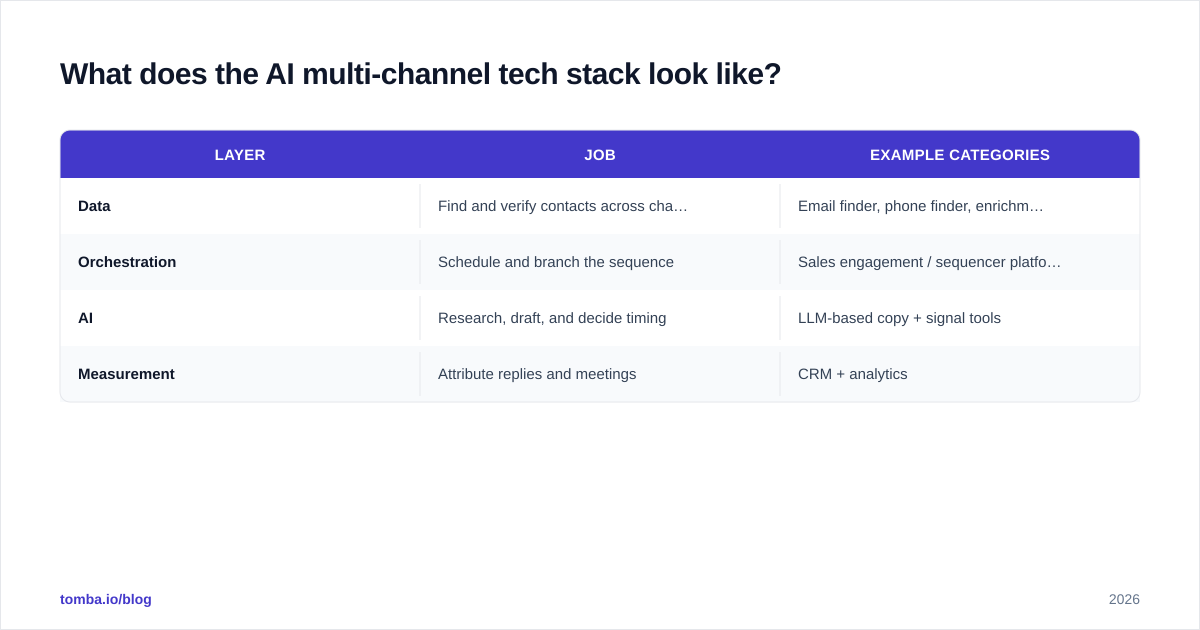
You need four layers. Most teams over-invest in the orchestration layer and under-invest in data, which is exactly backwards.
| Layer | Job | Example categories |
|---|---|---|
| Data | Find and verify contacts across channels | Email finder, phone finder, enrichment |
| Orchestration | Schedule and branch the sequence | Sales engagement / sequencer platforms |
| AI | Research, draft, and decide timing | LLM-based copy + signal tools |
| Measurement | Attribute replies and meetings | CRM + analytics |
Data layer. This is the foundation everything else stands on. Multi-channel means you need a verified email and a valid phone number and a matched LinkedIn profile for the same person. Use an email finder to source addresses by name and domain, an email verifier to keep bounce rates low, and a phone finder so your call steps are not dialing dead lines. For LinkedIn-driven outreach, a LinkedIn finder ties the profile to a deliverable email. Round it out with data enrichment so the AI has firmographic and role signals to personalize from.
Orchestration layer. Platforms like Outreach, Salesloft, or Apollo run the cadence and log activity to the CRM. Compare options on G2 before committing — feature overlap is heavy and pricing varies wildly by seat.
AI layer. This is where research signals become first lines. The best implementations feed enriched data into the model so the opener references something true about the prospect, not a hallucinated compliment.
Measurement layer. If you cannot attribute a booked meeting back to the channel mix that produced it, you are flying blind. Your CRM is the source of truth here, and most teams wire it up through native integrations like HubSpot.

Is AI multi-channel prospecting better than traditional cold calling?#
It is not better — it absorbs cold calling and makes it work harder. Calling alone connects rarely. But a call placed after the prospect has seen two relevant emails and a LinkedIn touch converts far better, because you are no longer a cold interruption; you are the third familiar contact.
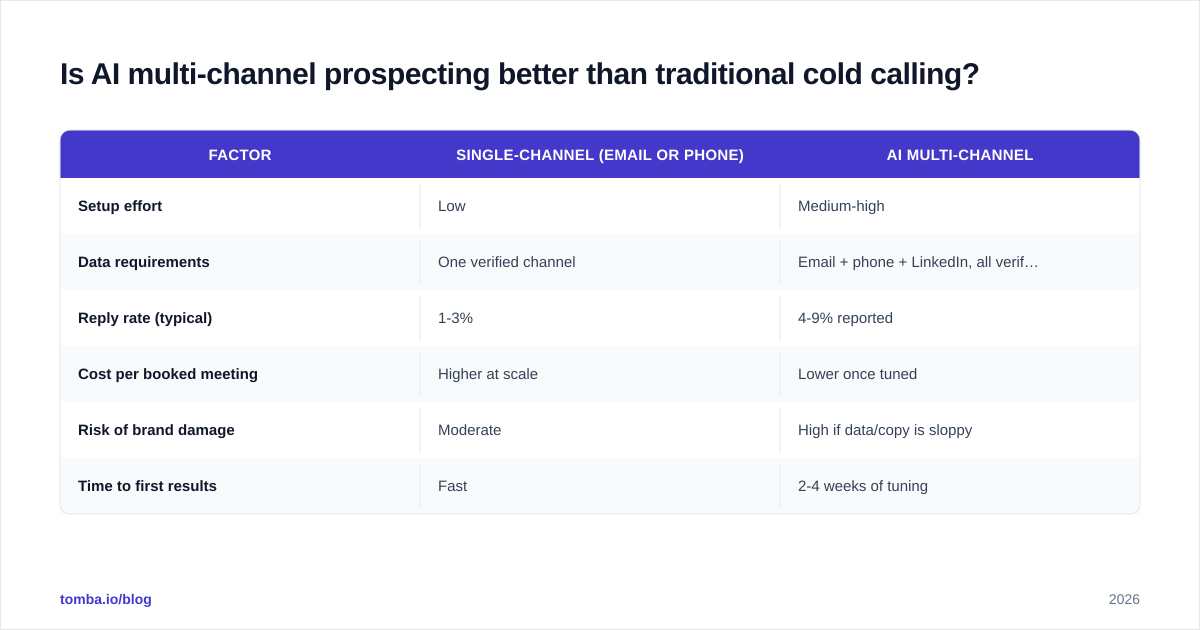
Here is the honest trade-off table:
| Factor | Single-channel (email or phone) | AI multi-channel |
|---|---|---|
| Setup effort | Low | Medium-high |
| Data requirements | One verified channel | Email + phone + LinkedIn, all verified |
| Reply rate (typical) | 1-3% | 4-9% reported |
| Cost per booked meeting | Higher at scale | Lower once tuned |
| Risk of brand damage | Moderate | High if data/copy is sloppy |
| Time to first results | Fast | 2-4 weeks of tuning |
The catch in the right-hand column is real. Multi-channel amplifies whatever you put into it. Good data and good copy compound; bad data and generic copy compound too, in the wrong direction. That is why the data layer is non-negotiable.
How do you measure AI multi-channel prospecting performance?#
Track the funnel by channel and by sequence, not just totals. The metrics that matter:
- Verified-data coverage — what percent of your list has a verified email, valid phone, and matched LinkedIn profile? Below ~70% and your multi-channel sequence is really a single-channel sequence with gaps.
- Per-channel reply rate — which lane actually drives responses for this ICP? Often it is not the one you expect.
- Channel-assisted meetings — meetings where the prospect engaged on 2+ channels before booking. This is the number that justifies the extra tooling.
- Bounce and spam-complaint rate — your early-warning system for domain health. Keep bounces under 2-3%.
- Cost per booked meeting — the only metric finance cares about. Multi-channel should lower it over time, not raise it.
A practical rule: if your channel-assisted meeting share is below 30%, your channels are running in parallel silos, not as a coordinated sequence. Fix the orchestration before adding more volume.
What are the biggest mistakes teams make?#
1. Scaling volume before fixing data. More sends across more channels with bad data is just faster failure. Verify first.
2. Letting AI personalize from thin context. "I saw you work at Acme" is not personalization. Feed the model real enrichment signals — funding, hiring, tech stack, recent activity — or the AI invents filler that reads worse than a blank template.
3. Treating channels as independent. The day-6 email should know the LinkedIn request was accepted. If your stack cannot pass engagement state between channels, you do not have multi-channel; you have three single-channel campaigns colliding.
4. Ignoring deliverability. Every extra email step is extra risk to your sending domain. Warm up, verify, and keep volume sane. The fastest way to kill a multi-channel program is to get your domain flagged in week two.
5. No human in the loop on replies. AI is great at the first three touches. The moment a prospect replies with a real question, hand it to a human. Buyers can tell when "I'd love to learn more" is a bot, and it costs you the deal.
How do you get started in 30 days?#
Start narrow and prove the loop before you scale. A realistic ramp:
- Week 1 — Data. Pick one ICP. Build a list of 200-300 accounts. Find and verify emails, phones, and LinkedIn profiles. Aim for 80%+ verified coverage before sending anything. Tomba's bulk email finder handles the list-level enrichment here.
- Week 2 — Sequence. Build one three-channel cadence. Write AI prompts that pull from your enrichment fields. Test the copy on yourself first — would you reply?
- Week 3 — Launch small. Run 50 prospects through the full sequence. Watch bounce rates and replies daily. Tune the worst-performing step.
- Week 4 — Read and adjust. Look at per-channel reply rate and channel-assisted meetings. Double down on the channel that works for this ICP, cut the dead step, then scale to the next batch.
Pricing for the data layer is the part teams forget to budget. Review the full Tomba pricing tiers — the Free plan gives you 25 searches a month to test the workflow, Starter is $49/mo, and Growth at $99/mo covers most small outbound teams running real volume. Gartner's research on sales tech consolidation is a useful sanity check before you stack five overlapping tools; see Gartner's sales technology coverage for the buyer's view.
The bottom line#
AI multi-channel prospecting wins because it compounds recognition across channels that each fail alone — but only when verified data feeds every touch and AI personalizes from real signals, not filler. The teams that win in 2026 are not the ones with the fanciest sequencer; they are the ones whose every channel fires against clean, verified contact data.
That is exactly where your stack should start. Before you wire up sequences and AI copy, make sure every prospect has a deliverable email behind them. Try the Tomba Email Finder to source and verify professional addresses by name, company, or domain — so your multi-channel program is built on contacts that actually receive your message. Clean data first, clever sequences second. Get that order right and the reply rate follows.
// get started
Find, verify and enrich your first contacts today
Start on the free plan with 25 searches a month, then scale when your team is ready.
Free plan · No credit card required · GDPR & CCPA
// about the author