AI Sales Bot in 2026: How They Work, Best Tools & ROI
An AI sales bot can qualify leads, book meetings, and answer buyers 24/7 — but only if you feed it clean data. Here's how they work in 2026 and which tools actually deliver.
An AI sales bot is software that talks to prospects and customers the way a junior rep would — qualifying, answering, scheduling, and following up — without a human typing every message. In 2026 the category has split into chat-first bots, outbound SDR bots, and full "AI sales agents," and the gap between marketing hype and real pipeline impact is wide. This guide cuts through it.
TL;DR#
- An AI sales bot automates conversational and repetitive selling tasks: lead qualification, meeting booking, instant replies, and first-touch outreach across chat, email, and SMS.
- The three real categories are chatbots (inbound), AI SDR/outbound bots, and AI sales agents that chain multiple steps together.
- ROI is real but conditional: bots win on speed-to-lead and 24/7 coverage, and lose badly when fed dirty contact data or pointed at the wrong accounts.
- The best stack is a bot for conversation plus a verified data layer underneath — bad emails and stale records sink even the smartest model.
- Start narrow (one use case, one channel), measure reply and meeting rates, then expand.
What is an AI sales bot?#
An AI sales bot is a program that uses large language models and workflow logic to handle parts of the sales conversation that used to require a person. Think of it like a really fast front-desk hire who never sleeps: it greets every inbound visitor, asks the qualifying questions, books the demo if the fit is good, and routes the messy cases to a human. Technically, it combines an LLM for natural language, a set of tools (calendar, CRM, email API), and guardrails that keep it on-script.
That's different from the rigid "click button 1 for sales" chatbots of five years ago. Modern bots understand intent, remember context across a thread, and can take actions — updating a CRM record, enriching a contact, or sending a tailored follow-up.
The architecture above is the part most buyers skip and later regret. A sales bot is only as good as the three layers beneath the chat window: the model (how well it reasons), the tools (what actions it can take), and the data (who it's talking to and what it knows about them). Most failed bot projects are data failures dressed up as model failures.
What can an AI sales bot actually do in 2026?#
Here's the honest split between what's production-ready and what's still demo-ware.
Reliable today:
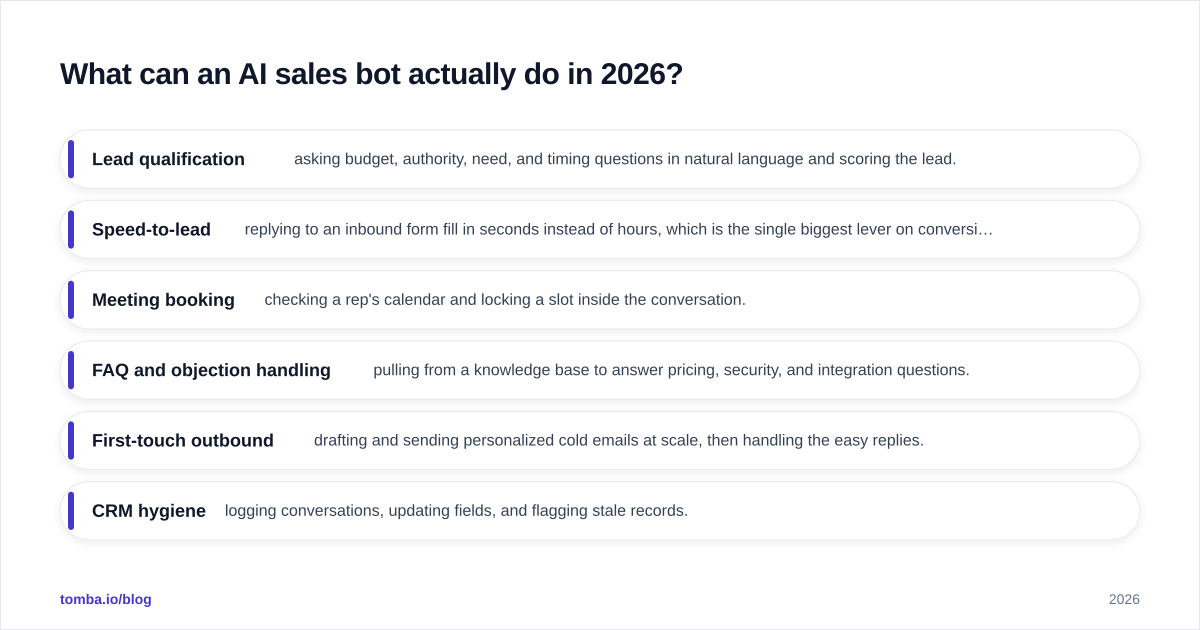
- Lead qualification — asking budget, authority, need, and timing questions in natural language and scoring the lead.
- Speed-to-lead — replying to an inbound form fill in seconds instead of hours, which is the single biggest lever on conversion.
- Meeting booking — checking a rep's calendar and locking a slot inside the conversation.
- FAQ and objection handling — pulling from a knowledge base to answer pricing, security, and integration questions.
- First-touch outbound — drafting and sending personalized cold emails at scale, then handling the easy replies.
- CRM hygiene — logging conversations, updating fields, and flagging stale records.
Still maturing:
- Multi-step negotiation and complex discovery on high-ACV deals.
- Fully autonomous account research without human review.
- Voice bots that handle nuanced live calls without awkward latency.
The pattern: bots excel at high-volume, low-ambiguity work. They struggle where judgment, relationship, and improvisation matter. Use that line to decide what to automate.
What are the types of AI sales bots?#
Not all "AI sales bots" do the same job. Buying the wrong type is the most common mistake.
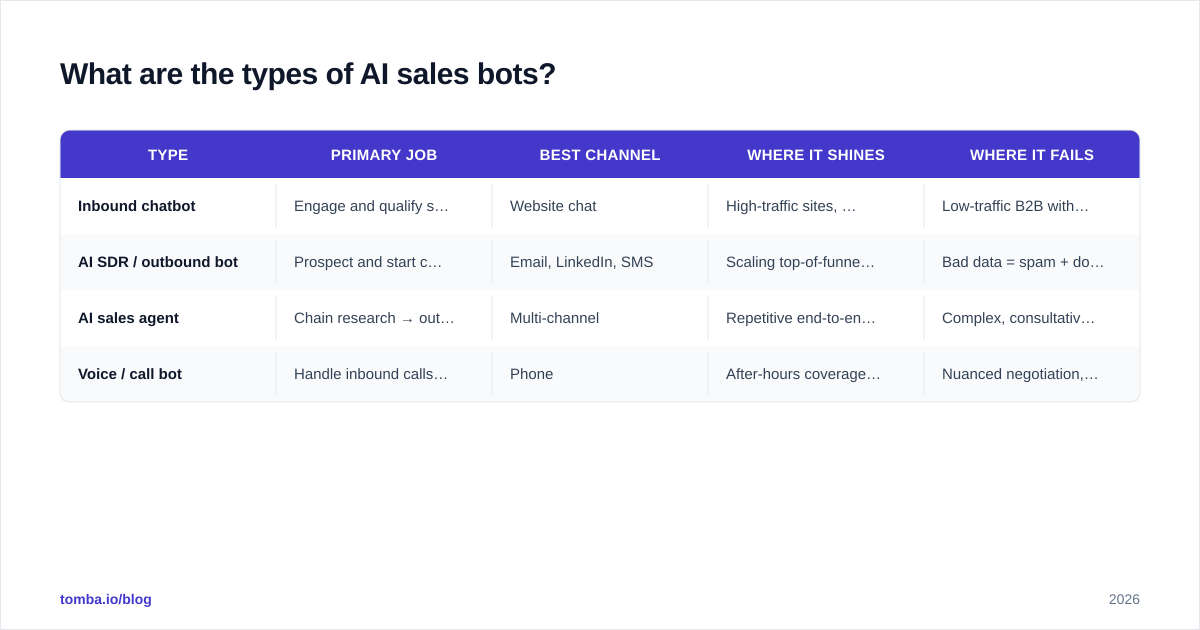
| Type | Primary job | Best channel | Where it shines | Where it fails |
|---|---|---|---|---|
| Inbound chatbot | Engage and qualify site visitors | Website chat | High-traffic sites, instant speed-to-lead | Low-traffic B2B with few visitors |
| AI SDR / outbound bot | Prospect and start cold conversations | Email, LinkedIn, SMS | Scaling top-of-funnel without headcount | Bad data = spam + domain damage |
| AI sales agent | Chain research → outreach → booking | Multi-channel | Repetitive end-to-end workflows | Complex, consultative enterprise deals |
| Voice / call bot | Handle inbound calls, screen leads | Phone | After-hours coverage, qualification | Nuanced negotiation, accents, latency |
If you have heavy inbound traffic, start with a chatbot. If you need more pipeline and can't hire reps, an AI SDR bot is the lever. If you're drowning in manual research-then-email busywork, an AI sales agent automates the chain — but only feed it accounts you've already vetted.
Is an AI sales bot worth it? The ROI math#
Yes, when two conditions hold: you have enough volume to matter, and the data underneath is clean. Here's how the value actually shows up.
Speed-to-lead is the headline. Research consistently shows that responding to an inbound lead within five minutes dramatically increases the odds of qualifying it versus waiting even 30 minutes. A bot replies in seconds, every time, including 2 a.m. on a Sunday. That alone can lift conversion on inbound forms.
Coverage and consistency are the quiet wins. A bot never forgets the follow-up, never has a bad day, and asks the qualifying questions the same way every time — which makes your funnel data trustworthy for the first time.
Cost per conversation drops sharply once you're past setup. One bot handles thousands of simultaneous chats; a human handles one.
But the costs are real too. Setup and integration take weeks, not minutes. A bot pointed at a bad list will torch your sender reputation and annoy real buyers. And a bot that hands off clumsily creates a worse experience than no bot at all. According to analyst coverage from firms like Gartner and peer reviews on G2, buyers who succeed treat the bot as one layer in a system — not a magic replacement for sales strategy.
The ROI killer nobody warns you about: data decay. B2B contact data goes stale at roughly 25–30% per year as people change jobs. A bot emailing dead addresses produces bounces, spam complaints, and zero pipeline — while looking busy the whole time. That's why the data layer matters as much as the model.
How do you build (or buy) an AI sales bot stack?#
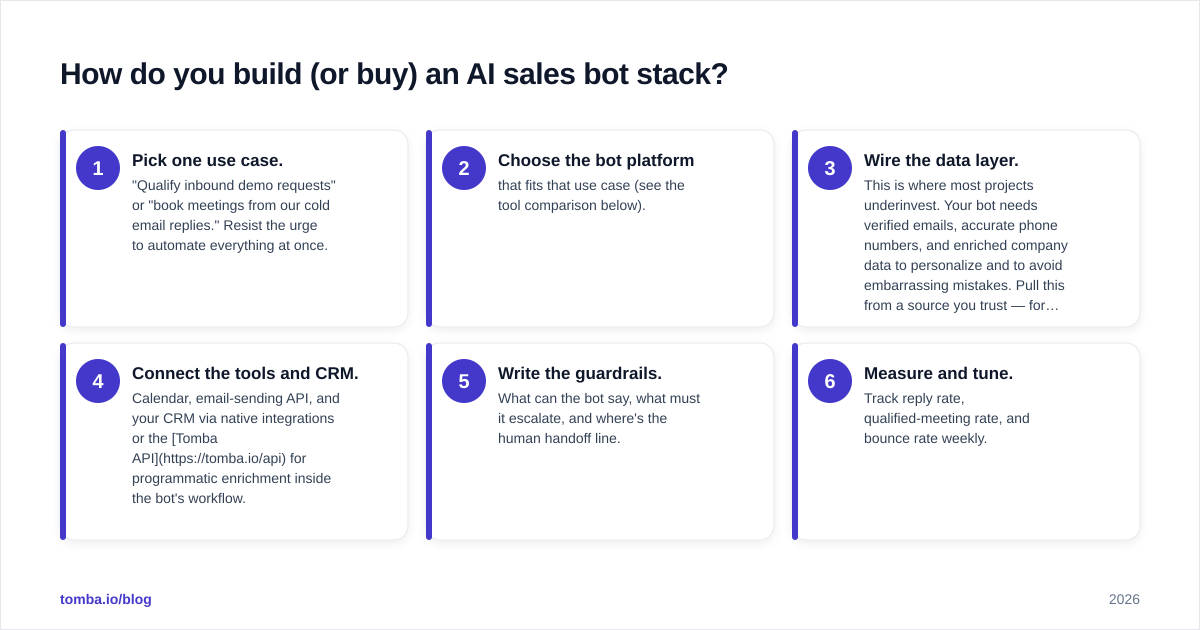
You don't need to train a model. You need to assemble four layers and get the order right.
- Pick one use case. "Qualify inbound demo requests" or "book meetings from our cold email replies." Resist the urge to automate everything at once.
- Choose the bot platform that fits that use case (see the tool comparison below).
- Wire the data layer. This is where most projects underinvest. Your bot needs verified emails, accurate phone numbers, and enriched company data to personalize and to avoid embarrassing mistakes. Pull this from a source you trust — for outbound, an email finder plus an email verifier keeps your bot off spam traps and protects deliverability.
- Connect the tools and CRM. Calendar, email-sending API, and your CRM via native integrations or the Tomba API for programmatic enrichment inside the bot's workflow.
- Write the guardrails. What can the bot say, what must it escalate, and where's the human handoff line.
- Measure and tune. Track reply rate, qualified-meeting rate, and bounce rate weekly.
A practical shortcut for the copy itself: tools like Tomba's cold email AI generate first-draft outreach you can feed into the bot's templates, so you're not starting from a blank prompt.
Which AI sales bot tools are best in 2026?#
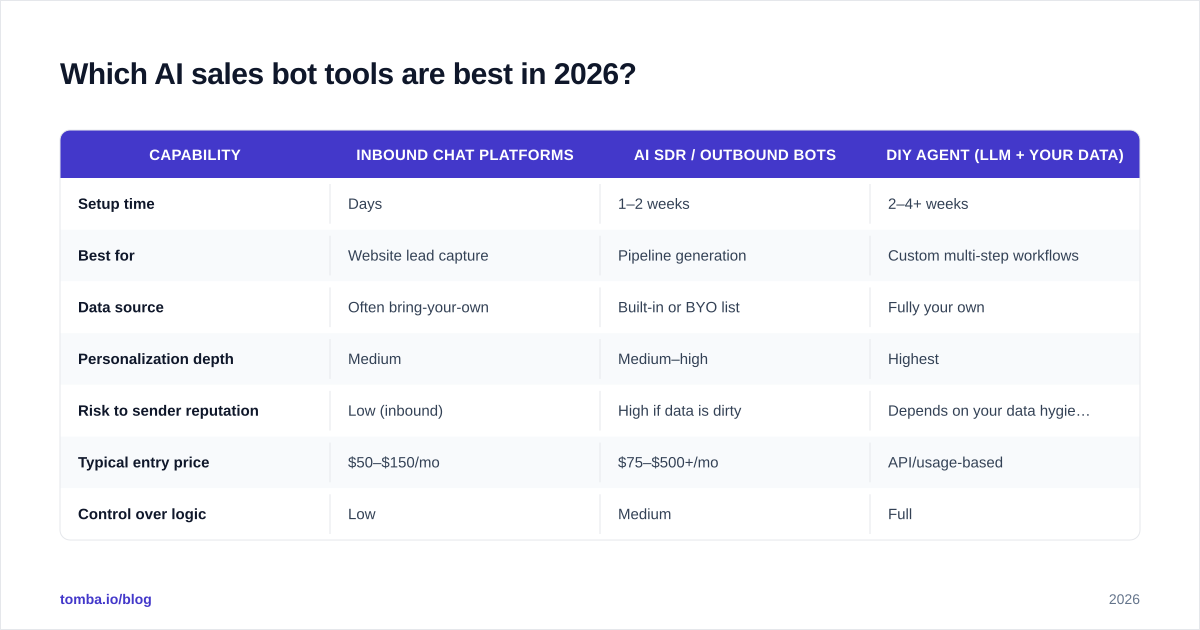
The market is crowded, so anchor on what your bot needs to do rather than the longest feature list. Here's how the major options compare on the dimensions that actually drive results.
| Capability | Inbound chat platforms | AI SDR / outbound bots | DIY agent (LLM + your data) |
|---|---|---|---|
| Setup time | Days | 1–2 weeks | 2–4+ weeks |
| Best for | Website lead capture | Pipeline generation | Custom multi-step workflows |
| Data source | Often bring-your-own | Built-in or BYO list | Fully your own |
| Personalization depth | Medium | Medium–high | Highest |
| Risk to sender reputation | Low (inbound) | High if data is dirty | Depends on your data hygiene |
| Typical entry price | $50–$150/mo | $75–$500+/mo | API/usage-based |
| Control over logic | Low | Medium | Full |
For most B2B teams, the winning move in 2026 is a focused bot platform for the conversation layer plus an independent, high-accuracy data layer you control. Bots bundle data, but bundled data is frequently stale or thin — which is exactly why teams pair them with a dedicated provider. If you want to see how vendors stack up on the data side specifically, compare verified-contact coverage and accuracy before you commit; it's the variable that most changes bot output.
Tomba sits in that data layer rather than competing as a chatbot. Its pricing is transparent — a Free tier (25 searches/mo), Starter at $49/mo, Growth at $99/mo, and Pro at $249/mo — and you can review the full Tomba pricing before scaling. For bots that need phone outreach too, the phone finder and data enrichment feed the same workflow.
How do you keep an AI sales bot from hurting your brand?#
A bot that emails dead inboxes or argues with a frustrated buyer does measurable damage. Three guardrails matter most.
Protect deliverability. Every address your outbound bot touches should be verified first. Bounces above a few percent get your domain throttled or blacklisted, and the bot has no idea it's happening. Verify before send, and re-verify lists older than a quarter. (See HubSpot's guidance on email deliverability for the sender-reputation fundamentals.)
Set a clear handoff line. Define the exact triggers — pricing negotiation, an angry tone, an enterprise logo — where the bot stops and a human takes over. Silent dead-ends are worse than no bot.
Stay honest about being a bot. Buyers increasingly expect disclosure, and pretending otherwise erodes trust fast. The best-performing bots in 2026 are upfront, helpful, and fast — not impersonations.
Keep humans in the loop on data. Even great enrichment needs spot-checks. Review a sample of the bot's outbound weekly to catch personalization that reads as creepy or wrong.
What does the future of AI sales bots look like?#
The trajectory is from single-task bots toward coordinated agents that own a whole motion — researching an account, drafting outreach, booking the meeting, and prepping the rep — with a human approving at key gates. Voice will keep improving but stay behind text for nuanced selling. And the differentiator will shift further from "which model" to "whose data and which workflow," because every vendor now has access to similar frontier models.
The teams that win won't be the ones with the flashiest bot. They'll be the ones whose bot is wired to clean, verified, continuously refreshed data and pointed at the right accounts. The model is the engine; the data is the fuel. Run a great engine on bad fuel and you go nowhere — loudly.
Get the data layer right first#
An AI sales bot is only as good as the contacts it works with. Before you spend a quarter tuning prompts, fix the fuel: feed your bot verified, accurate B2B emails so it reaches real buyers instead of burning your domain on bounces. Start free with the Tomba Email Finder — find professional email addresses by name, company, or domain, verify them in the same workflow, and hand your bot a list it can actually convert. Twenty-five searches a month cost nothing, and you can scale up only once the pipeline proves itself.
// get started
Find, verify and enrich your first contacts today
Start on the free plan with 25 searches a month, then scale when your team is ready.
Free plan · No credit card required · GDPR & CCPA
// about the author