AI Sales Follow-Up in 2026: Tools, Workflows & Templates
Most deals die in the follow-up gap, not the first touch. Here's how AI sales follow-up actually works in 2026 — the workflows, tools, and templates that lift reply rates without sounding like a bot.
Most reps don't lose deals on the first email. They lose them in the silence afterward — the third, fourth, and fifth touches that never get sent. AI sales follow-up exists to close that gap: to draft, time, and personalize the messages that humans keep forgetting to write.
This guide breaks down what AI sales follow-up actually does in 2026, where it helps, where it backfires, and how to build a workflow that books meetings instead of annoying prospects.
TL;DR#
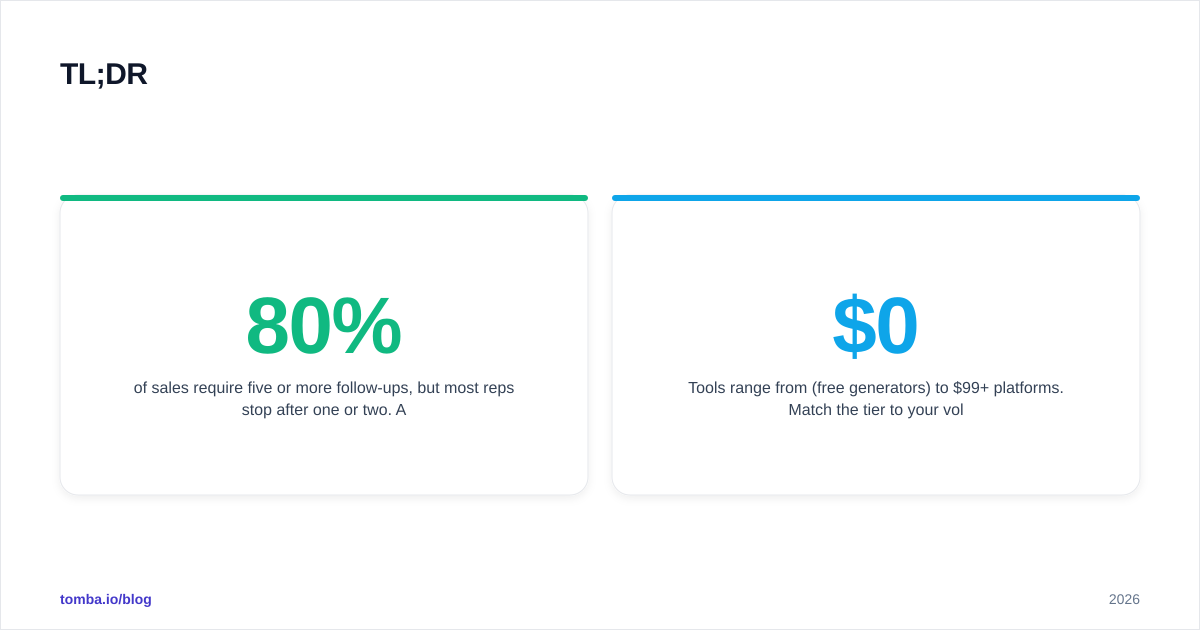
- 80% of sales require five or more follow-ups, but most reps stop after one or two. AI closes that execution gap.
- AI sales follow-up is strongest at three jobs: drafting context-aware replies, timing cadences, and triaging which threads need a human.
- It is weakest at judgment — knowing when to walk away, when a deal is political, and when silence means "no."
- The winning setup pairs clean contact data + an AI follow-up layer + human review on high-value threads.
- Tools range from $0 (free generators) to $99+/mo platforms. Match the tier to your volume, not the hype.
What is AI sales follow-up?#
AI sales follow-up is the use of large language models and automation to draft, schedule, and personalize the messages that come after the first outreach — without a rep writing each one from scratch.
Think of it like a diligent junior rep who never forgets a task. You hand it the context (the prospect's reply, the deal stage, what was said on the last call), and it produces the next touch: a nudge, a value-add resource, a meeting-confirmation, or a polite breakup email. The human stays in the loop on the messages that matter; the AI handles the volume that would otherwise slip.
The category covers a few distinct capabilities that often get lumped together:
- Reply drafting — generating a response based on an inbound email or thread history.
- Cadence management — deciding when the next touch fires and on which channel.
- Personalization at scale — inserting researched, specific details instead of
{{first_name}}tokens. - Thread triage — flagging which conversations are hot, stalled, or dead.
The reason this matters is brutal and well-documented: persistence wins deals, and humans are bad at persistence. Studies cited across the industry — including HubSpot's own sales statistics research — consistently show that a large share of sales require five or more follow-ups, while a large share of reps give up after one or two. AI doesn't make you smarter. It makes you consistent, which in follow-up is most of the battle.
Why do most follow-up sequences fail without AI?#
Because follow-up is repetitive, low-status work that competes with everything else on a rep's plate — and it loses.
Here's the everyday version: you send 40 cold emails Monday. Six reply by Wednesday. You handle those, then a demo runs long, a forecast call eats your afternoon, and by Friday the 34 non-responders are buried under a new batch. The fifth touch that would have converted three of them never gets written. Multiply that across a quarter and you've left a measurable chunk of pipeline on the floor.
The failure modes are predictable:
- Drop-off after touch two. The data is consistent across vendors: reply rates often climb between touches three and six, yet most sequences stop before then.
- Generic messaging. When reps do follow up under time pressure, they paste "just bumping this to the top of your inbox" — which prospects now filter out reflexively.
- Bad timing. Sending all follow-ups at 9 a.m. Monday (when everyone else does) tanks open rates.
- No triage. Treating a warm "circle back in Q3" the same as a cold non-open wastes the rep's best hours.
AI addresses all four — but only if the inputs are clean. Which brings us to the part most "AI follow-up" pitches skip.
What does AI sales follow-up actually need to work?#
Three things, in order: accurate contact data, thread context, and a feedback loop.
Accurate data comes first. An AI that drafts a perfect follow-up to a bounced or wrong address is worse than useless — it burns your sender reputation and inflates your "sent" metrics with garbage. Before any AI layer touches your sequences, the contact data underneath it has to be real. That means verified addresses and correct names, which is exactly the job of a good email finder plus an email verifier running ahead of the sequence. Garbage in, confident-sounding garbage out.
Thread context comes second. The difference between a follow-up that reads like a human and one that reads like a mail-merge is whether the model can see the actual conversation — the prospect's last reply, the objection they raised, the date they said to circle back. AI tools that only see your template, not the thread, produce the robotic "just following up" that everyone hates.
A feedback loop comes third. The systems that improve over time track which subject lines, timings, and angles actually get replies, and weight future drafts accordingly. Without measurement you're just automating guesses.
If your contact list is messy, fix that before you buy an AI tool. You can pressure-test a list fast with a free email checker or run the whole file through bulk verification.
How do AI follow-up tools compare in 2026?#
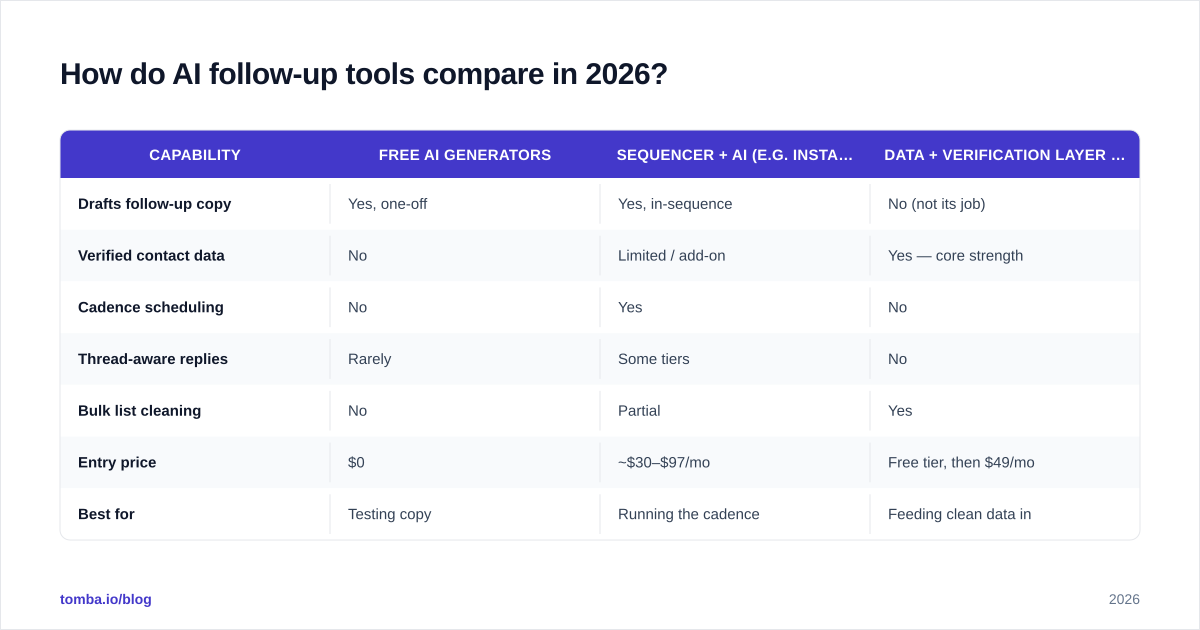
There's no single "best" — the right tier depends on your volume and how much human review you want. Here's an honest comparison of the common approaches, with Tomba's role shown where it's genuinely the fit (data layer, not the sequencer).
| Capability | Free AI generators | Sequencer + AI (e.g. Instantly, Saleshandy) | Data + verification layer (Tomba) |
|---|---|---|---|
| Drafts follow-up copy | Yes, one-off | Yes, in-sequence | No (not its job) |
| Verified contact data | No | Limited / add-on | Yes — core strength |
| Cadence scheduling | No | Yes | No |
| Thread-aware replies | Rarely | Some tiers | No |
| Bulk list cleaning | No | Partial | Yes |
| Entry price | $0 | ~$30–$97/mo | Free tier, then $49/mo |
| Best for | Testing copy | Running the cadence | Feeding clean data in |
The key insight: these layers stack, they don't compete. A sequencer runs the cadence and drafts copy; a data tool like Tomba makes sure those touches reach real, verified people. Teams that bolt an AI sequencer onto a dirty list get high send volume and low reply rates — they automated the wrong half of the problem.
For comparison shopping on the sequencer side, third-party review sites like G2's sales engagement category are more neutral than any vendor blog, including this one. Read the 3-star reviews, not the 5-star ones.
What does a good AI follow-up workflow look like?#
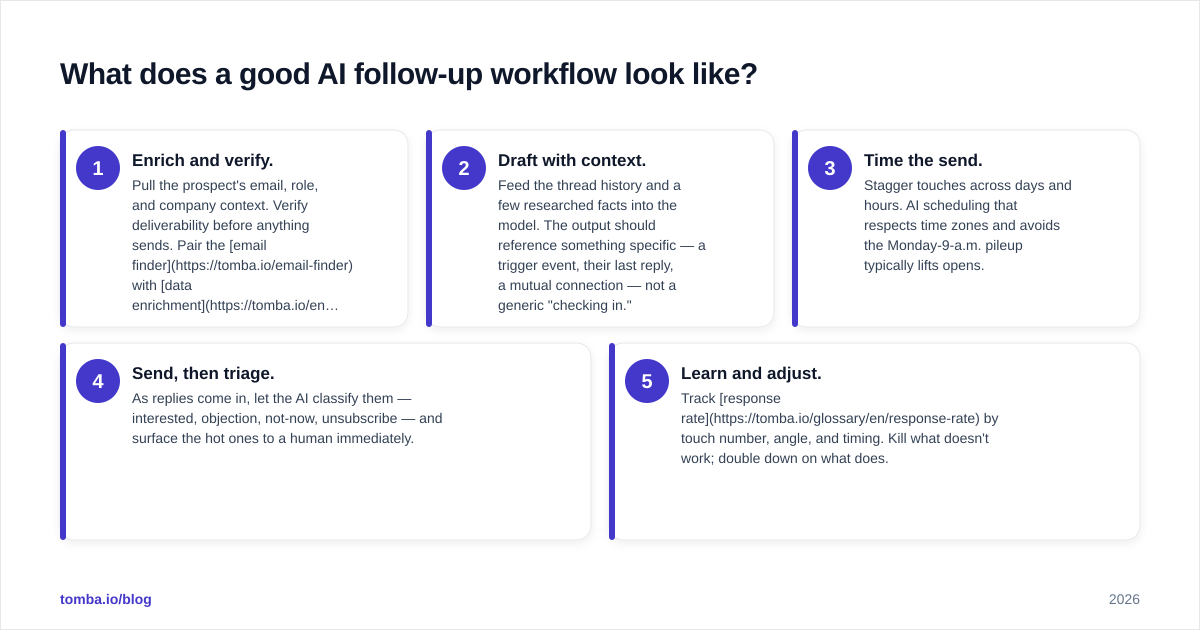
A repeatable five-stage loop. Here's the structure that consistently outperforms ad-hoc follow-up:
- Enrich and verify. Pull the prospect's email, role, and company context. Verify deliverability before anything sends. Pair the email finder with data enrichment so the AI has real attributes (title, seniority, tech stack) to personalize against.
- Draft with context. Feed the thread history and a few researched facts into the model. The output should reference something specific — a trigger event, their last reply, a mutual connection — not a generic "checking in."
- Time the send. Stagger touches across days and hours. AI scheduling that respects time zones and avoids the Monday-9-a.m. pileup typically lifts opens.
- Send, then triage. As replies come in, let the AI classify them — interested, objection, not-now, unsubscribe — and surface the hot ones to a human immediately.
- Learn and adjust. Track response rate by touch number, angle, and timing. Kill what doesn't work; double down on what does.
The non-negotiable: a human reviews every message to a high-value account. AI handles the long tail; you handle the deals worth six figures.

When should you NOT automate follow-up?#
When judgment matters more than consistency — and pretending otherwise is how AI follow-up earns its bad reputation.
Skip or heavily supervise automation in these cases:
- Enterprise / multi-stakeholder deals. Political nuance, internal champions, and procurement timing need a human read. An AI nudge sent to the wrong stakeholder at the wrong moment can stall a deal.
- After a clear "no." AI that keeps "circling back" past an explicit rejection isn't persistent, it's spam. Train your triage to actually stop.
- Sensitive or regulated contexts. Anything touching compliance, legal, or contractual language belongs with a person.
- When the relationship is the product. High-touch, relationship-led sales motions can be cheapened by obviously automated touches.
The rule of thumb: automate the cadence and drafting, never the decision to keep going. AI should free up your judgment, not replace it.
What do AI follow-up messages actually look like?#
Better than the "just bumping this" template, worse than your best rep on a good day. Here's a realistic three-touch sequence an AI layer might draft from thread context:
Touch 3 (value-add, day 5):
Hi Dana — saw [Company] just opened a second office in Austin. Scaling headcount usually breaks whatever email-sourcing process worked at 20 reps. Quick resource that might help your team [link]. Worth a 15-min look?
Touch 4 (social proof, day 9):
Dana, one more and I'll get out of your inbox. A team about your size cut sourcing time ~40% after cleaning their contact data first. Happy to share how — or I can send the breakdown and you skip the call.
Touch 5 (breakup, day 14):
Hi Dana — I'll assume the timing's off and close this out. If sourcing verified contacts becomes a priority later this year, just reply here and I'll pick it back up. No hard feelings either way.
Notice what makes these work: specific detail, a clear ask, escalating value, and a graceful exit. If you want to pressure-test your own copy, run drafts through a subject line tester and a spam checker before they go live, and keep a library of cold email templates the AI can adapt from.
How do you measure if AI follow-up is working?#
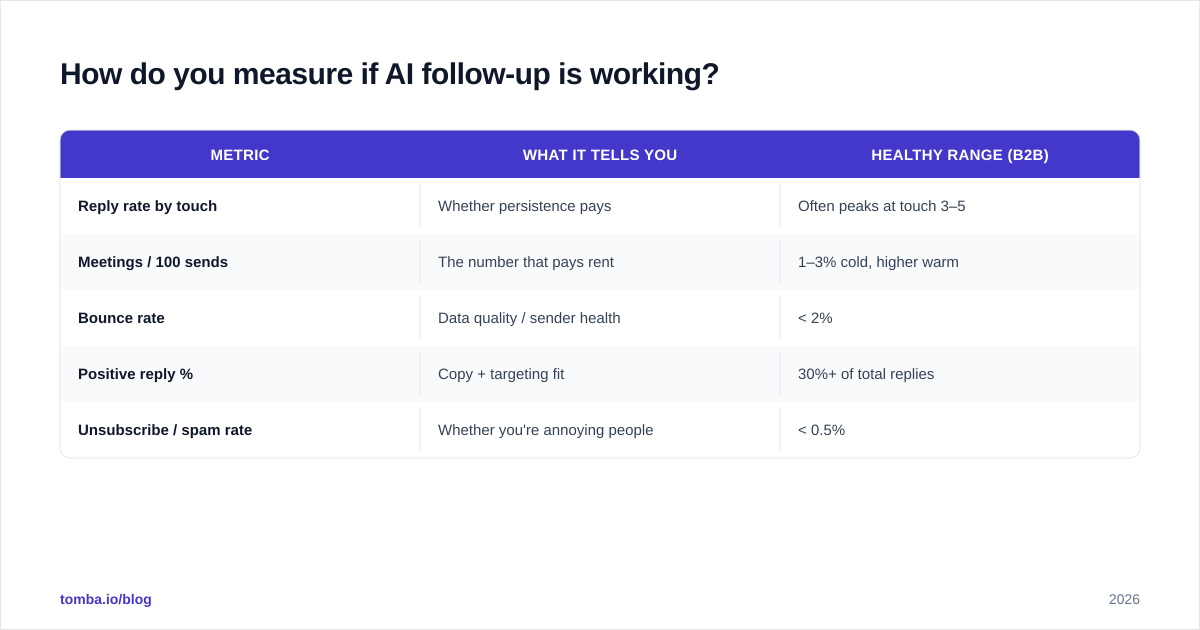
Track reply rate by touch number, meetings booked per 100 sends, and deliverability — in that order.
| Metric | What it tells you | Healthy range (B2B) |
|---|---|---|
| Reply rate by touch | Whether persistence pays | Often peaks at touch 3–5 |
| Meetings / 100 sends | The number that pays rent | 1–3% cold, higher warm |
| Bounce rate | Data quality / sender health | < 2% |
| Positive reply % | Copy + targeting fit | 30%+ of total replies |
| Unsubscribe / spam rate | Whether you're annoying people | < 0.5% |
If your bounce rate climbs, the problem is upstream data, not the AI — go back and verify the list. If replies are flat across all touches, your copy is generic. If positive replies are low but volume is fine, your targeting is off. The metrics tell you which layer to fix, which is the whole point of measuring.
Frequently asked questions#
Does AI follow-up hurt deliverability? Only if it sends to unverified addresses or blasts identical copy at high volume. Verified data and varied, context-aware messages keep sender reputation intact. Clean the list first.
Can prospects tell it's AI? They can tell when it's lazy AI — generic, no specifics, wrong context. Well-prompted, thread-aware drafts with real personalization read as a busy human, which is what you are.
Is free AI follow-up good enough? For testing copy and one-off drafts, yes. For running cadences at volume with verified data and triage, you'll outgrow free tools fast.
The bottom line#
AI sales follow-up wins where humans reliably fail: showing up for the third, fourth, and fifth touch, on time, with context. It loses where judgment matters. The teams that get it right treat AI as the consistency layer and keep humans on the decisions — and they feed the whole system clean, verified data so every automated touch lands on a real person.
That data layer is where most "AI follow-up" stacks quietly break. Start there. Use the Tomba Email Finder to source and verify the contacts before your sequence ever fires — free for your first 25 searches, then $49/mo on Starter when you scale. See full Tomba pricing to match a plan to your follow-up volume. Get the data right, and the AI does the part you keep forgetting to.
// get started
Find, verify and enrich your first contacts today
Start on the free plan with 25 searches a month, then scale when your team is ready.
Free plan · No credit card required · GDPR & CCPA
Get the Tomba newsletter
Product and data updates
// about the author