AI Voice Sales Agent in 2026: How It Works, Costs, and ROI
AI voice sales agents now handle live calls, qualify leads, and book meetings without a human dialing. Here's how they work, what they cost, and where they still fall short in 2026.
TL;DR
- An AI voice sales agent is software that makes or answers phone calls in a natural human-sounding voice, qualifies the prospect, and either books a meeting or routes the call to a rep — no human dialing required.
- The technology stack is now good enough for outbound qualification, inbound triage, and follow-up calls, but it still struggles with complex objection handling and high-stakes negotiation.
- Expect to pay roughly $0.07–$0.25 per connected minute on usage-based platforms, or $500–$5,000+/month on seat-and-volume plans.
- The biggest ROI lever is not the voice — it's the data feeding it. A bad number or stale contact kills the call before the AI says a word.
- Treat voice agents as the top of your funnel, not the whole funnel: pair them with clean contact data and a human closer.
What is an AI voice sales agent?#
An AI voice sales agent is a system that conducts real phone conversations on your behalf. Think of it as a tireless junior SDR who never gets call reluctance, never forgets the script, and dials the 300th number with the same energy as the first. Technically, it chains together three components: speech-to-text (to hear the prospect), a large language model (to decide what to say), and text-to-speech (to say it back) — all running fast enough to feel like a live conversation.
The difference between this and the robocallers you hate is latency and naturalness. Modern agents respond in 300–800 milliseconds, handle interruptions ("barge-in"), and use filler words and intonation that make them hard to distinguish from a person on a quick call. That is also why they raise legitimate disclosure and compliance questions, which we'll get to.
These agents are a subset of broader conversational AI, tuned specifically for revenue tasks: outbound prospecting, lead qualification, appointment setting, and inbound call routing.
How does an AI voice sales agent actually work?#
The loop is simpler than the marketing makes it sound. Five stages run in a tight cycle on every call:
- Trigger — a list upload, a form fill, or a CRM event tells the agent who to call and why.
- Connect — the dialer places the call and detects whether a human, voicemail, or IVR menu answered.
- Listen — speech-to-text transcribes the prospect in real time.
- Reason — the LLM matches what it heard against your script, knowledge base, and goal (book a demo, confirm interest, collect a detail).
- Respond and act — text-to-speech speaks the reply, and the agent can take actions mid-call: book a calendar slot, send an SMS, or warm-transfer to a rep.
The part teams underestimate is step 1. The agent's output is only as good as the list it dials. If your numbers are wrong or your contacts have left the company, you burn minutes on dead air. This is why serious deployments pair a voice platform with a clean data layer — a phone finder and phone validator to confirm the line is live, plus data enrichment so the agent opens with the prospect's correct name, role, and company.

What can an AI voice sales agent do well — and where does it fail?#
Be honest about the boundary. Voice agents are excellent at high-volume, low-complexity, scriptable conversations and poor at nuanced, emotional, or improvisational ones.
Strong use cases:
- Lead qualification — confirming budget, role, and intent on inbound leads before a human spends time.
- Appointment setting — calling a list and booking demos straight into a calendar.
- Speed-to-lead — dialing a web lead within 60 seconds, when conversion rates are highest.
- Reactivation — working aged leads or no-shows that your reps deprioritize.
- Inbound triage — answering, routing, and capturing details 24/7 so no call goes to voicemail.
Weak use cases:
- Multi-stakeholder negotiation and pricing pushback.
- Highly technical discovery where the answer isn't in a knowledge base.
- Emotionally charged saves (churn, complaints) where a human's empathy matters.
- Anything where mis-stating a fact creates legal or financial risk.
The practical pattern that works in 2026: let the AI own the first touch and qualification, then hand qualified, interested humans to your closers. The agent expands your reach; the rep wins the deal.
How much does an AI voice sales agent cost in 2026?#
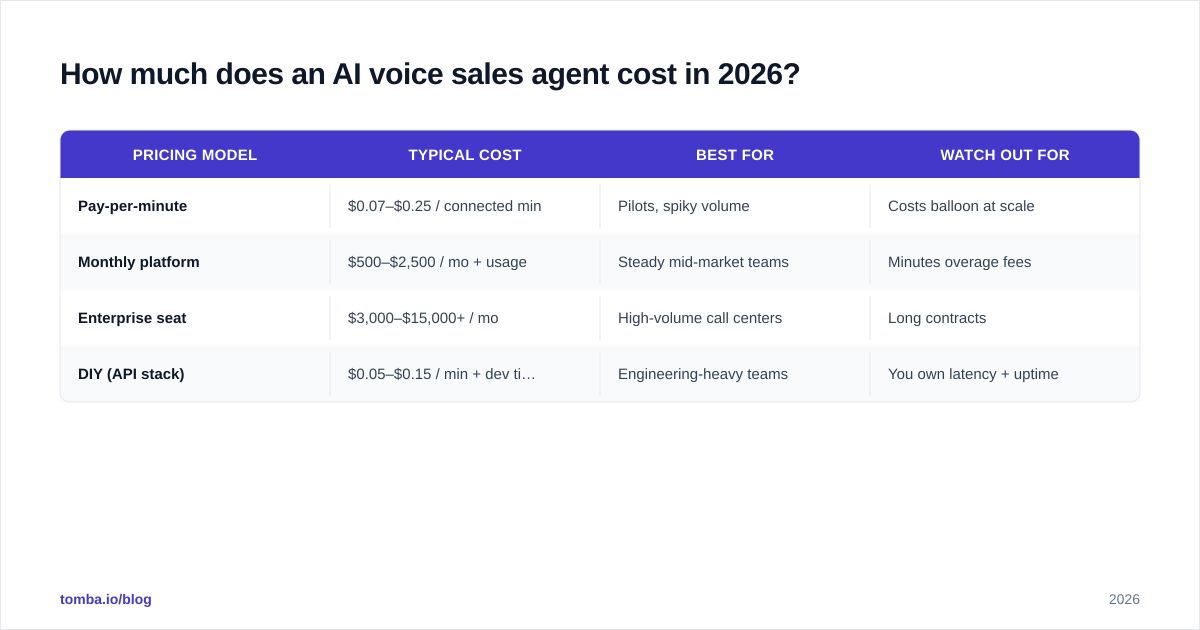
Pricing falls into two camps: usage-based (you pay per minute of connected conversation) and platform/seat plans (a monthly base plus volume). Usage-based is cheaper to start and scales with activity; seat plans get predictable at high volume.
| Pricing model | Typical cost | Best for | Watch out for |
|---|---|---|---|
| Pay-per-minute | $0.07–$0.25 / connected min | Pilots, spiky volume | Costs balloon at scale |
| Monthly platform | $500–$2,500 / mo + usage | Steady mid-market teams | Minutes overage fees |
| Enterprise seat | $3,000–$15,000+ / mo | High-volume call centers | Long contracts |
| DIY (API stack) | $0.05–$0.15 / min + dev time | Engineering-heavy teams | You own latency + uptime |
A useful back-of-envelope: at $0.12/connected minute and an average 2.5-minute qualified call, you're paying about $0.30 per real conversation — before list costs. The list is the hidden line item. Dialing a stale CSV at a 40% wrong-number rate means nearly half your minutes are wasted, which is why verifying numbers up front with a phone validator usually pays for itself.
For context on category pricing and reviews across vendors, G2's conversational and voice AI categories are a reasonable neutral starting point before you commit to a demo.
How do the main AI voice sales agent platforms compare?#
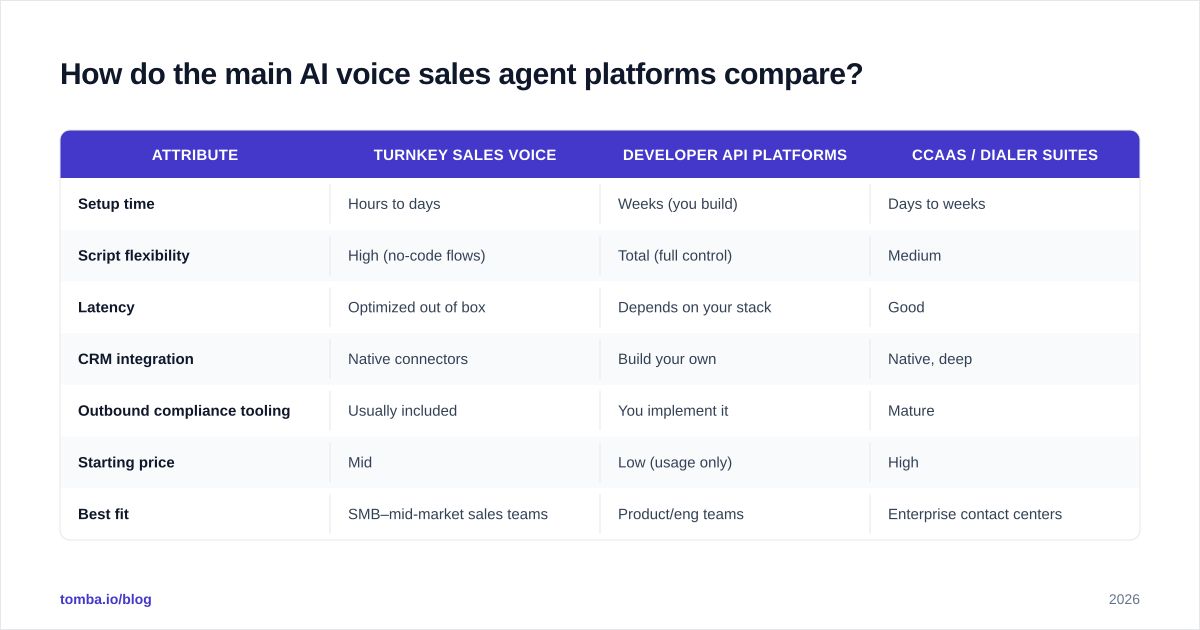
The market splits into three buckets: turnkey sales-voice products, developer platforms you assemble yourself, and CCaaS/dialer suites that bolted AI voice onto existing infrastructure. Here's how the categories stack up on the attributes that matter for a sales motion.
| Attribute | Turnkey sales voice | Developer API platforms | CCaaS / dialer suites |
|---|---|---|---|
| Setup time | Hours to days | Weeks (you build) | Days to weeks |
| Script flexibility | High (no-code flows) | Total (full control) | Medium |
| Latency | Optimized out of box | Depends on your stack | Good |
| CRM integration | Native connectors | Build your own | Native, deep |
| Outbound compliance tooling | Usually included | You implement it | Mature |
| Starting price | Mid | Low (usage only) | High |
| Best fit | SMB–mid-market sales teams | Product/eng teams | Enterprise contact centers |
Two rules when you evaluate. First, test on your call recordings and your objections, not the vendor's polished demo script. Second, measure connect rate and qualified-conversation rate, not raw dials — a platform that dials more dead numbers isn't winning. The quality of your underlying B2B database will move those metrics more than any vendor feature.
What does a good AI voice sales agent deployment look like?#
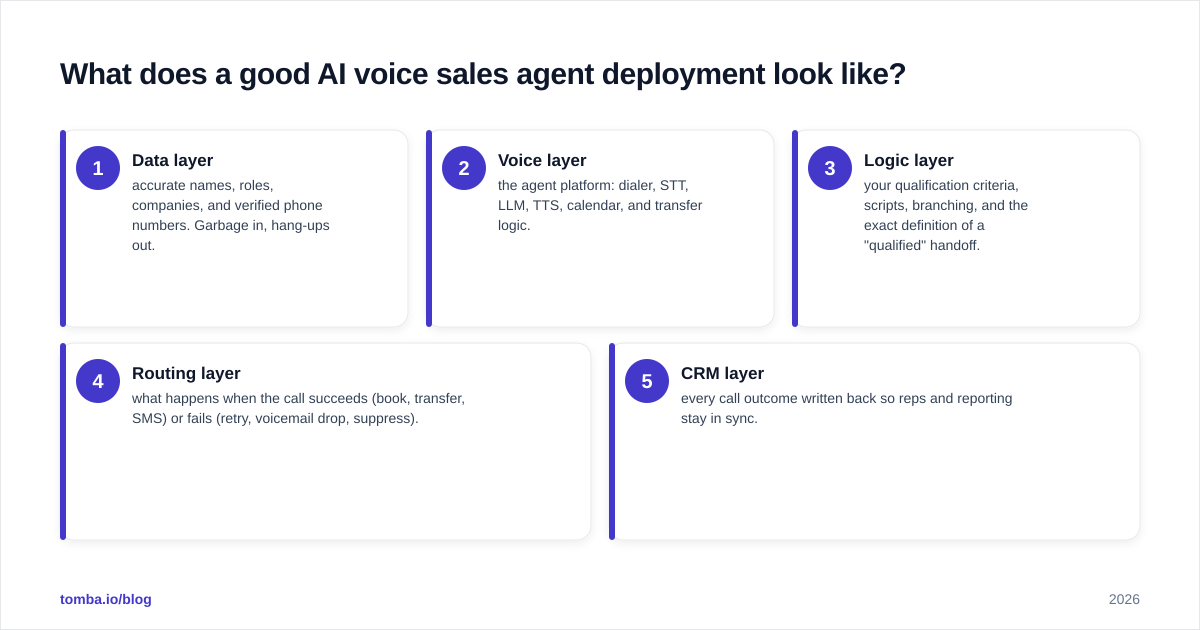
A working deployment is a pipeline, not a single tool. Five layers, each of which can sink the project if you skip it:
- Data layer — accurate names, roles, companies, and verified phone numbers. Garbage in, hang-ups out.
- Voice layer — the agent platform: dialer, STT, LLM, TTS, calendar, and transfer logic.
- Logic layer — your qualification criteria, scripts, branching, and the exact definition of a "qualified" handoff.
- Routing layer — what happens when the call succeeds (book, transfer, SMS) or fails (retry, voicemail drop, suppress).
- CRM layer — every call outcome written back so reps and reporting stay in sync.
Most failed pilots blame the voice layer when the real problem is layer 1. Before you scale dials, enrich and verify the list: use domain search and an email verifier to complete contact records so the agent can follow up by email after the call, and confirm the phone line is real before you spend a minute on it. A voice agent that opens with the right name and a relevant reason for calling converts dramatically better than one reading a blind script.
It's also worth wiring the agent into a real CRM and your broader sales automation so a booked meeting flows straight to the right rep with full context, not a lonely calendar invite.
Is an AI voice sales agent legal and compliant to use?#
Short answer: yes, when you follow the rules — and the rules are tightening. Several U.S. states and the FCC now require clear disclosure that the caller is an AI, and rules around AI-generated voices in outbound calls have hardened since 2024. The European approach under the EU AI Act also leans toward mandatory disclosure for systems that interact with people.
Practical guardrails:
- Disclose. Have the agent state it's an AI assistant early. It also performs better — prospects relax once they know.
- Respect consent and Do-Not-Call. Suppress DNC numbers and honor opt-outs in real time.
- Keep humans reachable. Always offer a path to a person.
- Log everything. Recordings and transcripts protect you in a dispute and improve the agent.
Vendors handle compliance unevenly, so make it a scored line item in your evaluation. For a vendor-neutral read on adoption trends and risk, analyst firms like Gartner track how sales orgs are governing AI agents — worth reviewing before you roll out at scale.
How do you measure ROI on an AI voice sales agent?#
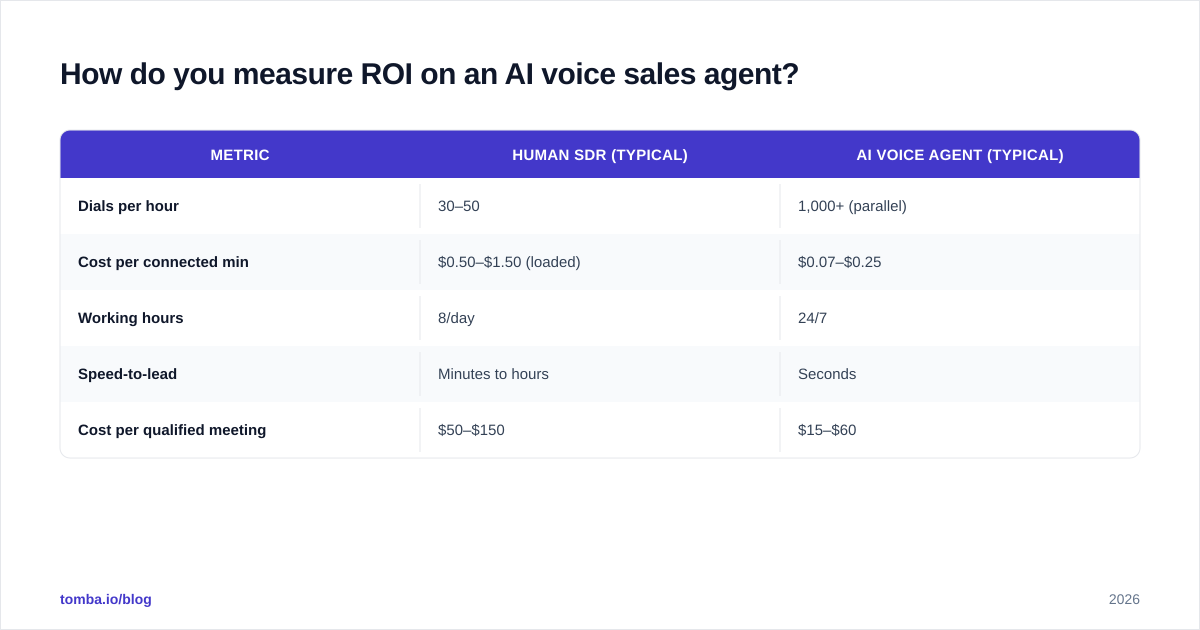
Tie the agent to one number your CFO already cares about: cost per qualified meeting booked. Then compare it to the same metric for your human SDRs.
| Metric | Human SDR (typical) | AI voice agent (typical) |
|---|---|---|
| Dials per hour | 30–50 | 1,000+ (parallel) |
| Cost per connected min | $0.50–$1.50 (loaded) | $0.07–$0.25 |
| Working hours | 8/day | 24/7 |
| Speed-to-lead | Minutes to hours | Seconds |
| Cost per qualified meeting | $50–$150 | $15–$60 |
These are ranges, not promises — your numbers depend entirely on list quality and offer-market fit. The cleanest way to prove value is a two-week A/B: same list, split in half, AI agent on one side and your existing process on the other. Measure connect rate, qualified-conversation rate, and meetings booked. If the AI side wins on cost per meeting and the meetings hold the same show-rate, scale it. If show-rate craters, your qualification logic is too loose — tighten the script, not the tooling.
One caveat that shows up in real deployments: a voice agent inflates activity metrics instantly, which can fool you into thinking it's working. Ignore dials and talk-time. Only downstream pipeline counts.
Should you build or buy an AI voice sales agent?#
Buy, unless you have a dedicated engineering team and a reason the market can't serve. The DIY API route looks cheap on a per-minute basis, but you inherit latency tuning, telephony reliability, compliance tooling, and on-call duty for a system that fails loudly in front of prospects. For most sales teams, a turnkey platform gets you live in days and lets you focus on the script and the list.
Build only when you need deep custom logic, you're embedding voice into your own product, or your volume is high enough that per-minute platform margins matter more than speed. Even then, start on a turnkey tool to validate the motion before you commit engineering quarters to it.
Whichever path you choose, the leverage point is the same: feed it good data. The fanciest voice model in the world dialing a stale list will lose to a basic agent dialing verified, enriched contacts. Get the phone finder and verification layer right first, and the voice layer becomes a much smaller decision.
The bottom line#
An AI voice sales agent in 2026 is a genuine force multiplier for the top of your funnel — qualification, appointment setting, speed-to-lead, and reactivation — provided you respect its limits and feed it clean data. It won't replace your closers, and it won't fix a bad list. It will let a small team behave like a much larger one, around the clock, at a fraction of the cost per conversation.
Start with the data, prove it on a two-week A/B against your current process, disclose that it's AI, and hand warm prospects to humans. Do that, and the voice agent earns its keep within the first month.
Ready to make every AI call count? Your voice agent is only as good as the contacts behind it. Use the Tomba Email Finder to build accurate, enriched contact records — verified names, roles, and companies — so your AI voice sales agent opens with the right person and the right reason every time. Start free with 25 searches a month, and see Tomba pricing when you're ready to scale your outbound data layer.
// get started
Find, verify and enrich your first contacts today
Start on the free plan with 25 searches a month, then scale when your team is ready.
Free plan · No credit card required · GDPR & CCPA
// about the author