AIDA Definition: The Marketing Model Explained (2026)
A plain-English AIDA definition: what Attention, Interest, Desire, and Action mean, how the model works in 2026, and copy templates you can steal today.
TL;DR
- The AIDA definition is simple: it's a four-stage model — Attention, Interest, Desire, Action — that maps how a buyer moves from "never heard of you" to "I bought."
- It was first sketched out by advertising pioneer Elias St. Elmo Lewis around 1898, and it still underpins landing pages, ads, and cold emails in 2026.
- Each stage has a job: grab the eye, earn the read, build the want, and remove friction from the click.
- AIDA isn't the only framework — PAS, FAB, and the 4Ps overlap with it — but it's the easiest one to apply to almost any piece of persuasive copy.
- Below you get a stage-by-stage breakdown, a comparison table, fill-in-the-blank templates, and the common ways people break the model.
What is the AIDA definition?#
The AIDA definition is a marketing and copywriting model that describes the four mental steps a prospect passes through before they buy: Attention, Interest, Desire, and Action.
Think of it like getting someone across a busy street. First you have to make them look up from their phone (Attention). Then you give them a reason to care about the other side (Interest). You make the other side genuinely appealing (Desire). Finally, you show them the crosswalk so they actually step off the curb (Action). Skip a step and they either don't move or they walk into traffic.
The model is sometimes called a "purchase funnel" or "hierarchy of effects," because each stage narrows the audience. Plenty of people see your ad; fewer get interested; fewer still want the thing; and only a subset acts. Your copy's job is to keep as many people as possible moving down to the next stage.
AIDA is credited to E. St. Elmo Lewis, an American advertising advocate who outlined the stages in the late 1890s. More than a century later it survives because it matches how attention actually works — you can't sell to someone who hasn't noticed you, and you can't close someone who doesn't want what you offer. You can read the full history on Wikipedia if you want the academic version.
What does each letter in AIDA stand for?#
Here's the stage-by-stage breakdown, with the question each stage has to answer in the reader's head.
A — Attention (or Awareness)#
Reader's question: "Should I even look at this?"
Attention is the gatekeeper. If your headline, subject line, or first frame doesn't interrupt the scroll, nothing else matters. This is where pattern interrupts, bold claims, specific numbers, and curiosity gaps live.
In a cold email, attention is the subject line and the first sentence. In an ad, it's the hook image and the first three words. Specificity beats cleverness: "Cut your AWS bill 31% in 60 days" earns more attention than "Optimize your cloud spend."
I — Interest#
Reader's question: "Is this relevant to me?"
Once you have a glance, you have to convert it into engaged reading. Interest is built by making the message about them — their problem, their industry, their goal. This is where you drop a relevant stat, a relatable pain point, or a short story that mirrors the reader's situation.
The fastest way to lose interest is to talk about yourself ("We were founded in 2014 and pride ourselves on..."). Nobody cares yet. Keep the spotlight on the reader.
D — Desire#
Reader's question: "Do I actually want this?"
Interest is intellectual; desire is emotional. Here you shift from "this is relevant" to "I want this outcome." You do that with benefits (not features), proof (case studies, testimonials, numbers), and a vision of life after the purchase.
The classic move is to translate features into outcomes: "256-bit encryption" becomes "your customer data stays yours, even if a laptop walks out the door."
A — Action#
Reader's question: "What do I do now?"
The final stage is the call to action. It must be singular, clear, and low-friction. "Book a 15-minute demo" beats "Reach out to learn more." Reduce risk with guarantees, free trials, or "no credit card required," and remove every extra click you can.
Many otherwise-great pieces of copy die here because the CTA is vague, buried, or asks for too much too soon.
Where did AIDA come from and is it still relevant in 2026?#
Short answer: it came from 1890s advertising theory, and yes, it's still relevant — with caveats.
AIDA predates the internet, social proof widgets, and retargeting. Critics rightly point out that real buying journeys aren't a clean one-way funnel; people loop back, research on their own, read reviews, and re-enter the funnel at different stages. Modern frameworks add stages like Retention and Advocacy (turning AIDA into AIDAR or AIDAS) to account for the post-purchase relationship.
But as a copywriting checklist, AIDA holds up because the underlying psychology hasn't changed: humans still need to notice, care, want, and then act. In 2026, the difference is mostly channel and speed. On a TikTok ad you compress all four stages into 15 seconds. In a six-email nurture sequence you might spread them across two weeks. The marketing teams at HubSpot and most B2B shops still teach AIDA as a foundational model precisely because it scales from a single subject line to a full campaign.
The honest take: use AIDA as a lens, not a law. It's a fast way to audit any asset — "Did I earn attention? Did I build desire? Is my CTA obvious?" — even if the real customer journey is messier than a straight line.
How does AIDA compare to other copywriting frameworks?#
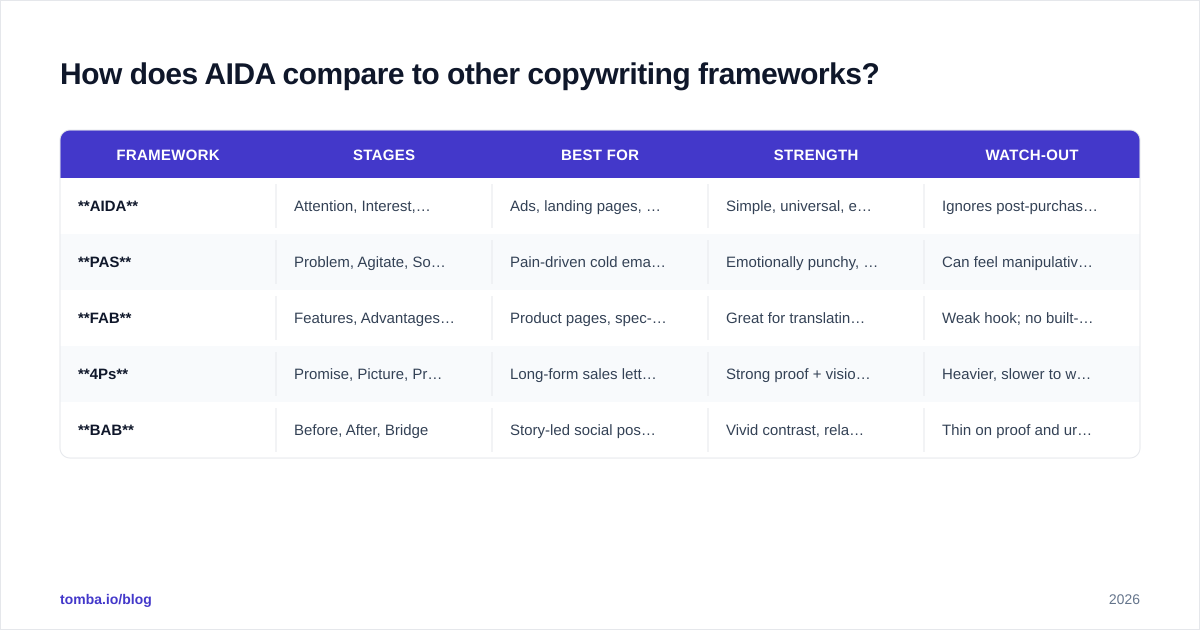
AIDA is one of several persuasion frameworks, and they overlap more than they compete. Here's how the most common ones stack up.
| Framework | Stages | Best for | Strength | Watch-out |
|---|---|---|---|---|
| AIDA | Attention, Interest, Desire, Action | Ads, landing pages, cold email | Simple, universal, easy to audit | Ignores post-purchase + objections |
| PAS | Problem, Agitate, Solution | Pain-driven cold email, sales pages | Emotionally punchy, fast | Can feel manipulative if overdone |
| FAB | Features, Advantages, Benefits | Product pages, spec-heavy sales | Great for translating specs to value | Weak hook; no built-in CTA |
| 4Ps | Promise, Picture, Proof, Push | Long-form sales letters | Strong proof + vision elements | Heavier, slower to write |
| BAB | Before, After, Bridge | Story-led social posts | Vivid contrast, relatable | Thin on proof and urgency |
Notice the family resemblance. PAS is basically AIDA with the Attention and Interest stages fused into "Problem" and "Agitate." FAB is a way to do the Desire stage well. You can even nest them: open with PAS to grab attention, use FAB to build desire, and close with AIDA's hard CTA.
If you want a deeper library of plug-and-play structures, our cold email templates collection maps several of these frameworks to real outreach scenarios.
How do you write copy using the AIDA model? (with templates)#
The fastest way to learn AIDA is to fill in the blanks. Here are two templates — one for a cold email, one for a landing page.
Cold email template (AIDA)#
Subject (Attention): [Specific result] for [their company]?
Opening (Interest): Hi [First name] — noticed [specific trigger: a hire, a launch, a tech-stack signal]. Most [their role]s I talk to are fighting [specific problem] right about now.
Body (Desire): We helped [comparable company] [achieve specific, quantified outcome] in [timeframe]. No rip-and-replace — it plugged into their existing [tool/stack].
Close (Action): Worth a quick 15-minute look next week? Tuesday or Thursday?
Landing page skeleton (AIDA)#
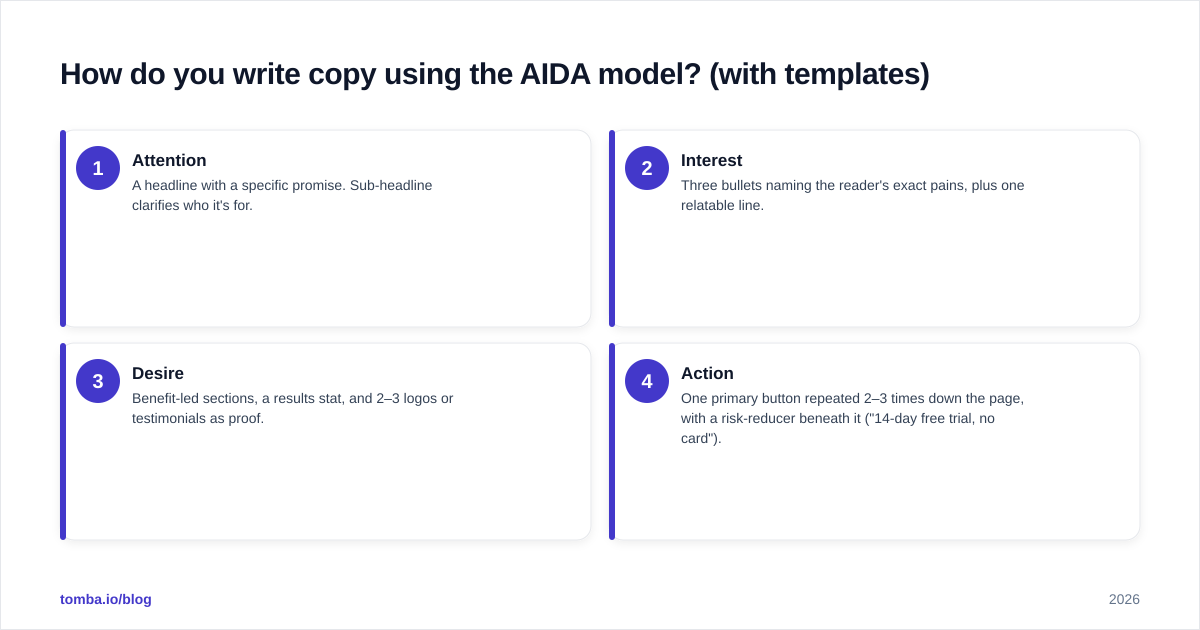
- Attention — A headline with a specific promise. Sub-headline clarifies who it's for.
- Interest — Three bullets naming the reader's exact pains, plus one relatable line.
- Desire — Benefit-led sections, a results stat, and 2–3 logos or testimonials as proof.
- Action — One primary button repeated 2–3 times down the page, with a risk-reducer beneath it ("14-day free trial, no card").
A practical tip for the Attention stage: your subject line and headline are doing 80% of the work. Test them ruthlessly — a free subject line generator gives you angles you wouldn't reach on your own, and an AI cold email writer can draft full AIDA-structured variants in seconds so you're editing instead of staring at a blank page.
What are the most common AIDA mistakes?#
Even people who know the AIDA definition cold still break it in practice. The usual suspects:
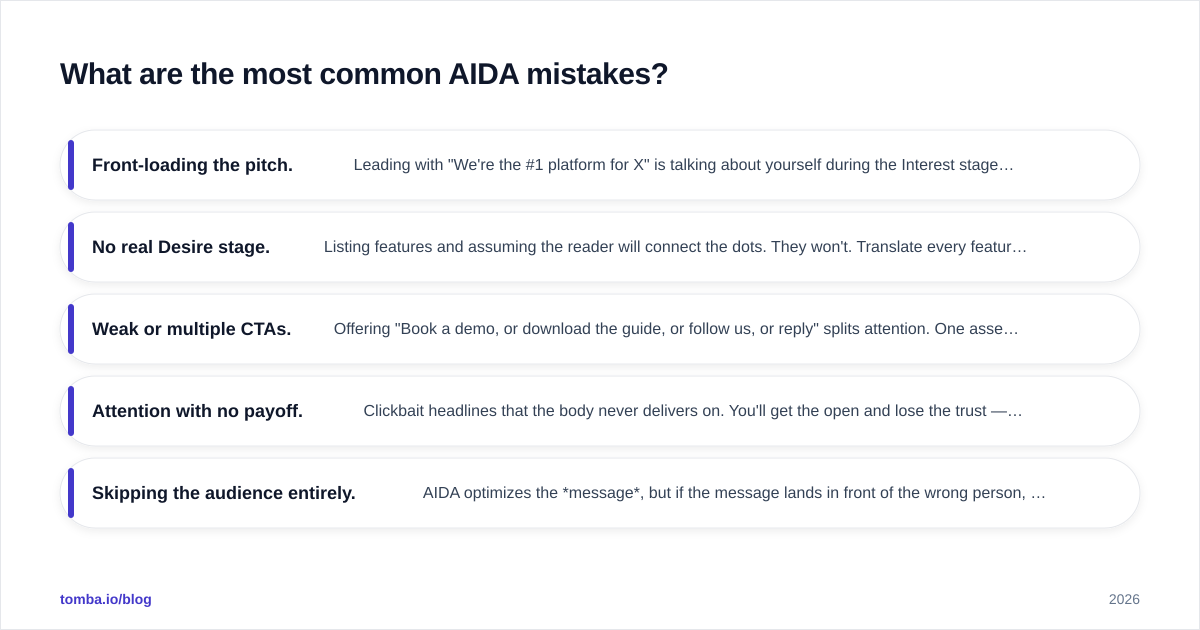
- Front-loading the pitch. Leading with "We're the #1 platform for X" is talking about yourself during the Interest stage, when the reader still wants to hear about themselves. Earn interest before you sell.
- No real Desire stage. Listing features and assuming the reader will connect the dots. They won't. Translate every feature into an outcome they can feel.
- Weak or multiple CTAs. Offering "Book a demo, or download the guide, or follow us, or reply" splits attention. One asset, one action. A confused reader does nothing.
- Attention with no payoff. Clickbait headlines that the body never delivers on. You'll get the open and lose the trust — and your sender reputation along with it if you do it at scale in email.
- Skipping the audience entirely. AIDA optimizes the message, but if the message lands in front of the wrong person, all four stages fail. Targeting comes before copy.
That last point is the one most teams underestimate. The slickest AIDA email in the world converts zero percent if it's sent to a bad address or the wrong persona. Frameworks shape the message; clean data decides whether anyone qualified ever reads it.
How does AIDA fit into a real outbound campaign?#
In a working B2B motion, AIDA is the message layer sitting on top of three other layers: a list, valid contact data, and deliverability.
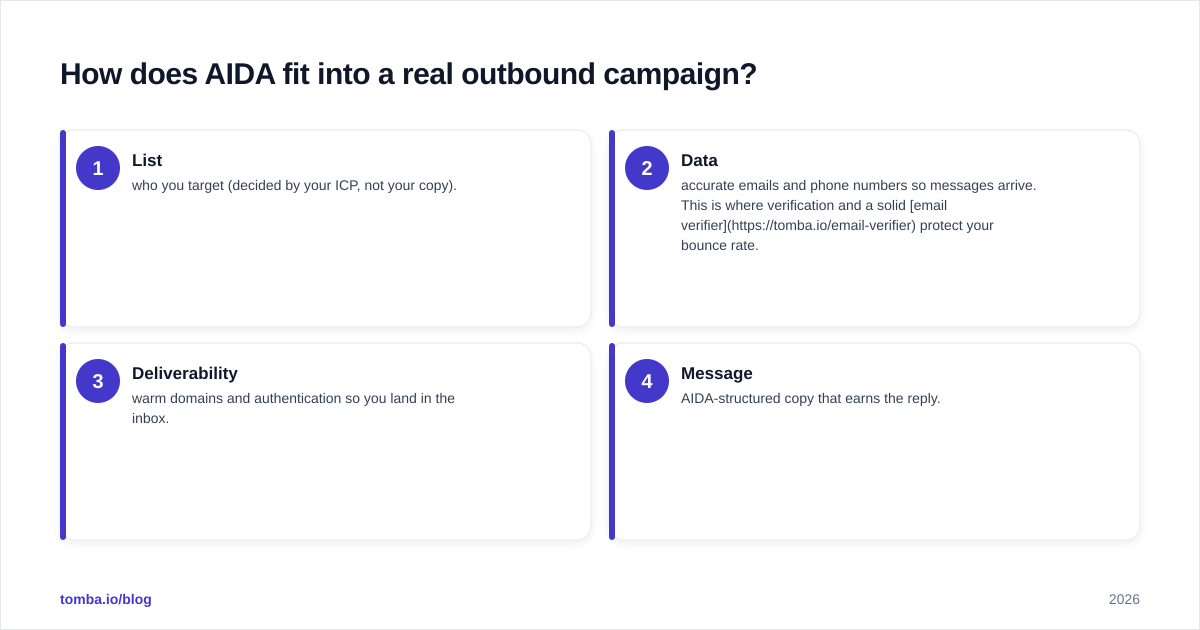
- List — who you target (decided by your ICP, not your copy).
- Data — accurate emails and phone numbers so messages arrive. This is where verification and a solid email verifier protect your bounce rate.
- Deliverability — warm domains and authentication so you land in the inbox.
- Message — AIDA-structured copy that earns the reply.
Get the bottom three wrong and even perfect AIDA copy underperforms. Get them right, and AIDA is the multiplier that turns delivered emails into booked meetings. Tools like G2 are full of platforms that automate the sending — but none of them fix weak copy or a dirty list for you.
Final word: pair the framework with the right data#
The AIDA definition gives you a reliable map for any persuasive message: grab Attention, build Interest, stoke Desire, and make Action effortless. Use it as a checklist on every subject line, ad, and landing page you write, and lean on PAS or FAB inside the Desire stage when you need more punch.
But a framework only converts the people who actually receive your message. Before you spend an hour perfecting an AIDA email, make sure it's reaching real, reachable decision-makers. Tomba's Email Finder finds verified professional email addresses by name, company, or domain — so your carefully crafted Attention-to-Action sequence lands in inboxes that exist. Start free with 25 searches a month, and check the full Tomba pricing when you're ready to scale. Great copy plus accurate data is where replies come from.
Get the Tomba newsletter
Practical outbound tactics and product updates — once every two weeks.
About the author