11 Alternatives to Cold Calling That Actually Work in 2026
Cold calling still works, but it is no longer the only way to book meetings. Here are 11 proven alternatives to cold calling that fill your pipeline in 2026 — ranked by effort, cost, and reply rate.
Cold calling is not dead, but for a lot of B2B teams it is the most expensive way to start a conversation. Connect rates keep falling, gatekeepers are better than ever, and a single rep can burn a full day to book one meeting. If the phone is your only motion, you are leaving pipeline on the table.
This guide breaks down 11 alternatives to cold calling that actually move numbers in 2026 — what each one is, when to use it, and the realistic effort and reply rate behind it. None of these require you to abandon the phone. They give you more shots on goal.
TL;DR#
- Cold calling still converts, but it is high-effort and low-leverage compared with channels you can scale and automate.
- The strongest alternatives to cold calling are cold email, LinkedIn outreach, and warm referrals — they compound and cost less per booked meeting.
- Intent data and website visitor identification let you reach buyers who are already shopping, which lifts reply rates dramatically.
- The winning play in 2026 is multi-channel sequencing: email + LinkedIn + a targeted call, not any single channel in isolation.
- Accurate contact data is the common dependency — every channel below dies without verified emails and direct dials.
Why look for alternatives to cold calling at all?#
Because the math has shifted. Average cold-call connect rates sit in the low single digits, and most reps need dozens of dials to reach one decision-maker. That is fine if calling is cheap for you, but most teams discover the loaded cost per meeting is far higher than email or social.
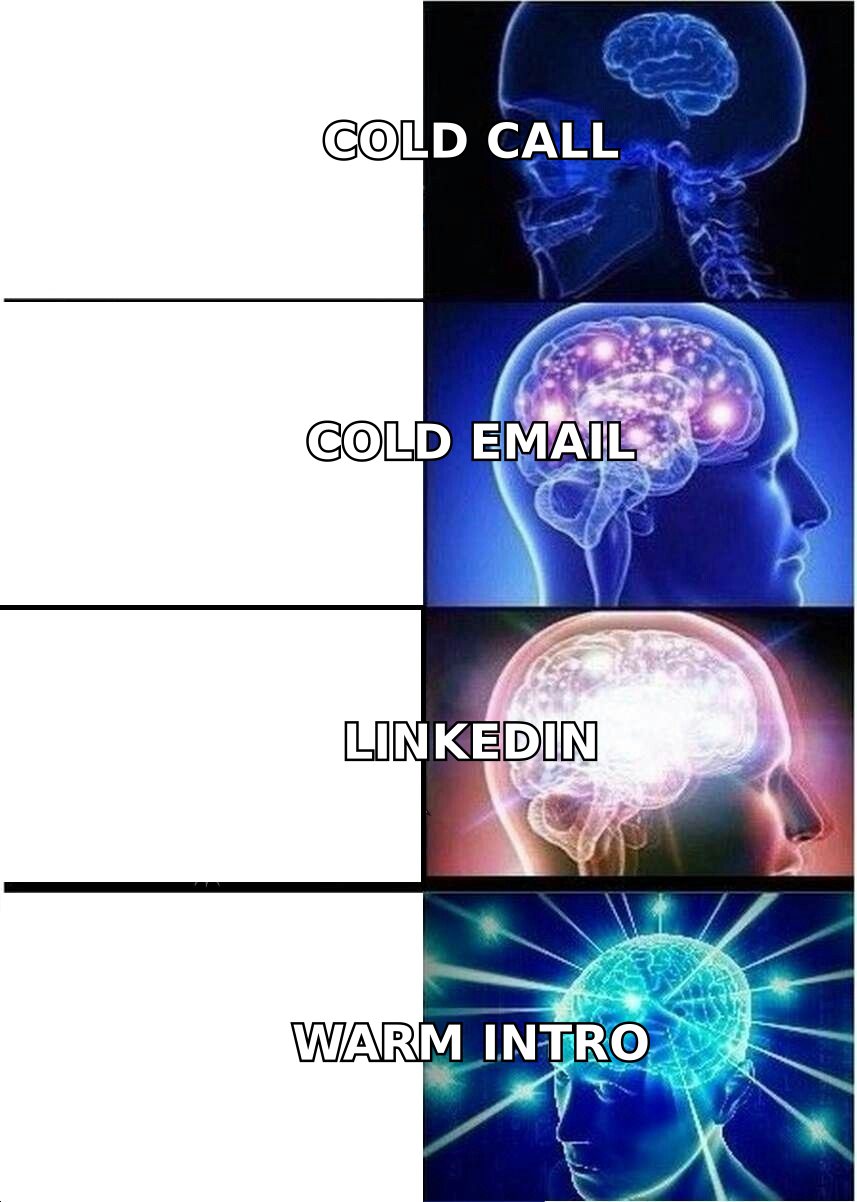
The bigger issue is leverage. A call happens once, reaches one person, and leaves no asset behind. A cold email, a LinkedIn comment, or a piece of content keeps working after you hit send. The best outbound orgs treat the phone as one instrument in a band, not the whole song.
There is also a buyer-behavior change. Modern B2B buyers self-educate before they ever talk to sales — Gartner research has shown buyers spend the majority of their journey researching independently and only a sliver of it with any sales rep. Channels that meet buyers in that research phase quietly outperform interruption-based calling.
What are the best alternatives to cold calling in 2026?#
Here is the full list, grouped from lowest-effort-to-start to highest-skill-to-master. Most teams run three or four of these at once.
1. Cold email#
The closest one-to-one swap for the phone. Done well, cold email reaches more prospects per hour than any dialer and leaves a paper trail you can A/B test. The catch is deliverability: you need verified addresses, a warmed-up domain, and tight personalization or you land in spam. Pair an email verifier with your sending tool to protect sender reputation.
2. LinkedIn outreach#
Connection requests, DMs, and voice notes reach buyers where they already spend time. LinkedIn outreach feels warmer than a cold dial and lets you reference a prospect's posts or role changes. Keep daily volume conservative to avoid restrictions, and lead with relevance, not a pitch.
3. Warm referrals and introductions#
The highest-converting channel that almost nobody systematizes. Ask happy customers, investors, and your own network for one-line intros. Referral leads close faster and at higher win rates because trust transfers with the introduction.
4. Social selling and content#
Posting useful insight on LinkedIn or X builds inbound demand and warms your outbound. When a prospect has seen three of your posts, your email is no longer cold. This is a slow compounder, but it lowers the cost of every other channel over time.
5. Inbound and SEO#
Ranking for the problems your buyers search means they come to you. It is the longest lead time on this list and the lowest marginal cost once it works. Treat it as a 6–12 month investment, not a quarter-end fix.
6. Webinars and virtual events#
A webinar turns one hour into dozens of qualified conversations. Attendees self-select by topic, so follow-up is warm. Co-hosting with a partner doubles your reach for the same effort.
7. Intent data and signal-based outreach#
Tools that surface companies researching your category let you reach buyers in-market right now. Reaching out on a signal — a job change, funding round, or tech install — converts far better than spray-and-pray. Enrich those signals with contact enrichment so you have a real person to message, not just an account.
8. Website visitor identification#
Most of your site traffic leaves anonymous. Website visitor reveal de-anonymizes the companies browsing your pricing page so you can follow up while interest is hot. It is outbound aimed at people who already raised a hand.
9. Referral and partner programs#
Channel partners, affiliates, and integration partners send you pre-qualified leads continuously. It takes setup, but a good partner motion produces pipeline without per-lead labor.
10. Direct mail and gifting#
In a saturated inbox, a thoughtful physical package cuts through. Reserve it for high-ACV target accounts where the cost is justified. Pair it with an email or call so the touch is connected, not random.
11. Multi-channel sequencing#
Not a single channel but the meta-play: combine email, LinkedIn, and a precise call into one orchestrated sequence. This is what top teams actually do, and it is why "email vs calling" is the wrong question.
How do these alternatives to cold calling compare?#
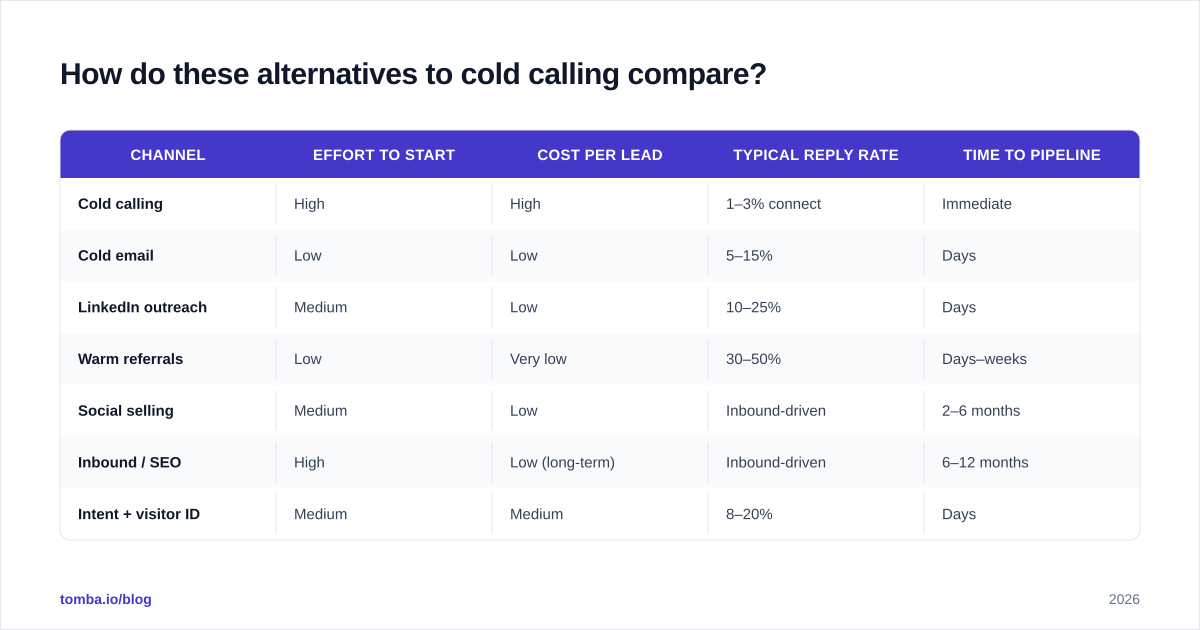
Use this table to pick based on your constraints — time, budget, and how fast you need pipeline. Reply-rate ranges assume solid targeting and verified data; sloppy lists tank every channel.
| Channel | Effort to start | Cost per lead | Typical reply rate | Time to pipeline |
|---|---|---|---|---|
| Cold calling | High | High | 1–3% connect | Immediate |
| Cold email | Low | Low | 5–15% | Days |
| LinkedIn outreach | Medium | Low | 10–25% | Days |
| Warm referrals | Low | Very low | 30–50% | Days–weeks |
| Social selling | Medium | Low | Inbound-driven | 2–6 months |
| Inbound / SEO | High | Low (long-term) | Inbound-driven | 6–12 months |
| Intent + visitor ID | Medium | Medium | 8–20% | Days |
| Direct mail | High | Very high | 5–15% | Weeks |
The pattern is clear: cold calling has the fastest start but the worst conversion per touch, while email, LinkedIn, and referrals give you more meetings for less effort once your data and messaging are dialed in.
Is cold email better than cold calling?#
For most B2B teams in 2026, yes — on a cost-per-meeting basis. One rep can send a few hundred personalized emails in the time it takes to make 40 dials, and every send is testable. Email also respects the buyer's time, which matters when you are trying to start a relationship, not interrupt a meeting.
The honest caveat: email only beats calling when your list is clean and your domain is healthy. A great message to an invalid address does nothing, and a 10% bounce rate can torch your email deliverability for the whole domain. That is why list hygiene is non-negotiable — run every address through verification before you send, and check formats with a free email checker when you are working a small batch.
Calling still wins in specific cases: high-ACV deals, executive buyers who ignore email, and time-sensitive follow-up after a demo or event. The answer is almost never "pick one." It is "sequence both."
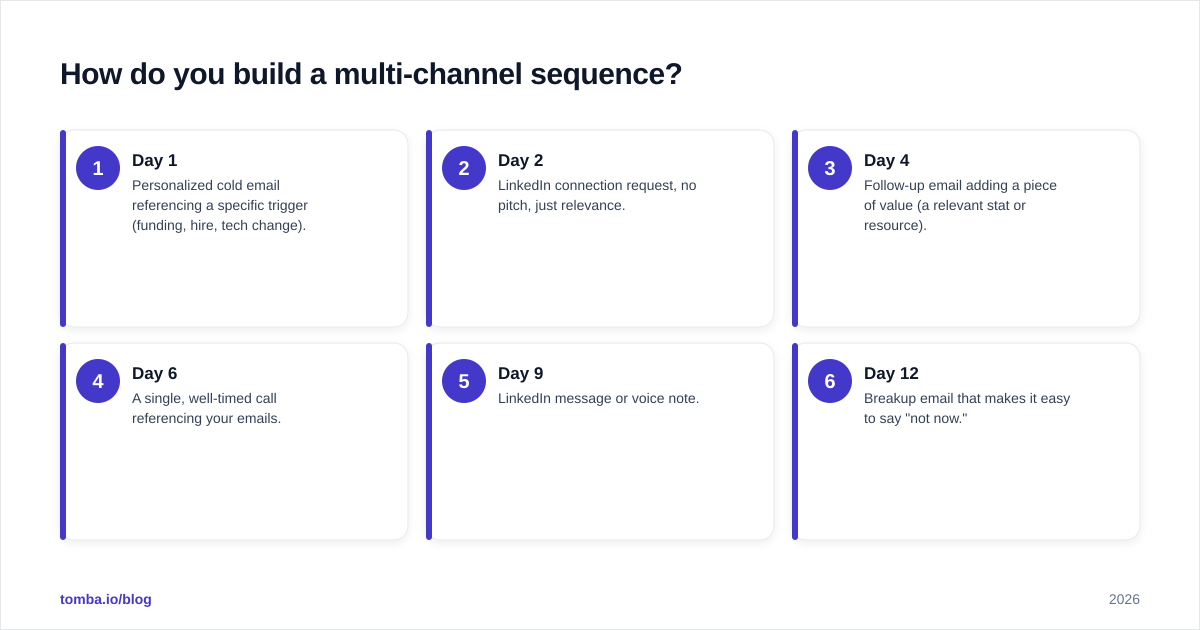
How do you build a multi-channel sequence?#
Start with a clean account list, then layer touches across channels over two to three weeks. A simple, proven structure looks like this:
- Day 1 — Personalized cold email referencing a specific trigger (funding, hire, tech change).
- Day 2 — LinkedIn connection request, no pitch, just relevance.
- Day 4 — Follow-up email adding a piece of value (a relevant stat or resource).
- Day 6 — A single, well-timed call referencing your emails.
- Day 9 — LinkedIn message or voice note.
- Day 12 — Breakup email that makes it easy to say "not now."
The reason sequencing beats any single channel is coverage: some buyers reply to email, some only answer LinkedIn, a few will pick up the phone. Hitting all three with a coherent story means you catch each buyer on their preferred channel. Platforms like HubSpot and others reviewed on G2 can automate the orchestration, but the sequence design and the data quality are on you.
What do every one of these alternatives depend on?#
Accurate contact data. Notice the thread running through all 11 plays: each one dies without a verified email, a real direct dial, or the right LinkedIn profile. You cannot email a bounce, sequence a wrong number, or enrich a signal into a contact that does not exist.
This is where most outbound programs quietly fail. They invest in tools and copy but feed them a stale list, then blame the channel when reply rates crater. Get the data layer right first:
- Pull verified addresses with a domain search when you are targeting a whole company.
- Add direct dials with a phone finder so your calling motion reaches mobiles, not switchboards.
- Process target accounts at scale through a bulk email finder instead of researching one prospect at a time.
When the data is clean, every channel above performs better — and you stop wasting reps' hours on contacts who were never reachable in the first place.
Which alternative should you start with?#
Pick based on your bottleneck. If you need pipeline this month and have a clean list, start with cold email plus a light LinkedIn motion — fastest to stand up, lowest cost, easy to measure. If you have happy customers, systematize referrals before anything else; it is the highest-converting channel and the most underused. If you have meaningful website traffic, turn on visitor identification so you stop ignoring buyers who are already interested.
Whatever you choose, layer a second channel within 30 days. Single-channel outbound is fragile; multi-channel is durable. And keep the phone in the mix for your highest-value accounts — calling is a bad only-strategy but a great closer.
Start with the data layer#
Every alternative to cold calling on this list runs on accurate contact data, and that is exactly what Tomba Email Finder is built for. Find verified professional emails by name, company, or domain, then push them straight into your email, LinkedIn, and calling sequences. Pair it with the built-in verifier to protect deliverability and the phone finder for your call-worthy accounts.
The Free plan gives you 25 searches a month to test the waters; paid plans start at $49/mo (Starter) and scale to $99/mo (Growth) and $249/mo (Pro) as your volume grows. See full Tomba pricing and start building a pipeline that does not depend on the phone alone.
// get started
Find, verify and enrich your first contacts today
Start on the free plan with 25 searches a month, then scale when your team is ready.
Free plan · No credit card required · GDPR & CCPA
Get the Tomba newsletter
Product and data updates
// about the author