Answer Rate in Sales: How to Boost Cold Call Pickups in 2026
Your answer rate decides whether outbound lives or dies. Here's how top teams push cold-call pickups from 1% to double digits in 2026 — data, benchmarks, and a fix list.
TL;DR
- Answer rate is the percentage of dials a live human picks up — the single metric that gates every downstream cold-call result.
- A "good" answer rate in 2026 sits around 5–12% for B2B; most untuned teams hover near 1–3%.
- The biggest levers are caller ID reputation, local presence, dial timing, list accuracy, and number health — not the script.
- Bad phone data quietly destroys answer rate: wrong, disconnected, or spam-flagged numbers never connect.
- Clean your dial list with verified, validated numbers before you blame the dialer or the rep.
What is answer rate?#
Answer rate is the share of your outbound calls that a real person actually picks up. Formula: calls answered by a human ÷ total dials, times 100. If your SDR dials 200 numbers and 14 humans say "hello," that's a 7% answer rate.
Think of it like fishing. You can have the best bait (your pitch) and the best technique (your rep), but if your hook never touches water — because the number is dead, spam-flagged, or dialed at the wrong hour — you catch nothing. Answer rate measures how often your hook actually hits the water.
It's distinct from two metrics it's often confused with:
- Connect rate sometimes means the same thing, but many dialers count voicemail pickups or carrier connections as "connects." Answer rate should mean a live human.
- Conversation rate is the share of answered calls that turn into a real talk (past "who is this?"). That's a downstream metric.
Answer rate is the gate. Everything else — conversation rate, meeting rate, pipeline — is a percentage of a percentage. Lift the gate and every number behind it rises with it.
What is a good answer rate in 2026?#
Short answer: 5–12% for most B2B outbound, with the best-tuned teams pushing 15%+ on tight, high-fit lists. If you're under 3%, you have a data or reputation problem, not a talent problem.
Answer rates have been sliding for a decade as spam filtering, carrier branding, and call-screening apps proliferate. According to widely cited HubSpot sales benchmarks, the average cold-call connect figure has drifted into the low single digits for untuned dialing. Analyst coverage from Gartner on buyer behavior shows decision-makers increasingly screen unknown numbers by default.
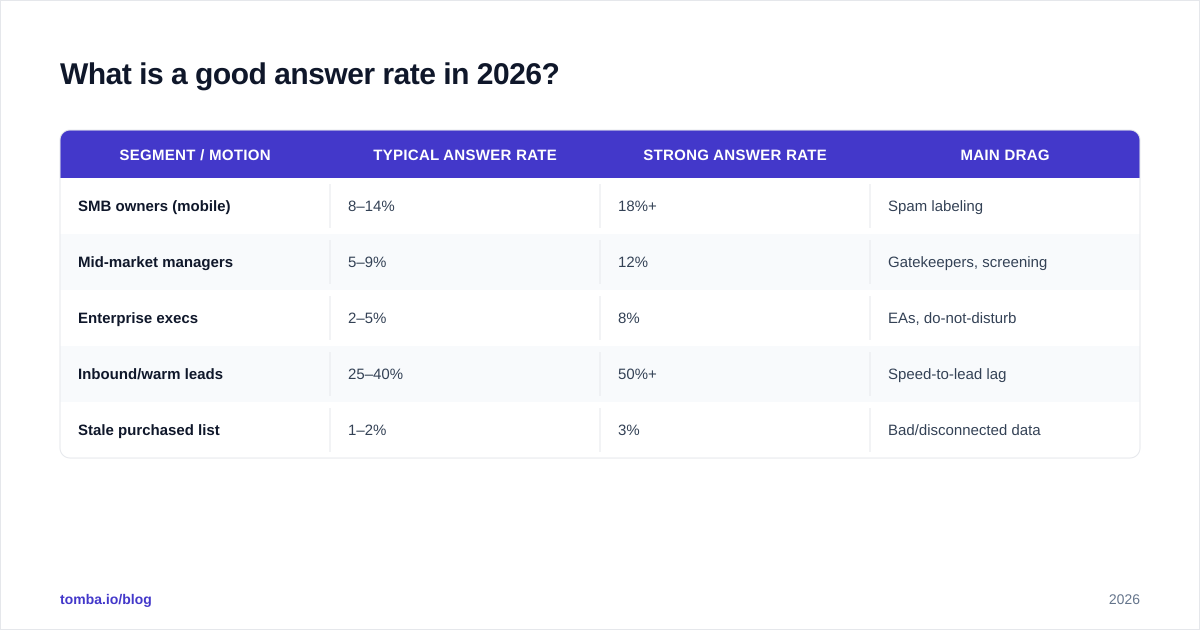
Here's a realistic 2026 benchmark band by motion:
| Segment / motion | Typical answer rate | Strong answer rate | Main drag |
|---|---|---|---|
| SMB owners (mobile) | 8–14% | 18%+ | Spam labeling |
| Mid-market managers | 5–9% | 12% | Gatekeepers, screening |
| Enterprise execs | 2–5% | 8% | EAs, do-not-disturb |
| Inbound/warm leads | 25–40% | 50%+ | Speed-to-lead lag |
| Stale purchased list | 1–2% | 3% | Bad/disconnected data |
Notice the bottom row. A stale, unverified list caps you at 1–2% no matter how good your reps are. That's not a coaching problem — it's a data problem, and it's the most common one.
Why is my answer rate so low?#
Nine things suppress answer rate. Most teams obsess over the last one (the script) and ignore the first five (data and reputation), which is exactly backwards.
- Spam-flagged numbers. Carriers and apps like Hiya and Truecaller tag high-volume numbers "Spam Likely." Once flagged, your answer rate collapses regardless of who you're calling.
- Wrong or disconnected numbers. Dialing a number that rings nowhere is a guaranteed zero. Purchased and scraped lists rot at 2–3% per month.
- Unknown caller ID. A non-local, non-branded number triggers screen-and-ignore behavior.
- Bad timing. Calling at lunch, at 9 a.m. Monday, or after 5 p.m. tanks pickups.
- Over-dialing one number. Hammering the same line in a day gets you flagged and blocked.
- No voicemail follow-through. No multi-touch cadence means one missed call equals one dead lead.
- Wrong persona on the line. Dialing a generic main line instead of the direct dial.
- No branded caller ID (CNAM/verified caller display).
- A weak opener — the only script-level factor, and it only matters after they answer.
)
Five of those nine are data and number-health problems. That's why answer rate is, first and foremost, a data-quality metric.
How does data quality affect answer rate?#
Garbage numbers cap your ceiling. You can't answer a phone that doesn't exist. This is the lever almost nobody pulls, because it's invisible — a bad number looks identical to a good one until you dial it and hear nothing.
Three data moves move the needle most:
- Get direct dials, not switchboards. A verified mobile or direct line for the actual buyer beats a corporate front desk every time. A phone finder that returns the decision-maker's direct number, rather than a generic company line, structurally raises answer rate because you skip the gatekeeper layer entirely.
- Validate before you dial. Run numbers through a phone validator to drop disconnected, invalid, and unreachable lines before they ever hit the dialer. Every dead number you remove raises your answer rate denominator quality.
- Enrich and refresh. People change roles and numbers constantly. Periodic data enrichment keeps your list current so you're dialing live humans, not last year's contacts.
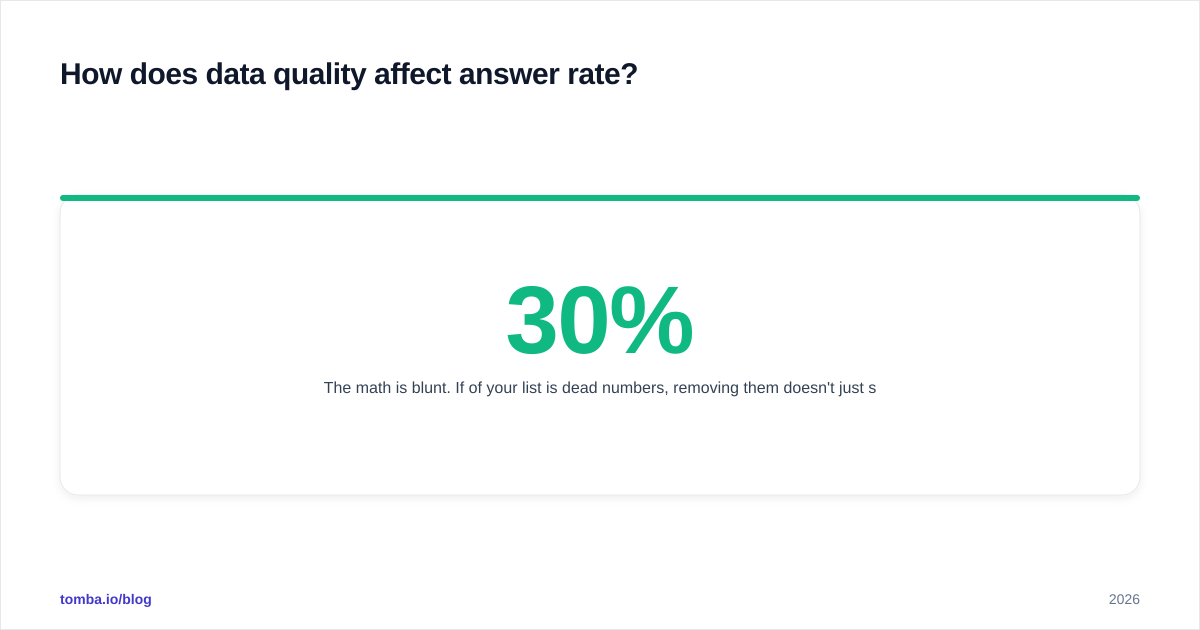
The math is blunt. If 30% of your list is dead numbers, removing them doesn't just save dial time — it mechanically lifts your answer rate because the denominator now contains only reachable people. A 2% answer rate on a list that's 30% dead is really ~2.9% on the reachable subset. Clean the list and the "real" number was there all along.
This is also where contact accuracy compounds with response rate across channels. The same verified record that lifts your call answer rate also powers a tighter email and LinkedIn follow-up, so a clean record pays off three times.
What's the fastest way to improve answer rate?#
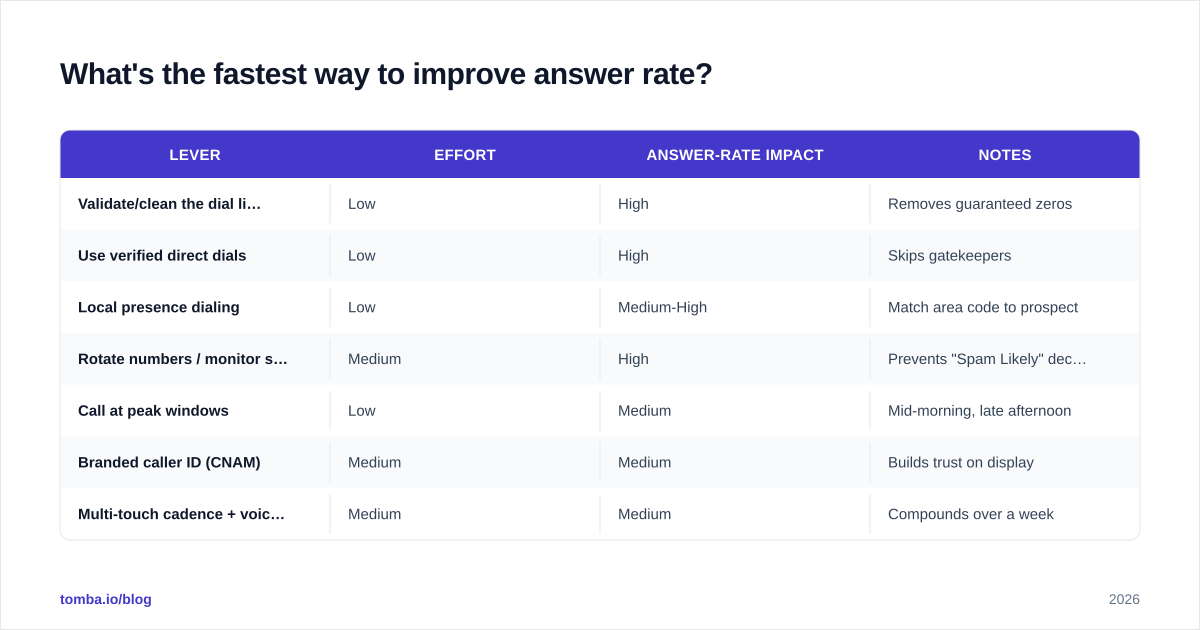
Fix the levers in order of impact-to-effort. Here's the priority stack most teams should run.
| Lever | Effort | Answer-rate impact | Notes |
|---|---|---|---|
| Validate/clean the dial list | Low | High | Removes guaranteed zeros |
| Use verified direct dials | Low | High | Skips gatekeepers |
| Local presence dialing | Low | Medium-High | Match area code to prospect |
| Rotate numbers / monitor spam flags | Medium | High | Prevents "Spam Likely" decay |
| Call at peak windows | Low | Medium | Mid-morning, late afternoon |
| Branded caller ID (CNAM) | Medium | Medium | Builds trust on display |
| Multi-touch cadence + voicemail | Medium | Medium | Compounds over a week |
| Tighten persona targeting | Medium | Medium | Right human, right line |
| Sharpen the opener | Low | Low-Medium | Only matters post-answer |
A few of these deserve a sentence more:
Local presence. People answer numbers that look local. Matching your outbound caller ID area code to the prospect's region is one of the highest-ROI, lowest-effort moves available, and most modern dialers support it natively.
Number rotation and spam monitoring. Treat phone numbers like email-sending domains: warm them, spread volume across several, and monitor reputation. The moment a number gets "Spam Likely," retire it. Tools like Truecaller and carrier analytics show you when a line is flagged. Vendors compared on G2 under "outbound call tracking" handle this rotation for you.
Timing. Across most B2B data sets, mid-morning (10–11:30 a.m.) and late afternoon (4–5 p.m.) local time beat the rest of the day. Avoid Monday mornings and Friday afternoons.
Does the dialer or the script matter more?#
Data and reputation matter more than either — but between the two, the dialer setup beats the script for answer rate specifically. The script only affects what happens after someone answers; it can't make a dead number ring or a flagged line look trustworthy.
That's the trap most teams fall into: they A/B test openers for months while their list quietly rots and their numbers get flagged. They're optimizing conversation rate while answer rate — the bigger lever — bleeds out upstream.
The right sequence:
- Fix data first. Verified direct dials, validated and current. This sets your ceiling.
- Fix number health second. Local presence, rotation, spam monitoring, branded ID. This determines how close to the ceiling you get.
- Fix timing and cadence third. Right hour, multiple touches, voicemail follow-through.
- Fix the opener last. Now that people are answering, give them a reason to stay.
Run them out of order and you'll plateau. You can have a world-class opener and still sit at a 1.5% answer rate because your list is half-dead and your number is flagged.
How do I measure and track answer rate properly?#
Measure it cleanly or you'll optimize the wrong thing. Three rules:
- Count only live humans as "answers." Voicemail and carrier connects don't count. Most dialers misreport this — check the definition.
- Segment by list source, number, and time block. Your aggregate answer rate hides the story. One flagged number or one rotten list segment can drag the whole average down while everything else performs fine.
- Track answer rate alongside data freshness. When answer rate dips, the cause is usually list decay or a newly flagged number — not your reps suddenly forgetting how to dial.
A simple weekly dashboard: answer rate by number, by list source, by hour, by rep. The first three will explain 80% of your variance before you ever look at the rep column.
If you're pulling contacts at scale, build the dial list from accurate, deliverable data at the source. Pairing a phone finder for direct dials with a phone validator pre-dial pass means the list that reaches your reps is already stripped of guaranteed zeros — your answer rate starts from a higher floor on day one.
Frequently asked questions#
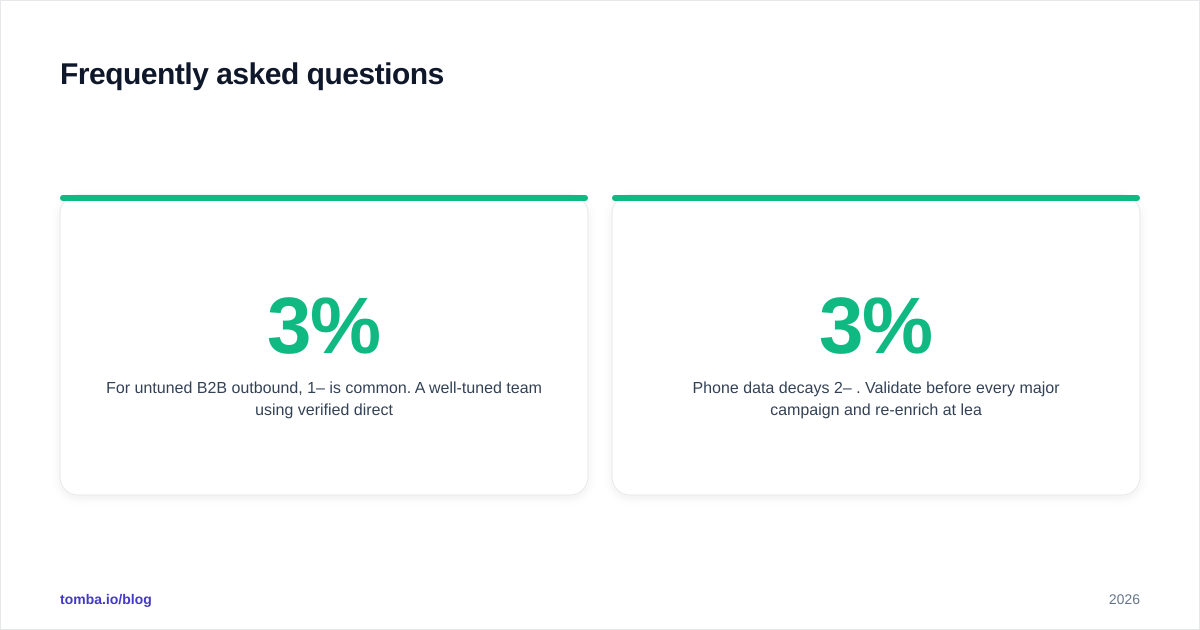
What is a realistic answer rate for cold calling in 2026? For untuned B2B outbound, 1–3% is common. A well-tuned team using verified direct dials, local presence, and number rotation typically lands at 5–12%, with the best lists pushing past 15%.
Is answer rate the same as connect rate? Not always. Many dialers count voicemails and carrier connections as "connects." A true answer rate counts only live humans. Define it strictly or you'll overstate performance.
Can better data really raise my answer rate? Yes — it's the highest-leverage fix. Removing dead and invalid numbers and dialing verified direct lines mechanically raises the rate, because you stop wasting dials on contacts who could never have answered.
How often should I clean my dial list? Phone data decays 2–3% per month. Validate before every major campaign and re-enrich at least quarterly. High-volume teams should validate continuously.
Build a dial list that actually gets answered#
Answer rate is won upstream, in the data — not in the script. Before your next campaign, stop dialing rotted lists and corporate switchboards. Use the Tomba Email Finder and Tomba's phone tools to pull verified direct dials for the actual decision-makers, validate every number before it hits your dialer, and keep records fresh with ongoing enrichment. Start free with 25 searches a month and scale on a Tomba plan — Starter is $49/mo — when your reps are ready to dial lists that pick up. Clean data is the cheapest answer-rate boost you'll ever buy.
// get started
Find, verify and enrich your first contacts today
Start on the free plan with 25 searches a month, then scale when your team is ready.
Free plan · No credit card required · GDPR & CCPA
// about the author