How to Ask for the Sale: 7 Closing Techniques for 2026
Most deals stall because nobody actually asks for the sale. Here are seven closing techniques, the exact words to use, and when to deploy each one.
Most reps do everything right up to the final moment, then never actually ask the prospect to buy. They send the proposal, answer the questions, build the rapport, and then wait. Waiting is not closing. This guide shows you how to ask for the sale directly, the seven techniques that work, and the exact language to use so you sound confident instead of pushy.
TL;DR#
- The single biggest reason deals stall is that nobody asks. Reps confuse presenting with closing. Asking for the sale is a separate, deliberate step.
- There are seven repeatable closing techniques — assumptive, summary, alternative, urgency, takeaway, question, and direct — each suited to a different buyer signal.
- Timing matters more than wording. Ask after you've confirmed value and surfaced (not buried) objections, not before.
- Silence is leverage. After you ask, stop talking. The first person to speak usually concedes.
- Pipeline quality decides close rate. You can't close contacts you can't reach — accurate data feeds the whole funnel.
Why do so many reps fail to ask for the sale?#
The short answer: fear of rejection dressed up as politeness. A rep who never asks can never technically be told no, so the deal lives in a comfortable limbo of "following up." That feels safer than a clean answer, but it quietly kills your win rate.
Think of it like a first date that never ends with anyone suggesting a second one. Both people had a nice time, nobody risked anything, and nothing happens. The "ask" is the moment you convert interest into commitment, and skipping it doesn't protect the relationship — it strands it.
There's also a skill gap. According to HubSpot's sales research, a large share of reps give up after one or two follow-ups, well before most buyers are ready to decide. They interpret silence as a soft no, when it's usually just a busy inbox. Asking clearly — and asking again — is what separates quota crushers from the rest.
What does "ask for the sale" actually mean?#
To ask for the sale means to make a specific, time-bound request for the prospect's commitment — and then to stop and let them respond. It is not "Let me know if you have questions." It is "Should we get the paperwork started this week?"
The request has three parts:
- A clear action — sign, start, schedule onboarding, issue the PO.
- A timeframe — today, this week, before the quarter closes.
- A pause — you ask, then you say nothing.
That third part is where most reps break. They ask, get nervous, and immediately fill the silence with a discount or a caveat, which undercuts the entire request. Treat the pause as part of the technique, not an awkward gap.
What are the seven ways to ask for the sale?#
Each technique fits a different moment. The art is reading the buyer's signal and choosing the matching close, rather than forcing your favorite line onto every deal.
1. The assumptive close#
You proceed as if the decision is already made. "I'll send the onboarding invite for Monday — does morning or afternoon work better?" This works when buying signals are strong and the prospect just needs a gentle push over the line.
2. The summary close#
You recap the agreed-upon value before asking. "So you'll get the integration, the priority support tier, and onboarding for your team — ready to move forward?" Best for complex deals where the buyer needs to feel the full weight of what they're getting.
3. The alternative close#
You offer two paths to "yes," never a path to "no." "Do you want to start on the Growth plan or the Pro plan?" The question quietly assumes the purchase and shifts the decision to which, not whether.
4. The urgency close#
You attach a real, honest reason to act now — a price change, a cohort start date, a capacity limit. Never fabricate scarcity; buyers can smell it, and it torches trust. Genuine urgency, like a contract that renews at quarter-end, is fair game.
5. The takeaway close#
You remove something to test commitment. "The custom-reporting add-on might be more than you need right now — we could leave it off." Loss aversion often makes the buyer reach for what you just pulled back.
6. The question close#
You ask what's left between you and a yes. "Is there any reason we couldn't get started today?" The answer either surfaces the real objection or confirms there isn't one.
7. The direct close#
You simply ask. "Are you ready to sign?" Underrated because it feels blunt, but with a warm, qualified buyer it's the most respectful option — it treats them like an adult who can make a decision.
Which closing technique should you use and when?#
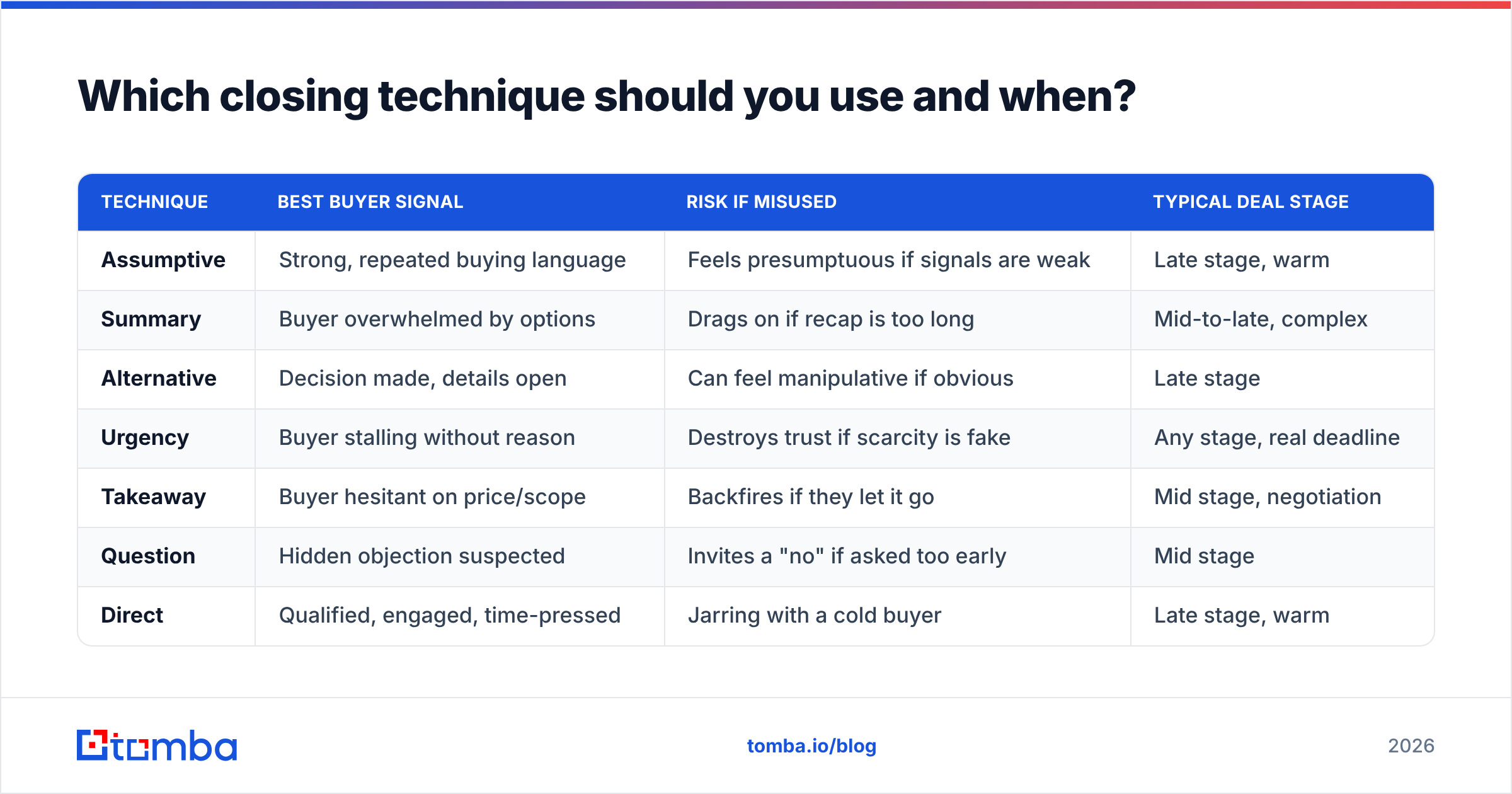
Match the close to the signal and the deal stage. Here's a quick reference.
| Technique | Best buyer signal | Risk if misused | Typical deal stage |
|---|---|---|---|
| Assumptive | Strong, repeated buying language | Feels presumptuous if signals are weak | Late stage, warm |
| Summary | Buyer overwhelmed by options | Drags on if recap is too long | Mid-to-late, complex |
| Alternative | Decision made, details open | Can feel manipulative if obvious | Late stage |
| Urgency | Buyer stalling without reason | Destroys trust if scarcity is fake | Any stage, real deadline |
| Takeaway | Buyer hesitant on price/scope | Backfires if they let it go | Mid stage, negotiation |
| Question | Hidden objection suspected | Invites a "no" if asked too early | Mid stage |
| Direct | Qualified, engaged, time-pressed | Jarring with a cold buyer | Late stage, warm |
A practical rule: open with a question close to surface objections, resolve them, then move to a summary or direct close to lock commitment. Stacking techniques in sequence beats firing one off in isolation.
How do you ask for the sale without sounding pushy?#
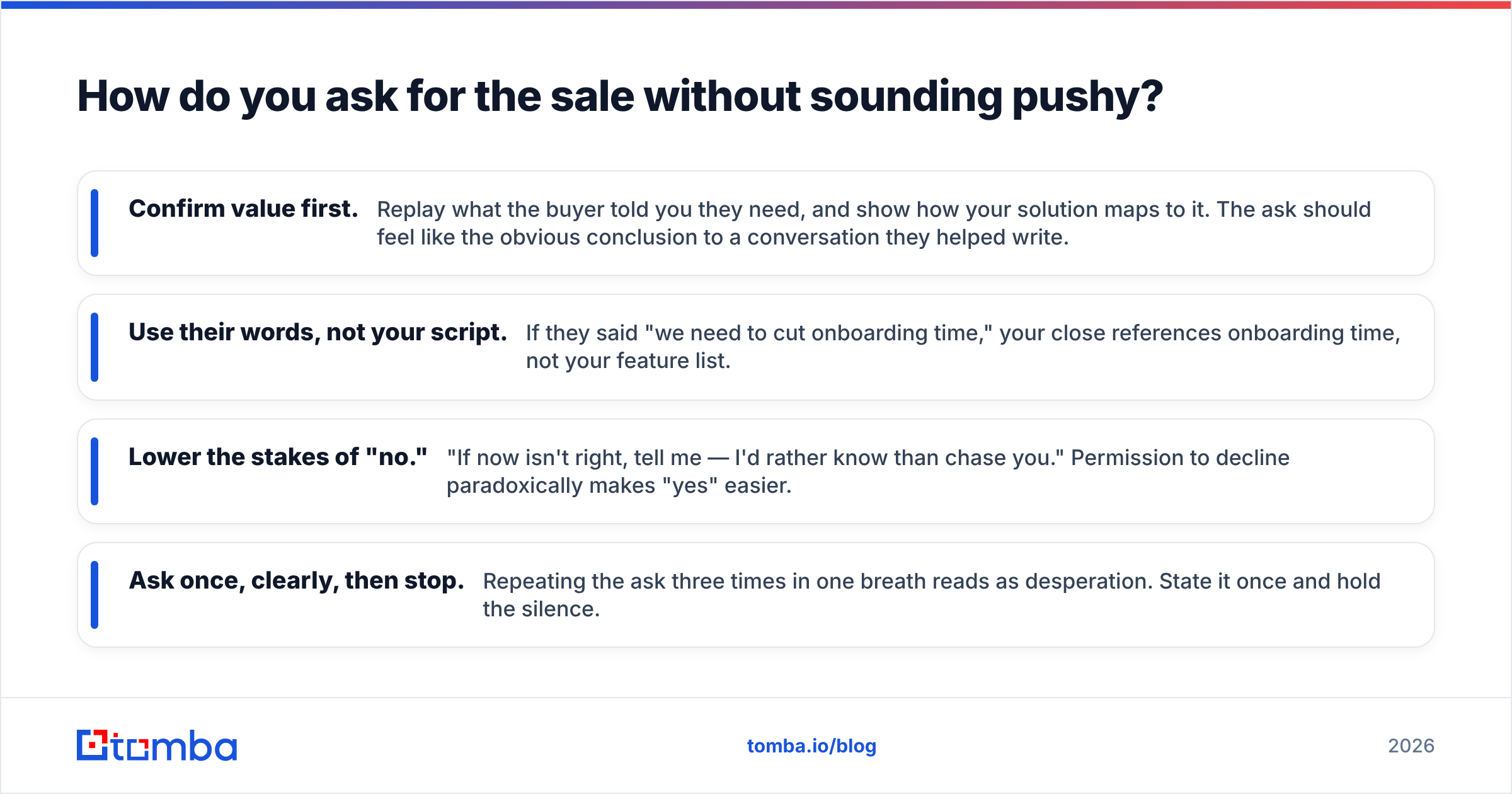
Pushiness comes from asking before you've earned the right, not from asking itself. Earn the right and the ask feels like a natural next step.
- Confirm value first. Replay what the buyer told you they need, and show how your solution maps to it. The ask should feel like the obvious conclusion to a conversation they helped write.
- Use their words, not your script. If they said "we need to cut onboarding time," your close references onboarding time, not your feature list.
- Lower the stakes of "no." "If now isn't right, tell me — I'd rather know than chase you." Permission to decline paradoxically makes "yes" easier.
- Ask once, clearly, then stop. Repeating the ask three times in one breath reads as desperation. State it once and hold the silence.
This is also where your broader sales process and pipeline discipline pays off. A rep who has logged every interaction and qualified the buyer properly asks from a position of knowledge, not hope. The confidence is real because the homework is done.
What happens after you ask? Handling the response#
There are only three answers to a well-formed ask: yes, no, or a condition. Each has a move.
Yes. Stop selling. The fastest way to lose a closed deal is to keep talking and reopen a question the buyer had already settled. Confirm the next step, send the paperwork, and exit gracefully.
A condition ("yes, if..."). This is the most common real answer. Isolate the condition — "If we can solve the security review, are we good to go?" — get a yes on the condition, then go solve exactly that. Don't treat a condition as a flat rejection.
No. Get curious, not defensive. "Totally fair — what tipped it?" A clean no with a reason is a gift; it tells you whether this is dead or just early. Many "nos" are really "not yet," and a logged, well-timed follow-up reopens them later.
The research backs this up. Gartner's B2B buying analysis shows buyers spend only a fraction of their journey with any single supplier, so the rep who asks clearly and follows up systematically captures attention the others leave on the table.
How does pipeline quality affect your ability to close?#
You cannot ask for the sale if you never reach the buyer — and you can't reach buyers with bad contact data. Closing technique is the last mile of a much longer road, and that road starts with accurate, reachable contacts at the right accounts.
Reps routinely lose deals not at the close but at the connect: bounced emails, wrong decision-makers, and dialed numbers that ring a former employee's desk. If a quarter of your outreach never lands, your close rate is being throttled long before anyone gets the chance to say yes. This is why high-performing teams treat data hygiene as a revenue lever, not an admin chore.
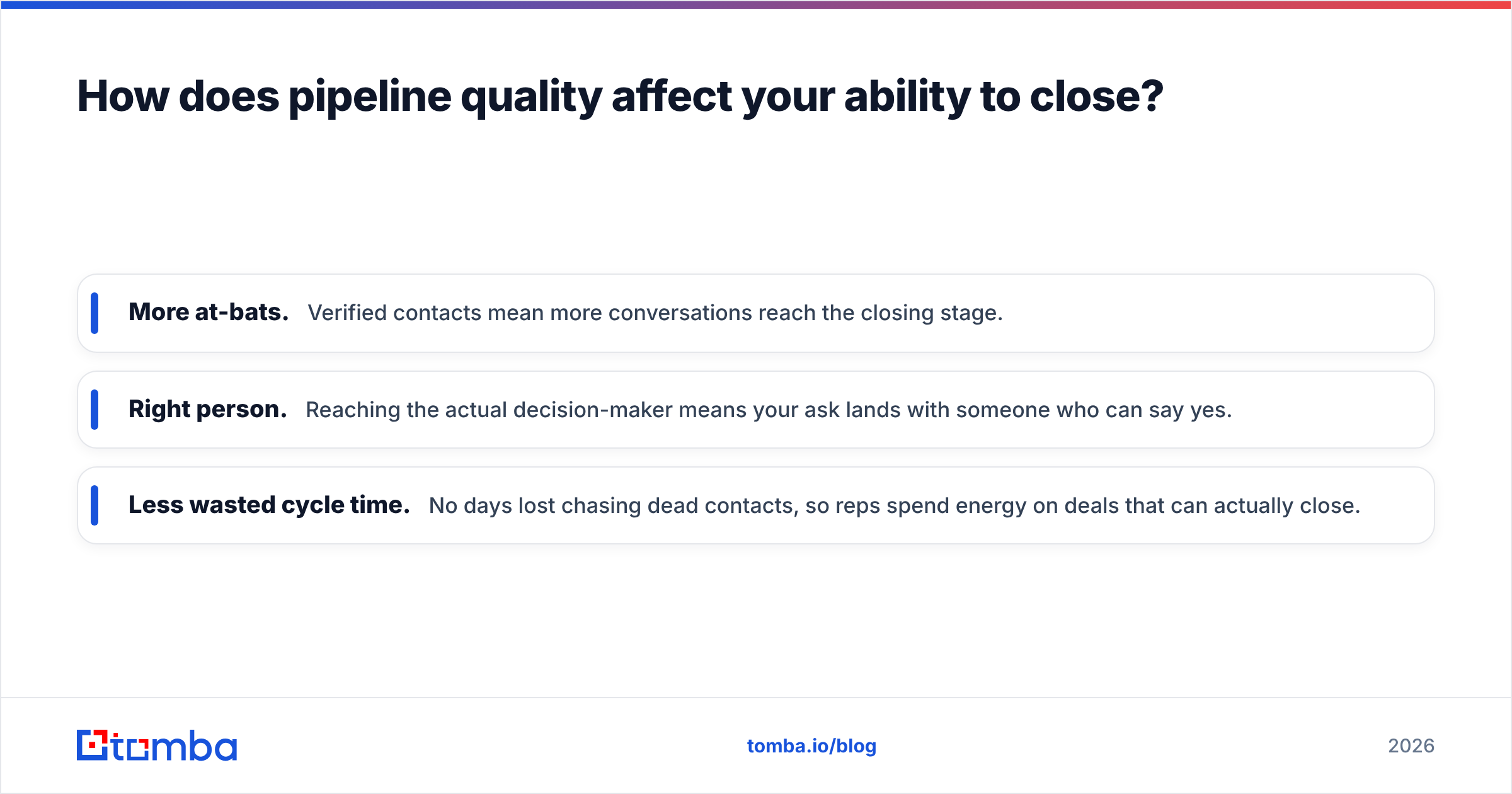
A clean top-of-funnel does three things for your close rate:
- More at-bats. Verified contacts mean more conversations reach the closing stage.
- Right person. Reaching the actual decision-maker means your ask lands with someone who can say yes.
- Less wasted cycle time. No days lost chasing dead contacts, so reps spend energy on deals that can actually close.
This is where a tool like Tomba's email finder feeds the rest of your motion. Find the verified work email of the decision-maker, run it through the email verifier to strip bounces, and use domain search to map every relevant contact at a target account. The better your data, the more often you earn the right to ask — and the cleaner your response rate at the top of the funnel.
What are the most common mistakes when asking for the sale?#
Avoid these and you'll out-close most of your peers without learning a single new technique.
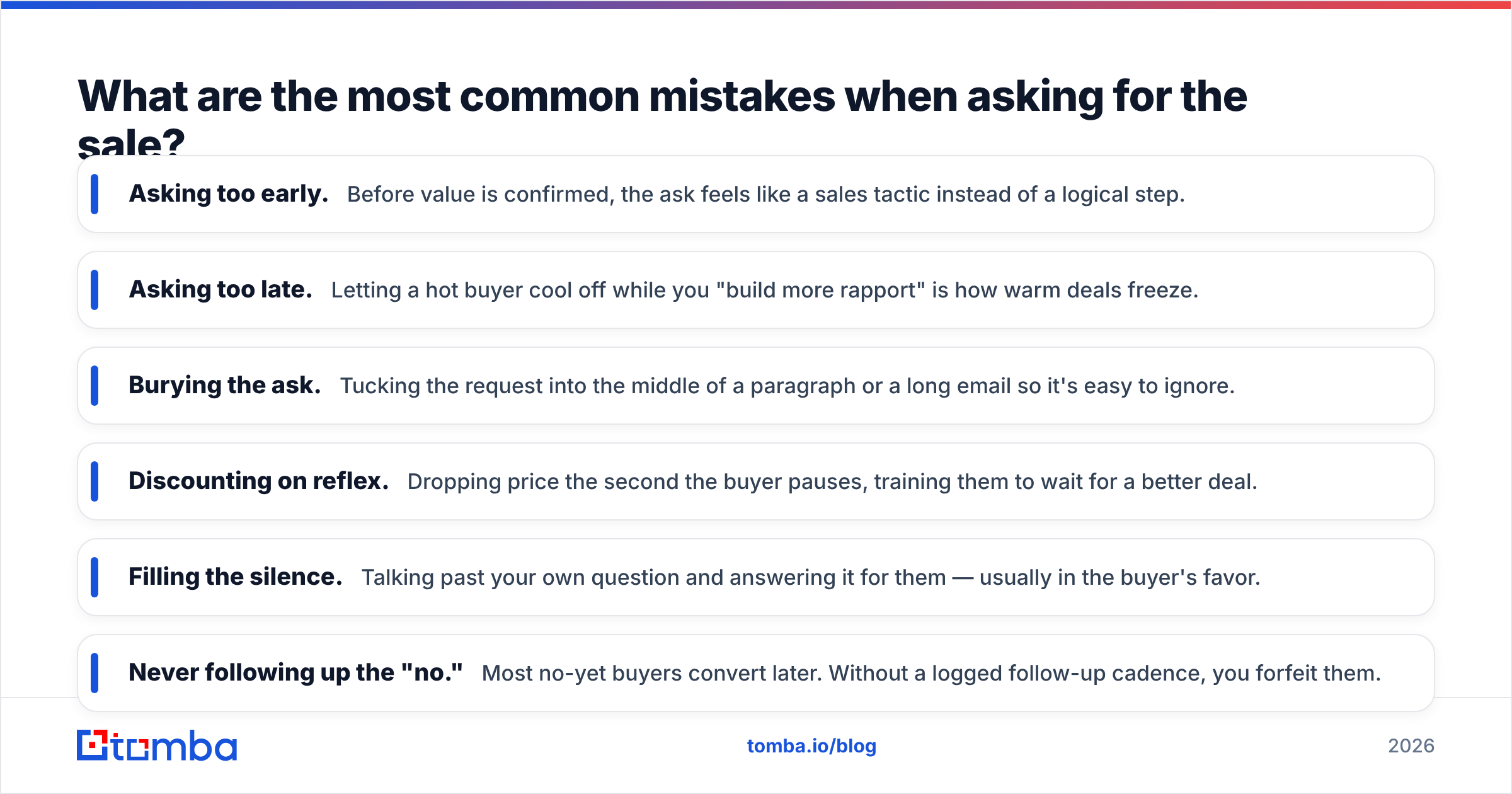
- Asking too early. Before value is confirmed, the ask feels like a sales tactic instead of a logical step.
- Asking too late. Letting a hot buyer cool off while you "build more rapport" is how warm deals freeze.
- Burying the ask. Tucking the request into the middle of a paragraph or a long email so it's easy to ignore.
- Discounting on reflex. Dropping price the second the buyer pauses, training them to wait for a better deal.
- Filling the silence. Talking past your own question and answering it for them — usually in the buyer's favor.
- Never following up the "no." Most no-yet buyers convert later. Without a logged follow-up cadence, you forfeit them.
How do you build asking for the sale into your process?#
Turn the close from a personality trait into a repeatable step. Add a required "commitment requested?" field to your CRM stage gates so a deal can't advance to "closing" until a rep has actually asked. Script the seven closes and have reps practice them in role-plays until the words feel natural. Review lost deals specifically for whether — and how — the ask was made.
When the behavior is built into the sales process and pipeline, it stops depending on whether a given rep felt brave that day. The system carries the discipline so individuals don't have to.
The bottom line#
Asking for the sale is a learnable, repeatable skill, not a gift some reps are born with. Confirm value, choose the close that matches the buyer's signal, ask once with a clear action and timeframe, and then hold the silence. Do that consistently and your close rate climbs without a single gimmick.
But none of it matters if your outreach never reaches a real, qualified decision-maker. Feed the top of your funnel with verified contacts so every closing conversation is one you actually get to have. Start with Tomba's Email Finder to surface accurate work emails by name, company, or domain — then spend your energy on the only step that closes deals: asking for the sale. Check Tomba pricing to find the plan that fits your team, starting free with 25 searches a month.
// get started
Find, verify and enrich your first contacts today
Start on the free plan with 25 searches a month, then scale when your team is ready.
Free plan · No credit card required · GDPR & CCPA
Get the Tomba newsletter
Product and data updates
// about the author