Average Cold Email Conversion Rate in 2026: Real Benchmarks
What counts as a good cold email conversion rate in 2026? Real benchmarks for reply, positive-reply, and meeting-booked rates — plus the levers that move them.
TL;DR
- The average cold email conversion rate lands around 1–5% reply rate, with 0.5–2% positive replies and roughly 0.3–1% booked meetings per email sent in 2026.
- "Conversion" means different things at each stage — open, reply, positive reply, meeting, closed deal. Pick one definition and measure it consistently or your benchmarks are noise.
- The biggest lever is not your subject line. It is list quality: verified, well-targeted contacts convert several times higher than scraped, unverified lists.
- Deliverability sets your ceiling. If 30% of your sends bounce or hit spam, no amount of copy genius fixes the math.
- Realistic 2026 targets: 5%+ reply rate is good, 10%+ is excellent, and 1%+ meeting rate per send is a strong outbound engine.
What is the average cold email conversion rate in 2026?#
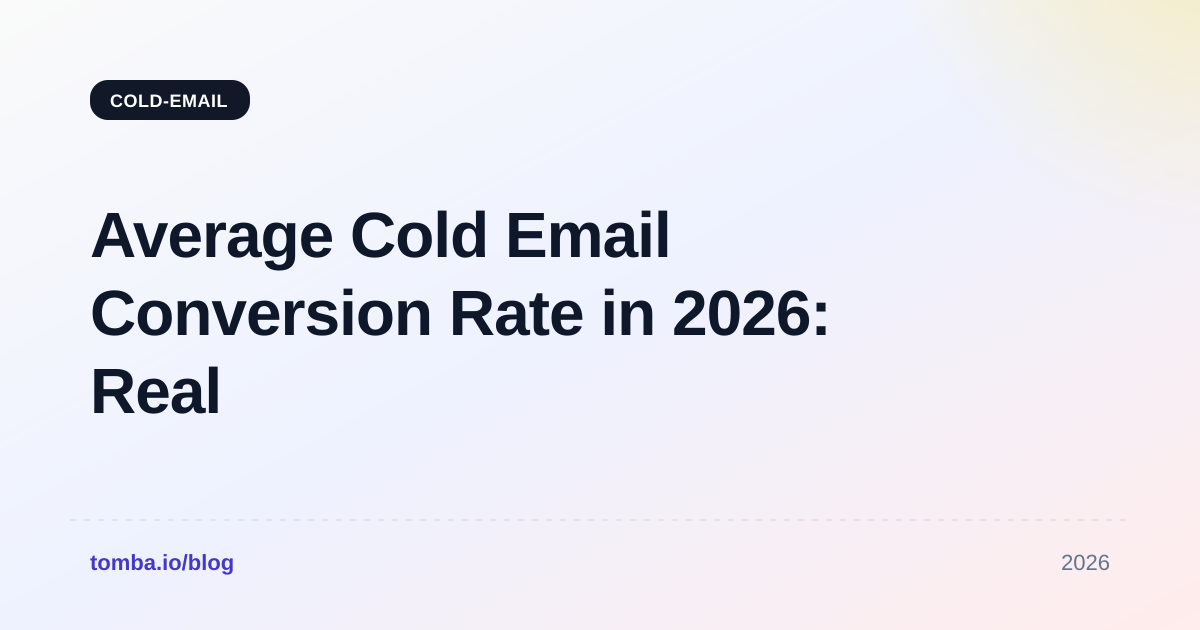
Short answer: most cold campaigns convert between 1% and 5% when "conversion" means a reply, and between 0.3% and 1% when it means a booked meeting. Anything above those bands puts you in the top quartile.
The confusion starts because "conversion rate" is a slippery term. A marketer running a webinar invite, an SDR booking demos, and a founder chasing partnerships all use the same phrase for completely different outcomes. Think of it like "miles per gallon" — useless until you know the car, the road, and who's driving.
Cold email is a funnel, and every stage has its own rate:
- Delivery rate — the share of sent emails that actually reach an inbox (target: 95%+).
- Open rate — opens divided by delivered. Increasingly unreliable since Apple Mail Privacy Protection inflates it; treat it as directional, not gospel.
- Reply rate — total replies divided by sent. The cleanest top-line health metric.
- Positive reply rate — interested replies only, stripping out "unsubscribe" and "wrong person."
- Meeting / conversion rate — the action you actually want, divided by sent.
When someone quotes you a single "conversion rate," your first question should be: converted to what?

What's a good cold email reply rate versus conversion rate?#
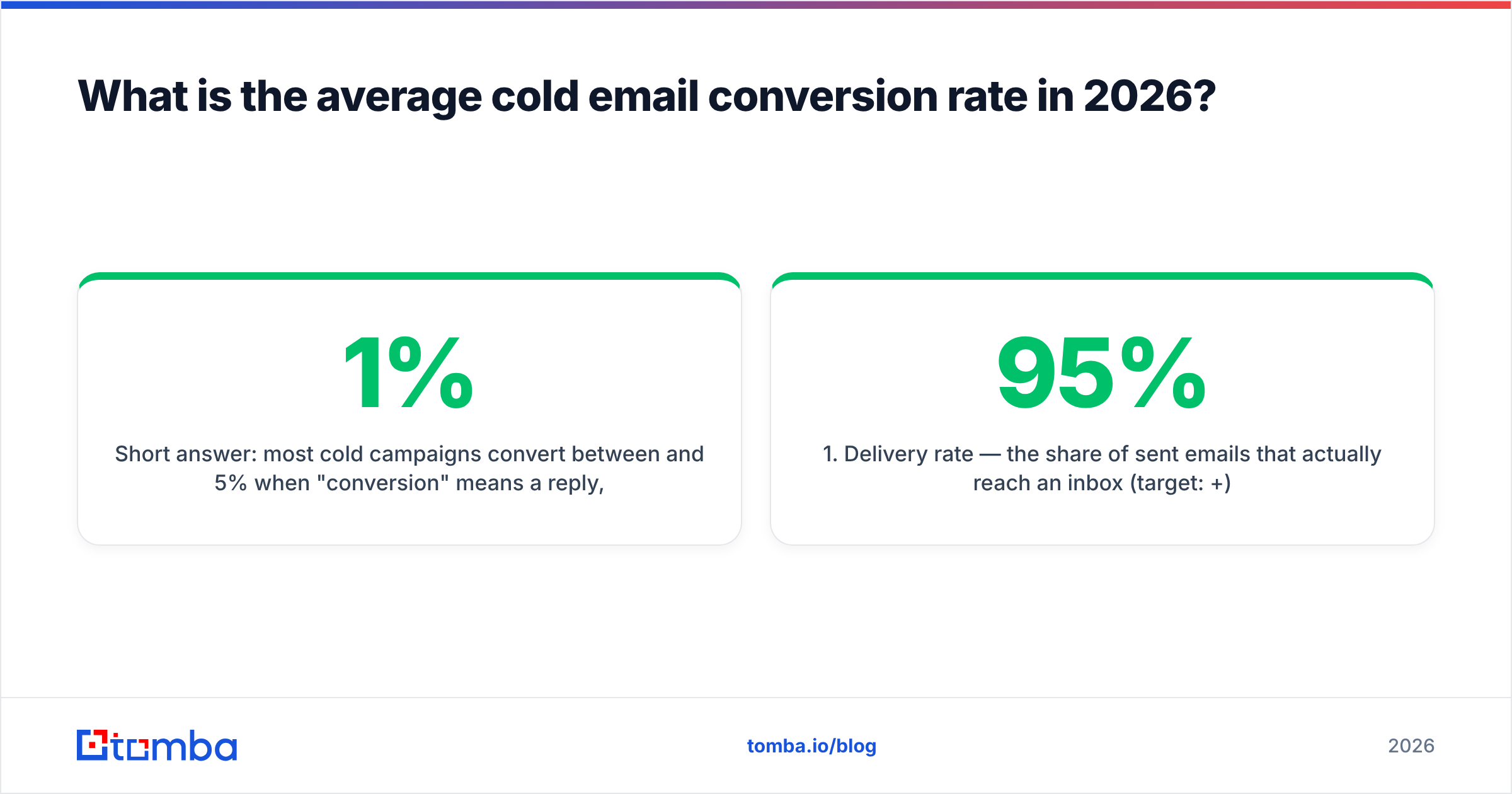
A good reply rate in 2026 is 5% or higher; a good meeting rate is 1% or higher of total emails sent. Here is how the stages typically stack up across B2B outbound:
| Funnel stage | Poor | Average | Good | Excellent |
|---|---|---|---|---|
| Delivery rate | < 90% | 92–95% | 96–98% | 99%+ |
| Open rate | < 20% | 25–40% | 45–60% | 60%+ |
| Reply rate | < 1% | 1–5% | 5–10% | 10%+ |
| Positive reply rate | < 0.5% | 0.5–2% | 2–5% | 5%+ |
| Meeting booked (per send) | < 0.2% | 0.3–1% | 1–3% | 3%+ |
Two things to notice. First, the drop from reply rate to positive reply rate is brutal — roughly half of all replies are neutral or negative ("not interested," "remove me"). Plan for it. Second, small absolute numbers compound: a 1% meeting rate on 3,000 well-targeted sends is 30 conversations, which for most B2B teams is a full pipeline month.
A useful rule of thumb: if you want N meetings, and your realistic meeting rate is around 1%, you need roughly 100 × N verified, targeted contacts in the campaign — not 100 × N scraped rows, verified ones. The distinction is the whole game.
Why is list quality the biggest conversion lever?#
Because you cannot convert someone who never receives the email. List quality decides your floor and your ceiling at the same time.
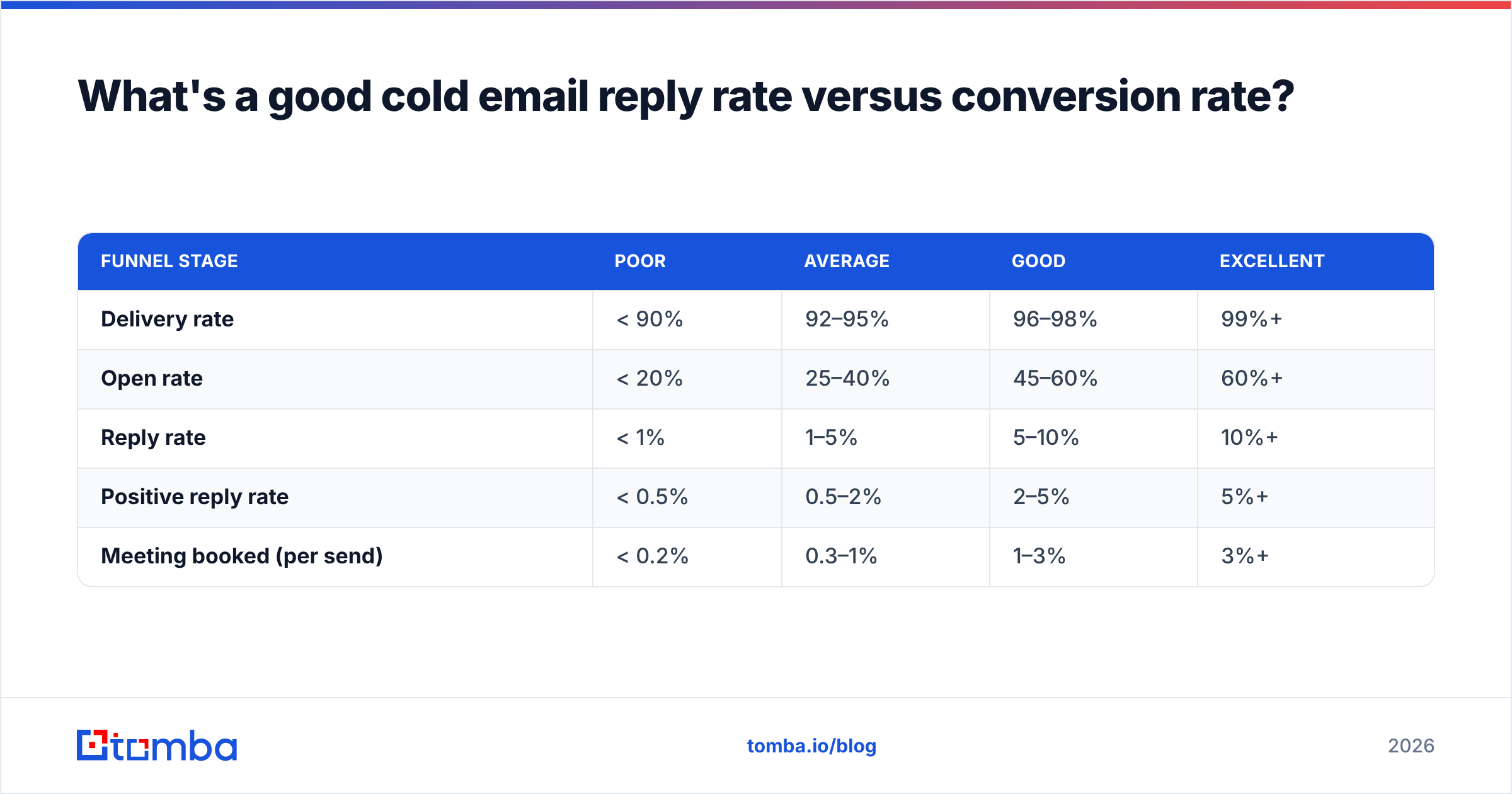
Run the math on a 1,000-contact campaign with a sloppy list versus a clean one:
- Sloppy list: 25% invalid addresses. You send 1,000, 250 bounce, your sender reputation drops, another 150 land in spam. Only ~600 reach a human. At a 3% reply rate on delivered, that's 18 replies.
- Clean list: 3% invalid after verification. You send 1,000, 30 bounce, reputation stays healthy, ~950 reach the inbox. At the same 3% reply rate, that's ~28 replies — 55% more from identical copy.
That gap exists before anyone reads a word you wrote. High bounce rates also trigger spam filters, so a bad list quietly poisons the deliverability of your next campaign too. This is why verification is non-negotiable: run every address through an email verifier before you load it into a sequence, and use a bulk email finder that returns confidence scores rather than guesses.
Targeting matters just as much as validity. A perfectly deliverable email to the wrong persona converts at zero. Building lists from a precise domain search — pulling the actual decision-makers at companies that fit your ICP — beats buying a generic 50,000-row database every time. Per-contact relevance is what moves the positive-reply rate, and positive replies are the only ones that pay rent.

How do deliverability and volume change the numbers?#
Deliverability is the multiplier on everything else, and in 2026 the rules are stricter than ever. Google and Yahoo now enforce authentication and complaint-rate thresholds that quietly kill unprepared senders.
The non-negotiable setup checklist:
- Authenticate fully — SPF, DKIM, and DMARC all aligned. Missing records send you straight to spam. Check your SPF record and run a quick audit before launch.
- Warm up new domains — never blast from a domain registered last week. Ramp sending volume over 3–6 weeks.
- Keep complaint rate under 0.3% — Gmail's hard line. One bad campaign can blacklist a domain.
- Cap daily volume per inbox — 30–50 cold sends per mailbox per day is the safe modern range; scale by adding mailboxes, not by cranking one inbox to 500.
- Use a separate sending domain — protect your primary corporate domain's reputation from cold-outreach risk.
Google's own Postmaster Tools documentation spells out the sender requirements, and it's worth reading directly rather than trusting third-hand summaries. The takeaway for conversion math: a campaign with broken authentication can lose 30–50% of its delivered volume to spam folders, which silently halves your conversion rate no matter how sharp the copy is. For a deeper treatment of inbox placement, see the fundamentals of email deliverability.
How do you actually increase cold email conversion rate?#
Fix the funnel in order — top to bottom. Optimizing copy while your list bounces is like polishing the trim on a car with no engine.
The priority stack, highest impact first:
- Targeting and list quality (biggest lever). Tighten your ICP. Verify every address. A smaller, more relevant list almost always out-converts a bigger generic one. This is where 60% of your gains live.
- Deliverability. Authentication, warmup, volume discipline. Protects the gains above.
- Personalization that signals research. A single specific, true line about the prospect's company beats three paragraphs of generic flattery. Reference a recent hire, a product launch, a real trigger event.
- Offer and relevance of the ask. "15 minutes to show you X" converts better than "let's hop on a call." Make the value obvious and the next step tiny.
- Subject line and first sentence. They control opens and the preview pane. Keep them short, lowercase-ish, and curiosity-driven — not salesy.
- Follow-ups. 40–50% of replies come from follow-ups, not the first email. Three to four well-spaced touches is the sweet spot; more than six annoys.
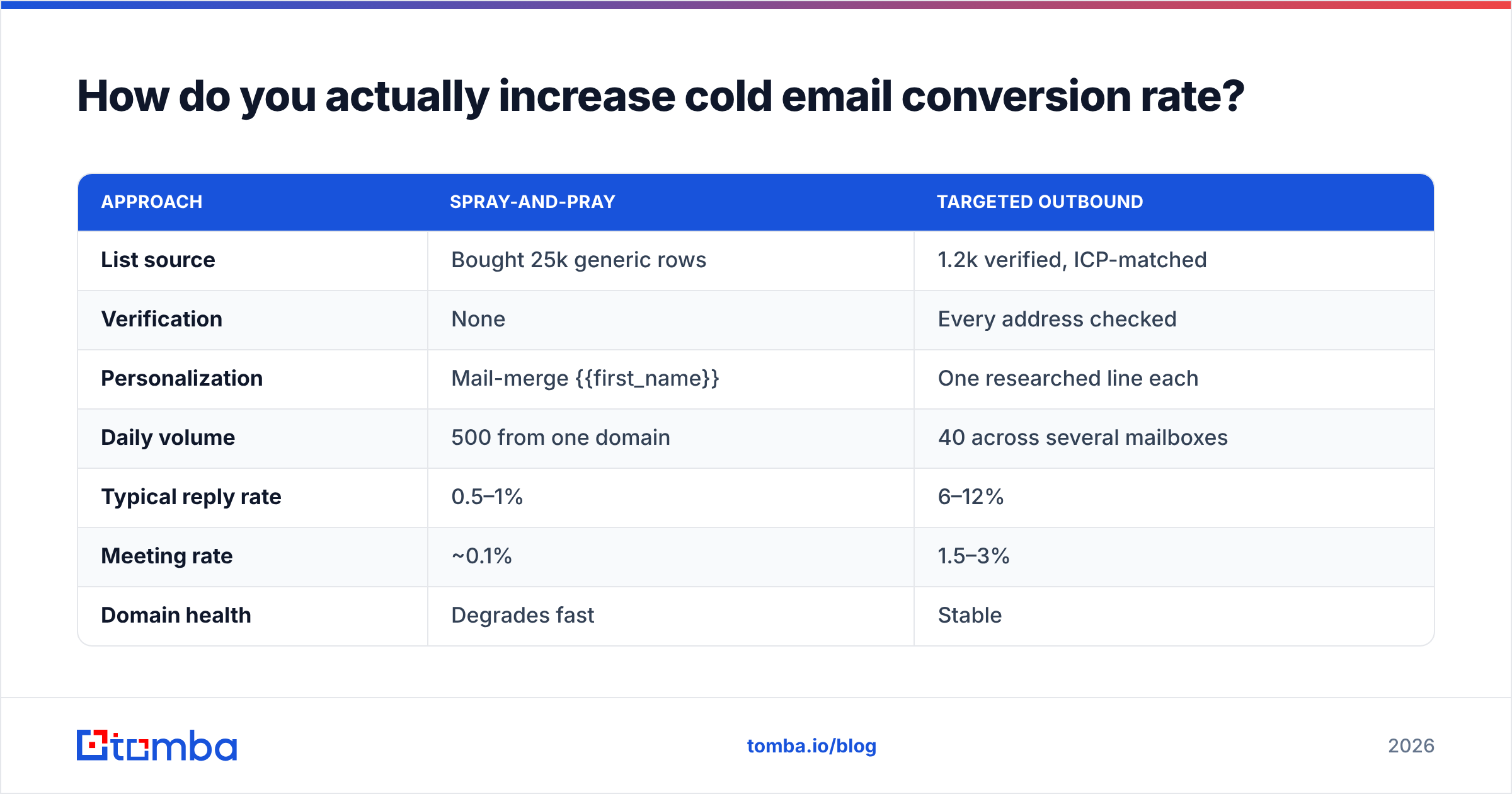
A practical comparison of two real-world approaches:
| Approach | Spray-and-pray | Targeted outbound |
|---|---|---|
| List source | Bought 25k generic rows | 1.2k verified, ICP-matched |
| Verification | None | Every address checked |
| Personalization | Mail-merge {{first_name}} | One researched line each |
| Daily volume | 500 from one domain | 40 across several mailboxes |
| Typical reply rate | 0.5–1% | 6–12% |
| Meeting rate | ~0.1% | 1.5–3% |
| Domain health | Degrades fast | Stable |
The targeted column costs more time per contact and far less money per result. That is the entire argument for doing outbound properly in 2026.
What conversion metrics should you track and benchmark?#
Track these five, review weekly, and never optimize one in isolation:
- Reply rate — your campaign's pulse. Sudden drops usually mean a deliverability problem, not a copy problem.
- Positive reply rate — the honest measure of message-market fit. If replies are high but positives are low, your targeting or offer is off.
- Meeting rate per send — the metric your revenue team actually cares about.
- Bounce rate — keep it under 3%. Above 5% and you're damaging your domain with every send.
- Unsubscribe / complaint rate — your early-warning system. Rising complaints predict a deliverability cliff.
For industry context on what "good" looks like beyond cold email specifically, HubSpot's email marketing benchmarks and peer-review data on G2 are reasonable external anchors — just remember marketing-email benchmarks (opt-in lists) run higher than cold-outbound benchmarks, so don't compare yourself to the wrong baseline.
One more discipline: segment your reporting. A blended 3% reply rate can hide a 9% rate to your best segment and a 0.5% rate to a segment you should cut entirely. Averages lie; segments tell the truth.
Frequently asked questions#
Is a 2% cold email conversion rate good? It depends on the definition. A 2% reply rate is average-to-below-average and signals room to improve targeting or copy. A 2% meeting rate per send is genuinely strong outbound. Always clarify which number you're quoting.
What's a realistic meeting-booked rate from cold email? For a well-run, verified, targeted campaign, 1–3% of emails sent converting to booked meetings is realistic in 2026. Below 0.3% suggests a list or deliverability problem; above 3% means you've found strong product-market fit in that segment.
Do longer sequences convert better? Up to a point. Three to four touches capture most of the upside because nearly half of replies come after the first email. Beyond six touches, complaint and unsubscribe rates climb faster than incremental replies, hurting your domain.
Does personalization actually raise conversion? Yes, when it signals real research. One true, specific line about the prospect reliably lifts positive-reply rates. Token-merge "personalization" ({{first_name}} only) does almost nothing.
Build the list that actually converts#
Every benchmark in this post traces back to one starting point: the quality of the contacts you load into the sequence. Spend your energy there first. Define a tight ICP, find the real decision-makers, and verify every address before a single email goes out.
That's exactly what the Tomba Email Finder is built for — finding accurate, professional email addresses by name, company, or domain, with confidence scores and built-in verification so your bounce rate stays low and your sender reputation stays clean. Pair it with the email verifier for a final pre-send pass, and start on the free tier (25 searches/month); paid plans begin at $49/mo with full details on the Tomba pricing page. Get the list right, and the average cold email conversion rate stops being something you read about — it becomes your floor.
// get started
Find, verify and enrich your first contacts today
Start on the free plan with 25 searches a month, then scale when your team is ready.
Free plan · No credit card required · GDPR & CCPA
// about the author