Avoma vs Gong 2026: Which Revenue Intelligence Tool Wins?
Avoma vs Gong, broken down by pricing, AI accuracy, coaching, and team size — so you can pick the conversation intelligence platform that actually fits your revenue motion in 2026.
Choosing between Avoma and Gong is really a choice between two philosophies: an affordable all-in-one meeting assistant versus a premium revenue intelligence platform built for large, coached sales orgs. This guide cuts through the marketing and shows you exactly which one fits your team, budget, and stage in 2026.
TL;DR — Avoma vs Gong at a glance#
- Avoma is the budget-friendly, all-in-one pick: AI note-taking, scheduling, and basic deal intelligence starting under $20/user. Best for SMBs and lean RevOps teams.
- Gong is the enterprise-grade revenue intelligence leader: deeper deal forecasting, market intelligence, and coaching analytics — but pricing is quote-only and lands in the high three to four figures per seat per year.
- Pick Avoma if you want fast time-to-value, transparent pricing, and a single tool that also handles scheduling.
- Pick Gong if you run a 50+ rep org, need rigorous forecasting, and have budget to match.
- Neither tool finds or enriches contact data — pair whichever you choose with a dedicated data enrichment source so reps spend calls selling, not data-entry.
What is the core difference between Avoma and Gong?#
Avoma is a meeting lifecycle assistant; Gong is a revenue intelligence system. That single sentence explains most of the pricing, feature, and audience gaps you'll run into.
Avoma thinks in terms of the meeting: book it, record it, transcribe it, summarize it, and push notes to your CRM. Conversation intelligence and basic deal tracking sit on top of that foundation. It's like hiring a sharp executive assistant who also happens to take great notes.
Gong thinks in terms of revenue: every call, email, and deal signal feeds a model that scores pipeline health, flags at-risk deals, and benchmarks rep behavior against what closes. It's less an assistant and more a revenue radar for the whole go-to-market team.
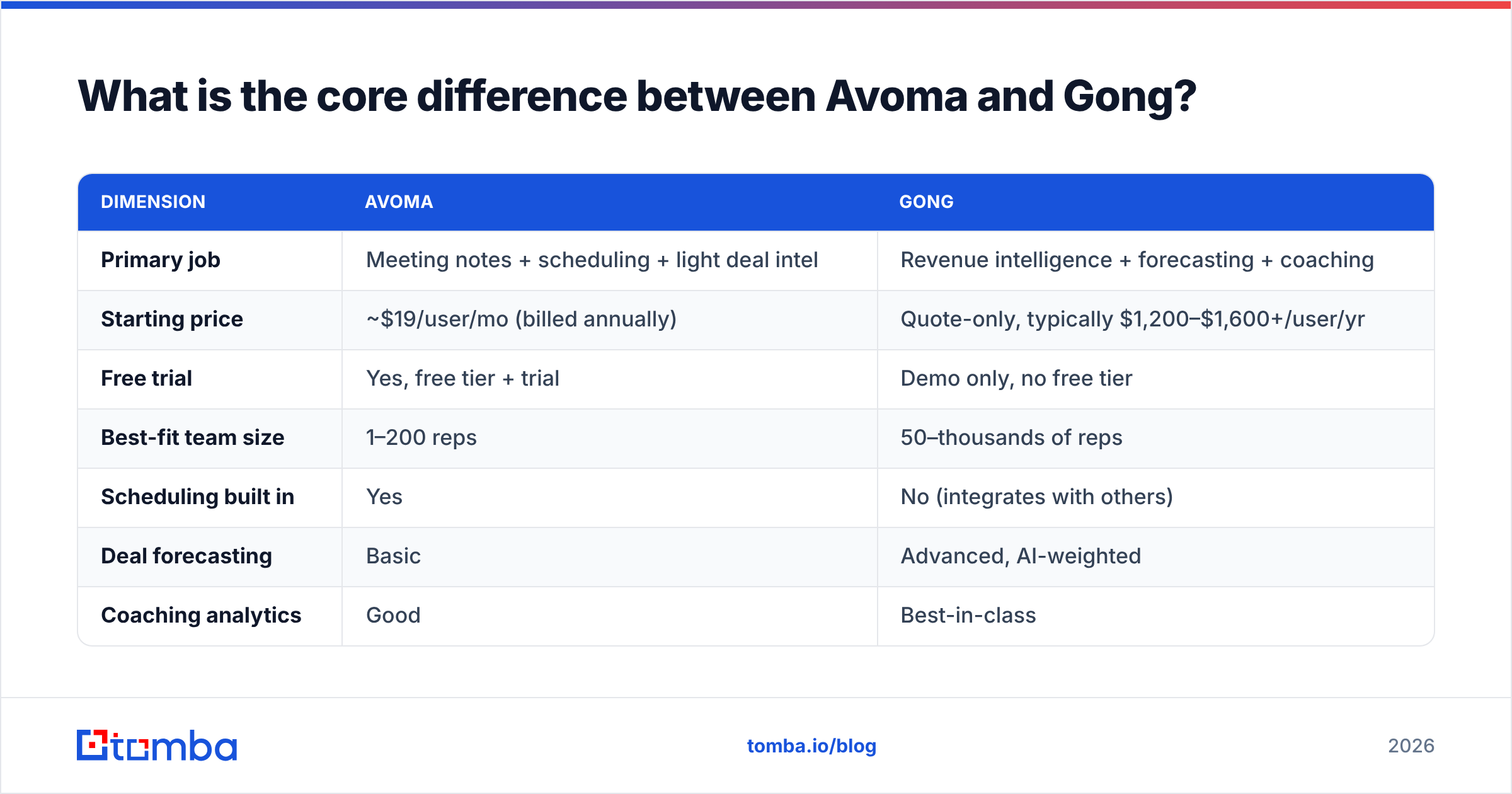
Here's how the two map across the dimensions buyers actually weigh:
| Dimension | Avoma | Gong |
|---|---|---|
| Primary job | Meeting notes + scheduling + light deal intel | Revenue intelligence + forecasting + coaching |
| Starting price | ~$19/user/mo (billed annually) | Quote-only, typically $1,200–$1,600+/user/yr |
| Free trial | Yes, free tier + trial | Demo only, no free tier |
| Best-fit team size | 1–200 reps | 50–thousands of reps |
| Scheduling built in | Yes | No (integrates with others) |
| Deal forecasting | Basic | Advanced, AI-weighted |
| Coaching analytics | Good | Best-in-class |
| Setup time | Hours to days | Weeks, with onboarding |
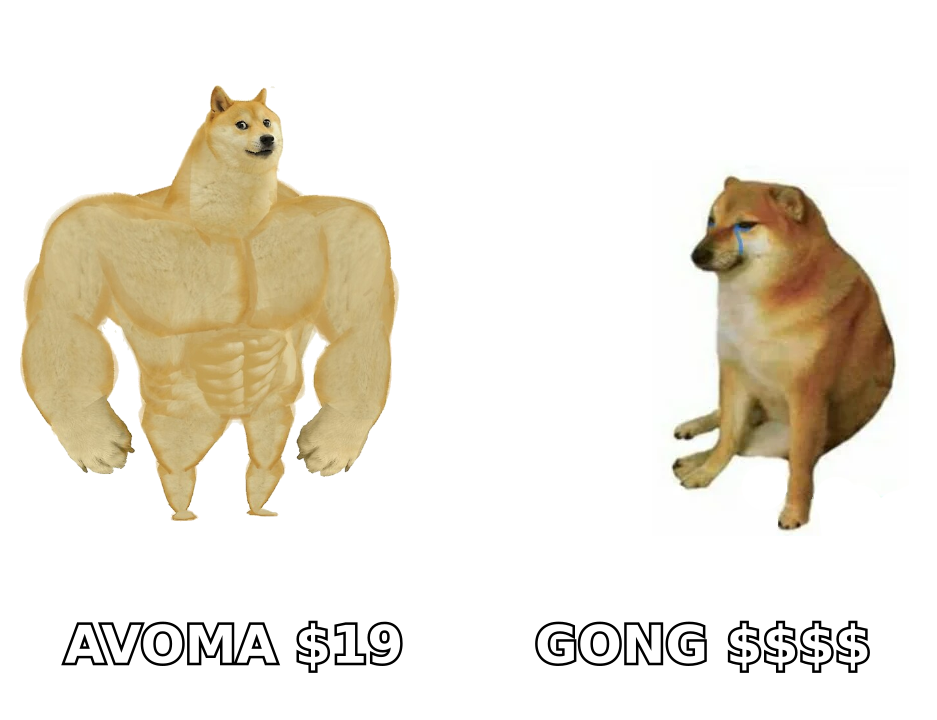
Image above is a meme placeholder; the orchestrator swaps it for the rendered version.
How do Avoma and Gong price their plans in 2026?#
Avoma wins on price transparency and entry cost; Gong wins on enterprise depth you pay a premium for.
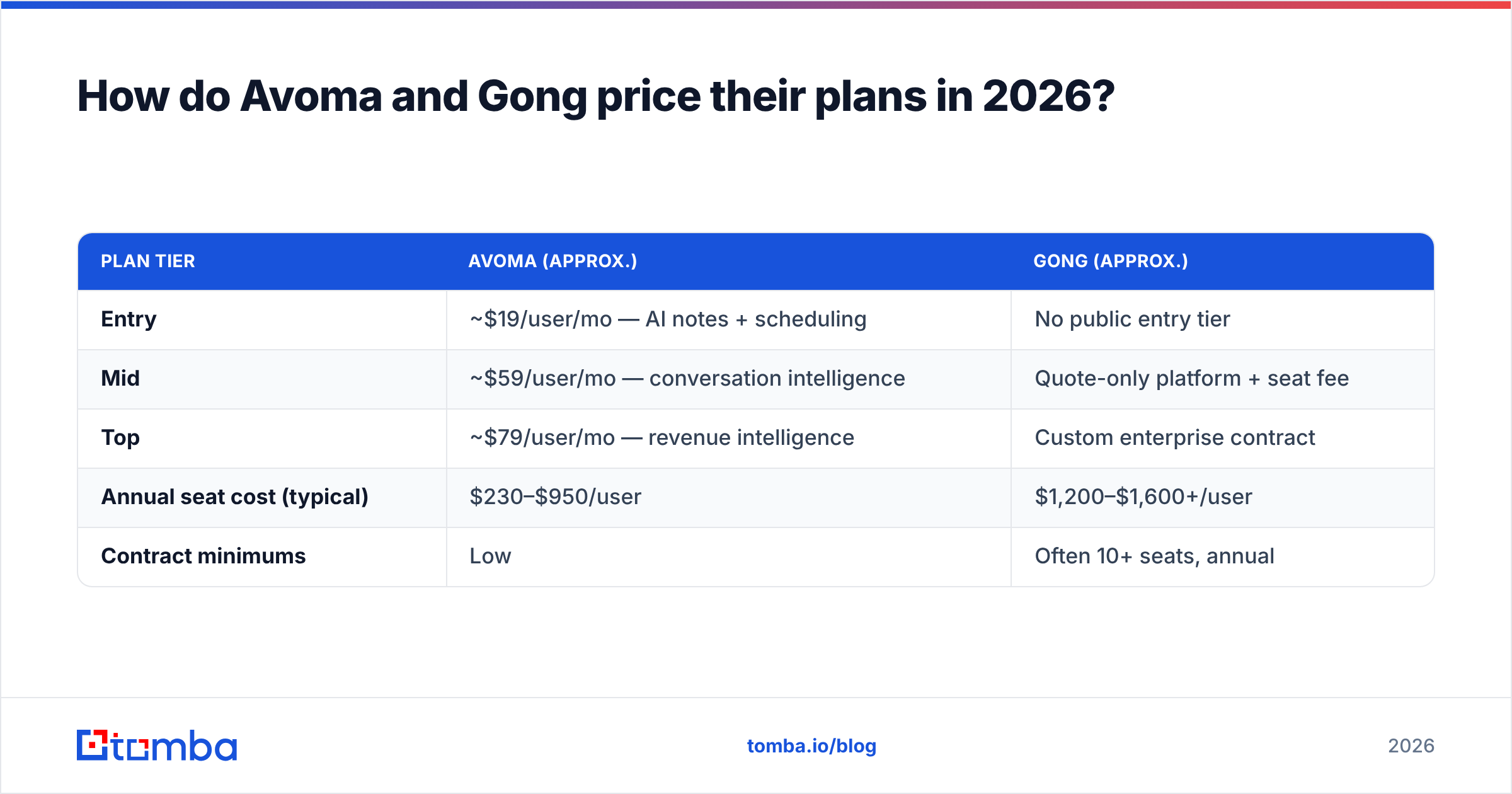
Avoma publishes tiered pricing on its site, which makes budgeting painless. Plans scale from a basic AI meeting assistant up to a full conversation-and-revenue-intelligence bundle. Gong, like most enterprise revenue platforms, runs a quote-only model with an annual platform fee plus per-seat licensing — expect a sales conversation before you see a number.
| Plan tier | Avoma (approx.) | Gong (approx.) |
|---|---|---|
| Entry | ~$19/user/mo — AI notes + scheduling | No public entry tier |
| Mid | ~$59/user/mo — conversation intelligence | Quote-only platform + seat fee |
| Top | ~$79/user/mo — revenue intelligence | Custom enterprise contract |
| Annual seat cost (typical) | $230–$950/user | $1,200–$1,600+/user |
| Contract minimums | Low | Often 10+ seats, annual |
The takeaway: if you have ten reps and a tight budget, Avoma's annual cost can be a tenth of Gong's. If you have two hundred reps and forecasting accuracy is worth six figures of pipeline, Gong's premium is easier to justify. Always validate current numbers on the vendors' own pricing pages and on third-party review sites like G2, because both platforms revise packaging frequently.
Which has better AI note-taking and transcription accuracy?#
Both are strong; Avoma is faster to deploy, Gong is more accurate on noisy, multi-speaker enterprise calls.
Avoma's AI notes are genuinely good — speaker identification, topic detection, automatic summaries, and action items that sync to your CRM without manual cleanup. For most SMB sales and customer-success calls, the output is ready to paste into a deal record.
Gong invests heavily in transcription quality across accents, industries, and crosstalk-heavy calls, and its topic-tracking (competitor mentions, pricing objections, next steps) is more granular. It also analyzes emails and other touchpoints, not just calls, giving a fuller activity picture.
A practical note on accuracy that applies to both: AI summaries are only as useful as the contact and account data they attach to. If your CRM record has the wrong title, a stale email, or a missing phone number, even a perfect transcript lands on a broken foundation. That's why mature teams keep their records clean with a contact enrichment layer and validated B2B phone numbers feeding the CRM before calls ever get recorded.
Is Gong better than Avoma for deal intelligence and forecasting?#
Yes — forecasting is Gong's flagship strength and the clearest reason enterprises pay its premium.
Gong's deal and forecast intelligence weighs hundreds of signals — engagement frequency, sentiment shifts, single-threaded risk, stalled next steps — to predict which deals will actually close. Sales leaders use it to run data-driven forecast calls and catch slipping deals weeks earlier than a CRM stage field would reveal.
Avoma offers deal intelligence too, but it's lighter: pipeline visibility, conversation trends, and risk flags that work well for SMB pipelines without the depth (or the cost) of Gong's models.
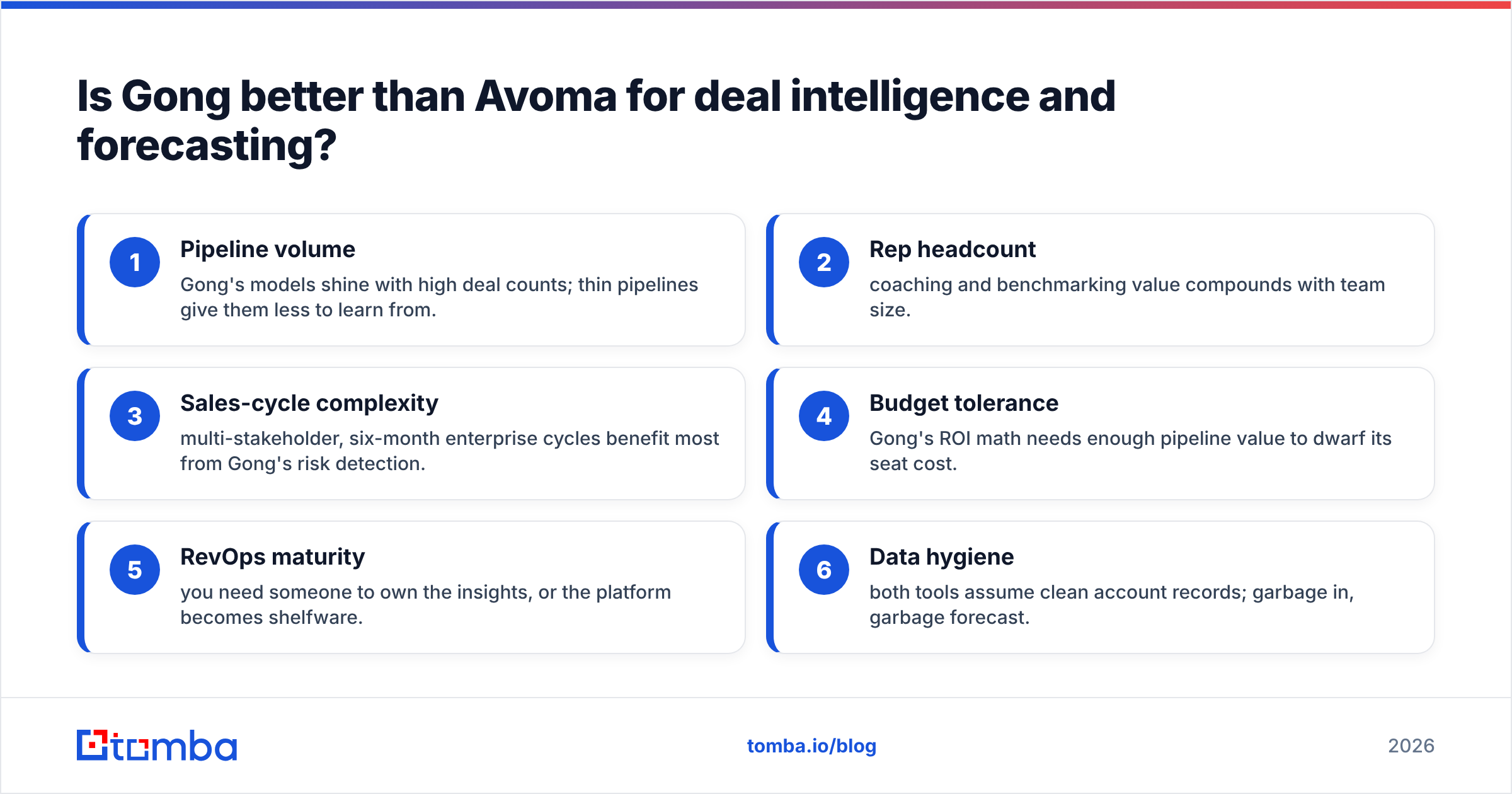
Consider these decision factors when forecasting accuracy is the priority:
- Pipeline volume — Gong's models shine with high deal counts; thin pipelines give them less to learn from.
- Rep headcount — coaching and benchmarking value compounds with team size.
- Sales-cycle complexity — multi-stakeholder, six-month enterprise cycles benefit most from Gong's risk detection.
- Budget tolerance — Gong's ROI math needs enough pipeline value to dwarf its seat cost.
- RevOps maturity — you need someone to own the insights, or the platform becomes shelfware.
- Data hygiene — both tools assume clean account records; garbage in, garbage forecast.
If three or more of those point toward complexity and scale, Gong earns its keep. If not, Avoma covers the same jobs for a fraction of the spend.
How do Avoma and Gong compare on coaching and team enablement?#
Gong is the gold standard for scaled coaching; Avoma covers the essentials for smaller teams.
Gong's coaching suite — scorecards, call libraries, talk-ratio and longest-monologue analytics, and rep-to-benchmark comparisons — is built to ramp dozens of reps consistently. Enablement leaders can build a coaching program directly inside the platform.
Avoma provides scorecards, keyword tracking, and playlists too, which is plenty for a team of five to thirty reps where the manager already coaches one-to-one. The difference is scale and statistical rigor, not the presence of features.
What integrations and workflows do they support?#
Both cover the major CRMs and dialers; Avoma adds native scheduling, Gong adds a deeper analytics ecosystem.
Avoma integrates with Salesforce, HubSpot, Pipedrive,
Zoom, Google Meet, Microsoft Teams, and conferencing/dialer tools — and uniquely bundles meeting scheduling, so it can replace a separate calendar-booking app.
Gong connects to the same CRMs and dialers plus a broad partner ecosystem aimed at RevOps and analytics workflows, and it ingests email activity for a fuller engagement model. It does not include native scheduling.
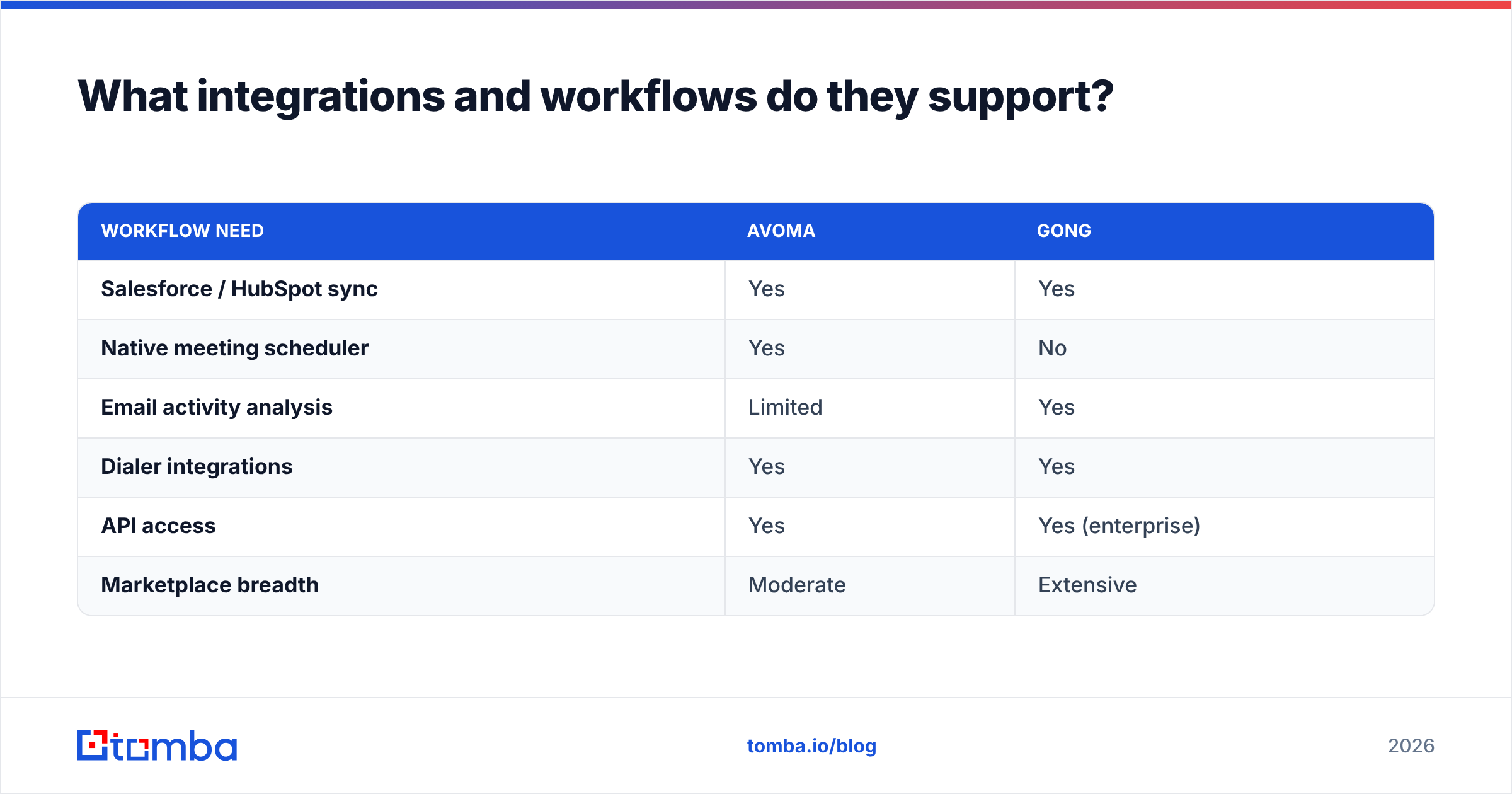
| Workflow need | Avoma | Gong |
|---|---|---|
| Salesforce / HubSpot sync | Yes | Yes |
| Native meeting scheduler | Yes | No |
| Email activity analysis | Limited | Yes |
| Dialer integrations | Yes | Yes |
| API access | Yes | Yes (enterprise) |
| Marketplace breadth | Moderate | Extensive |
Whichever you choose, the upstream gap is the same: neither platform sources new contacts. They analyze conversations with people already in your pipeline. To fill that pipeline, teams pair their conversation-intelligence tool with an email finder and verification layer so reps reach the right person with a deliverable address before a call ever gets booked. For a primer on the underlying concept, the CRM glossary entry is a useful refresher on how these systems share data.
Avoma vs Gong: pros and cons#
Avoma pros
- Transparent, low entry pricing
- All-in-one: notes, scheduling, and intelligence in one tool
- Fast setup and quick time-to-value
- Free tier and trial to test before buying
Avoma cons
- Forecasting and coaching less advanced at scale
- Fewer market-intelligence features
- Best fit caps out around mid-market
Gong pros
- Best-in-class forecasting and deal risk detection
- Deepest coaching and enablement analytics
- Analyzes calls and emails for full engagement view
- Trusted by large, complex sales orgs
Gong cons
- Quote-only, premium pricing
- Longer onboarding and a steeper learning curve
- Overkill (and overpriced) for small teams
- No built-in scheduling
Which should you choose — Avoma or Gong?#
Choose Avoma if you're an SMB or mid-market team that wants strong AI notes, scheduling, and solid deal intel without an enterprise price tag. It delivers most of the day-to-day value of conversation intelligence at a cost a growing team can absorb, and you'll be live in days, not weeks.
Choose Gong if you run a large, coached revenue org where forecast accuracy and rep benchmarking drive real money. When a single percentage point of forecast accuracy or win rate is worth more than the entire Gong contract, the premium is rational.
A simple rule of thumb: under ~30 reps, start with Avoma and revisit later; over ~50 reps with complex deals and a dedicated RevOps owner, evaluate Gong seriously. Between those, run both trials against your real calls before deciding. You can cross-check both vendors' current claims on their official sites — avoma.com and gong.io — and against verified user reviews.
The data layer both tools assume you already have#
Here's the part neither Avoma's nor Gong's marketing emphasizes: conversation intelligence starts after you've reached the right person. Both platforms make your existing conversations smarter, but they can't tell you who to call, find a verified email, or fix a CRM record full of bounced addresses and missing phone numbers.
That's the job to solve first. Tomba's Email Finder finds and verifies professional email addresses by name, domain, or company, so your reps book meetings with real, reachable buyers — the meetings your Avoma or Gong subscription then analyzes. Pair it with Tomba's verification and enrichment, available from a free tier up through paid plans (see full Tomba pricing), and you give whichever conversation-intelligence platform you pick clean fuel to run on. Start free, fill the pipeline, and let your AI assistant handle the rest.
// get started
Find, verify and enrich your first contacts today
Start on the free plan with 25 searches a month, then scale when your team is ready.
Free plan · No credit card required · GDPR & CCPA
Get the Tomba newsletter
Product and data updates
// about the author