The B2B Buying Process in 2026: Stages, Roles & How to Win
The B2B buying process now runs through 6-10 stakeholders and mostly happens before a rep gets a call. Here's the modern map, the buying roles, and how to influence each stage.
The way companies buy software, services, and tools has changed more in the last five years than in the previous twenty. If you are still selling like a single decision-maker picks up the phone, reads your pitch, and signs, you are selling to a buyer that no longer exists.
This guide maps the b2b buying process as it actually runs in 2026: who is in the room, what happens before you ever hear from them, where deals stall, and how to influence each stage with the right data and timing.
TL;DR#
- The b2b buying process is now a non-linear journey run by a 6–10 person buying committee, not a single decision-maker.
- Roughly 70% of the journey happens before a buyer talks to a vendor, so your content and data presence matter as much as your pitch.
- Deals stall most often at consensus-building, not at price — "no decision" beats your competitor more than your competitor does.
- Accurate contact and account data is the difference between reaching one champion and mapping the whole committee.
- Match your motion to the buying stage: educate early, differentiate in the middle, de-risk at the close.
What is the B2B buying process?#
The b2b buying process is the series of steps an organization moves through to recognize a problem, evaluate options, and commit to a purchase. Think of it like a group road trip: there is no single driver, everyone wants a say in the destination, and the trip stalls the moment one passenger isn't convinced. Technically, it's a multi-stakeholder, multi-stage decision cycle that blends individual research with group consensus.
Two things make it different from consumer buying:
- Multiple people decide. A typical purchase involves a buying committee of six to ten stakeholders, each with a veto.
- The stakes are organizational, not personal. Buyers carry career risk, budget scrutiny, and cross-team politics into every step.
Because of this, the modern process is messy. Gartner describes it as a set of "jobs" buyers loop through repeatedly rather than a clean funnel. A buyer might be deep in vendor evaluation, then jump back to problem definition when a new stakeholder joins.
What are the stages of the B2B buying process?#
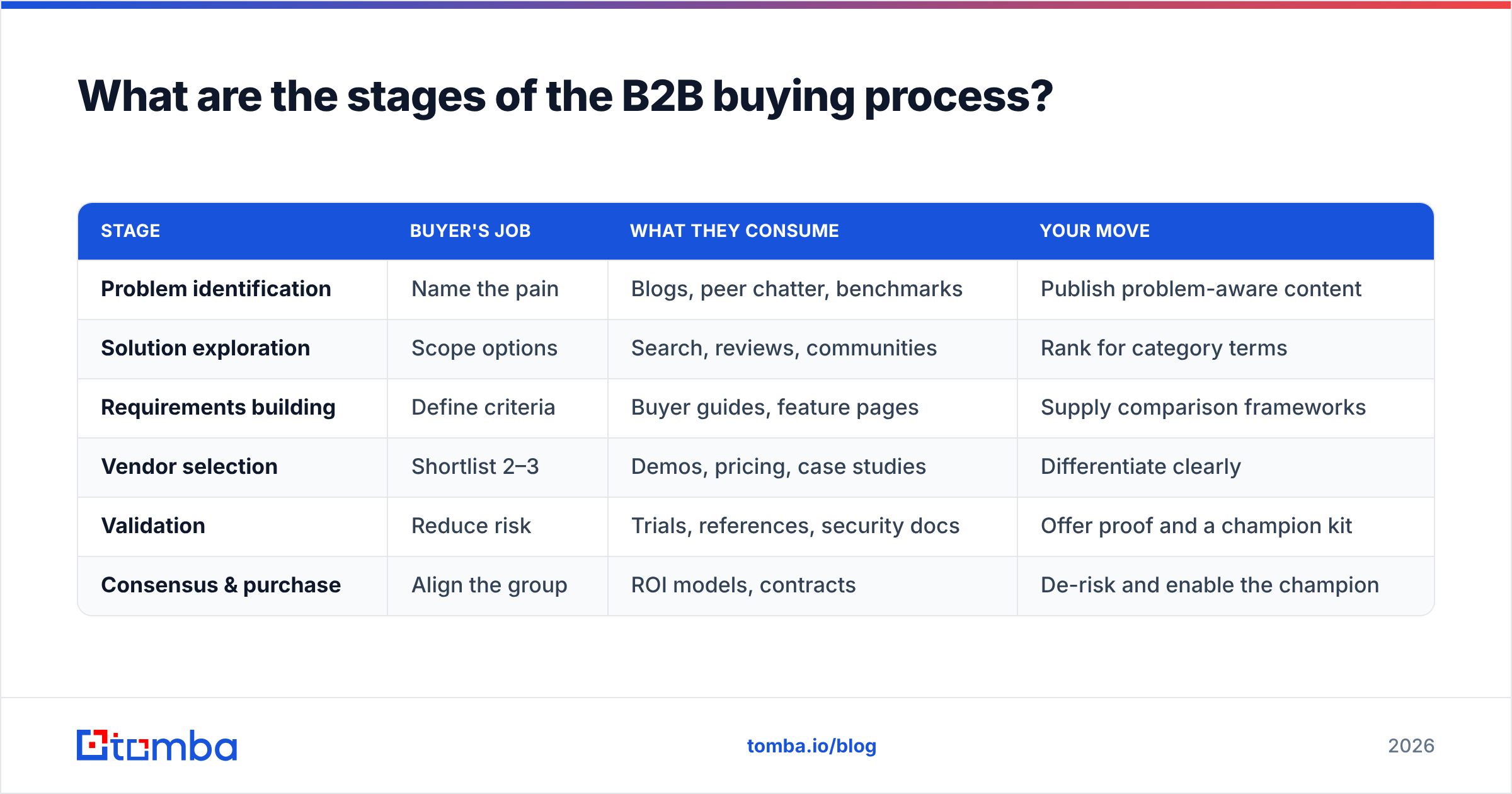
Even though the journey is non-linear, most purchases pass through six recognizable stages. Buyers revisit them out of order, but each one represents a distinct job that has to get done.
- Problem identification — A team realizes the status quo is costing them time, money, or growth. No vendor is in the picture yet.
- Solution exploration — Buyers research categories of solutions, mostly through search, peer communities, and review sites like G2.
- Requirements building — The committee defines must-haves, integrations, security needs, and budget guardrails.
- Vendor selection — Shortlisted vendors are compared head-to-head, often in a spreadsheet or scorecard.
- Validation — Buyers seek proof: demos, trials, references, ROI cases, and security reviews.
- Consensus and purchase — The committee aligns, procurement and legal step in, and the deal closes (or dies in "no decision").
Here is how each stage maps to what the buyer is actually doing and what you should do in response.
| Stage | Buyer's job | What they consume | Your move |
|---|---|---|---|
| Problem identification | Name the pain | Blogs, peer chatter, benchmarks | Publish problem-aware content |
| Solution exploration | Scope options | Search, reviews, communities | Rank for category terms |
| Requirements building | Define criteria | Buyer guides, feature pages | Supply comparison frameworks |
| Vendor selection | Shortlist 2–3 | Demos, pricing, case studies | Differentiate clearly |
| Validation | Reduce risk | Trials, references, security docs | Offer proof and a champion kit |
| Consensus & purchase | Align the group | ROI models, contracts | De-risk and enable the champion |
Who is in the B2B buying committee?#
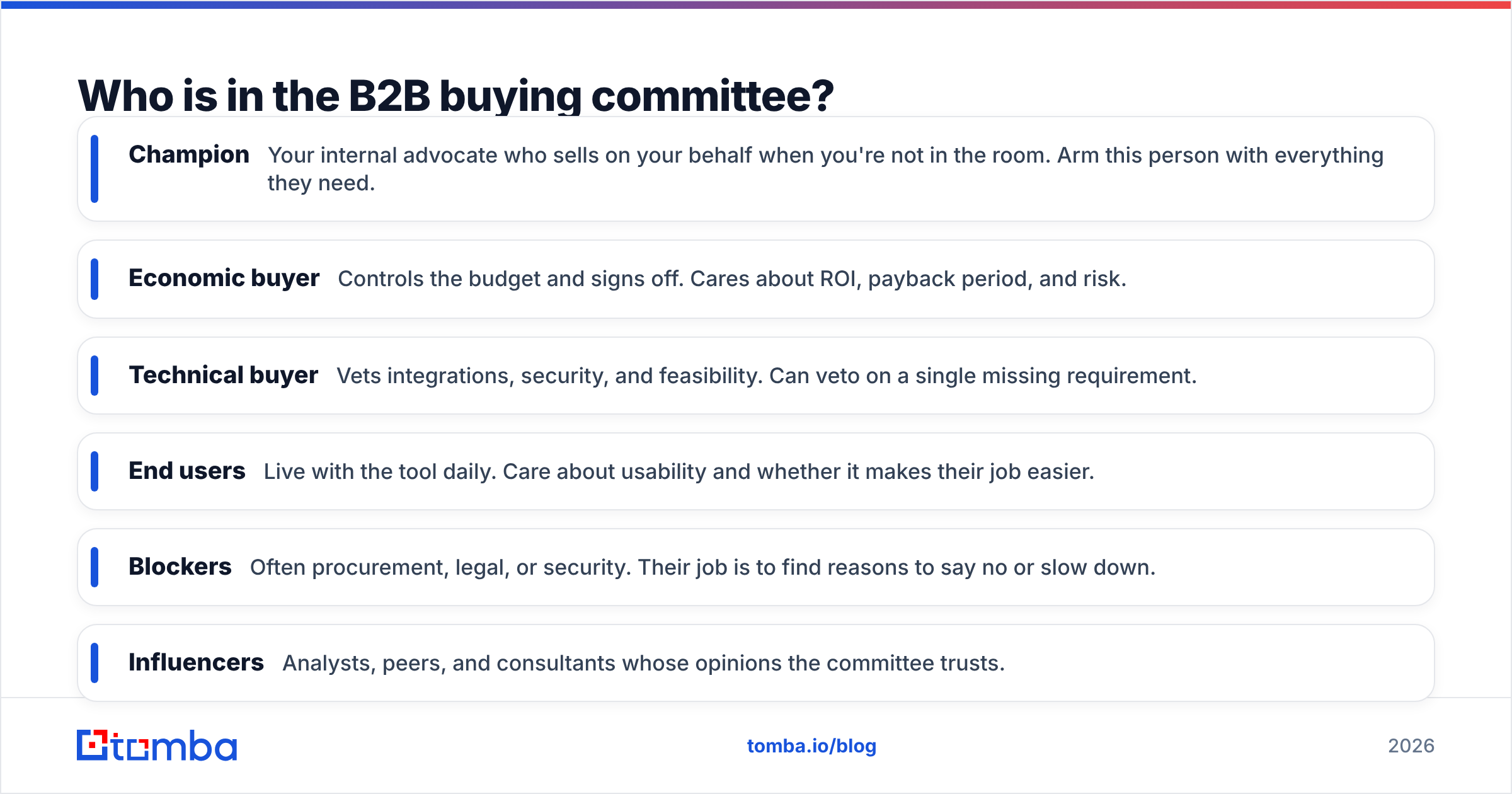
The single biggest mistake reps make is selling to one person when six are deciding. Each member of the committee evaluates you through a different lens, and ignoring any of them is how deals quietly die.
- Champion — Your internal advocate who sells on your behalf when you're not in the room. Arm this person with everything they need.
- Economic buyer — Controls the budget and signs off. Cares about ROI, payback period, and risk.
- Technical buyer — Vets integrations, security, and feasibility. Can veto on a single missing requirement.
- End users — Live with the tool daily. Care about usability and whether it makes their job easier.
- Blockers — Often procurement, legal, or security. Their job is to find reasons to say no or slow down.
- Influencers — Analysts, peers, and consultants whose opinions the committee trusts.
Mapping these roles is a data problem before it is a sales problem. You cannot influence a committee you cannot find. This is where an accurate email finder and data enrichment layer earns its keep: you start with one contact and build out the full org map, complete with verified emails and titles, instead of guessing at who else matters.
Why do B2B deals stall in the buying process?#
Most deals don't lose to a competitor — they lose to indecision. Forrester and Gartner research consistently shows "no decision" is the most common outcome of a stalled B2B cycle. Understanding the failure points lets you design around them.
The usual culprits:
- No consensus. One unconvinced stakeholder freezes the whole group.
- Unclear ROI. The economic buyer can't justify the spend to their own boss.
- Information overload. Buyers drown in vendor content and default to doing nothing.
- Champion goes quiet. Your advocate gets reassigned, leaves, or loses internal political capital.
- Bad timing. Budget cycles, reorgs, and competing priorities push the decision out.
The antidote is enablement, not pressure. Give your champion a one-page business case. Pre-write the answers to procurement's questions. Map the committee early so a single quiet stakeholder doesn't surprise you in week eight.
How is B2B buying different in 2026?#
Three shifts define the current landscape, and each one changes how you should sell.
Self-serve research dominates. Buyers complete the majority of their journey before contacting sales. They have already read your reviews, compared you to alternatives, and formed opinions. Your job in the first call is often to correct misconceptions, not to introduce yourself.
The committee keeps growing. More stakeholders means more veto points and longer cycles. Security and procurement now enter earlier, especially for anything touching data.
Signal beats spray. Generic outreach to cold lists is dead. The winners watch for intent signals — a new hire in a relevant role, a funding round, a tech-stack change — and reach out with relevance. Identifying anonymous interest with tools like website visitor reveal turns passive research into actionable timing.
The practical takeaway: stop optimizing for volume and start optimizing for precision. One well-timed, well-researched touch to the right committee beats a hundred templated emails to the wrong inbox. If your data is wrong, every downstream tactic inherits the error.
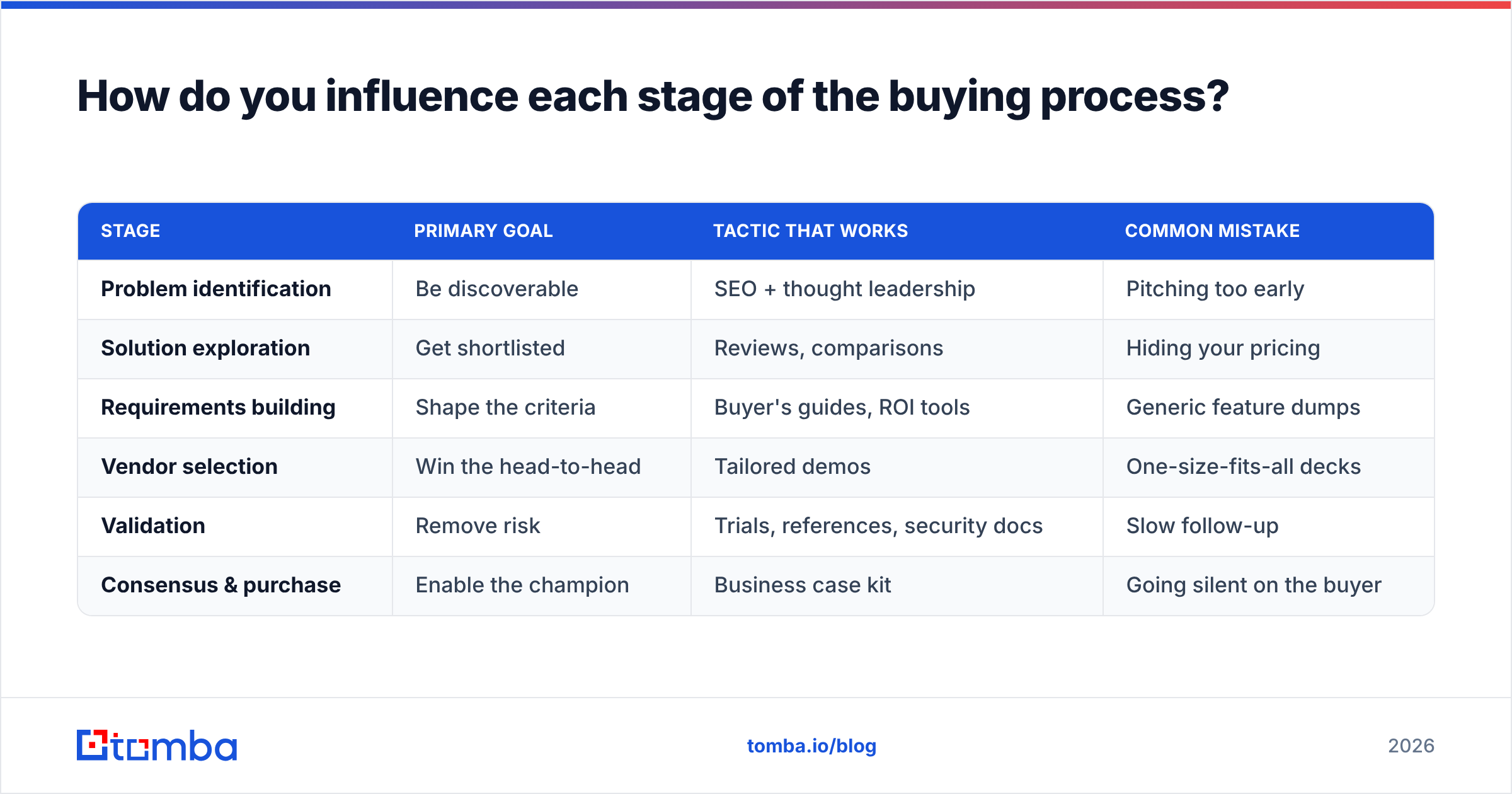
How do you influence each stage of the buying process?#
You can't control the buyer's timeline, but you can show up usefully at every stage. Here's a stage-by-stage playbook.
| Stage | Primary goal | Tactic that works | Common mistake |
|---|---|---|---|
| Problem identification | Be discoverable | SEO + thought leadership | Pitching too early |
| Solution exploration | Get shortlisted | Reviews, comparisons | Hiding your pricing |
| Requirements building | Shape the criteria | Buyer's guides, ROI tools | Generic feature dumps |
| Vendor selection | Win the head-to-head | Tailored demos | One-size-fits-all decks |
| Validation | Remove risk | Trials, references, security docs | Slow follow-up |
| Consensus & purchase | Enable the champion | Business case kit | Going silent on the buyer |
A few principles cut across every stage:
- Lead with the buyer's job, not your product. Each stakeholder is trying to accomplish something specific. Speak to that.
- Reduce effort. Every form, delay, and unanswered question is friction that pushes the buyer toward "no decision."
- Keep your data clean. A bounced email to the economic buyer at the validation stage can cost you the deal. Run lists through an email verifier before any committee-wide outreach.
For multi-stakeholder accounts, building the full contact map at the requirements stage pays off later. Use domain search to pull every relevant contact at the target company, then prioritize by role.
What tools support the modern B2B buying process?#
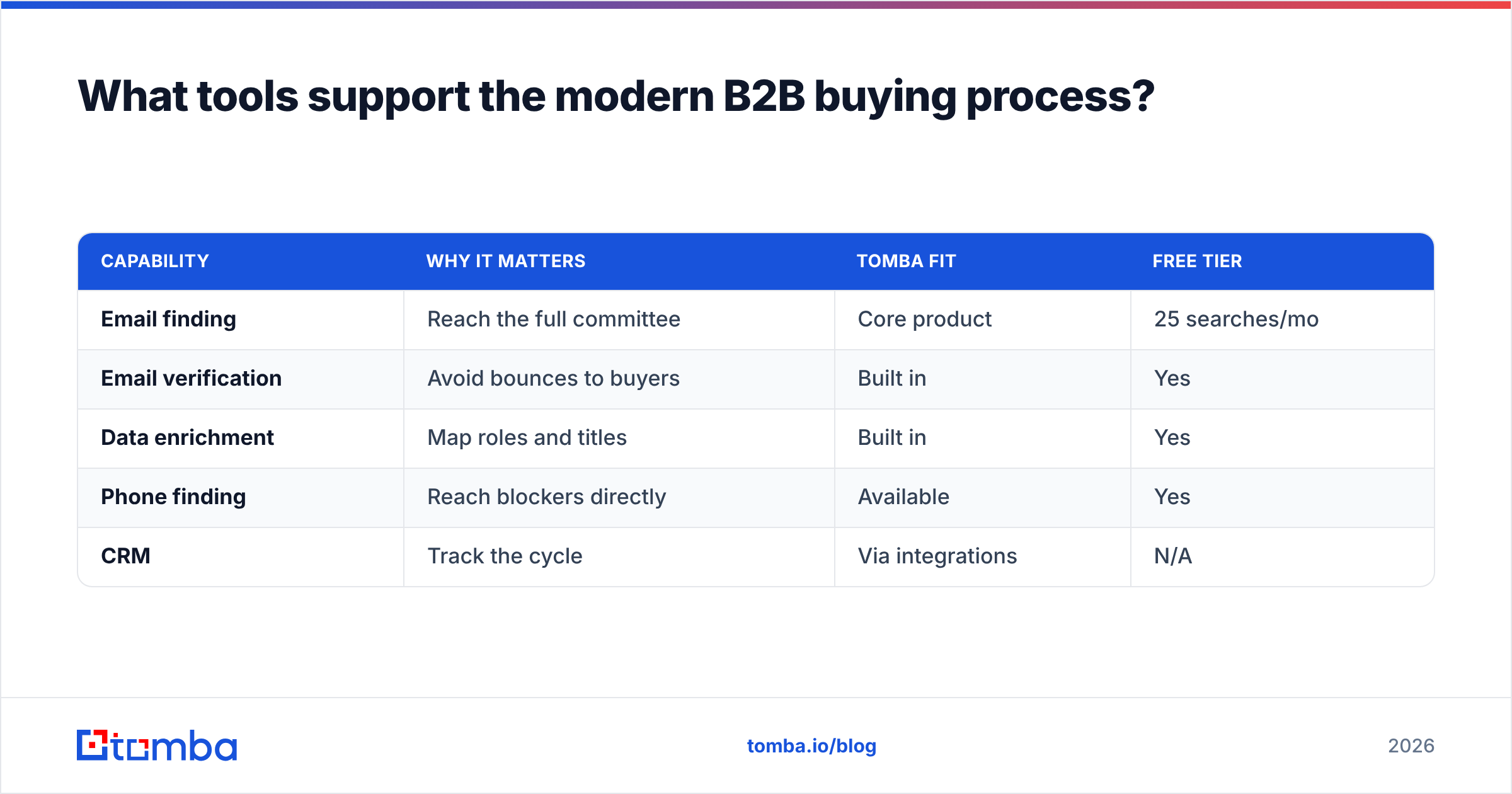
You don't need a 30-tool stack. You need accurate data, a way to reach the committee, and a system to manage the cycle. Here's how the core categories compare.
| Capability | Why it matters | Tomba fit | Free tier |
|---|---|---|---|
| Email finding | Reach the full committee | Core product | 25 searches/mo |
| Email verification | Avoid bounces to buyers | Built in | Yes |
| Data enrichment | Map roles and titles | Built in | Yes |
| Phone finding | Reach blockers directly | Available | Yes |
| CRM | Track the cycle | Via integrations | N/A |
Tomba's pricing scales with how many contacts you work: a Free tier with 25 searches a month, Starter at $49/mo, Growth at $99/mo, and Pro at $249/mo, with Enterprise custom. You can see full Tomba pricing for the per-plan credit breakdown. The point isn't to buy the biggest plan — it's to make sure the contact data feeding your buying-process motion is verified before you act on it.
If your CRM is the system of record, connect it directly. Tomba's HubSpot integration and Salesforce integration push verified contacts straight into your pipeline so the committee map lives where your team works.
How long does the B2B buying process take?#
It depends on deal size and committee complexity, but most considered B2B purchases run from one to nine months. Small, single-team tools can close in weeks. Enterprise platforms with security review, procurement, and legal can stretch past a year.
What actually moves the timeline:
- Number of stakeholders — Each added decision-maker lengthens the cycle.
- Perceived risk — Higher switching costs mean more validation.
- Budget cycle alignment — Hitting the buyer's fiscal calendar can shave months.
- Champion strength — A motivated internal advocate is the single biggest accelerator.
You can't shortcut consensus, but you can remove friction. Faster reference calls, pre-built ROI models, and answers to security questions before they're asked all compress the timeline.
Frequently asked questions#
What is the difference between the buying process and the sales process? The buying process is the buyer's journey; the sales process is your internal method for guiding it. The best sales processes mirror the buyer's stages rather than forcing a vendor-centric sequence.
How many people are in a typical B2B buying committee? Most considered purchases involve six to ten stakeholders, and larger enterprise deals can involve more. Mapping all of them early is critical.
Why do most B2B deals end in "no decision"? Because consensus is hard. When the committee can't align on ROI or priorities, the safest choice feels like doing nothing. Enabling your champion to build internal agreement is the fix.
Where does data fit into the buying process? Everywhere. You need accurate contacts to reach the committee, verified emails to avoid bounces, and enrichment to understand each role. Bad data breaks every downstream tactic.
Win the buying process with accurate data#
The b2b buying process rewards the seller who shows up to the right people, at the right stage, with the right message. None of that is possible on guesswork. Start by mapping the full committee with verified contact data, then enable your champion to build consensus inside their own organization.
If you want to stop spraying cold lists and start reaching the actual decision-makers in your target accounts, begin with the Tomba Email Finder. Find professional emails by domain, name, or company, verify them before you send, and build the complete buying-committee map your competitors are still guessing at. Spin up the free tier, map your next target account, and sell to the whole room instead of one inbox.
// get started
Find, verify and enrich your first contacts today
Start on the free plan with 25 searches a month, then scale when your team is ready.
Free plan · No credit card required · GDPR & CCPA
// about the author