B2B Cold Call Playbook 2026: Scripts, Data, and Win Rates
A no-fluff 2026 guide to the B2B cold call: scripts that open doors, the data that powers dials, objection handling, and the metrics that actually predict booked meetings.
The B2B cold call is not dead — it is just badly run by most teams. A rep who dials the wrong list with a weak opener will conclude the channel is broken. A rep who dials accurate numbers with a tight script and a reason to call will book meetings every week. The difference is rarely talent. It is process and data.
This guide gives you the 2026 playbook: how the modern B2B cold call works, the script framework, the objection responses, the benchmarks you should hold yourself to, and the data layer that quietly decides whether you ever reach a human at all.
TL;DR#
- A b2b cold call still converts when you dial the right person with a verified number and lead with a relevant reason, not a pitch.
- Expect roughly 1 connect per 8–10 dials and a 5–8% connect-to-meeting rate once your list and opener are dialed in.
- The first 10 seconds decide the call — earn time before you explain anything.
- Bad phone data is the silent killer; wrong or disconnected numbers waste 20–40% of dial time on many teams.
- Pair calls with email and LinkedIn touches — a multi-channel sequence beats phone-only by a wide margin.
What is a B2B cold call in 2026?#
A B2B cold call is a phone outreach to a business prospect who has not requested contact, with the goal of starting a conversation — usually to book a discovery meeting. What changed is not the definition but the context around it. Buyers screen unknown numbers, gatekeepers are now voicemail and mobile carriers, and your prospect has likely been called by five vendors this week.
Think of it like knocking on an office door that now has a peephole, a doorbell camera, and a "no soliciting" sign. You can still get invited in — but only if the first thing you say sounds like it was meant for that specific person, not a list.
The teams winning on the phone in 2026 do three things differently:
- They call with intent data or a trigger. A funding round, a new hire in the buyer role, a tech-stack change — something that makes the call timely.
- They dial verified mobile numbers, not the main switchboard, so they actually reach the decision-maker.
- They treat the call as one touch in a sequence, reinforced by email and social, instead of a one-shot pitch.
What makes a good cold call script?#
A good script is a flexible frame, not a word-for-word recital. The best reps internalize a structure and improvise inside it. Here is the five-part frame that holds up across industries.
- Pattern-interrupt opener — Acknowledge the cold call honestly. "Hi Sarah, this is a cold call — do you want to hang up, or give me 30 seconds?" Candor disarms the screening reflex.
- Reason for the call — Tie it to them: a trigger, a peer outcome, or a specific problem their role owns. This is where research pays off.
- Permission and discovery — Ask one sharp question that gets them talking. You are diagnosing, not presenting.
- Concise value bridge — One or two sentences connecting their answer to an outcome you have driven for similar companies. Resist the feature dump.
- Clear, low-friction ask — Propose a specific next step: "Worth a 20-minute look next Tuesday?" Specificity beats "sometime."
Keep total talk-to-listen ratio around 45/55 in your favor of listening. Reps who talk less close more, because discovery is where the real selling happens. For more on framing the message itself, our guide on improving your email response rate covers hooks that translate directly to phone openers.
How many dials does it take to book a meeting?#
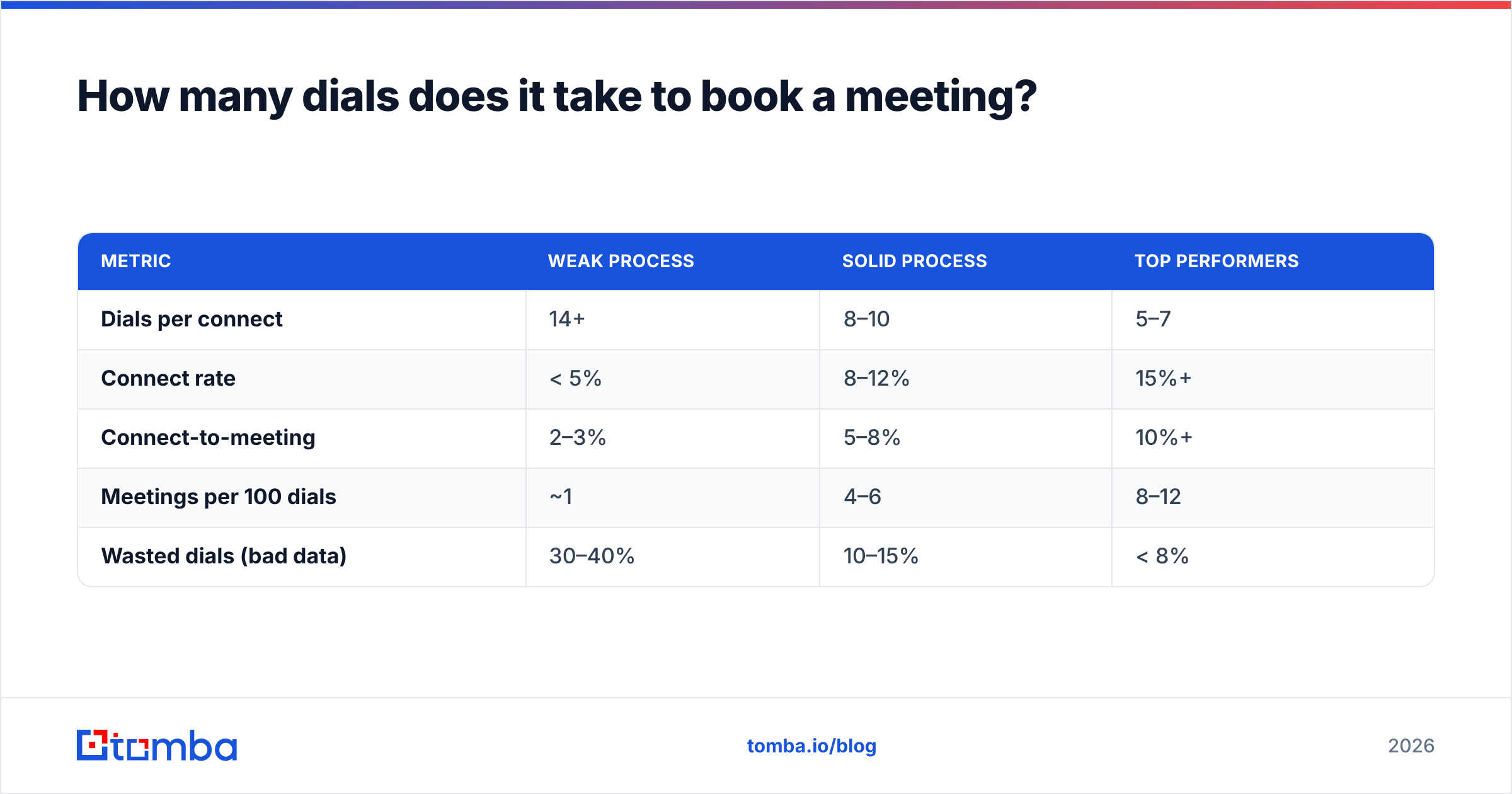
Plan around funnel math, not hope. The exact numbers vary by segment, but these 2026 benchmarks are a realistic baseline for outbound SDR teams calling mid-market B2B.
| Metric | Weak process | Solid process | Top performers |
|---|---|---|---|
| Dials per connect | 14+ | 8–10 | 5–7 |
| Connect rate | < 5% | 8–12% | 15%+ |
| Connect-to-meeting | 2–3% | 5–8% | 10%+ |
| Meetings per 100 dials | ~1 | 4–6 | 8–12 |
| Wasted dials (bad data) | 30–40% | 10–15% | < 8% |
The single biggest lever in this table is the bottom row. If a third of your numbers are wrong, you can have a flawless script and still miss quota — you are dialing into a void. That is why list hygiene and accurate phone data sit upstream of every other improvement. You can validate numbers before a campaign with a phone validator so your reps spend minutes on conversations, not on disconnected lines.
How do you handle the most common objections?#
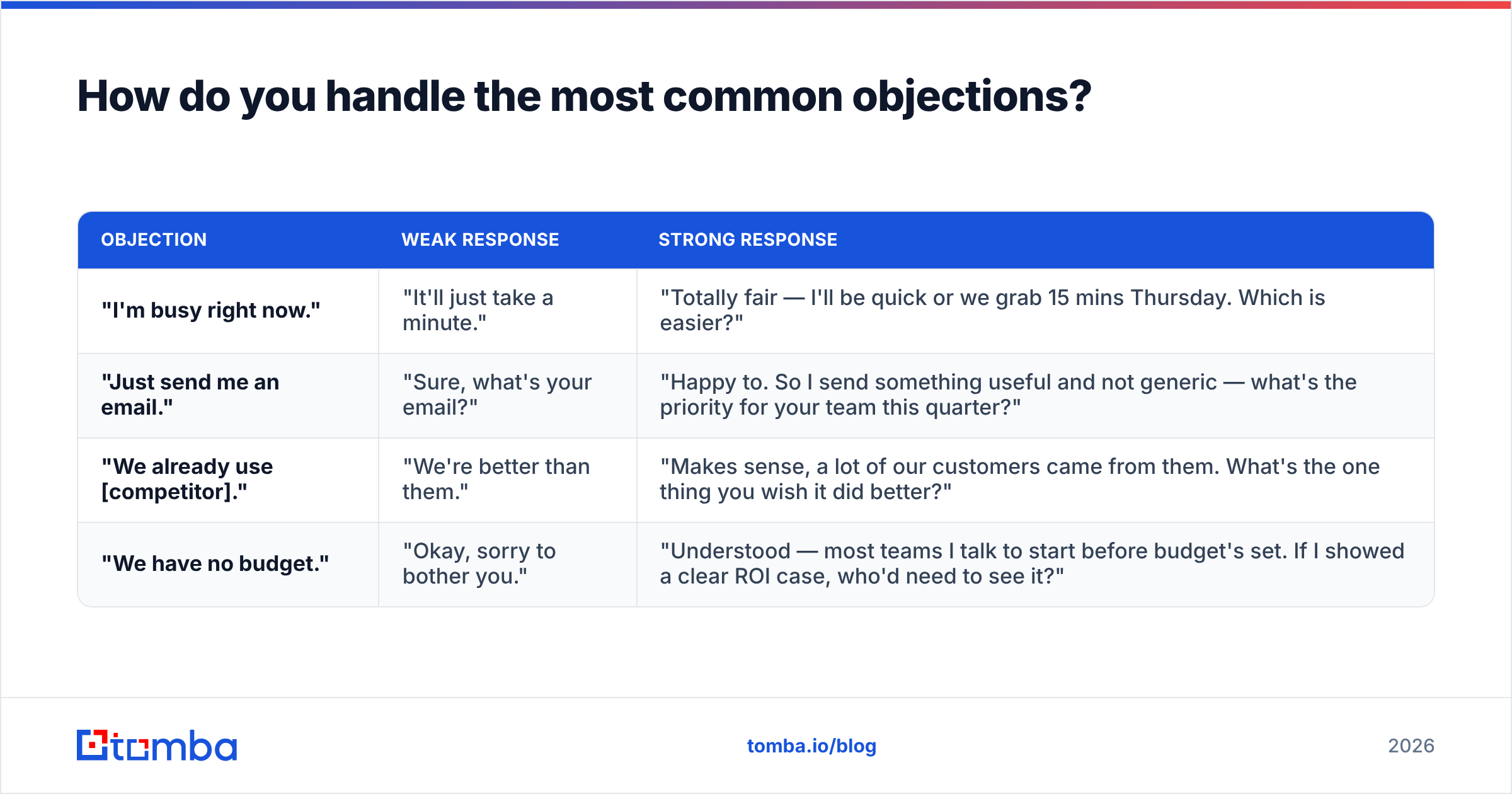
Objections are not rejection — they are reflexes. Your job is to acknowledge, reframe, and redirect to a question. Memorize calm responses to the four you will hear most.
| Objection | Weak response | Strong response |
|---|---|---|
| "I'm busy right now." | "It'll just take a minute." | "Totally fair — I'll be quick or we grab 15 mins Thursday. Which is easier?" |
| "Just send me an email." | "Sure, what's your email?" | "Happy to. So I send something useful and not generic — what's the priority for your team this quarter?" |
| "We already use [competitor]." | "We're better than them." | "Makes sense, a lot of our customers came from them. What's the one thing you wish it did better?" |
| "We have no budget." | "Okay, sorry to bother you." | "Understood — most teams I talk to start before budget's set. If I showed a clear ROI case, who'd need to see it?" |
Notice every strong response ends with a question. You are keeping the conversation alive and gathering qualification data even when the answer is "no." Treat each objection as a fork that either books a meeting or teaches you something about the account.
Why does your phone data decide everything?#
Conclusion first: the best script in the world fails against a wrong number. Data quality is the foundation the entire call rests on, and it is the part most teams under-invest in.
Here is what separates a productive dialing block from a frustrating one:
- Direct dials over switchboards. Reaching a mobile or direct line skips the gatekeeper entirely. Switchboard-only lists bury reps in transfers and voicemail.
- Role accuracy. Calling the right title matters as much as the right number. A perfect pitch to the wrong persona is wasted breath.
- Freshness. People change jobs constantly. A number that was right last year may now route to someone who left. Stale data quietly inflates your dials-per-connect.
- Enrichment context. Knowing the company size, recent news, and tech stack before you dial turns a cold call into a warm-ish one. Layer data enrichment onto thin lists so every record carries a reason to call.
This is where a dedicated phone finder earns its keep — it surfaces verified B2B phone numbers tied to the right contact, so your reps start each block with a clean, dial-ready list instead of a spreadsheet full of dead ends. Industry research from Gartner and analyst commentary on G2 both point to the same conclusion: contact data decay, often 25–30% per year, is the hidden tax on outbound productivity.
How should you sequence calls with email and LinkedIn?#
Phone-only outreach leaves meetings on the table. The modern cadence interleaves channels so each touch reinforces the others, and so a missed call still lands a message through a different door.
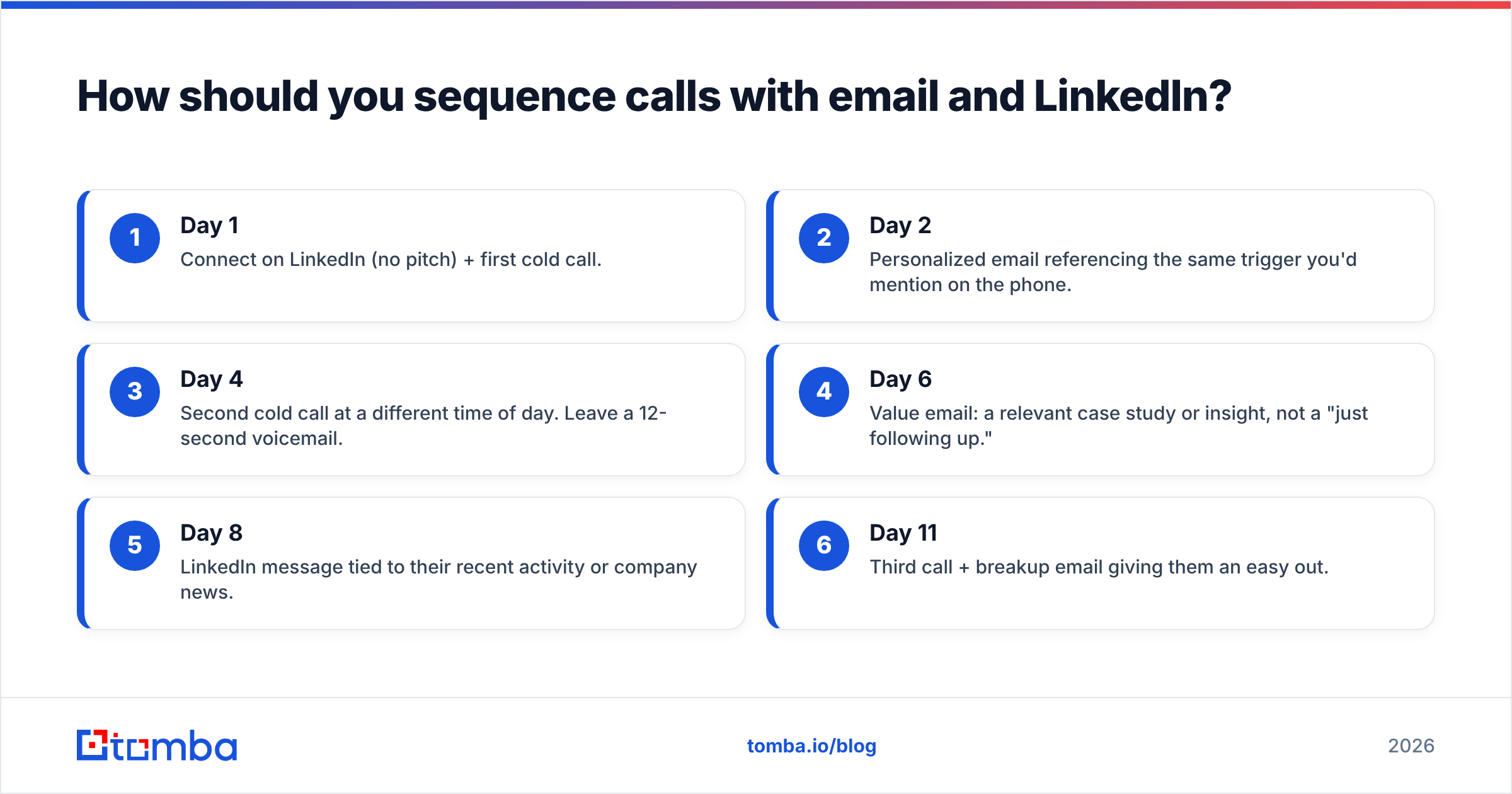
A proven 10–14 business-day sequence looks like this:
- Day 1 — Connect on LinkedIn (no pitch) + first cold call.
- Day 2 — Personalized email referencing the same trigger you'd mention on the phone.
- Day 4 — Second cold call at a different time of day. Leave a 12-second voicemail.
- Day 6 — Value email: a relevant case study or insight, not a "just following up."
- Day 8 — LinkedIn message tied to their recent activity or company news.
- Day 11 — Third call + breakup email giving them an easy out.
The phone is the highest-conversion channel in this mix, but email is how you stay visible between dials. To build the email side, an accurate email finder ensures your messages reach the same verified contact you are dialing, and pairing it with proper email deliverability habits keeps those touches out of spam. HubSpot's outreach research, published on hubspot.com, consistently shows multi-channel sequences outperforming single-channel by a meaningful margin on reply and meeting rates.
What metrics should you track on cold calls?#
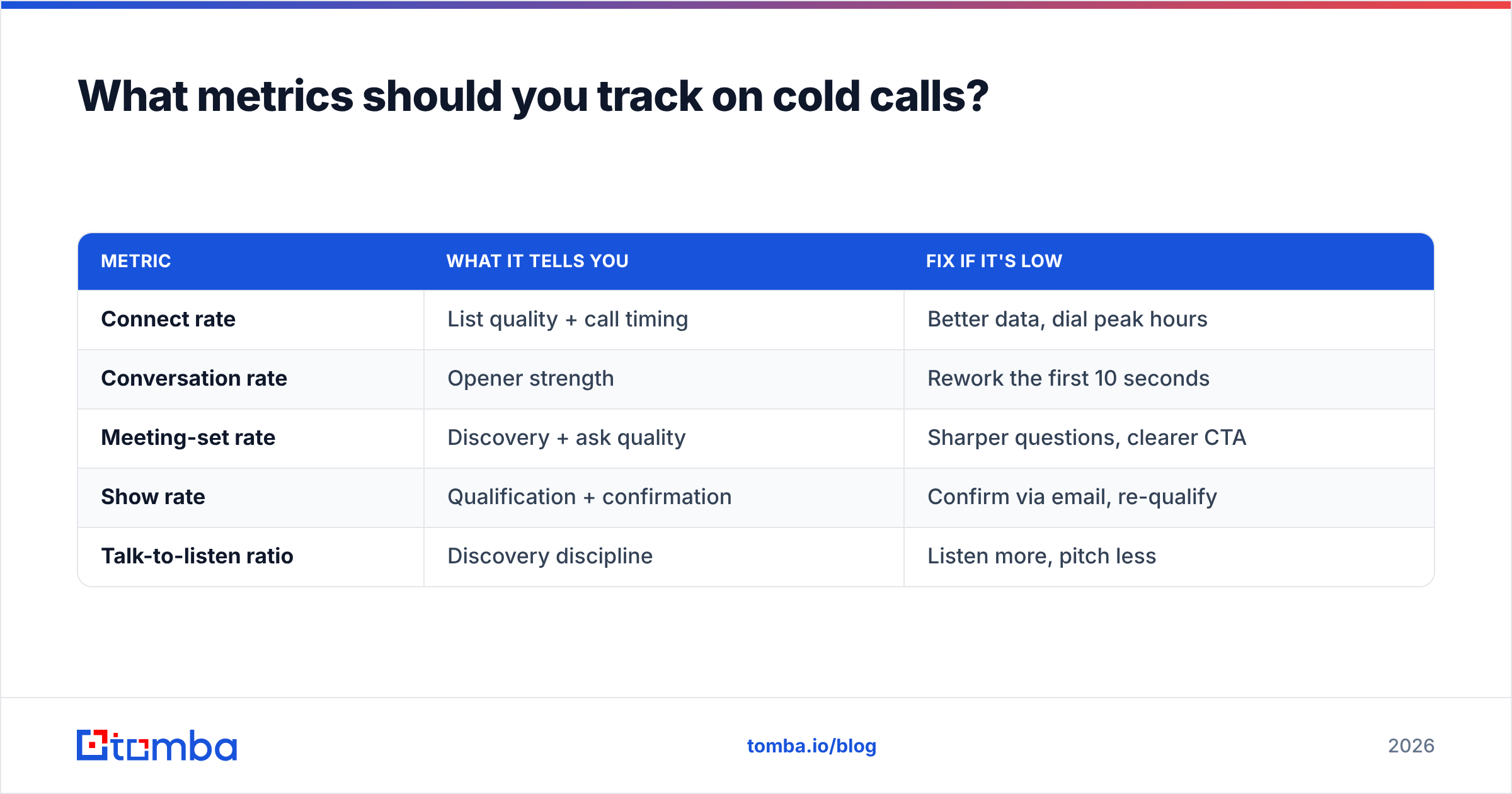
Track leading indicators you can act on this week, not just lagging revenue. The point of metrics is to find the broken link in the chain.
| Metric | What it tells you | Fix if it's low |
|---|---|---|
| Connect rate | List quality + call timing | Better data, dial peak hours |
| Conversation rate | Opener strength | Rework the first 10 seconds |
| Meeting-set rate | Discovery + ask quality | Sharper questions, clearer CTA |
| Show rate | Qualification + confirmation | Confirm via email, re-qualify |
| Talk-to-listen ratio | Discovery discipline | Listen more, pitch less |
Review these weekly per rep. If connect rate is the problem, no amount of script coaching helps — you fix the data. If conversation rate is fine but meetings don't get set, the issue is your ask. Diagnosing the right stage is what turns a slumping caller around fast. For pipeline-level tracking, tie these into your broader win rate analysis so call activity connects to closed revenue.
What times and habits improve connect rates?#
Small operational habits compound across a quarter. None are glamorous, but together they move the bottom-line number.
- Call early and late. Mid-morning (8–10 AM) and late afternoon (4–5 PM) local time consistently outperform the lunch lull.
- Batch your dials. Block 60–90 uninterrupted minutes. Context-switching between calls and email kills momentum and tone.
- Use a local presence number where compliant — prospects answer familiar area codes more often.
- Stand up and smile. It sounds trivial; it changes your energy and the listener hears it.
- Log everything immediately. Notes written 10 calls later are fiction. Fresh notes fuel the next touch in the sequence.
- Warm up the list the night before. Verify numbers and enrich records so dialing time is spent talking, not researching.
Consistency beats intensity. A rep who makes 40 focused, well-prepared dials a day will out-book a rep who blasts 120 cold, unprepared ones — because the prepared rep reaches more real humans and sounds like they belong in the conversation.
The bottom line#
The B2B cold call rewards preparation over volume. Win the first 10 seconds with candor and relevance, run discovery instead of a pitch, handle objections with questions, and sequence the phone alongside email and LinkedIn. But none of it matters if you are dialing the wrong number — data quality is the foundation everything else stands on.
Start there. Build clean, verified call lists with accurate direct dials and enriched context so every dial has a real chance of becoming a conversation. Tomba's Phone Finder and Email Finder give your reps dial-ready, verified B2B contacts — and you can test the data on the free tier before scaling up. Check the full Tomba pricing when you're ready to equip the whole team, and watch your dials-per-meeting drop the moment your list stops lying to you.
// get started
Find, verify and enrich your first contacts today
Start on the free plan with 25 searches a month, then scale when your team is ready.
Free plan · No credit card required · GDPR & CCPA
// about the author