B2B Cold Calling Conversion Rate: 2026 Benchmarks & Fixes
Most teams guess at their cold calling numbers. Here's what a healthy B2B cold calling conversion rate looks like in 2026 — and how to fix a low one.
TL;DR
- The average B2B cold calling conversion rate (dial-to-meeting) sits around 1–3% in 2026; top reps clear 5%+ by fixing data and timing, not by dialing harder.
- Conversion is a chain of smaller rates: connect rate → conversation rate → meeting-booked rate → opportunity rate. Measure each, fix the weakest.
- Bad phone numbers silently kill the funnel before a word is spoken. Verified, accurate direct-dial data is the cheapest lever you have.
- Scripts, call timing, and persistence (6–8 touches) move the needle far more than tone or "energy."
- Pairing verified phone data with verified email lets you run multi-channel sequences that roughly double connect rates.
What is a B2B cold calling conversion rate?#
Your B2B cold calling conversion rate is the percentage of cold dials that turn into a desired next step — usually a booked meeting or a qualified opportunity. Simple definition, but the word "conversion" hides a trap: it bundles several distinct rates into one number, and that's why most teams can't fix theirs.
Think of cold calling like a series of doors, not one door. Dialing is door one. A human picking up is door two. Them staying on the line past your opener is door three. Agreeing to a meeting is door four. If you only track "calls to meetings," you're measuring all four doors at once and have no idea which one is jammed.
Here's the funnel broken into the rates that actually matter:
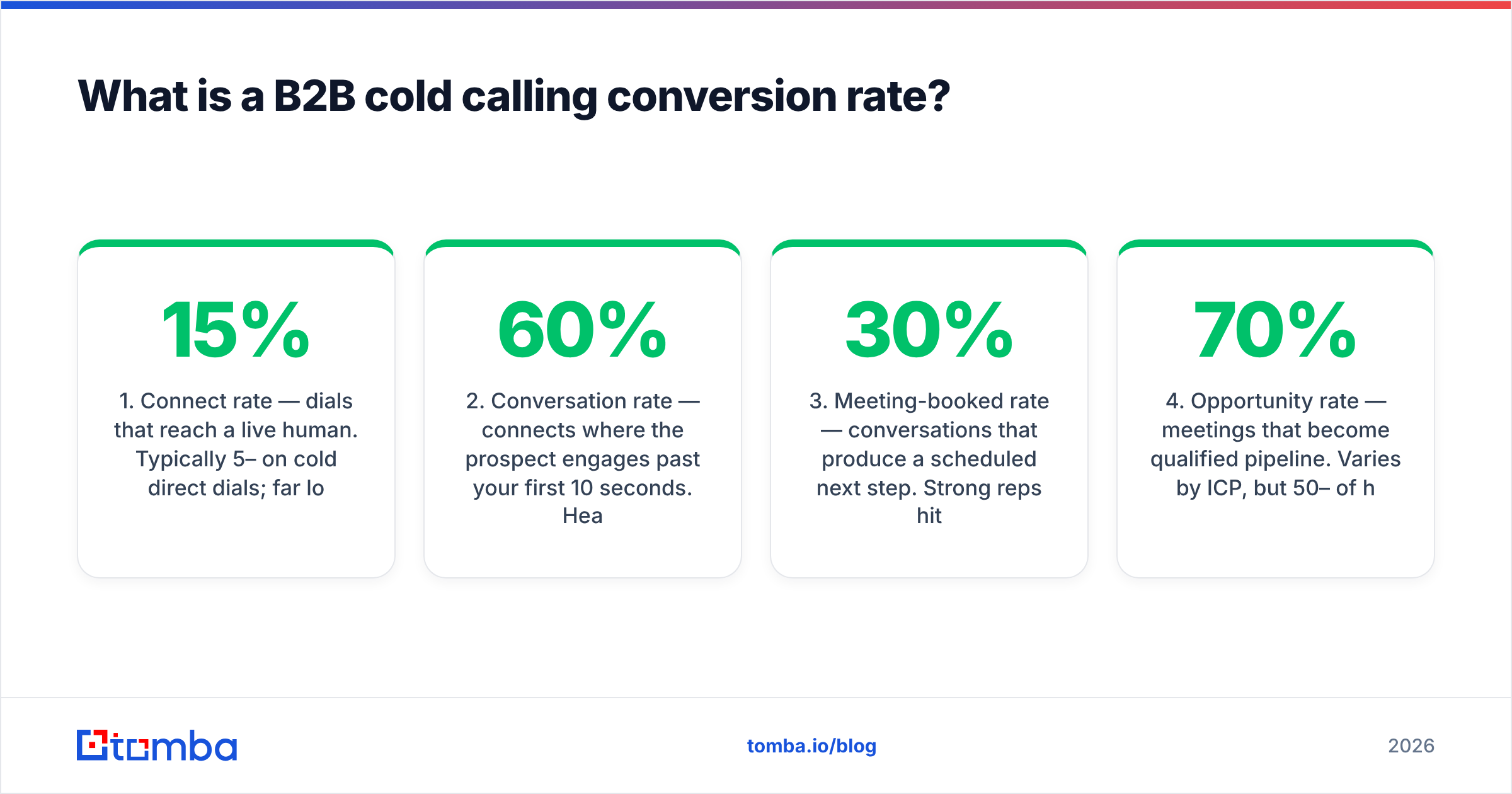
- Connect rate — dials that reach a live human. Typically 5–15% on cold direct dials; far lower on switchboard numbers.
- Conversation rate — connects where the prospect engages past your first 10 seconds. Healthy is 40–60% of connects.
- Meeting-booked rate — conversations that produce a scheduled next step. Strong reps hit 15–30% of conversations.
- Opportunity rate — meetings that become qualified pipeline. Varies by ICP, but 50–70% of held meetings is a good target.
Multiply those together and you get your true end-to-end conversion. A rep at 10% connect × 50% conversation × 20% meeting × 60% opportunity converts roughly 0.6% of raw dials into pipeline — which sounds bleak-prone until you realize that's a normal, profitable number at scale.
)
What is a good cold calling conversion rate in 2026?#
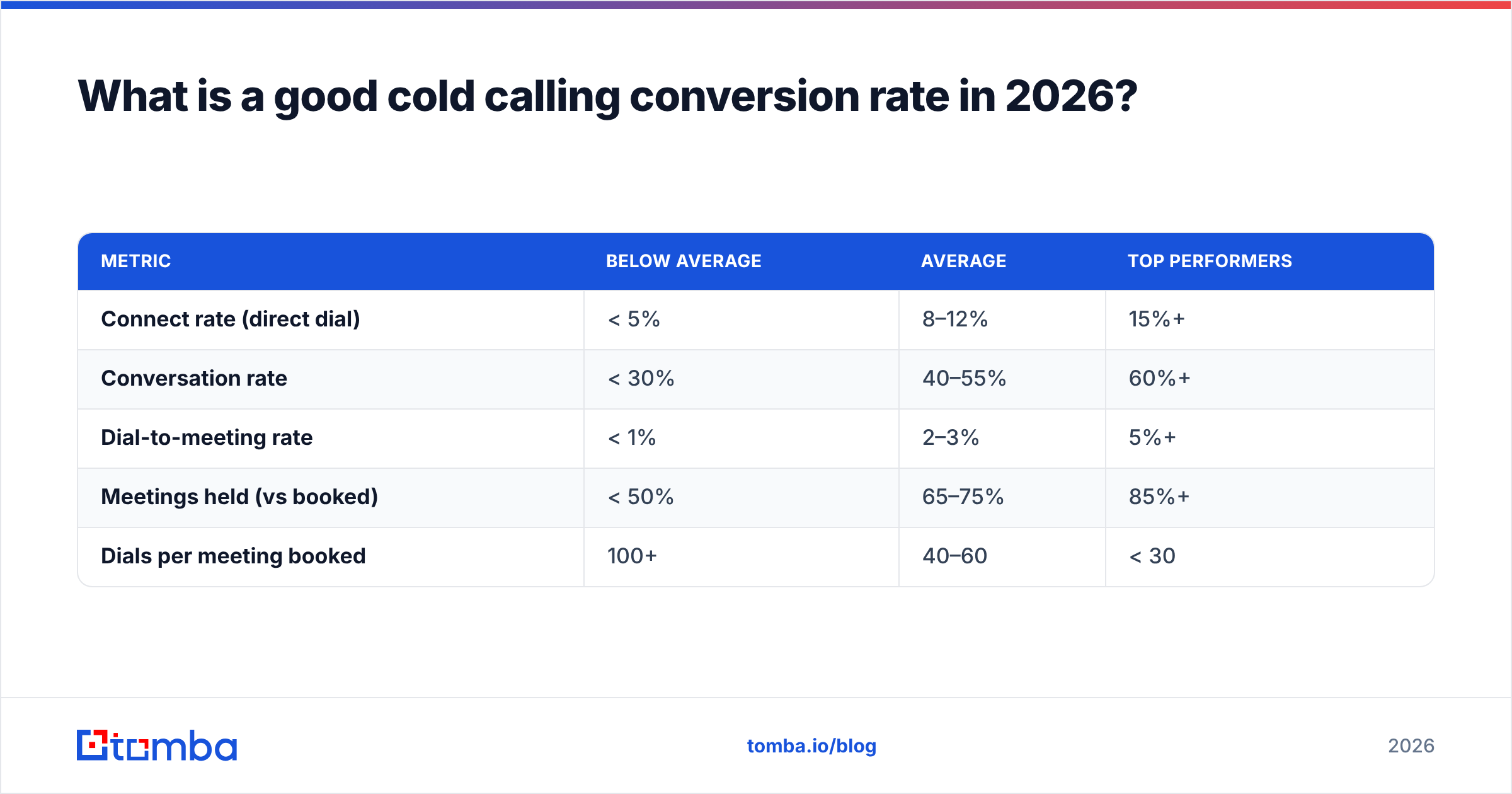
A good dial-to-meeting rate in 2026 is 2–5%, and a good connect rate is 8–15% on verified direct dials. Anything above that usually means tight targeting plus clean data, not magic.
The benchmarks below reflect what B2B SDR and AE teams report across industry surveys from sources like HubSpot and Gartner. Treat them as goalposts, not gospel — your motion, ACV, and ICP shift the math.
| Metric | Below average | Average | Top performers |
|---|---|---|---|
| Connect rate (direct dial) | < 5% | 8–12% | 15%+ |
| Conversation rate | < 30% | 40–55% | 60%+ |
| Dial-to-meeting rate | < 1% | 2–3% | 5%+ |
| Meetings held (vs booked) | < 50% | 65–75% | 85%+ |
| Dials per meeting booked | 100+ | 40–60 | < 30 |
The single biggest spread is in connect rate, and it's almost entirely a data problem. A rep dialing a list where 30% of numbers are wrong or disconnected is throwing away a third of their effort before they open their mouth. That's why fixing data beats fixing scripts nine times out of ten.
Why is your B2B cold calling conversion rate low?#
Most low conversion rates trace back to four causes, in this order of impact: bad data, bad targeting, bad timing, bad message. Reps obsess over the last one and ignore the first three.
Bad data. Disconnected lines, switchboard numbers instead of direct dials, and wrong-person matches gut your connect rate. If you can't reach the human, nothing else matters. This is where a verified phone finder and a phone validator earn their keep — they strip out dead numbers before your reps waste dials on them.
Bad targeting. Calling people who can't buy or don't have the problem you solve produces polite brush-offs that look like a messaging issue but are really a list-building issue. Tight ICP filtering and data enrichment — adding title, seniority, company size, and tech stack — keeps reps on accounts that can actually say yes.
Bad timing. Call-connect data consistently shows mid-morning and late afternoon outperform lunch hours and Monday mornings. Calling the same lead once and giving up wastes the list; 6–8 touches across days and channels is the floor for cold outbound.
Bad message. Yes, your opener matters — but it's the smallest lever. A tight, permission-based opener ("Did I catch you at a bad time?") and a clear reason for the call beat any "high-energy" gimmick.
)
How do you calculate cold calling conversion rate correctly?#
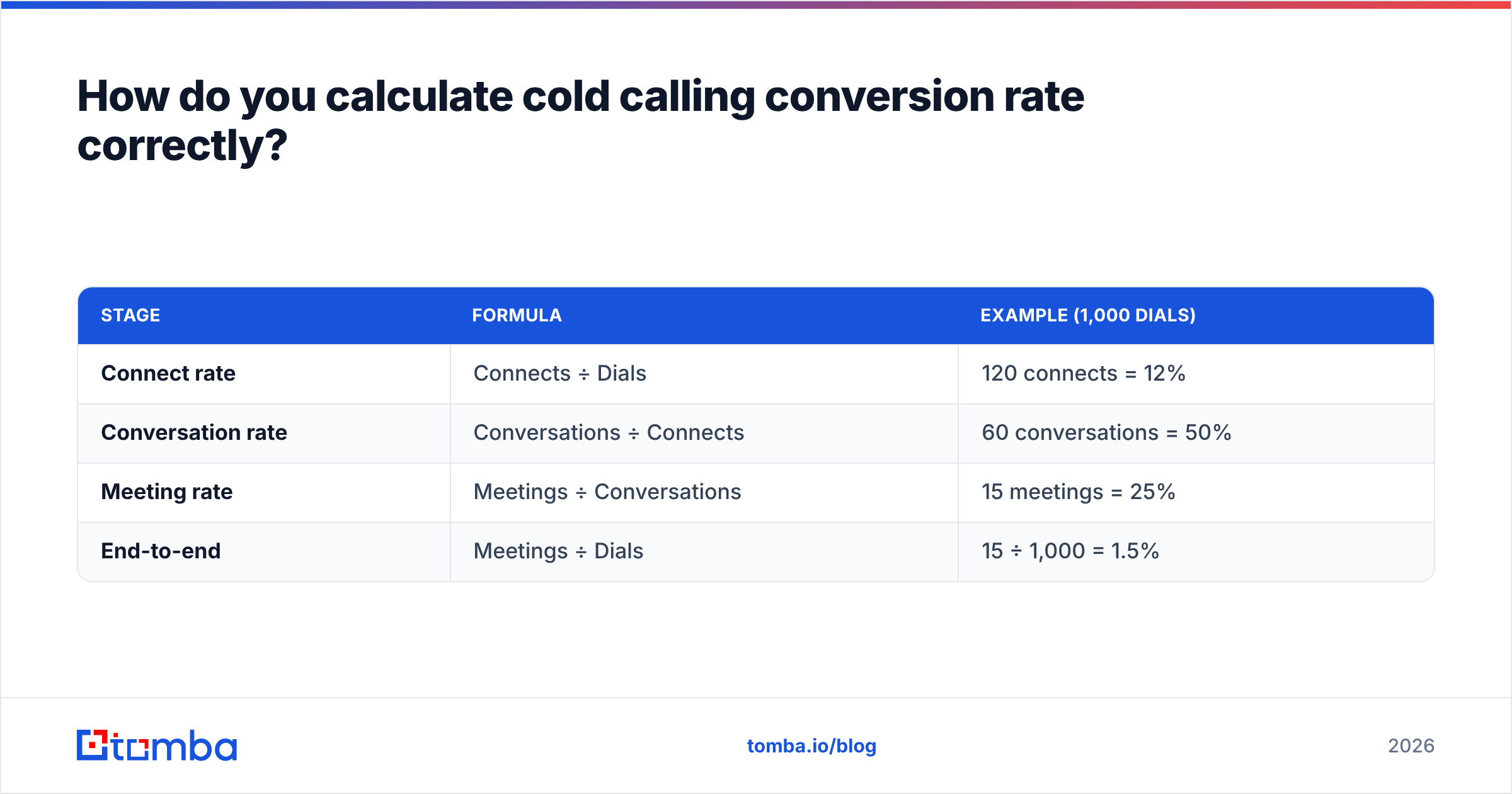
Use this formula, and track every stage separately so you know which door is jammed:
Conversion rate = (Desired outcomes ÷ Total dials) × 100
But the version that actually drives improvement is the staged one:
| Stage | Formula | Example (1,000 dials) |
|---|---|---|
| Connect rate | Connects ÷ Dials | 120 connects = 12% |
| Conversation rate | Conversations ÷ Connects | 60 conversations = 50% |
| Meeting rate | Meetings ÷ Conversations | 15 meetings = 25% |
| End-to-end | Meetings ÷ Dials | 15 ÷ 1,000 = 1.5% |
In this example, 1,000 dials produced 15 meetings. If you wanted to double meetings, the staged view tells you exactly where to push. Lifting connect rate from 12% to 18% (a data fix) would push you from 15 meetings to roughly 22 — without changing your script or making a single extra dial. That's the entire argument for fixing data first.
One discipline most teams skip: log dispositions honestly. A "no answer" is not a "not interested," and a wrong number is not a rejection. If your CRM blurs those, your benchmarks are fiction.
What lifts a B2B cold calling conversion rate the most?#
Rank your fixes by leverage, not by how fun they are to work on. Here's the order that pays off fastest.
1. Verify your phone data. Every dead number is a guaranteed zero. Running your list through verification before reps touch it is the highest-ROI hour you'll spend all quarter. Combine accurate direct dials with verified email and you can sequence both channels — see the Tomba pricing tiers if you're sizing this for a team.
2. Tighten the list. Fewer, better-fit accounts beat a giant generic list. Enrichment turns a name and company into a real targeting decision.
3. Run multi-channel cadences. A call after an email that the prospect already opened connects at a noticeably higher rate than a cold-cold dial. Pull verified addresses with an email finder and layer calls on top.
4. Fix timing and persistence. Block calling hours when connects are highest. Commit to 6–8 touches before you retire a lead.
5. Then, and only then, refine the script. Once data and targeting are clean, opener and objection-handling tweaks compound.
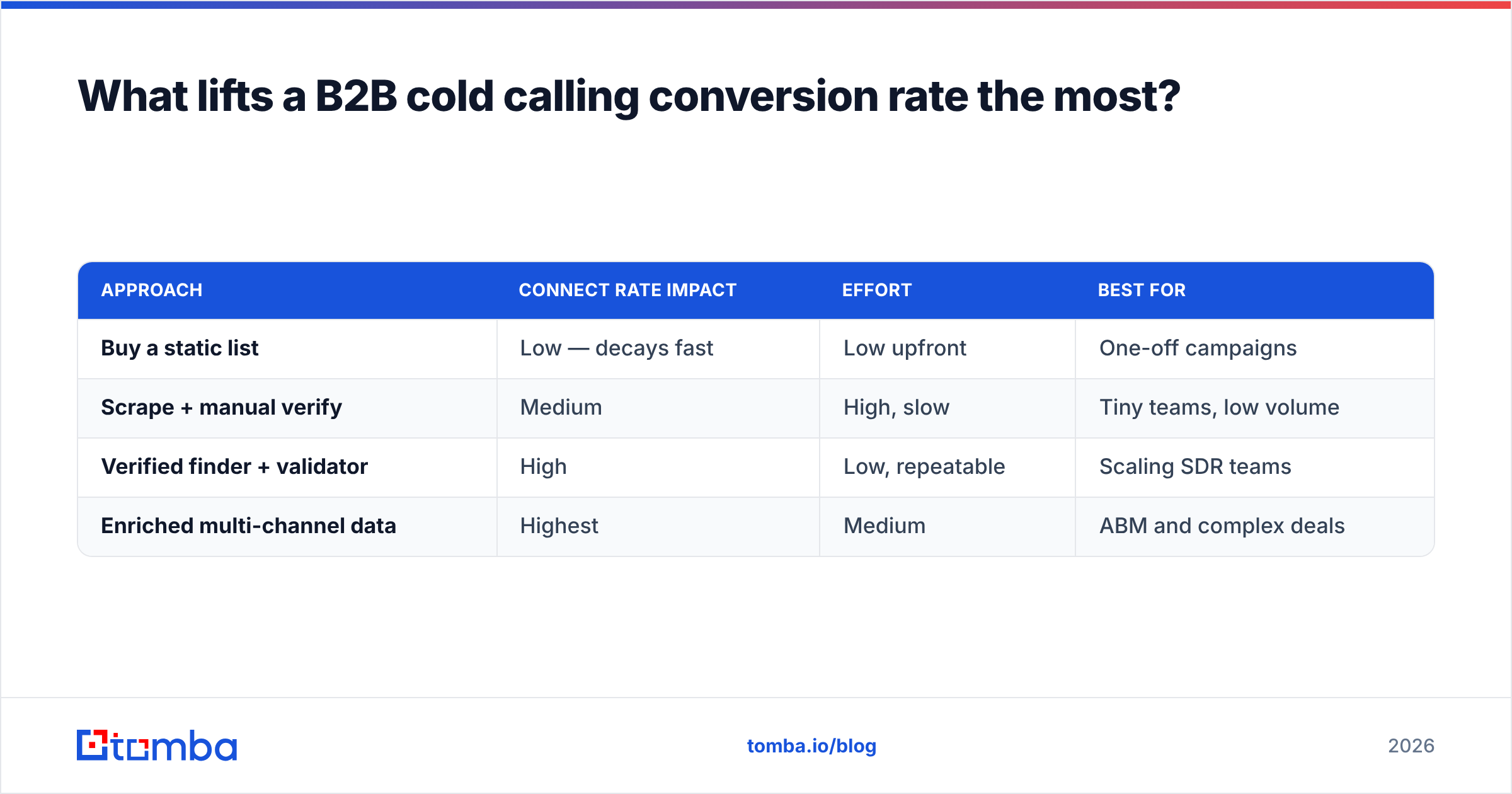
Here's how the leading data approaches compare for a calling team:
| Approach | Connect rate impact | Effort | Best for |
|---|---|---|---|
| Buy a static list | Low — decays fast | Low upfront | One-off campaigns |
| Scrape + manual verify | Medium | High, slow | Tiny teams, low volume |
| Verified finder + validator | High | Low, repeatable | Scaling SDR teams |
| Enriched multi-channel data | Highest | Medium | ABM and complex deals |
You can cross-check vendor accuracy claims on independent review sites like G2 before you commit budget — connect rate lives or dies on whether the numbers are real.
How does data quality change the math?#
Data quality is a multiplier on every downstream rate, which is why a small accuracy gain produces an outsized conversion lift. Treat it as the foundation, not a line item.
Picture two reps with identical scripts, identical work ethic, identical 1,000 dials. Rep A works a list that's 70% accurate. Rep B works one that's 95% accurate. Even if every other rate is identical, Rep B reaches 36% more humans — and because she's not burning energy on dead lines, her conversations are sharper too. Over a quarter, that compounds into a meaningfully bigger pipeline from the same effort.
This is the unglamorous truth of cold calling: the rep dialing isn't usually the bottleneck. The list is. Verified contact data — accurate direct dials, validated against live signals, enriched with the context to know you're calling the right person — does more for your B2B cold calling conversion rate than any motivational sales-floor poster ever will.
If you want to see where verified numbers come from and how they're scored, Tomba documents its data sources openly, which matters when you're staking a quarter's pipeline on the accuracy claim.
Frequently asked questions#
What's the average dials-to-meeting ratio? Most teams land near 40–60 dials per booked meeting in 2026. Top performers with clean data get under 30; teams on stale lists creep past 100.
How many touches before I give up on a lead? Six to eight across calls, email, and LinkedIn. Most reps quit after one or two, which is why most reps underperform.
Does cold calling still work in 2026? Yes, for the right ICP and with verified direct dials. The tools changed; the channel didn't die. What died is dialing random switchboard numbers and hoping.
Is connect rate or conversation rate more important? Connect rate, because it's the cheapest to fix and gates everything downstream. You can't have a conversation with someone you never reach.
Start with data that actually connects#
Your conversion rate problem is probably a connect rate problem, and your connect rate problem is almost always a data problem. Fix that first and the rest of the funnel gets easier.
Use the Tomba Email Finder to build verified, enriched contact lists — then layer accurate direct dials and multi-channel cadences on top so your reps spend their dials on humans who can actually buy. Clean data in, real conversations out. That's the whole game.
// get started
Find, verify and enrich your first contacts today
Start on the free plan with 25 searches a month, then scale when your team is ready.
Free plan · No credit card required · GDPR & CCPA
// about the author