B2B Cold Calling Guide 2026: Scripts, Tips and Tools
Cold calling still books meetings in 2026 — if you have clean data, a tight script, and the discipline to dial. Here's the full playbook.
Cold calling was supposed to be dead by now. It isn't. In 2026, a well-run outbound dialing motion still books more first meetings per rep-hour than almost any other channel — provided you stop treating it as a numbers game and start treating it as a data-plus-skill game. This guide walks through the full motion: who to call, what to say, how to handle the brush-offs, and which tools keep your dial list accurate.
TL;DR#
- Cold calling works in 2026, but only with clean data. Wrong numbers and dead lines kill connect rates faster than a bad script ever could.
- The first 10 seconds decide the call. A permission-based opener beats a pitch every time.
- Objections are signals, not stop signs. Most "not interested" responses are reflexes you can move past with one calm sentence.
- Volume still matters, but connect rate matters more. 60 dials to verified mobiles beats 200 dials to a stale list.
- Pair your dialer with accurate contact data — a phone finder and verified email backup turn guesswork into a repeatable system.
Is cold calling still worth it in 2026?#
Yes — and the data backs it up. Buyers screen unknown numbers harder than ever, but decision-makers still pick up when the call is relevant and the timing is right. The difference between reps who hit quota and reps who burn out is rarely talent. It's the list.
Think of cold calling like fishing. You can have the best rod and the smoothest cast, but if you're casting into an empty pond, you go home hungry. Most "cold calling doesn't work" complaints are really "my pond is empty" complaints — outdated direct dials, disconnected mobiles, and contacts who left the company eight months ago.
According to HubSpot's sales research, it takes an average of multiple touchpoints to reach a prospect, and phone remains one of the highest-intent channels for booking a live conversation. The phone isn't obsolete. Bad data is.
What makes a B2B cold call actually connect?#
Three things, in order of impact: data quality, the opener, and the conversation that follows. Get the first one wrong and the other two never matter.
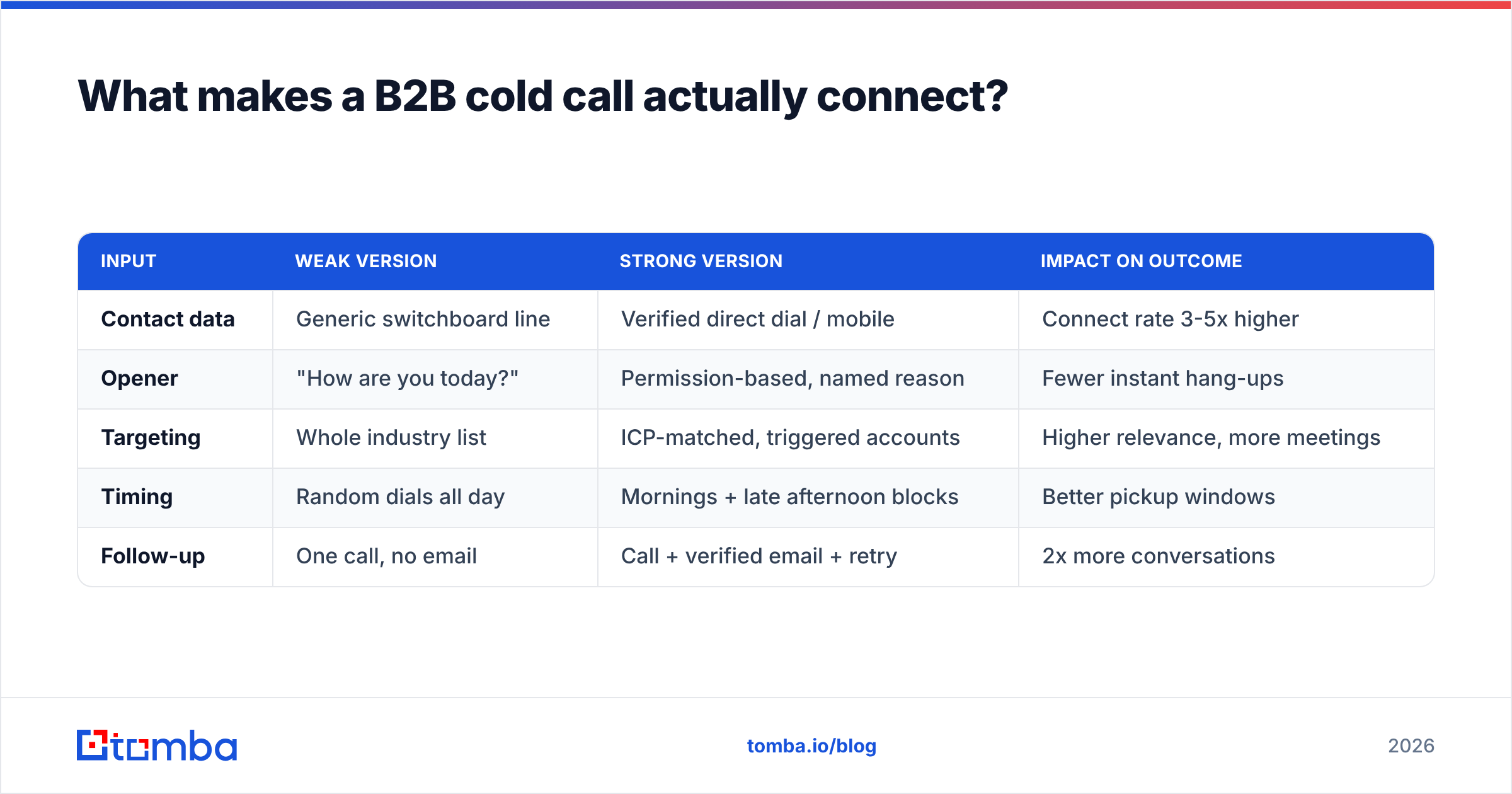
Here's how the inputs stack up against the outcomes you care about:
| Input | Weak version | Strong version | Impact on outcome |
|---|---|---|---|
| Contact data | Generic switchboard line | Verified direct dial / mobile | Connect rate 3-5x higher |
| Opener | "How are you today?" | Permission-based, named reason | Fewer instant hang-ups |
| Targeting | Whole industry list | ICP-matched, triggered accounts | Higher relevance, more meetings |
| Timing | Random dials all day | Mornings + late afternoon blocks | Better pickup windows |
| Follow-up | One call, no email | Call + verified email + retry | 2x more conversations |
The pattern is obvious once you see it: every "strong version" depends on knowing something accurate about the person before you dial. That's a data problem before it's a sales-skill problem.
How do you build a clean cold call list?#
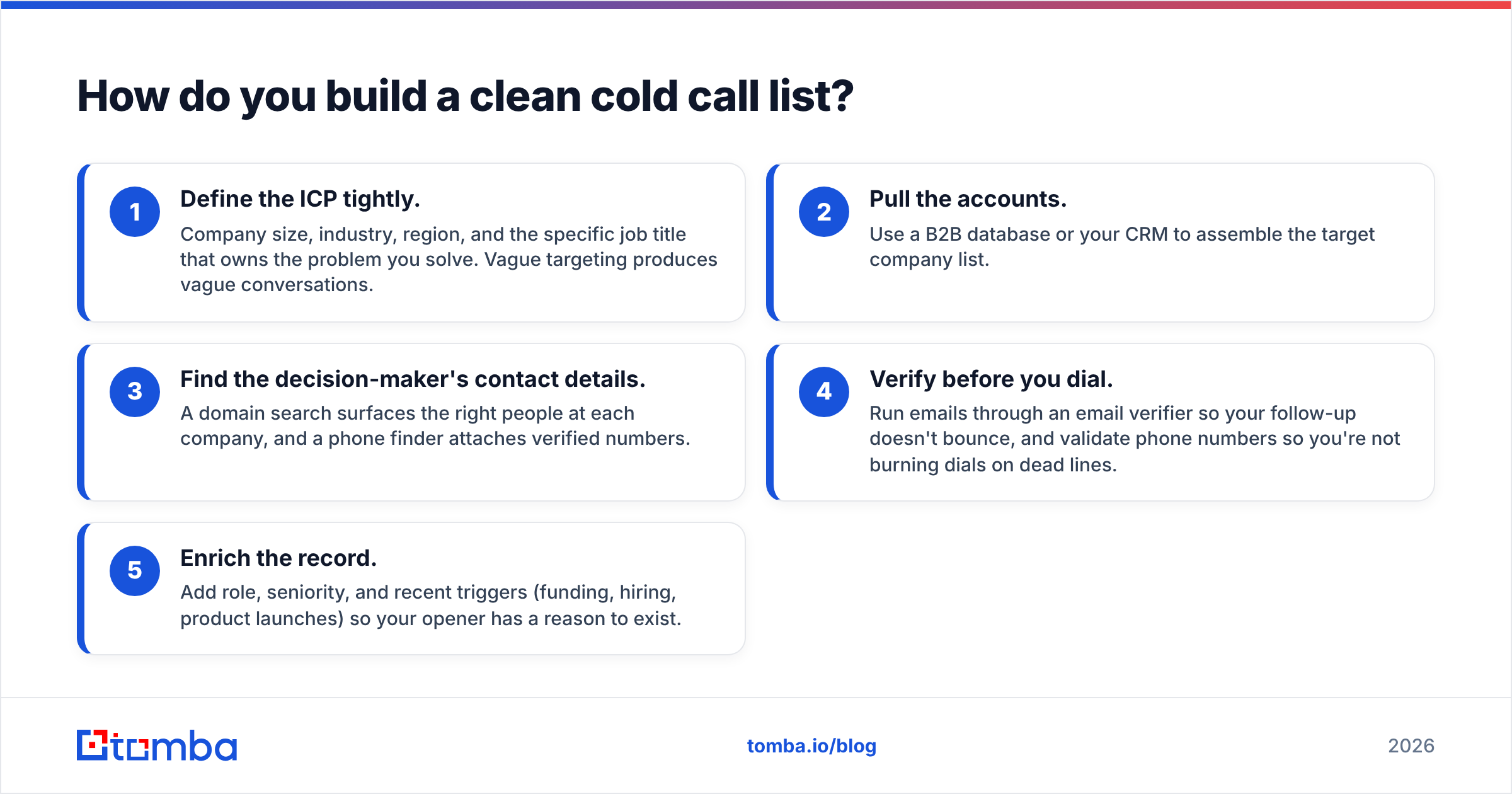
Start with your ideal customer profile, then layer on accurate contact details. The workflow looks like this:
- Define the ICP tightly. Company size, industry, region, and the specific job title that owns the problem you solve. Vague targeting produces vague conversations.
- Pull the accounts. Use a B2B database or your CRM to assemble the target company list.
- Find the decision-maker's contact details. A domain search surfaces the right people at each company, and a phone finder attaches verified numbers.
- Verify before you dial. Run emails through an email verifier so your follow-up doesn't bounce, and validate phone numbers so you're not burning dials on dead lines.
- Enrich the record. Add role, seniority, and recent triggers (funding, hiring, product launches) so your opener has a reason to exist.
A list built this way is small, but every name is reachable and relevant. That beats a 5,000-row export where half the numbers ring nowhere.
What is the best cold call opening script?#
The best opener earns permission instead of assuming it. The classic mistake is launching into a pitch the second someone says hello. Instead, acknowledge the interruption, give a reason, and ask for a few seconds.
The permission-based opener:
"Hi [Name], it's [Your Name] from [Company]. I know I'm catching you out of the blue — do you have 30 seconds for me to explain why I called, and then you can tell me to get lost?"
This works because it's honest. You're naming the elephant (the cold call) and handing them control. Most people give you the 30 seconds.
The reason-led opener:
"Hi [Name], the reason I'm calling is I saw [trigger event] at [Company], and we help teams like yours [specific outcome]. Did I catch you at an okay time?"
Notice both openers skip "How are you today?" — the phrase that instantly signals "salesperson" and triggers the brush-off reflex. Need help writing variations? A cold email AI tool can draft openers you adapt for the phone, since the same relevance principles apply across channels.
How do you handle the most common cold call objections?#
Objections early in a call are almost never real objections. They're reflexes. Your job is to stay calm, acknowledge, and redirect — not to argue. Here are the four you'll hear most and how to respond:
- "I'm not interested." → "Totally fair — most people aren't when I first call. Can I ask what you're using today for [problem]? If it's working, I'll leave you alone." This reframes from pitch to curiosity.
- "Send me an email." → "Happy to. So I send something useful instead of generic, what's the one thing you'd actually want to know?" Then capture a real need and follow up with a verified address.
- "We already have a solution." → "Makes sense, most teams your size do. A lot of them tell me [common gap] is still a headache — is that true for you?" You're not attacking the incumbent, you're finding the crack.
- "I don't have time." → "I figured, that's why I asked for 30 seconds. Want me to make this quick or grab two minutes on Thursday?" Give them an easy out that's still a yes.
The throughline: never fight the objection. Acknowledge it, ask one question, and let curiosity do the work.
How many cold calls should you make per day?#
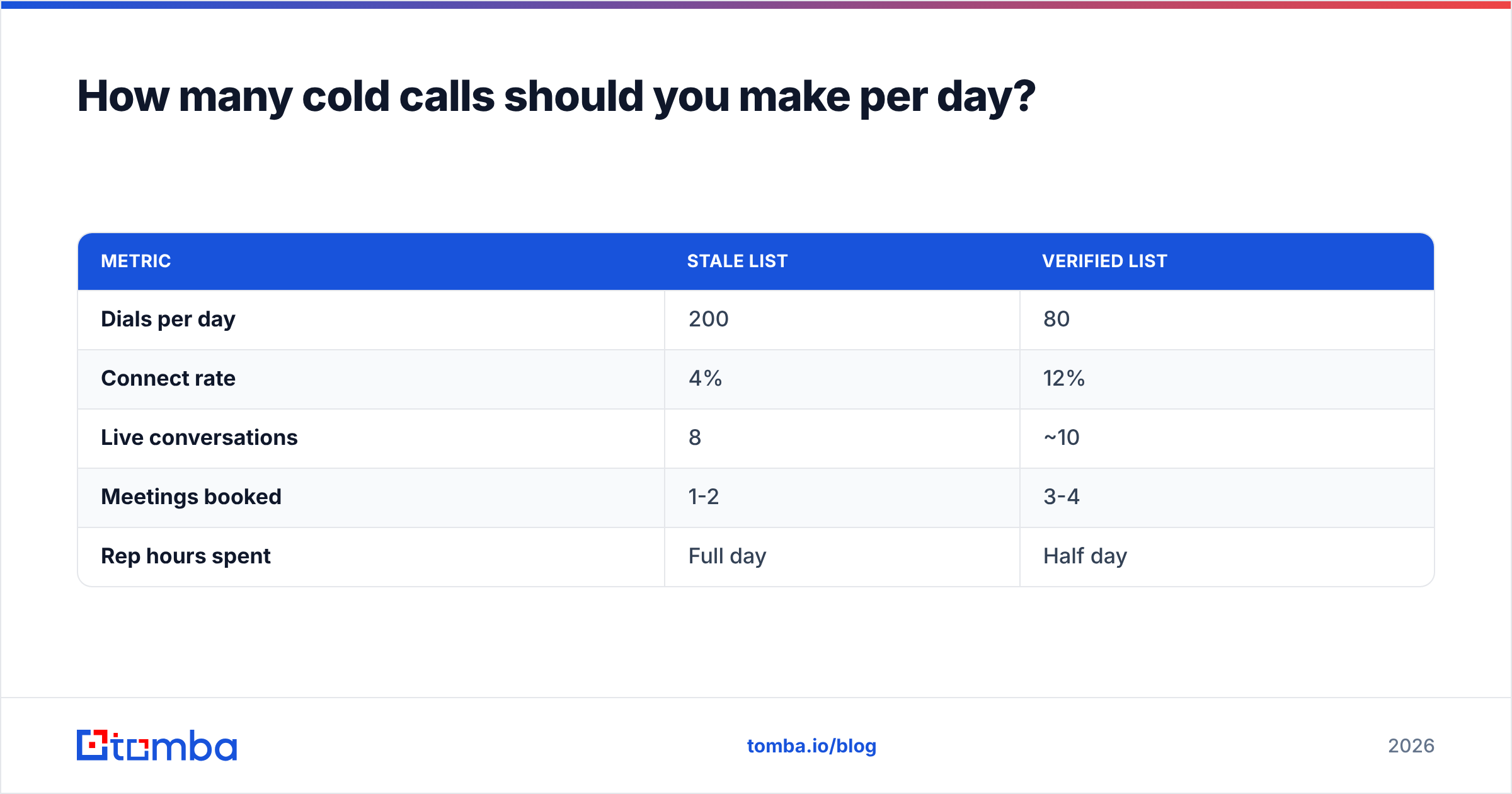
The honest answer: enough to hit your connect and conversation targets, not an arbitrary dial count. Working backward from outcomes beats chasing vanity activity metrics.
| Metric | Stale list | Verified list |
|---|---|---|
| Dials per day | 200 | 80 |
| Connect rate | 4% | 12% |
| Live conversations | 8 | ~10 |
| Meetings booked | 1-2 | 3-4 |
| Rep hours spent | Full day | Half day |
The verified list produces more meetings in less time because almost every dial reaches a real person. This is the core argument of this B2B cold calling guide: stop optimizing dial volume and start optimizing who you're dialing. Quality of data compounds; brute force doesn't.
That said, don't swing to the other extreme. You still need disciplined volume blocks — two or three focused calling windows per day, phone off do-not-disturb, no email multitasking. Connect rate and volume work together; one without the other underperforms.
What's the right cold call cadence and follow-up?#
A single call rarely lands a decision-maker. Build a multi-touch cadence that mixes channels so you stay persistent without being annoying. A practical 10-business-day sequence:
- Day 1 — Call (leave a 15-second voicemail naming a specific reason)
- Day 1 — Follow-up email referencing the voicemail
- Day 3 — Call at a different time of day
- Day 4 — LinkedIn connection or relevant comment
- Day 6 — Call + value-add email (a stat, a case, a teardown)
- Day 8 — Call
- Day 10 — Breakup email ("Should I close your file?")
Varying the time of day matters more than people expect — someone who never answers at 9 a.m. might pick up at 4:45 p.m. And every email touch should go to a verified address. Bouncing emails wreck your sender reputation and quietly tank deliverability across your whole domain, which sabotages the email half of your cadence.
Which tools do you actually need for cold calling?#
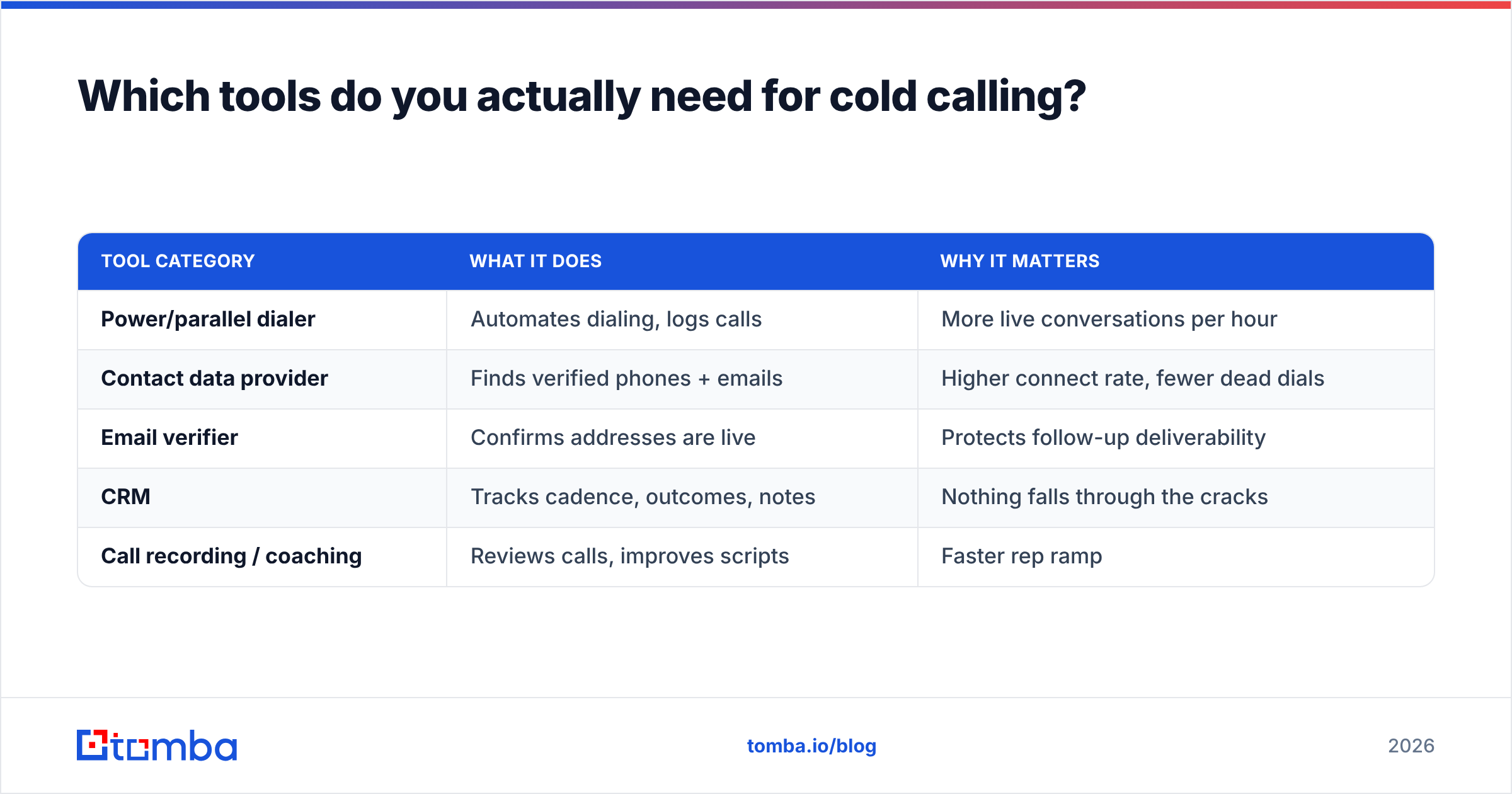
You need fewer tools than vendors want you to buy. The essential stack is a dialer, accurate contact data, and a CRM to track it. Everything else is optional.
| Tool category | What it does | Why it matters |
|---|---|---|
| Power/parallel dialer | Automates dialing, logs calls | More live conversations per hour |
| Contact data provider | Finds verified phones + emails | Higher connect rate, fewer dead dials |
| Email verifier | Confirms addresses are live | Protects follow-up deliverability |
| CRM | Tracks cadence, outcomes, notes | Nothing falls through the cracks |
| Call recording / coaching | Reviews calls, improves scripts | Faster rep ramp |
The non-negotiable line item is contact data. A dialer that fires through a list of disconnected numbers just helps you fail faster. Compare Tomba pricing against standalone data vendors and you'll usually find the email-plus-phone bundle covers what you'd otherwise stitch together from three tools. For teams running outbound at scale, a bulk email finder lets you enrich entire account lists in one pass instead of looking up contacts one at a time.
If you want to vet a provider's data, third-party reviews on G2 are a reasonable sanity check before you commit budget. Look specifically at accuracy and "data freshness" comments, since those predict your connect rate.
How do you measure and improve cold calling performance?#
Track the funnel, not just the activity. The metrics that tell you whether your motion is healthy:
- Connect rate — live conversations ÷ dials. Below 8%? Your data is the problem, not your script.
- Conversation-to-meeting rate — meetings booked ÷ live conversations. Below 20%? Your opener or targeting needs work.
- Meeting-held rate — meetings that actually happen ÷ booked. Low show rates point to weak qualification on the call.
- Dials-to-meeting ratio — your true efficiency number; watch it trend over weeks.
Review recorded calls weekly and isolate the one moment where good calls and bad calls diverge — usually the first 15 seconds or the first objection. Fix that one moment and your whole funnel lifts. Improvement comes from tightening the highest-leverage step, not from rewriting everything at once.
Cold calling FAQ#
Is cold calling legal for B2B in 2026? In most regions, B2B cold calling to business numbers is legal, but rules vary — honor do-not-call registries, identify yourself, and check local regulations before running campaigns.
What's a good cold call connect rate? With verified direct dials and mobiles, 10-15% is achievable. On switchboard or stale lists, you'll often see under 5%.
Should I leave voicemails? Yes — short, specific ones. They prime the prospect for your follow-up call and email even if they don't call back.
How is cold calling different from cold email? Calling is higher-intent and faster to a yes/no, but lower volume. The strongest motions combine both, which is why accurate phone and email data together outperform either alone.
Start with the data, not the dialer#
If you take one thing from this guide, make it this: the call is only as good as the contact behind it. Tighten your ICP, find the right people, verify their details, and your connect rate — and your morale — climb together.
That's exactly where Tomba fits. Use the Tomba Email Finder to source verified professional emails for your follow-up cadence, pair it with the phone finder for direct dials, and you've replaced guesswork with a list where almost every name picks up. Start free with 25 searches a month, scale to the Starter plan at $49/mo when you're ready to run real volume, and spend your calling hours talking to people who actually answer.
// get started
Find, verify and enrich your first contacts today
Start on the free plan with 25 searches a month, then scale when your team is ready.
Free plan · No credit card required · GDPR & CCPA
Get the Tomba newsletter
Product and data updates
// about the author