B2B Cold Emailing in 2026: The Complete Playbook That Converts
B2B cold emailing still works in 2026 — if you skip the spray-and-pray playbook. Here's the targeting, deliverability, and copy system that books meetings.
TL;DR
- B2B cold emailing still books meetings in 2026 — but only when your list is verified, your domain is warmed, and your copy reads like a human wrote it for one person.
- The biggest reply-rate killer is not your subject line. It's bad data: invalid addresses, spam traps, and catch-all domains that tank your sender reputation before anyone reads a word.
- A clean send looks like this: tight ICP → verified contacts → warmed sending domain → personalized first line → 3-4 step follow-up → measured and iterated.
- Volume is not strategy. 50 researched emails to the right people beat 5,000 generic blasts every time.
- Tools matter, but sequence matters more. Get the inputs right (data + deliverability) and average copy still converts.
What is B2B cold emailing in 2026?#
B2B cold emailing is sending an unsolicited but relevant email to a business contact you have not spoken to before, with the goal of starting a commercial conversation. Think of it like knocking on the right office door with a useful reason to be there — not papering the whole street with flyers.
What changed by 2026 is the cost of getting it wrong. Mailbox providers (Google and Microsoft especially) now lean hard on engagement signals and authentication. Send to dead addresses or get marked as spam a few times, and your domain reputation drops fast. Once that happens, even your good emails land in spam. So the modern game is less about clever tricks and more about hygiene, relevance, and consistency.
The other shift: buyers are saturated. The average B2B decision-maker gets dozens of pitches a week. Generic "I'd love to hop on a call" emails get deleted on sight. The emails that work in 2026 are short, specific, and obviously written by someone who did 30 seconds of homework.
Does cold email still work, or is it dead?#
It works — when the inputs are right. The "cold email is dead" crowd is usually describing spray-and-pray: buying a sketchy list of 50,000 contacts, blasting one template, and wondering why the reply rate is 0.2%. That approach is dead. Targeted, well-researched outbound is very much alive, and for most B2B companies it's still one of the cheapest predictable pipeline sources.
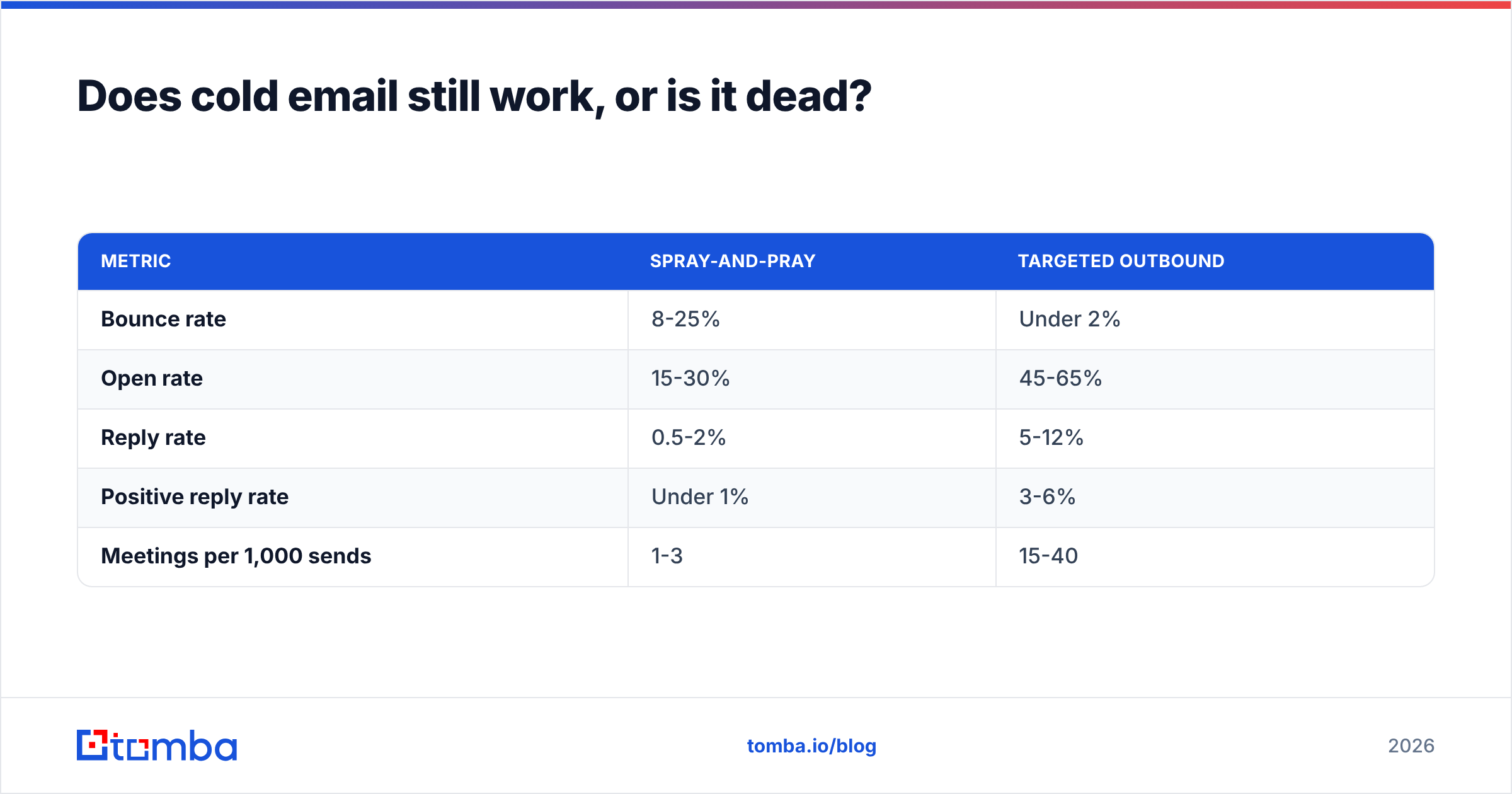
Here's the honest math. A good cold email campaign in 2026 lands somewhere in these ranges:
| Metric | Spray-and-pray | Targeted outbound |
|---|---|---|
| Bounce rate | 8-25% | Under 2% |
| Open rate | 15-30% | 45-65% |
| Reply rate | 0.5-2% | 5-12% |
| Positive reply rate | Under 1% | 3-6% |
| Meetings per 1,000 sends | 1-3 | 15-40 |
The difference is not magic copy. It's that targeted senders verify their lists, warm their domains, and personalize. If you only fix one thing this year, fix your data — that single change moves bounce, open, and reply rates all at once.

How do you build a clean B2B cold email list?#
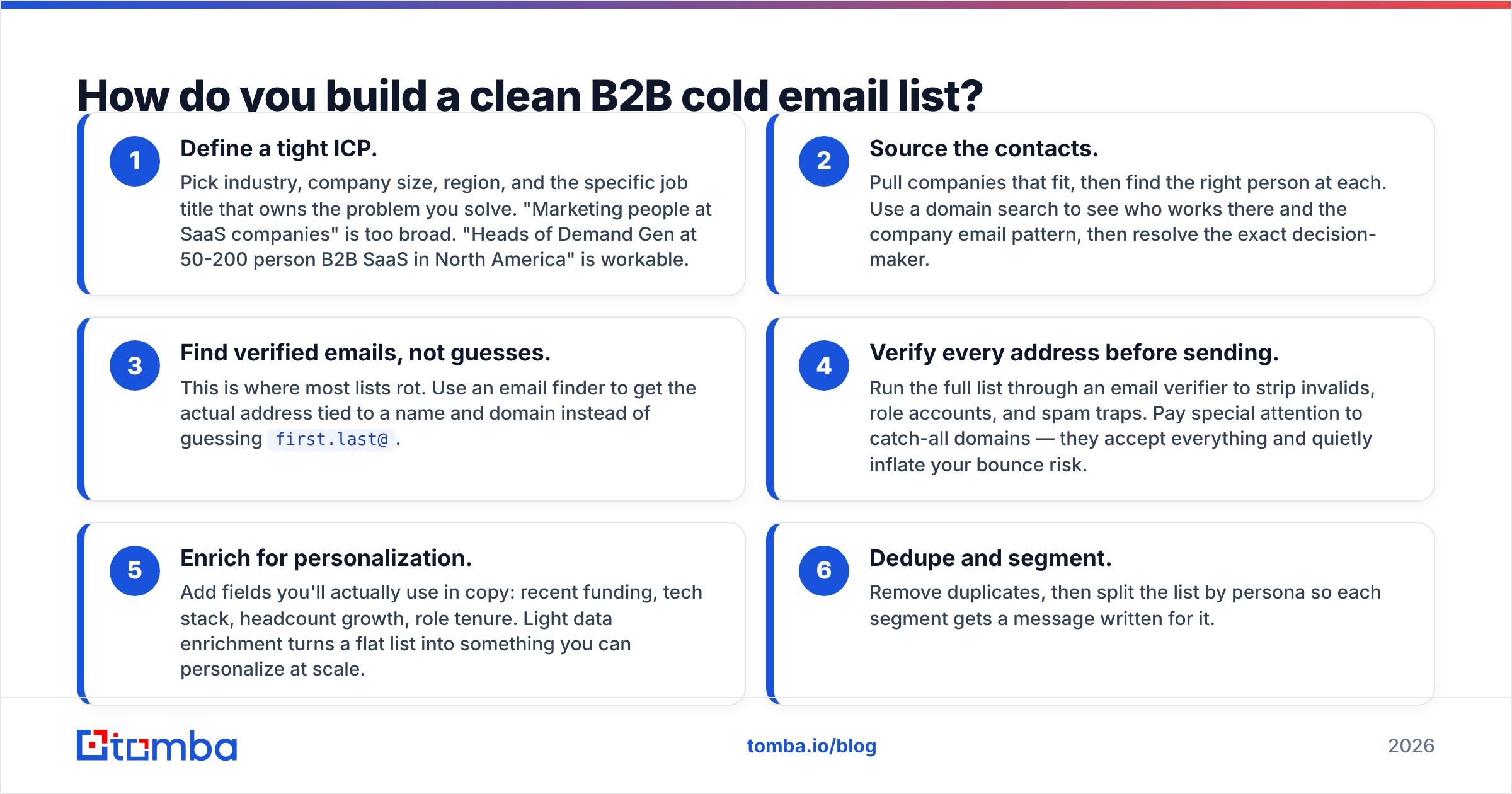
Your list is the foundation. A brilliant email to the wrong person — or a bounced address — is worthless. Build the list in this order:
- Define a tight ICP. Pick industry, company size, region, and the specific job title that owns the problem you solve. "Marketing people at SaaS companies" is too broad. "Heads of Demand Gen at 50-200 person B2B SaaS in North America" is workable.
- Source the contacts. Pull companies that fit, then find the right person at each. Use a domain search to see who works there and the company email pattern, then resolve the exact decision-maker.
- Find verified emails, not guesses. This is where most lists rot. Use an email finder to get the actual address tied to a name and domain instead of guessing
first.last@. - Verify every address before sending. Run the full list through an email verifier to strip invalids, role accounts, and spam traps. Pay special attention to catch-all domains — they accept everything and quietly inflate your bounce risk.
- Enrich for personalization. Add fields you'll actually use in copy: recent funding, tech stack, headcount growth, role tenure. Light data enrichment turns a flat list into something you can personalize at scale.
- Dedupe and segment. Remove duplicates, then split the list by persona so each segment gets a message written for it.
The rule of thumb: if you would not send the email by hand, don't send it automated. Your tooling should make the manual-quality version faster, not replace the judgment.
Why does deliverability matter more than copy?#
Because copy only matters if the email reaches the inbox. You can write the best message in the world, but if it lands in spam, nobody reads it. Deliverability is the gatekeeper, and in 2026 it's stricter than ever.
Three things govern whether you land in the primary inbox:
- Authentication. Set up SPF, DKIM, and DMARC on your sending domain. These are non-negotiable in 2026 — Google and Yahoo require DMARC for bulk senders. If you don't know what these are, start with email deliverability basics before sending a single campaign.
- Reputation and warmup. A brand-new domain has no trust. Warm it gradually — start with a handful of sends per day and ramp over 3-4 weeks. Use a separate domain (not your main company domain) for cold outreach so a reputation hit never touches your real email.
- Engagement signals. Replies, opens, and "not spam" marks build reputation. Spam complaints, bounces, and deletes-without-open destroy it. This is why list verification feeds directly into deliverability — bounces are a reputation tax.
A practical rule: keep bounce rate under 2% and spam complaints under 0.1%. Cross those thresholds and providers throttle you. The cheapest way to stay under them is to verify before you send, not after you've already burned your domain.
For the authentication side, follow the official guidance from Google's sender requirements rather than random blog advice — the rules change and the source of truth is the mailbox provider.
What does a high-converting cold email look like?#
Short, specific, and about them. The structure that works in 2026 is almost boring in its consistency:
- Subject line: 2-5 words, lowercase, no hype. "quick question re: [their initiative]" beats "Revolutionary solution for YOUR business!!!"
- First line: a personalized observation that proves you're not blasting. Reference their recent launch, a hire, a post, a number.
- The problem: one sentence naming a pain your ICP feels. Make them nod.
- The proof: one short, concrete result you've driven for someone like them. Specific numbers, not adjectives.
- The ask: one low-friction CTA. "Worth a 15-min look?" not "Let's schedule a 60-minute discovery call to align on synergies."
Keep the whole thing under 90 words. On mobile, a long email is a deleted email. Here's the shape:
Subject: question about [their Q3 launch]
Hi Sarah — saw [Company] just launched the self-serve tier. Congrats.
Teams rolling out self-serve usually hit a wall on activation emails. We helped [Similar Co] lift trial-to-paid by 22% in one quarter.
Worth a quick look at how?
Notice there's no "I hope this email finds you well," no company history, no five paragraphs about your platform. One relevant observation, one proof point, one easy yes.
If writing 200 of these feels impossible, use a cold email AI draft as a starting point — but always edit the first line by hand. The personalization is what gets the reply; never automate that away.

How many follow-ups should you send?#
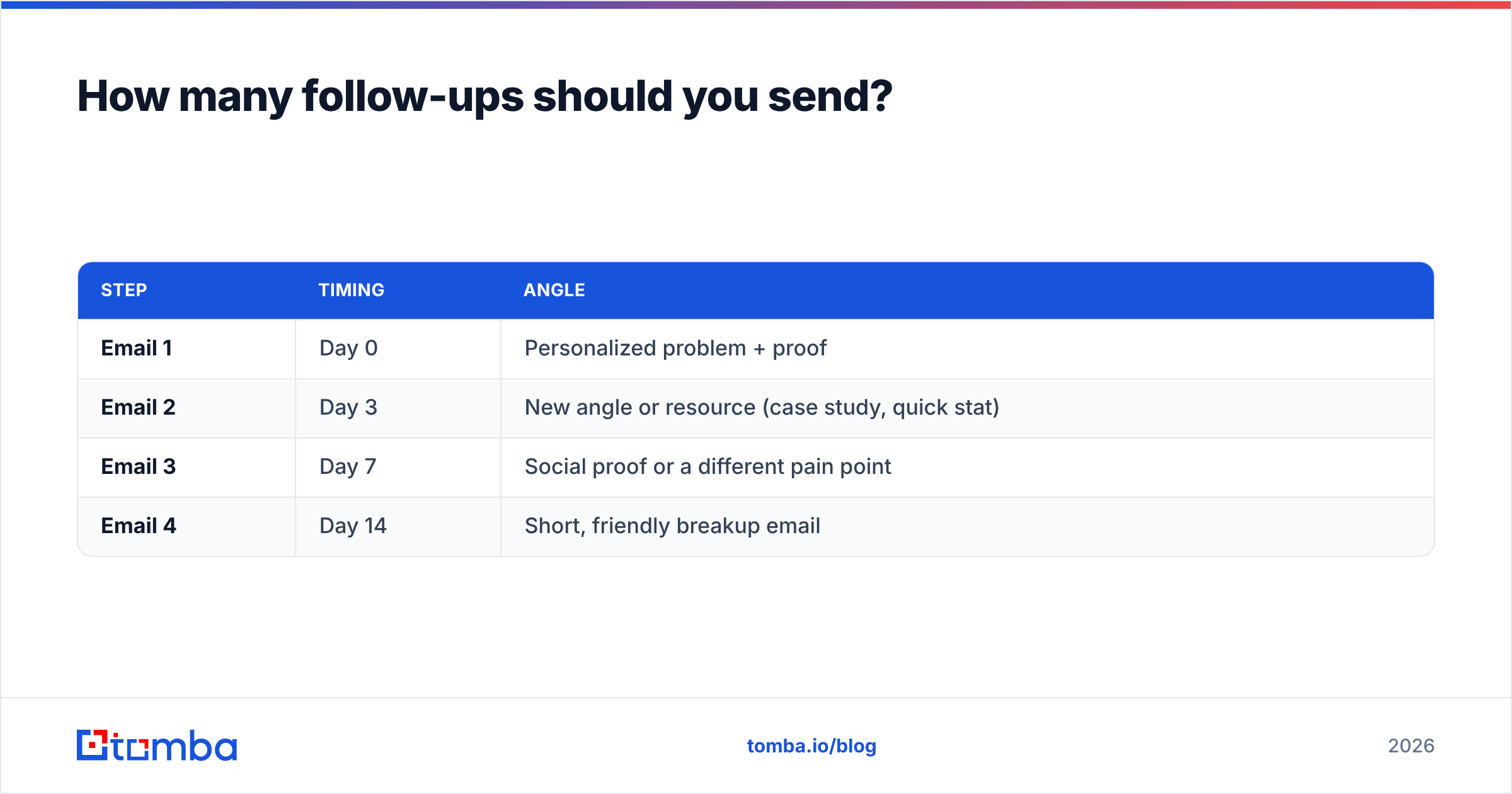
Three to four, spaced out, each adding new value. Most replies don't come from the first email — they come from follow-ups two and three. People are busy; a polite, useful nudge is not annoying, it's how business gets done.
The pattern that works:
| Step | Timing | Angle |
|---|---|---|
| Email 1 | Day 0 | Personalized problem + proof |
| Email 2 | Day 3 | New angle or resource (case study, quick stat) |
| Email 3 | Day 7 | Social proof or a different pain point |
| Email 4 | Day 14 | Short, friendly breakup email |
Two rules for follow-ups. First, never just "bump" with "just checking in" — add something each time: a relevant case study, a new insight, a different framing of the problem. Second, the breakup email punches above its weight. A simple "Should I close the loop on this?" gets surprising reply rates because it triggers loss aversion.
Stop the sequence the moment someone replies or books — nothing kills trust faster than a "follow-up" arriving after the prospect already responded.
What tools do you actually need?#
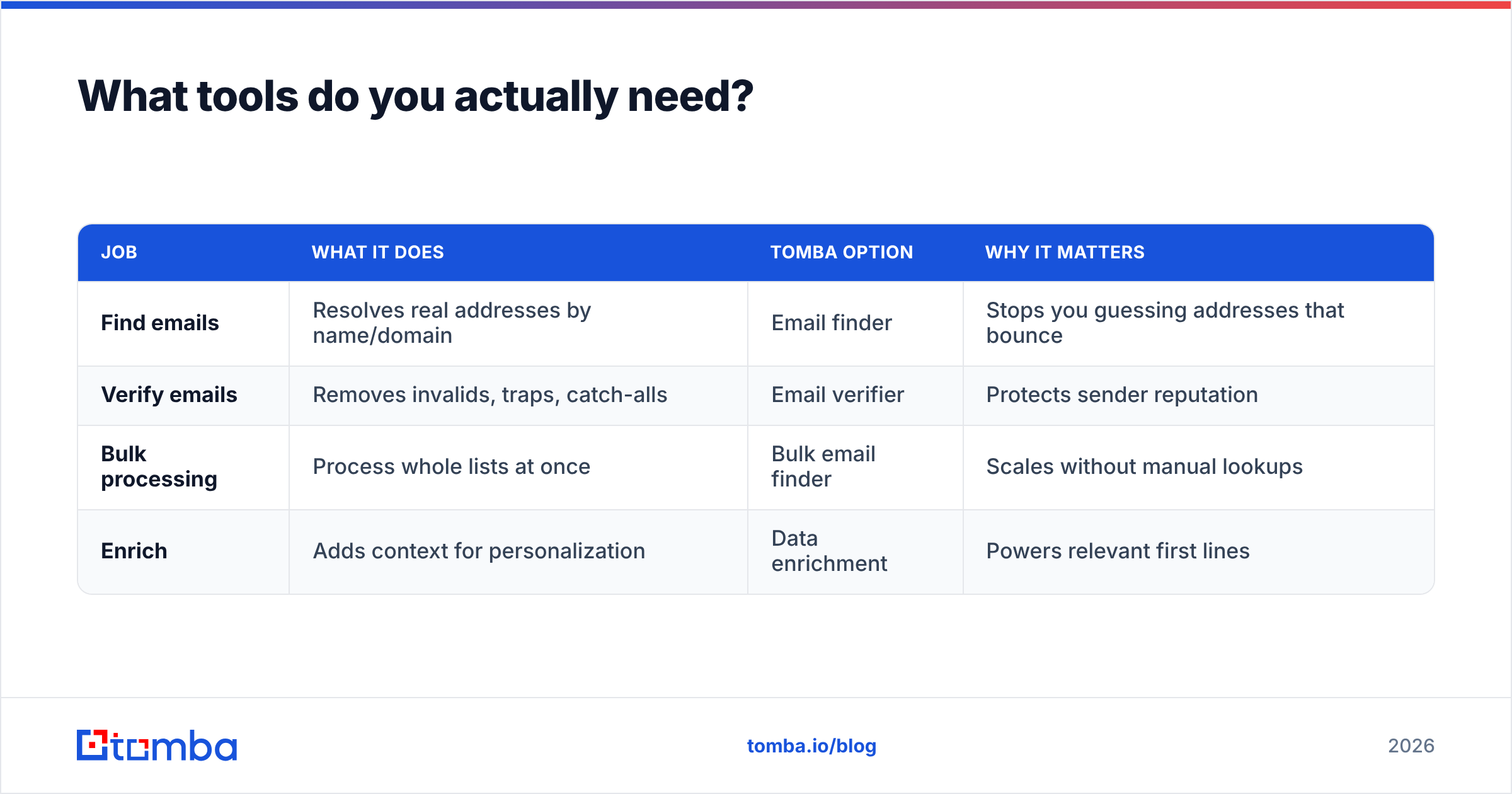
Fewer than vendors want you to believe. A complete B2B cold emailing stack in 2026 has four jobs: find data, verify data, send, and measure. Here's how the core pieces compare against what each actually does for you:
| Job | What it does | Tomba option | Why it matters |
|---|---|---|---|
| Find emails | Resolves real addresses by name/domain | Email finder | Stops you guessing addresses that bounce |
| Verify emails | Removes invalids, traps, catch-alls | Email verifier | Protects sender reputation |
| Bulk processing | Process whole lists at once | Bulk email finder | Scales without manual lookups |
| Enrich | Adds context for personalization | Data enrichment | Powers relevant first lines |
For the sending layer itself — sequencing, inbox rotation, warmup — you'll add a dedicated outbound platform. There are many solid ones; compare them on G2 rather than picking the loudest ad. The key is integration: your finder and verifier should feed clean data into whatever sender you choose. Check Tomba pricing to see how the data layer fits — the Free tier (25 searches/mo) lets you test the workflow, Starter is $49/mo, and Growth at $99/mo covers most small teams running steady outbound.
One thing to resist: buying a tool for every micro-task. A finder, a verifier, a sender, and a CRM cover 95% of B2B cold emailing. Everything else is optimization you earn later.
How do you measure and improve a campaign?#
Track four numbers and change one variable at a time. The metrics that actually tell you something:
- Bounce rate — your data health. Over 2%? Fix verification before anything else.
- Open rate — your subject line and sender reputation. Low opens with clean data usually means a deliverability problem, not a copy problem.
- Reply rate — your targeting and copy. This is the number that matters most.
- Positive reply rate — your offer and fit. High replies but low positives means you're reaching the wrong people or pitching the wrong thing.
The discipline that separates good outbound teams from average ones is isolating variables. Don't change the subject line, the offer, and the list in the same week — you'll never know what moved the needle. Run an A/B test on one element, give it enough volume to mean something (a few hundred sends minimum), then lock the winner and test the next thing. For benchmarking, HubSpot publishes solid email marketing data you can sanity-check your numbers against.
Also watch the leading indicator most people ignore: how fast your reputation recovers after a bad send. If one messy campaign tanks your opens for two weeks, your warmup and list hygiene aren't strong enough yet.
Is cold email legal for B2B?#
Mostly yes, with rules you must follow. In the US, CAN-SPAM allows cold B2B email if you identify yourself honestly, don't use deceptive subject lines, include a physical address, and honor opt-outs. In the EU and UK, GDPR and PECR are stricter — you generally need a "legitimate interest" basis, and you must offer easy opt-out. Canada's CASL is the toughest and often requires consent.
The safe operating procedure: only email business addresses with a genuine, relevant reason; always include an unsubscribe path; honor opt-outs immediately; keep records of why you contacted someone. None of this is legal advice — check the rules for the regions you sell into — but the practical upshot is simple. Relevance and easy opt-out keep you compliant and keep your reputation clean at the same time. The same hygiene that makes you legal makes you effective.
The bottom line#
B2B cold emailing in 2026 rewards discipline over cleverness. The teams winning aren't the ones with the slickest templates — they're the ones with verified lists, warmed domains, and tight targeting feeding average-but-personalized copy. Get the inputs right and the outputs follow.
Start where the leverage is highest: your data. Before your next campaign, find the real decision-makers and confirm every address resolves. The Tomba Email Finder gets you accurate, source-backed emails by name, domain, or company, and the built-in verification keeps your bounce rate where it needs to be. Spin up the free tier, build one clean segment, and send 50 researched emails instead of 5,000 blind ones. Your reply rate — and your sender reputation — will thank you.
// get started
Find, verify and enrich your first contacts today
Start on the free plan with 25 searches a month, then scale when your team is ready.
Free plan · No credit card required · GDPR & CCPA
// about the author