B2B Competitor Analysis in 2026: A Practical Framework
A repeatable framework for B2B competitor analysis in 2026 — what to track, how to gather signal without guesswork, and how to turn it into pipeline.
Most B2B competitor analysis dies in a slide deck. Someone builds a tidy grid of logos, presents it once, and nobody opens it again until the next board meeting. That is a waste, because the same research — done right and kept fresh — can lift your win rate, sharpen your messaging, and tell your reps exactly what to say when a prospect names a rival.
This guide gives you a framework you can actually run on a cadence, the signals worth tracking, and the data sources that turn opinion into evidence.
TL;DR#
- B2B competitor analysis is an operating habit, not a one-off deck. Treat it like a living system that feeds sales, product, and marketing every week.
- Track four layers: company fundamentals, product and pricing, go-to-market motion, and customer sentiment. Most teams only track the first two.
- Battle cards are the deliverable that matters. A research doc nobody reads loses to a one-page card a rep uses on a live call.
- Good data beats clever frameworks. You need accurate contact, firmographic, and hiring signals — not just guesses scraped from a homepage.
- Score and refresh. Rank competitors by threat level, revisit the high-threat ones monthly, and archive the noise.
What is B2B competitor analysis?#
B2B competitor analysis is the structured process of identifying the companies competing for your buyers, then studying how they sell, price, position, and retain so you can win more deals against them.
Think of it like scouting in sports. You do not study an opposing team to copy their playbook — you study them to find the gap you can exploit on game day. In B2B, "game day" is a live sales call where a prospect says, "We're also looking at [Rival]." If your rep freezes, you lose. If your rep calmly explains the three places you win, you advance the deal.
It differs from consumer competitor research in three ways:
- Buying committees, not individuals. You are influencing five to ten stakeholders, so you need positioning for each persona.
- Long sales cycles. A competitor's move shows up in your pipeline months later, so early signal matters.
- Opaque pricing. Most B2B vendors hide pricing, so you reconstruct it from reviews, RFPs, and lost-deal interviews.
Why does competitor analysis matter for revenue?#
Because it directly moves the numbers your board cares about. Strong competitive intelligence has measurable effects on win rate, deal velocity, and churn. When reps know how to handle a competitor objection, deals stop stalling at the evaluation stage.
It also protects you from being blindsided. A rival that quietly drops its starter price, ships a feature you have been promising, or hires twenty SDRs in your territory is telling you something — if you are listening. The companies that lose to competitors usually were not outsold on the call; they were out-prepared weeks earlier.
This is squarely a revenue operations function. RevOps owns the data plumbing, the cadence, and the feedback loop that turns a research finding into a battle-card update that a rep actually sees.
What are the layers of a competitor profile?#
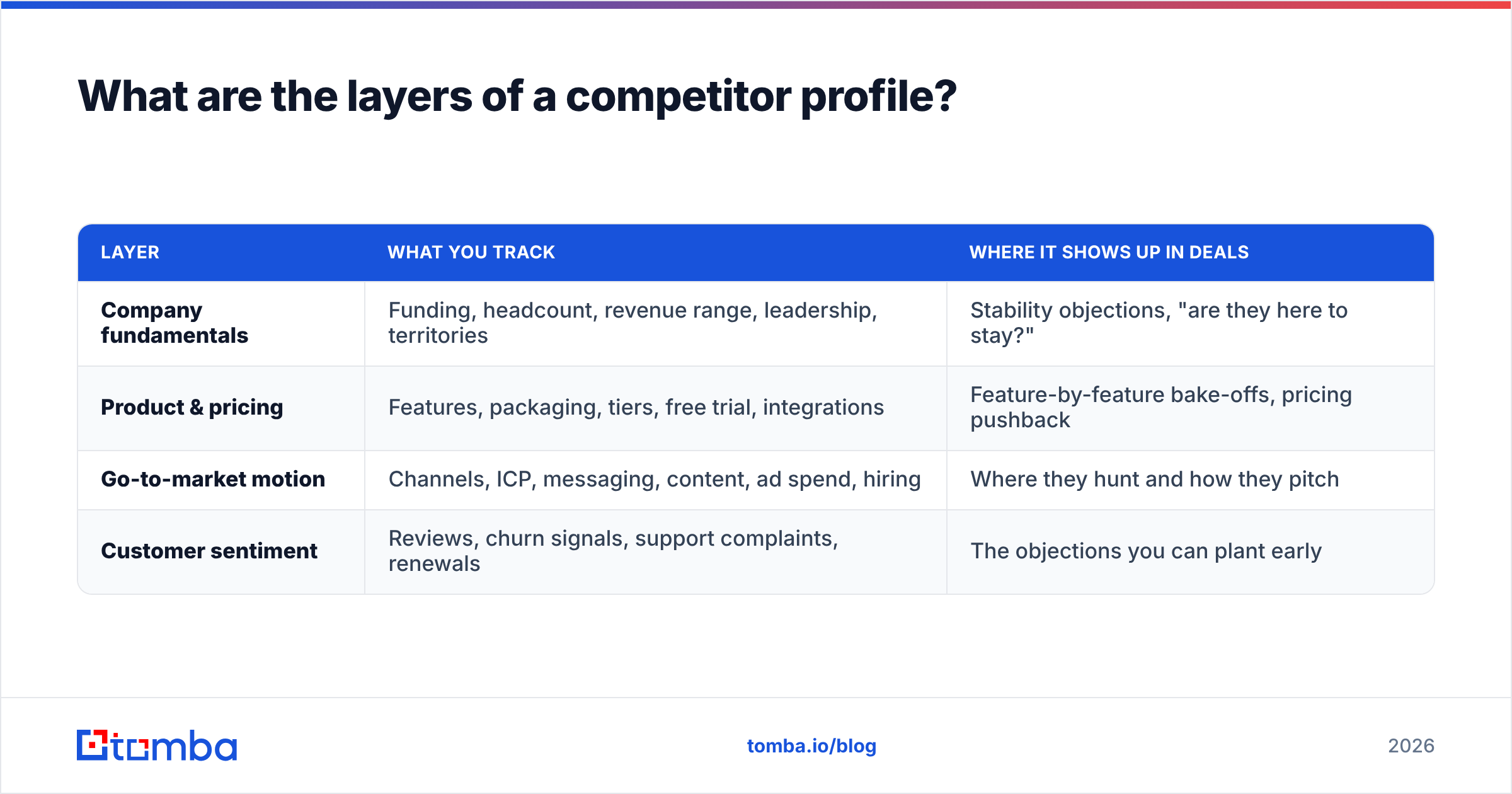
Most teams stop at "what does their product do and what does it cost." That is two of the four layers you need. Here is the full stack.
| Layer | What you track | Where it shows up in deals |
|---|---|---|
| Company fundamentals | Funding, headcount, revenue range, leadership, territories | Stability objections, "are they here to stay?" |
| Product & pricing | Features, packaging, tiers, free trial, integrations | Feature-by-feature bake-offs, pricing pushback |
| Go-to-market motion | Channels, ICP, messaging, content, ad spend, hiring | Where they hunt and how they pitch |
| Customer sentiment | Reviews, churn signals, support complaints, renewals | The objections you can plant early |
The third and fourth layers are where the edge lives. Anyone can read a pricing page. Knowing that a competitor just posted nine sales roles in your top vertical, or that their G2 reviews are quietly filling with onboarding complaints, is the kind of signal that changes how you sell this quarter.
A quick way to build the go-to-market layer: pull the company's domain and map who works there. With a domain search, you can see the email pattern, the people listed under sales and marketing, and roughly how the team is structured — useful context when you are trying to understand how a rival actually goes to market.
How do you run a B2B competitor analysis, step by step?#
Here is the repeatable loop. Run the first pass over a week, then maintain it on a monthly cadence.
- Build the competitor set. List direct competitors (same product, same buyer), indirect competitors (different product, same problem), and the "do nothing / build in-house" option. Do not skip that last one — it wins more deals than any named rival.
- Tier by threat. Score each competitor on how often you face them and how often you lose. Spend your time on the high-frequency, high-loss quadrant.
- Gather evidence, not vibes. Pull pricing from review sites and lost-deal notes, features from their docs and changelogs, and GTM signals from hiring pages and ad libraries.
- Interview your own losses. Five honest lost-deal calls beat fifty hours of desk research. Ask what the buyer saw in the other vendor.
- Synthesize into battle cards. One page per competitor: how to position, traps to set, landmines to avoid, and proof points.
- Distribute and train. Put the cards where reps work — the CRM, not a shared drive. Run a 20-minute role-play so reps can say the lines out loud.
- Refresh on a cadence. Re-check high-threat competitors monthly; archive the rest until something changes.
The teams that win treat steps 6 and 7 as the real work. Research that never reaches a rep on a live call is a hobby, not a system.
What goes on a competitor battle card?#
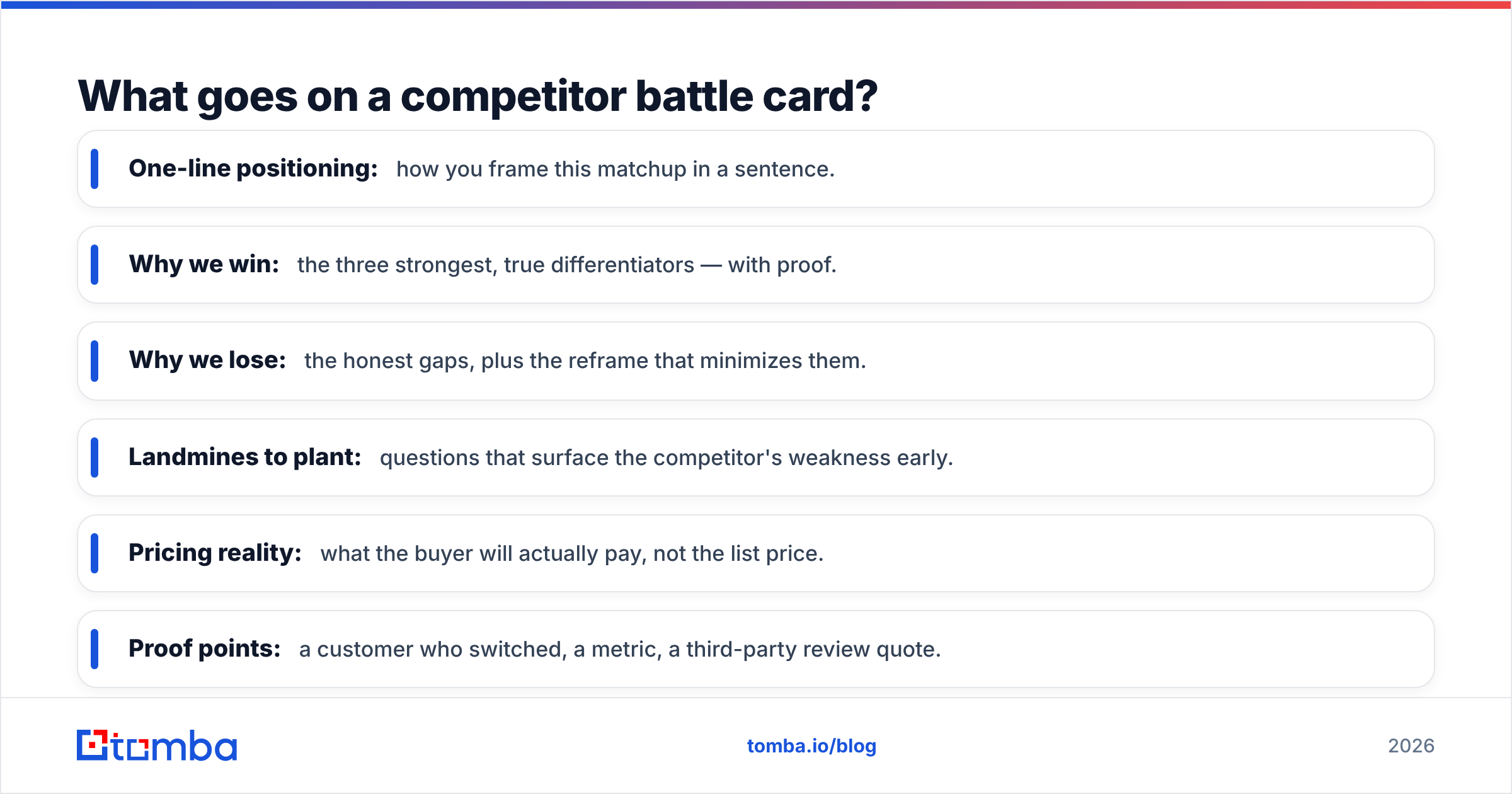
A battle card is the one artifact your sales team will actually use, so design it for a stressed rep mid-call, not for a strategy offsite. Keep it to a single screen.
- One-line positioning: how you frame this matchup in a sentence.
- Why we win: the three strongest, true differentiators — with proof.
- Why we lose: the honest gaps, plus the reframe that minimizes them.
- Landmines to plant: questions that surface the competitor's weakness early.
- Pricing reality: what the buyer will actually pay, not the list price.
- Proof points: a customer who switched, a metric, a third-party review quote.
Honesty is what makes a card credible. If you pretend you win everywhere, reps stop trusting the card the first time a prospect catches the exaggeration. Name the two deals you genuinely lose and arm reps to requalify out of them fast.

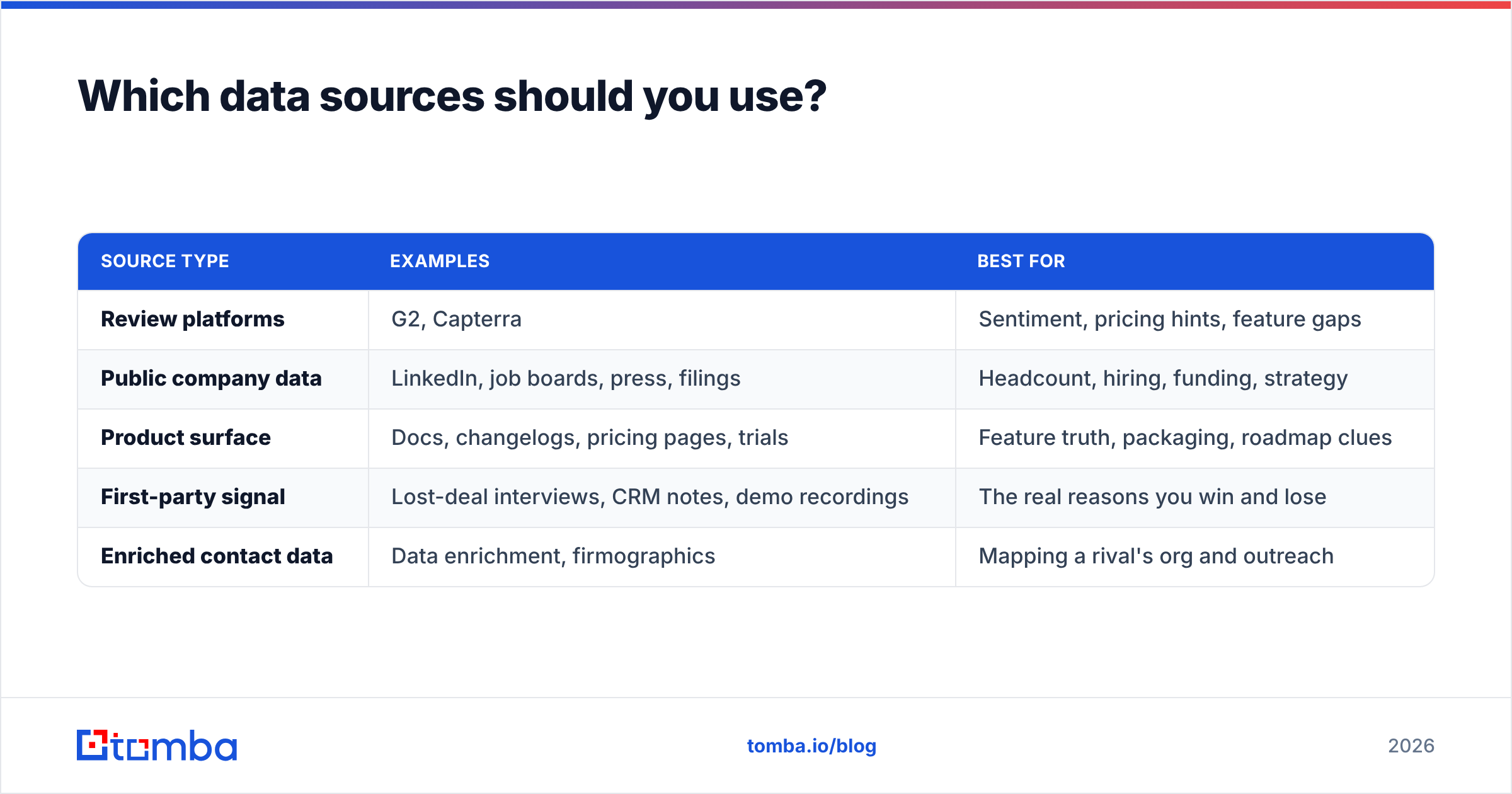
Which data sources should you use?#
Your analysis is only as good as your inputs. Mixing free public signal with enriched contact and firmographic data gives you a picture that opinion alone never will.
| Source type | Examples | Best for |
|---|---|---|
| Review platforms | G2, Capterra | Sentiment, pricing hints, feature gaps |
| Public company data | LinkedIn, job boards, press, filings | Headcount, hiring, funding, strategy |
| Product surface | Docs, changelogs, pricing pages, trials | Feature truth, packaging, roadmap clues |
| First-party signal | Lost-deal interviews, CRM notes, demo recordings | The real reasons you win and lose |
| Enriched contact data | Data enrichment, firmographics | Mapping a rival's org and outreach |
For the analyst frameworks behind all this, Gartner and Forrester publish competitive and market-positioning research worth reading alongside your own primary work. Use them for the market shape; use your lost-deal calls for the truth on the ground.
One practical tip on the data layer: when you are reconstructing a competitor's GTM team or trying to reach a prospect who is evaluating both of you, accurate contact data is the bottleneck. Verifying addresses before you reach out with an email verifier keeps your bounce rate down and your sender reputation intact — which matters when competitive deals move fast and you only get one clean shot at the buyer.
How is AI changing competitive intelligence in 2026?#
AI has made the gathering half of competitor analysis cheap and the judgment half more valuable. You can now summarize a hundred reviews, cluster complaints, and draft a first-pass battle card in minutes. What you cannot automate is deciding which of those signals actually changes a deal.
The practical shift in 2026 is from periodic to continuous. Instead of a quarterly deck, teams wire up alerts on competitor hiring, pricing-page changes, and review velocity, then let a human curate the weekly summary. The framework above does not change — AI just compresses steps 3 and 5. Keep the human on steps 2, 4, and 6, where context and credibility live.
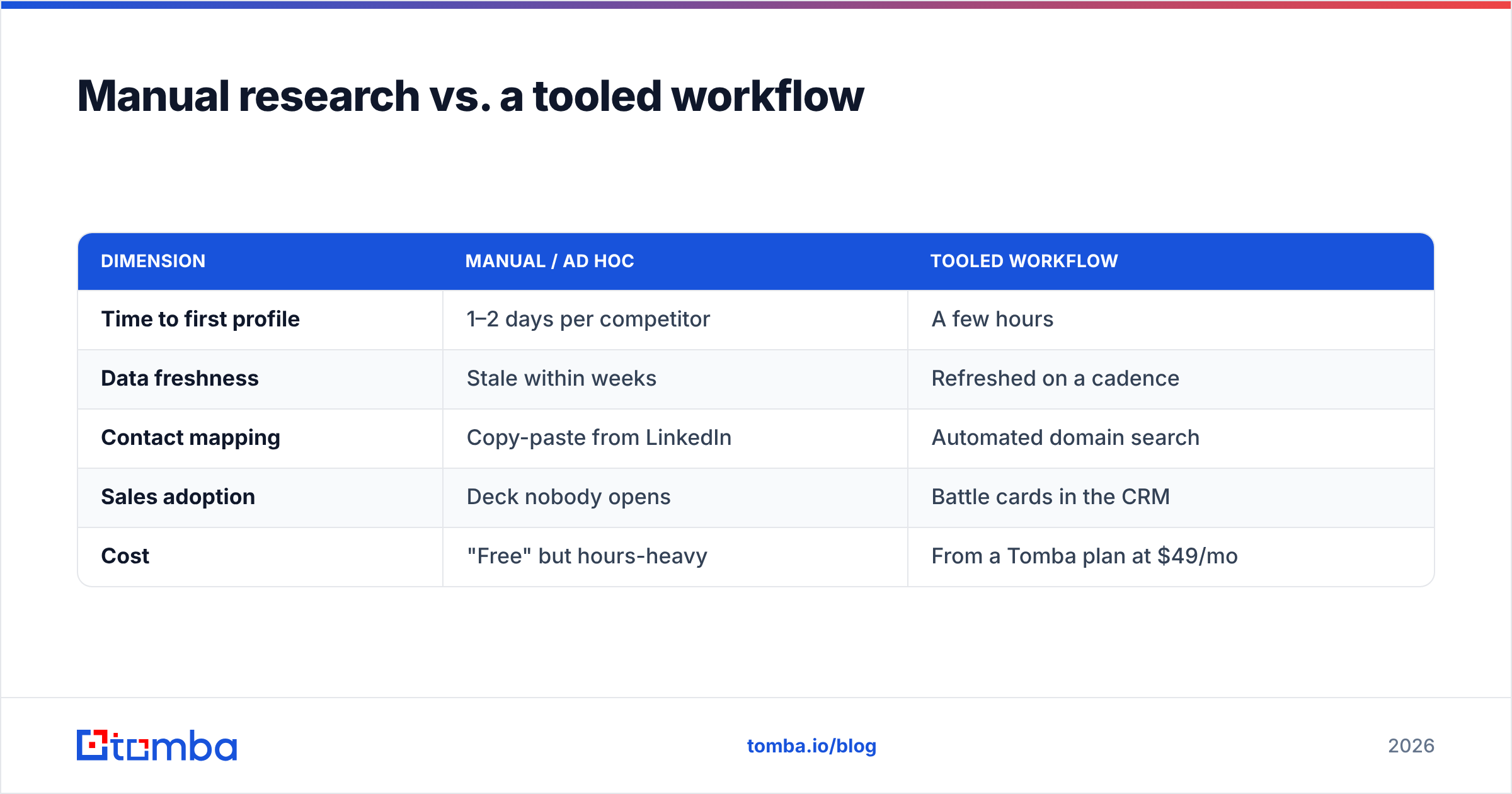
Manual research vs. a tooled workflow#
To make the trade-off concrete, here is how the two approaches compare on the work that actually consumes your week.
| Dimension | Manual / ad hoc | Tooled workflow |
|---|---|---|
| Time to first profile | 1–2 days per competitor | A few hours |
| Data freshness | Stale within weeks | Refreshed on a cadence |
| Contact mapping | Copy-paste from LinkedIn | Automated domain search |
| Sales adoption | Deck nobody opens | Battle cards in the CRM |
| Cost | "Free" but hours-heavy | From a Tomba plan at $49/mo |
The manual route is not wrong for a single competitor or a one-time strategy review. It breaks down the moment you have five rivals to track and a sales team that needs the intel weekly. At that point, the hours you spend copying contacts and re-checking pricing cost more than a tool that keeps the data current for you.
What are the most common mistakes?#
- Feature-listing instead of positioning. A 40-row feature grid does not tell a rep how to win. Translate features into three reasons a buyer should care.
- Researching only named rivals. Your biggest competitor is usually "do nothing." Build a card for it.
- One-and-done. A competitor profile from last year is fiction. If you cannot refresh it, narrow your set until you can.
- Hiding the losses. Cards that pretend you win everywhere destroy rep trust. Name the gaps.
- Bad contact data. If you are mapping a rival's org or chasing a contested deal with stale emails, you waste the whole motion. Clean data is the foundation, not a nice-to-have.
Avoiding these five is most of the battle. Notice that three of them are about discipline and honesty, not research technique — which is why competitor analysis is a habit problem before it is a tooling problem.
Turn competitor research into pipeline with Tomba#
Competitor analysis only pays off when it ends in a conversation with the right buyer — and that requires accurate contact data, not guesswork. The Tomba Email Finder lets you map a competitor's go-to-market team, find the decision-makers at accounts evaluating both of you, and reach them with verified addresses that actually land. Pair it with domain search and verification, start free with 25 searches a month, and scale up from $49/mo when your competitive motion is working. Do the research, then go win the deal.
// get started
Find, verify and enrich your first contacts today
Start on the free plan with 25 searches a month, then scale when your team is ready.
Free plan · No credit card required · GDPR & CCPA
// about the author