B2B Marketing Strategy in 2026: A Practical GTM Playbook
Most B2B marketing strategies fail because they chase volume over fit. Here is a 2026 GTM playbook built on tight ICPs, clean data, and channels that actually convert.
TL;DR
- A B2B marketing strategy in 2026 wins on precision, not volume: a sharp ICP, clean contact data, and a channel mix matched to how your buyers actually buy.
- The biggest leak is not creative — it's bad data and loose targeting. Verified contacts and account-level focus beat bigger ad budgets almost every time.
- Pipeline is a team sport: marketing, sales, and RevOps share one definition of a qualified account and one source of truth.
- Measure what compounds — pipeline influenced, win rate, and CAC payback — not vanity metrics like impressions or raw MQL counts.
- The fastest fix for most teams is upstream: enrich and verify your target list before you spend a dollar on outreach or ads.
What is a B2B marketing strategy in 2026?#
A B2B marketing strategy is the plan that connects who you sell to, what you say, and where you say it — so that the right accounts move from unaware to revenue. Think of it like fishing: you can cast a giant net across the whole ocean and burn fuel, or you can learn where your specific fish feed and drop the line there. In 2026, the winners are the precise anglers.
The shift is structural. Buying committees now average six to ten people, most of the research happens before a rep is ever contacted, and AI-generated content has flooded every channel. That means generic, high-volume tactics are getting more expensive and less effective at the same time. Your edge is no longer "more reach." It's relevance — showing the right account a message that fits their problem, backed by data clean enough to actually deliver.
This is also where revenue operations becomes the backbone. A strategy is only as good as the systems that execute it: one shared definition of a qualified account, one clean database, and one set of metrics everyone trusts.
How is B2B marketing different from B2C?#
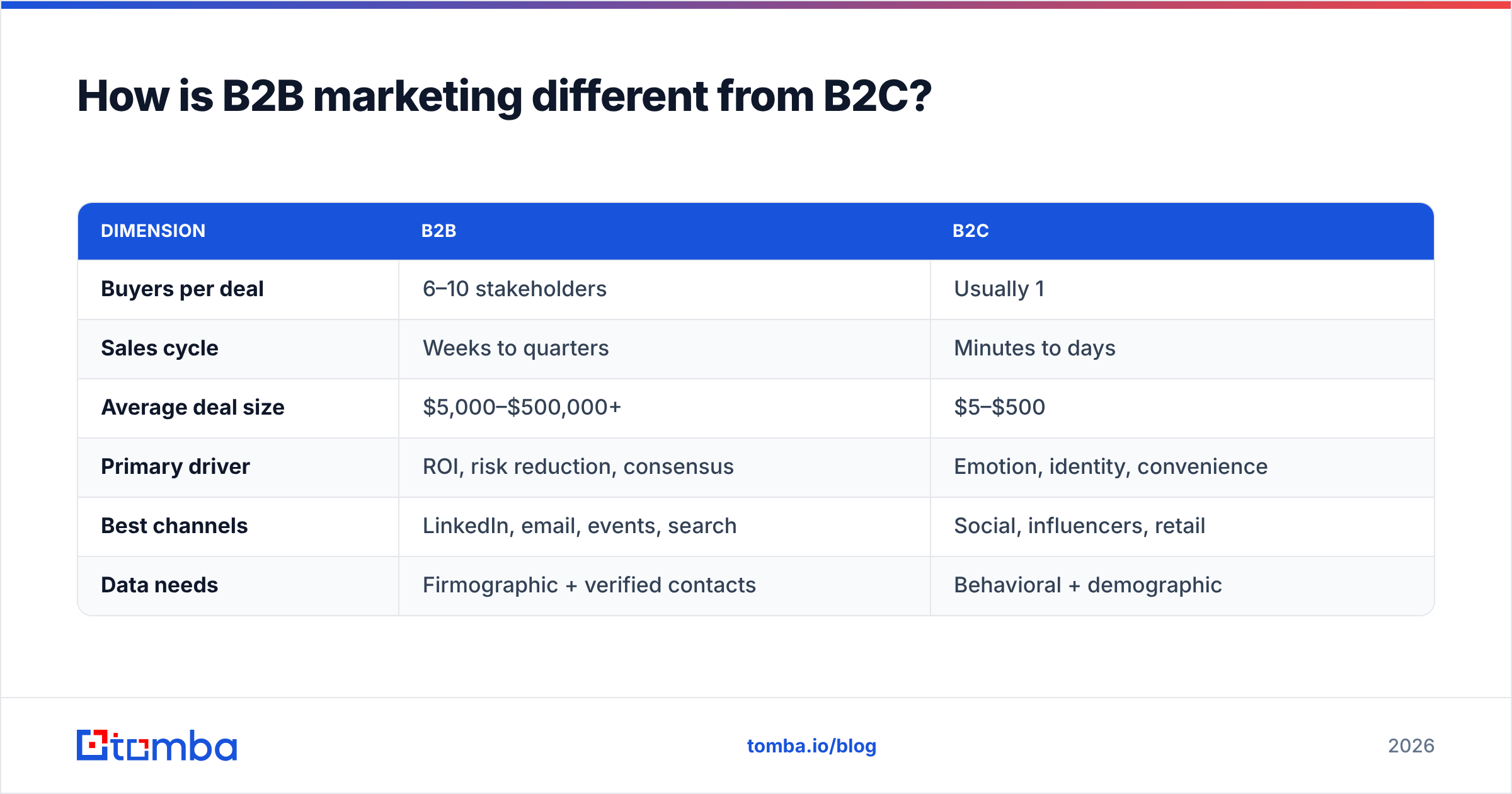
The mechanics look similar — ads, content, email — but the underlying buying behavior is different enough to break a B2C playbook. Understanding the contrast keeps you from copying tactics that won't transfer.
| Dimension | B2B | B2C |
|---|---|---|
| Buyers per deal | 6–10 stakeholders | Usually 1 |
| Sales cycle | Weeks to quarters | Minutes to days |
| Average deal size | $5,000–$500,000+ | $5–$500 |
| Primary driver | ROI, risk reduction, consensus | Emotion, identity, convenience |
| Best channels | LinkedIn, email, events, search | Social, influencers, retail |
| Data needs | Firmographic + verified contacts | Behavioral + demographic |
The practical takeaway: B2B marketing has to sell to a committee over time, not a person in a moment. Your strategy needs content for the champion who discovers you, the economic buyer who signs, and the skeptic in security or finance who can kill the deal. That's why account-level thinking — not just lead-level — defines modern B2B.
What are the core pillars of a winning B2B strategy?#
Five pillars hold up almost every high-performing B2B program. Get these right and the channel tactics mostly take care of themselves.
- Ideal Customer Profile (ICP): A specific description of the accounts you win fastest and keep longest — industry, size, tech stack, and trigger events. A vague ICP is the root cause of most wasted spend.
- Positioning and messaging: A clear answer to "why you, why now, why not the alternative." If your homepage could be swapped with a competitor's by changing the logo, your positioning is too soft.
- Clean, enriched data: Your CRM is the engine room. Stale or unverified records mean bounced emails, misrouted leads, and dashboards nobody believes. This is the cheapest place to win and the most common place to lose.
- A matched channel mix: Choose channels based on where your buyers research and decide — not on what's trendy. For most B2B, that's a tight loop of search, LinkedIn, email, and a content engine.
- Aligned measurement: One shared scoreboard across marketing, sales, and RevOps. When teams argue about which numbers are "real," the strategy stalls.
Notice that two of the five pillars — ICP and data — are about who before what. That ordering is deliberate. The best message sent to the wrong list still fails.
Why does data quality decide your strategy's ceiling?#
Conclusion first: bad data is the silent tax on every B2B marketing strategy, and no amount of clever creative offsets it. If a quarter of your list bounces or routes to the wrong person, you've quietly capped your entire program's results before the first send.
Here's the chain reaction. Unverified emails hurt your sender reputation, which lowers inbox placement, which means even your good contacts stop seeing you. Outdated firmographics break your lead scoring, so sales chases the wrong accounts. Duplicate records inflate your reporting, so you make budget decisions on fiction. None of these problems show up as a line item — they just make everything underperform.
The fix is upstream and unglamorous: enrich and verify before you act. Run new contacts through an email verifier before they enter a sequence, fill firmographic gaps with data enrichment, and dedupe on a schedule. Teams that treat data hygiene as a recurring operating cost — not a one-time cleanup — consistently get more pipeline from the same headcount and budget.
This is also where a tool like Tomba's email finder earns its place in the stack: instead of buying static lists that decay the moment you download them, you build targeted, verified contact lists tied to the exact accounts in your ICP.
What channels actually drive B2B pipeline?#
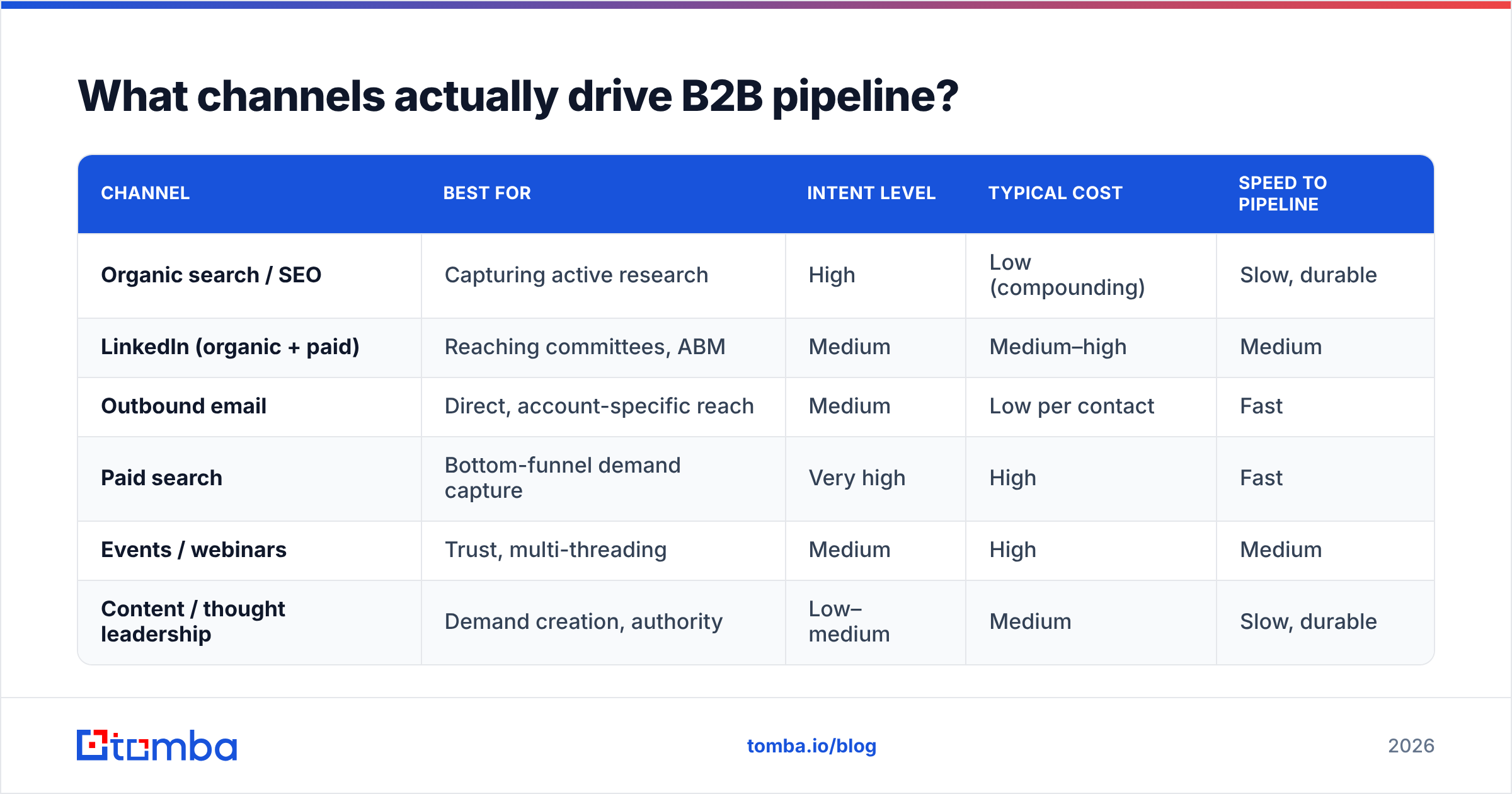
The honest answer is that "best channel" depends on your ICP, but the patterns are remarkably stable across B2B. Below is how the major channels stack up on the things that matter for a 2026 strategy.
| Channel | Best for | Intent level | Typical cost | Speed to pipeline |
|---|---|---|---|---|
| Organic search / SEO | Capturing active research | High | Low (compounding) | Slow, durable |
| LinkedIn (organic + paid) | Reaching committees, ABM | Medium | Medium–high | Medium |
| Outbound email | Direct, account-specific reach | Medium | Low per contact | Fast |
| Paid search | Bottom-funnel demand capture | Very high | High | Fast |
| Events / webinars | Trust, multi-threading | Medium | High | Medium |
| Content / thought leadership | Demand creation, authority | Low–medium | Medium | Slow, durable |
A balanced 2026 program usually pairs a demand-capture engine (SEO + paid search catching people already looking) with a demand-creation engine (content + LinkedIn + outbound creating awareness in accounts that aren't searching yet). The mistake is funding only one. Capture-only teams plateau when they exhaust existing demand; creation-only teams generate interest they can't convert because nobody's there to catch it.
Outbound deserves special mention because it's the most controllable. With a verified list built from domain search across your target accounts, you don't wait for an algorithm — you reach the specific people on the buying committee directly. The catch is that outbound only works on clean data, which loops back to the previous section.
How do you build an account-based motion without overcomplicating it?#
Account-based marketing (ABM) gets oversold as an enterprise-only, six-figure-platform affair. It doesn't have to be. At its core, ABM is just running your strategy at the account level instead of the lead level — and you can start with a spreadsheet and clean data.
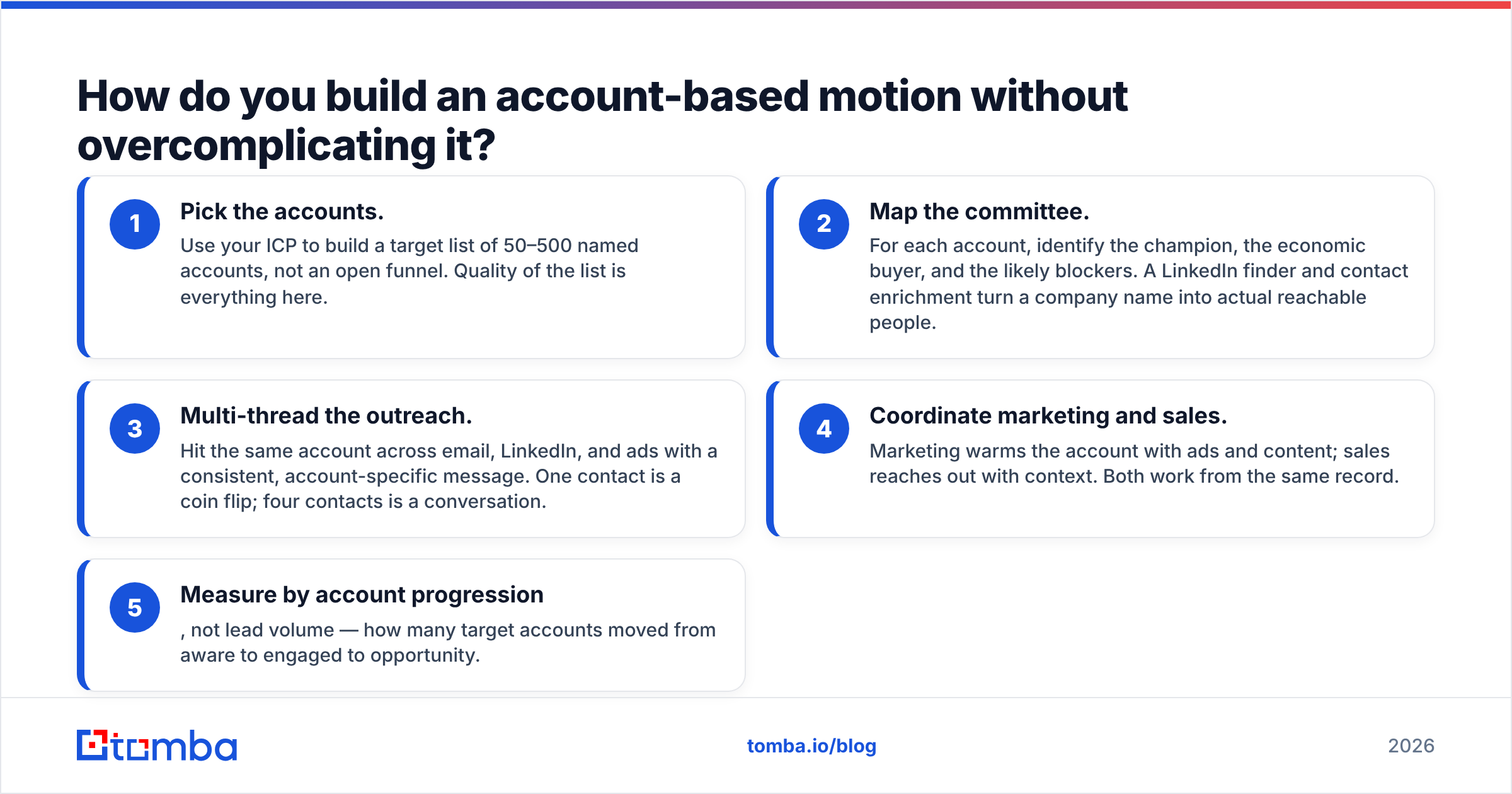
A lightweight ABM motion looks like this:
- Pick the accounts. Use your ICP to build a target list of 50–500 named accounts, not an open funnel. Quality of the list is everything here.
- Map the committee. For each account, identify the champion, the economic buyer, and the likely blockers. A LinkedIn finder and contact enrichment turn a company name into actual reachable people.
- Multi-thread the outreach. Hit the same account across email, LinkedIn, and ads with a consistent, account-specific message. One contact is a coin flip; four contacts is a conversation.
- Coordinate marketing and sales. Marketing warms the account with ads and content; sales reaches out with context. Both work from the same record.
- Measure by account progression, not lead volume — how many target accounts moved from aware to engaged to opportunity.
The reason ABM works is consensus: B2B deals close when enough of the committee agrees, and you can't manufacture agreement by emailing one person harder. The reason ABM fails is almost always the list — wrong accounts or unreachable contacts. Spend your energy there first.
What metrics prove a B2B marketing strategy is working?#
Lead first: track metrics that connect to revenue and compound over time, and ignore the ones that only make slides look good. Impressions, raw MQL counts, and "engagement" are easy to inflate and weakly tied to dollars.
The metrics worth defending in a board meeting:
- Pipeline influenced and sourced: How much qualified pipeline did marketing touch, and how much did it originate? This is the closest honest link between marketing and money.
- Win rate by source and segment: Reveals which channels and ICP slices actually convert, not just which generate activity. Watch your win rate trend per channel.
- CAC payback period: How many months to recover the cost of acquiring a customer. Under 12 months is healthy for most B2B SaaS; rising payback is an early warning.
- Speed-to-lead and response rate: How fast you follow up and how often people reply. Both are fixable with process and good data, and both move revenue quickly.
- Data health score: Bounce rate, duplicate rate, and enrichment coverage. Treating this as a first-class metric prevents the slow decay that quietly kills everything else.
A simple rule keeps you honest: if a metric goes up but pipeline doesn't, it was a vanity metric. Demote it.
How should a lean team sequence the first 90 days?#
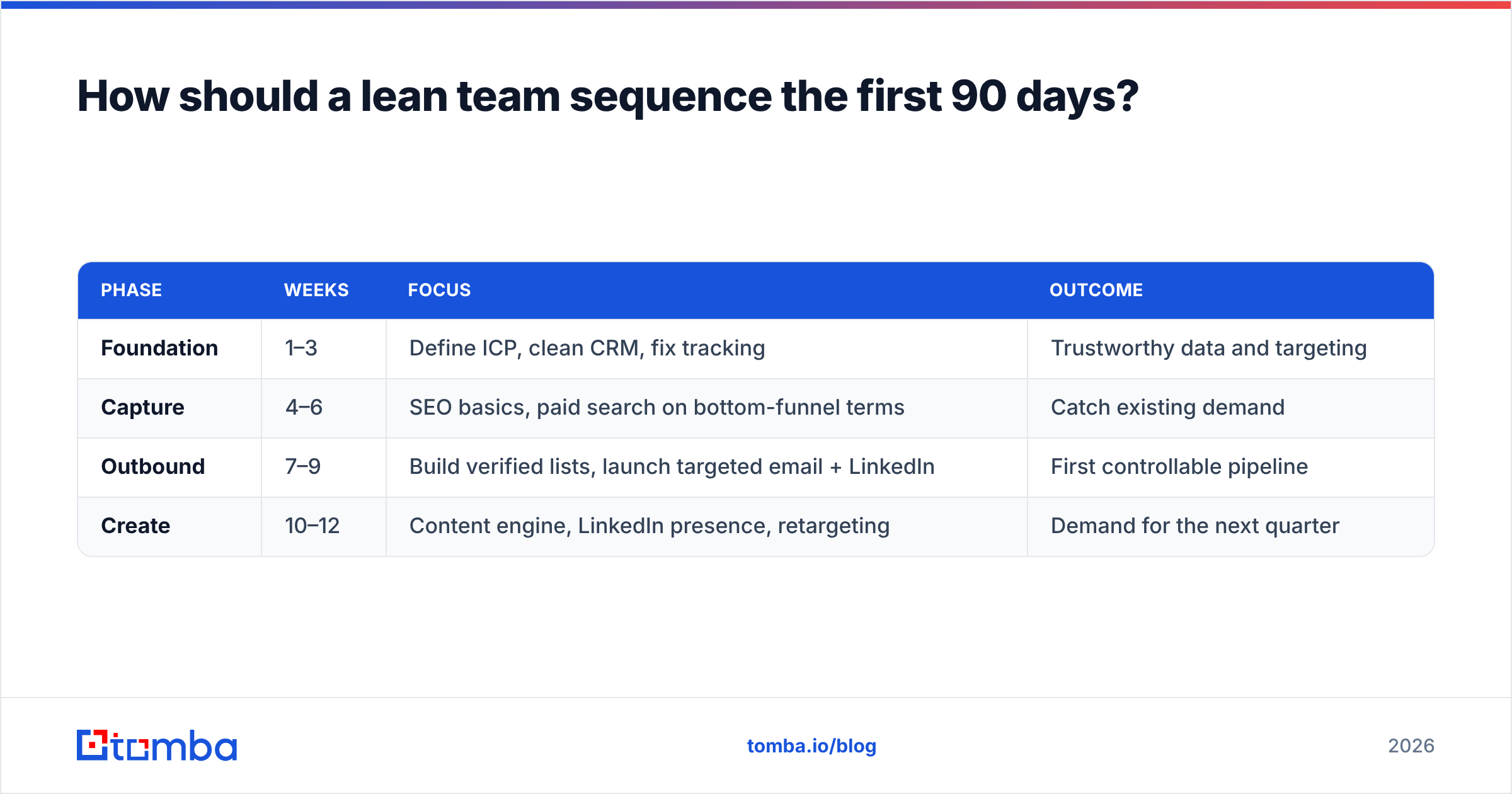
You don't need to do everything at once. Sequencing matters more than scope, because early wins fund later bets. Here's a pragmatic order for a small B2B team.
| Phase | Weeks | Focus | Outcome |
|---|---|---|---|
| Foundation | 1–3 | Define ICP, clean CRM, fix tracking | Trustworthy data and targeting |
| Capture | 4–6 | SEO basics, paid search on bottom-funnel terms | Catch existing demand |
| Outbound | 7–9 | Build verified lists, launch targeted email + LinkedIn | First controllable pipeline |
| Create | 10–12 | Content engine, LinkedIn presence, retargeting | Demand for the next quarter |
Notice that data and ICP come first — every later phase depends on them. Teams that skip to "launch the campaign" almost always circle back to fix data anyway, having burned budget and sender reputation in the meantime. Front-loading the boring work is the cheat code.
If budget is tight, the Tomba pricing free tier (25 searches per month) is enough to validate your ICP list and test outreach before you commit to a paid plan. Scale to Starter at $49/mo once the motion is working.
What mistakes quietly kill B2B strategies?#
Most failures aren't dramatic. They're slow leaks that look fine on a dashboard until pipeline dries up. Watch for these:
- Targeting everyone. A broad ICP feels safe but dilutes every message and inflates CAC. Narrow until it feels almost uncomfortable, then test.
- Buying static lists. Purchased lists decay fast, hurt deliverability, and often violate compliance. Build verified lists tied to your real ICP instead.
- Ignoring email deliverability. You can have perfect targeting and copy, and still land in spam because nobody verified the list or warmed the domain.
- Marketing and sales running separate playbooks. Two definitions of "qualified" means leads get dropped and blame gets assigned. One shared definition fixes it.
- Optimizing the wrong end. Tweaking subject lines is easy; fixing the underlying list is hard — but the list is usually where the real gains hide.
According to research summarized by Gartner and practitioner data on G2, the highest-performing B2B teams consistently invest earlier in data and alignment than their peers — not in flashier campaigns. The unglamorous fundamentals are the differentiator.
How does AI change the 2026 playbook?#
AI changes the cost of producing content and the speed of research, but it doesn't change the fundamentals — and it creates a new problem. When everyone can generate a thousand emails or blog posts in an afternoon, the inbox and the SERP get noisier, and generic AI output gets ignored faster. Volume is no longer an advantage; it's becoming a liability.
The teams that win with AI use it to sharpen precision, not crank up volume. Use it to research accounts faster, personalize at the account level, summarize buyer signals, and draft first versions a human then sharpens with real insight. Pair that with structured data access — through tools like the Tomba API — so your AI workflows act on verified, current contacts instead of hallucinated ones. The differentiator in 2026 isn't who has AI; it's who feeds it clean data and points it at the right accounts.
Putting it together#
A strong B2B marketing strategy in 2026 is less about any single channel and more about a tight loop: a sharp ICP, clean and verified data, a matched channel mix, and shared metrics that everyone trusts. Nail the data and targeting first, sequence your channels, and measure what compounds. The teams that obsess over fundamentals — not the ones with the biggest ad budgets — are the ones building durable pipeline.
The cheapest, highest-leverage move you can make this quarter is upstream: build a verified, ICP-matched contact list before you spend on outreach or ads. Start free with the Tomba Email Finder to turn your target account list into reachable, verified contacts — then plug those into the channels and ABM motion above. Precision in, pipeline out.
// get started
Find, verify and enrich your first contacts today
Start on the free plan with 25 searches a month, then scale when your team is ready.
Free plan · No credit card required · GDPR & CCPA
// about the author