B2B Sales Cadence: The 2026 Playbook for Multi-Touch Outreach
A B2B sales cadence turns random outreach into a repeatable system. Here is the 2026 playbook: touch counts, channel mix, timing, and templates that book meetings.
TL;DR
- A B2B sales cadence is a planned sequence of outreach touches across email, phone, LinkedIn, and SMS, spaced over a fixed window — not random follow-up.
- The sweet spot in 2026 is 8–12 touches over 2–3 weeks across at least three channels. Single-channel cadences underperform multi-channel ones on reply rate.
- Timing and channel mix matter more than message volume. The first 48 hours and a clean break-up touch do most of the heavy lifting.
- Bad contact data quietly kills cadences. If 30% of your emails bounce, your sequence math is broken before the first send.
- Below: a copy-ready 10-touch cadence, a channel-by-channel comparison, and the metrics that tell you when to cut a cadence.
What is a B2B sales cadence?#
A B2B sales cadence is a structured, time-boxed sequence of outreach touches aimed at a single prospect or account. Think of it like a workout program rather than a single trip to the gym: one email won't change anything, but a planned series of touches — spaced and varied on purpose — produces a result. Technically, a cadence defines how many times you reach out, through which channels, in what order, and with what gap between each touch.
The word people confuse with cadence is "sequence." They overlap, but a sequence usually refers to the automated email steps inside a tool, while a cadence is the full multi-channel rhythm — including the manual calls and LinkedIn touches your automation can't fully run. A good cadence is the operating system for your outbound; everything else (copy, lists, timing) plugs into it.
Why does it matter? Because most replies do not come from the first touch. Industry data from vendors like Salesforce and HubSpot consistently shows that a large share of booked meetings happen after the third or fourth contact, yet most reps stop after one or two. The cadence exists to make persistence systematic instead of relying on a rep's mood or memory.
Why do single-touch and single-channel outreach fail?#
One email is a coin flip you almost always lose. Inbox volume keeps rising, and your prospect was in a meeting when your message landed. They didn't reject you — they never saw you. A cadence solves the visibility problem by showing up again, in a different place, at a different time.
Single-channel cadences fail for a related reason: people have channel preferences. Some prospects ignore email but answer LinkedIn. Some never check LinkedIn but pick up a call from an unknown number. When you run email-only, you self-select for the minority who happen to prefer your one channel. Layering channels widens the net without adding prospects.
There's also a deliverability angle. If your entire cadence is email and your list is dirty, every bounce damages your sender reputation and pushes the good emails toward spam. Multi-channel cadences spread the load and reduce the blast radius of a bad list — though the real fix is verifying contacts before you ever hit send.
How many touches should a B2B sales cadence have?#
Aim for 8 to 12 touches over 14 to 21 days. Fewer than six and you're quitting before the meeting-booking touches kick in; more than fourteen and you cross from persistent into annoying, with diminishing returns and rising unsubscribe risk.
Here's the structure most high-performing teams converge on:
- Day 1 — Email + LinkedIn view. Open with a relevant, specific email. Quietly view their profile the same day so your name looks familiar later.
- Day 2 — Phone call. No voicemail yet. You're just testing for a live pickup while the email is fresh.
- Day 4 — Follow-up email. Add a new angle or proof point. Never just "bumping this to the top of your inbox."
- Day 6 — LinkedIn connection request with a one-line, no-pitch note.
- Day 8 — Phone call + voicemail. Now you leave a 15-second voicemail referencing your email.
- Day 11 — Value email. Share a resource, benchmark, or customer result with zero ask.
- Day 14 — LinkedIn message (if connected) or a second call.
- Day 17 — Break-up email. The honest "I'll assume the timing's wrong and close your file" message — which reliably generates replies.
That's eight core touches; stretch to 10–12 for high-value accounts by adding a second voicemail and a final LinkedIn touch. The point isn't to hit a magic number — it's to vary channel and angle on every touch so you never look like an automated drip.
Which channels belong in your cadence?#
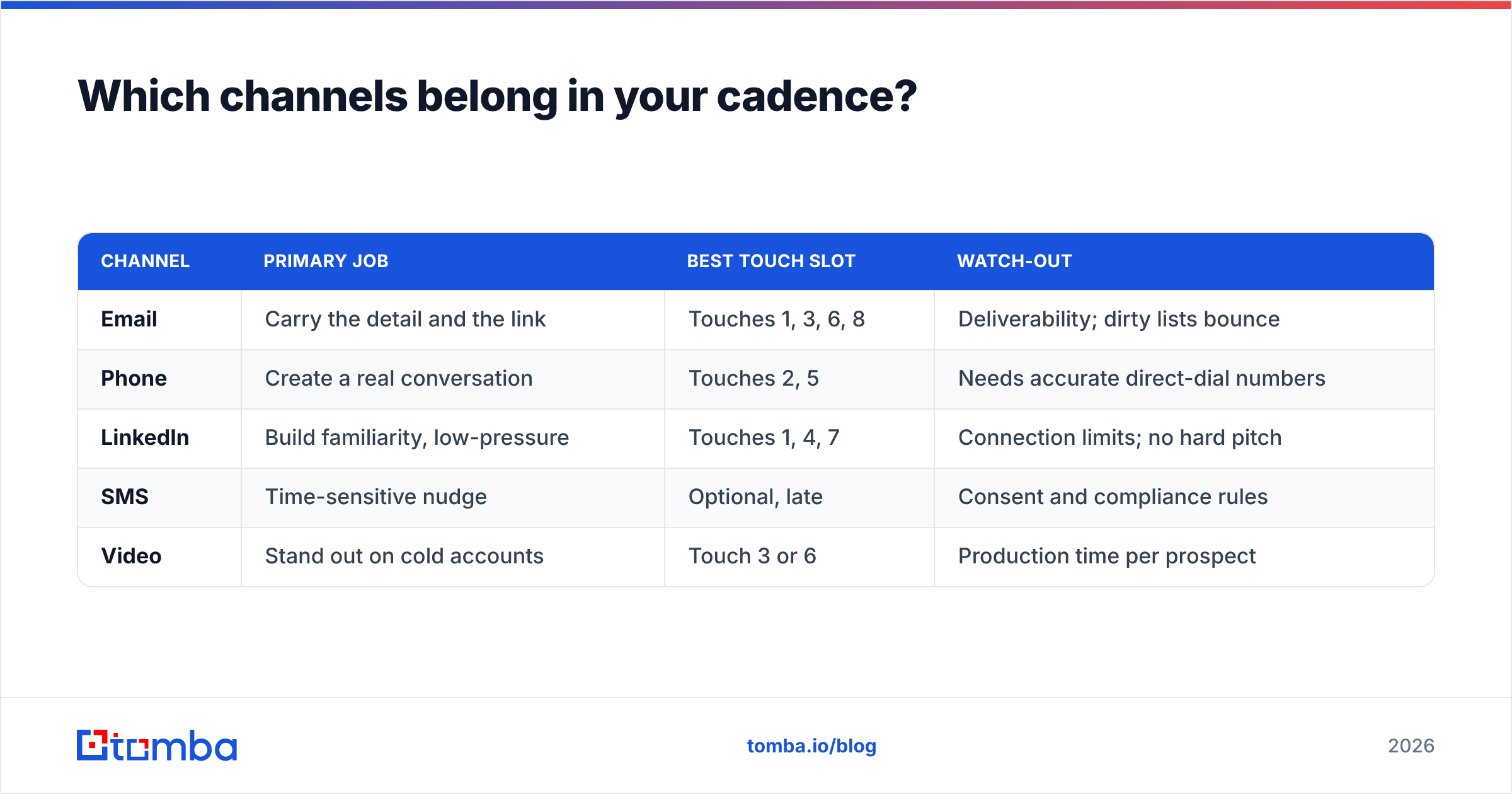
Use at least three. Each channel does a different job, and the combination is what lifts reply rates.
| Channel | Primary job | Best touch slot | Watch-out |
|---|---|---|---|
| Carry the detail and the link | Touches 1, 3, 6, 8 | Deliverability; dirty lists bounce | |
| Phone | Create a real conversation | Touches 2, 5 | Needs accurate direct-dial numbers |
| Build familiarity, low-pressure | Touches 1, 4, 7 | Connection limits; no hard pitch | |
| SMS | Time-sensitive nudge | Optional, late | Consent and compliance rules |
| Video | Stand out on cold accounts | Touch 3 or 6 | Production time per prospect |
Email is the workhorse, but it leans entirely on data quality. A call channel is worthless if you don't have the right B2B phone numbers, and a LinkedIn touch needs the right profile. This is the unglamorous truth of cadences: the channel plan is only as good as the contact record behind it. Garbage in, no meetings out.
What does the timing and spacing look like?#
Front-load the first 48 hours, then taper. The strongest signal you'll ever get is a prospect engaging early, so stack email + profile view + a call attempt in the opening two days. After that, spacing of 2–3 business days keeps you present without crowding the inbox.
A few timing rules that consistently hold up:
- Send the first email Tuesday–Thursday, mid-morning local time. Mondays drown and Friday afternoons evaporate.
- Call before 9am or after 4pm to catch people outside the meeting block. Decision-makers are easier to reach at the edges of the day.
- Never two touches in the same channel back-to-back. Alternate, so each touch feels like a new attempt rather than a nag.
- Respect the break-up. When the cadence ends, it ends. Re-enrolling someone three days later torches trust and your domain reputation.
Map every gap to business days, not calendar days, or your carefully spaced cadence collapses into a weekend pile-up.
How do you build a B2B sales cadence step by step?#
Five steps take you from idea to a running cadence:
- Define the segment and trigger. A cadence for inbound demo no-shows looks nothing like one for cold enterprise accounts. One cadence, one audience, one reason for reaching out now.
- Source and verify contact data. Pull names, roles, work emails, and direct dials — then verify them. Use an email verifier to strip risky and invalid addresses before the first send so your bounce rate stays under 2–3%.
- Write channel-specific copy. Don't paste the same paragraph into email and LinkedIn. Each channel has its own length and tone. Keep emails under 120 words and LinkedIn notes under 300 characters.
- Set the schedule and owners. Decide which touches are automated and which a human must run (calls, personalized LinkedIn). Assign them so nothing silently drops.
- Instrument it. Track open, reply, positive-reply, and meeting-booked rates per touch and per channel. You can't improve what you don't measure.
The data step is where most cadences live or die. If you're building lists by guessing email formats, you're injecting bounces into step two. Pull verified emails directly with a domain search across your target accounts, then enrich the rows with titles and phone numbers so every channel in your cadence has something to fire on.
How do you measure and optimize a cadence?#
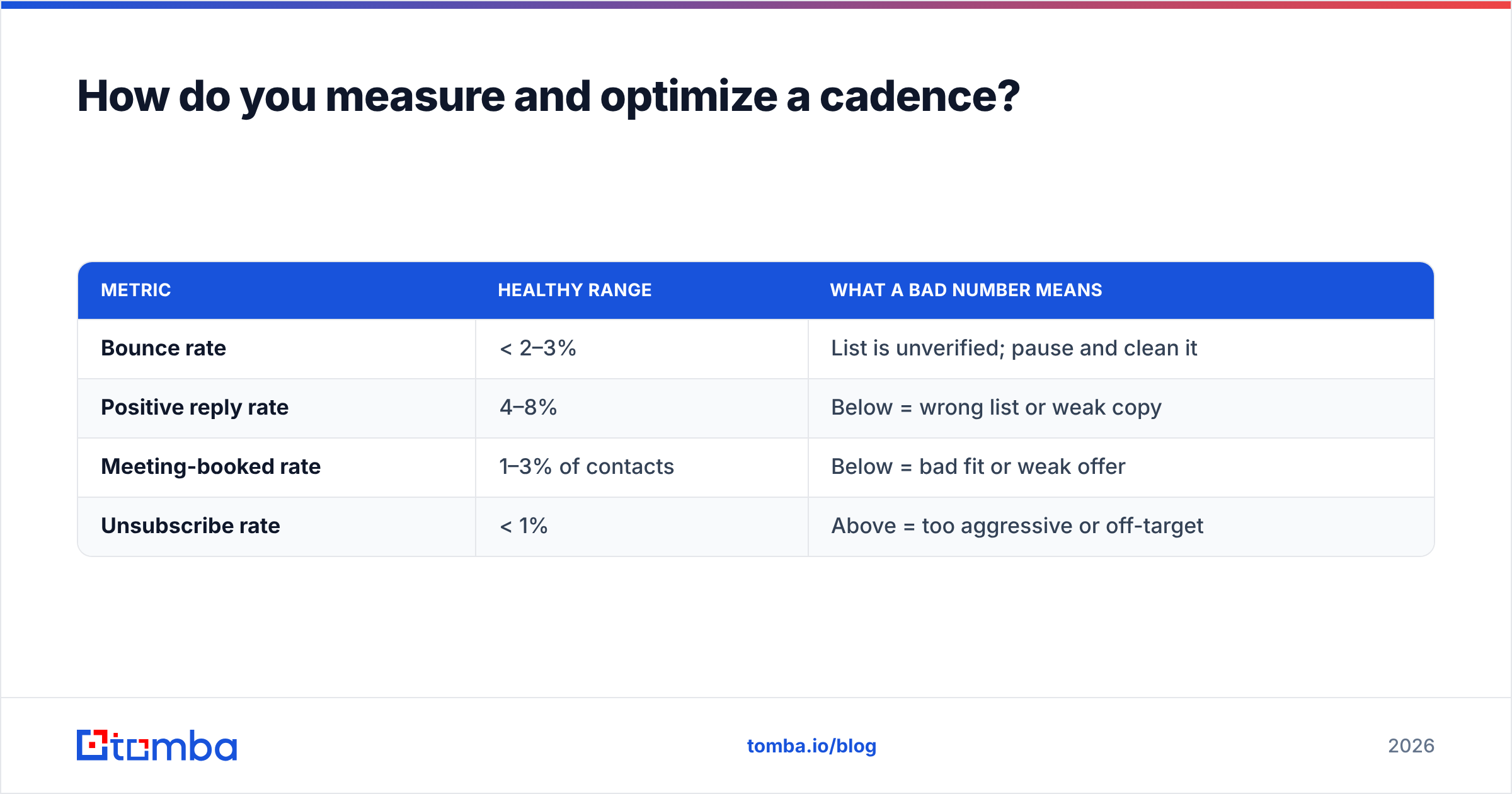
Watch four numbers, in this order of importance: positive reply rate, meeting-booked rate, bounce rate, and unsubscribe rate. Open rate is increasingly unreliable thanks to privacy features, so treat it as a soft signal, not a verdict.
| Metric | Healthy range | What a bad number means |
|---|---|---|
| Bounce rate | < 2–3% | List is unverified; pause and clean it |
| Positive reply rate | 4–8% | Below = wrong list or weak copy |
| Meeting-booked rate | 1–3% of contacts | Below = bad fit or weak offer |
| Unsubscribe rate | < 1% | Above = too aggressive or off-target |
Optimize one variable at a time. If positive replies are low but bounces are fine, the problem is targeting or copy — not the cadence structure. If bounces are high, stop everything and fix data; no copy tweak survives a 20% bounce rate. Track response rate by touch number so you can see exactly where prospects engage and prune the dead touches.
A practical rule: kill a cadence when two full cycles produce a positive reply rate under 2% with a clean list. That's the data telling you the segment, offer, or message is wrong — and no amount of extra touches will rescue a bad match. Compare your numbers against published benchmarks on G2 before declaring a cadence broken; sometimes your "low" rate is normal for the segment.
What does a real 10-touch cadence look like?#
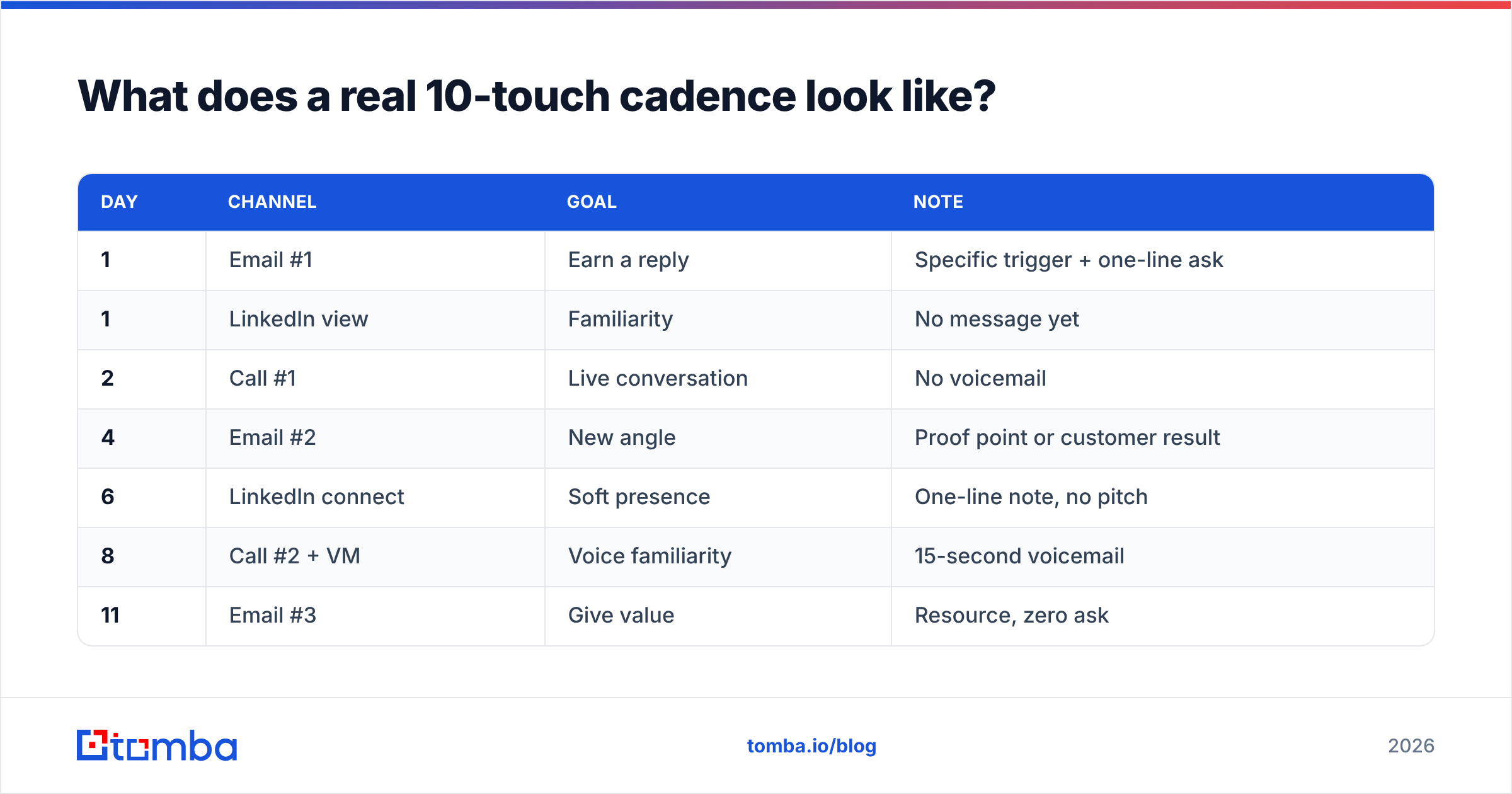
Here's a copy-ready cold cadence for a mid-market SaaS buyer. Adjust the angles to your offer.
| Day | Channel | Goal | Note |
|---|---|---|---|
| 1 | Email #1 | Earn a reply | Specific trigger + one-line ask |
| 1 | LinkedIn view | Familiarity | No message yet |
| 2 | Call #1 | Live conversation | No voicemail |
| 4 | Email #2 | New angle | Proof point or customer result |
| 6 | LinkedIn connect | Soft presence | One-line note, no pitch |
| 8 | Call #2 + VM | Voice familiarity | 15-second voicemail |
| 11 | Email #3 | Give value | Resource, zero ask |
| 14 | LinkedIn DM | Direct nudge | Reference earlier email |
| 16 | Call #3 | Last live attempt | Edge-of-day timing |
| 17 | Email #4 | Break-up | Honest close-the-file message |
Ten touches, four channels, 17 days. Notice no channel fires twice in a row and every touch carries a distinct purpose. The break-up email on day 17 will often outperform every "just following up" message you sent — because it gives the prospect a reason to respond now.
Common B2B sales cadence mistakes to avoid#
- Treating the cadence as the strategy. The cadence is the delivery mechanism. List quality and offer relevance do the real work.
- Skipping data verification. Every bounce is a touch that never happened plus reputation damage. Verify before you enroll.
- Identical copy across channels. A LinkedIn note that reads like an email gets ignored on both.
- No break-up touch. You leave replies on the table by quietly disappearing instead of closing the loop.
- Re-enrolling too fast. Respect the exit. Pushy re-adds drive unsubscribes and spam complaints.
The thread running through all of these: cadences amplify whatever you feed them. Feed a clean, well-segmented list a varied multi-channel rhythm and you get meetings. Feed a guessed-format list the same rhythm and you get bounces and burned domains — faster.
Build cadences on data you can trust#
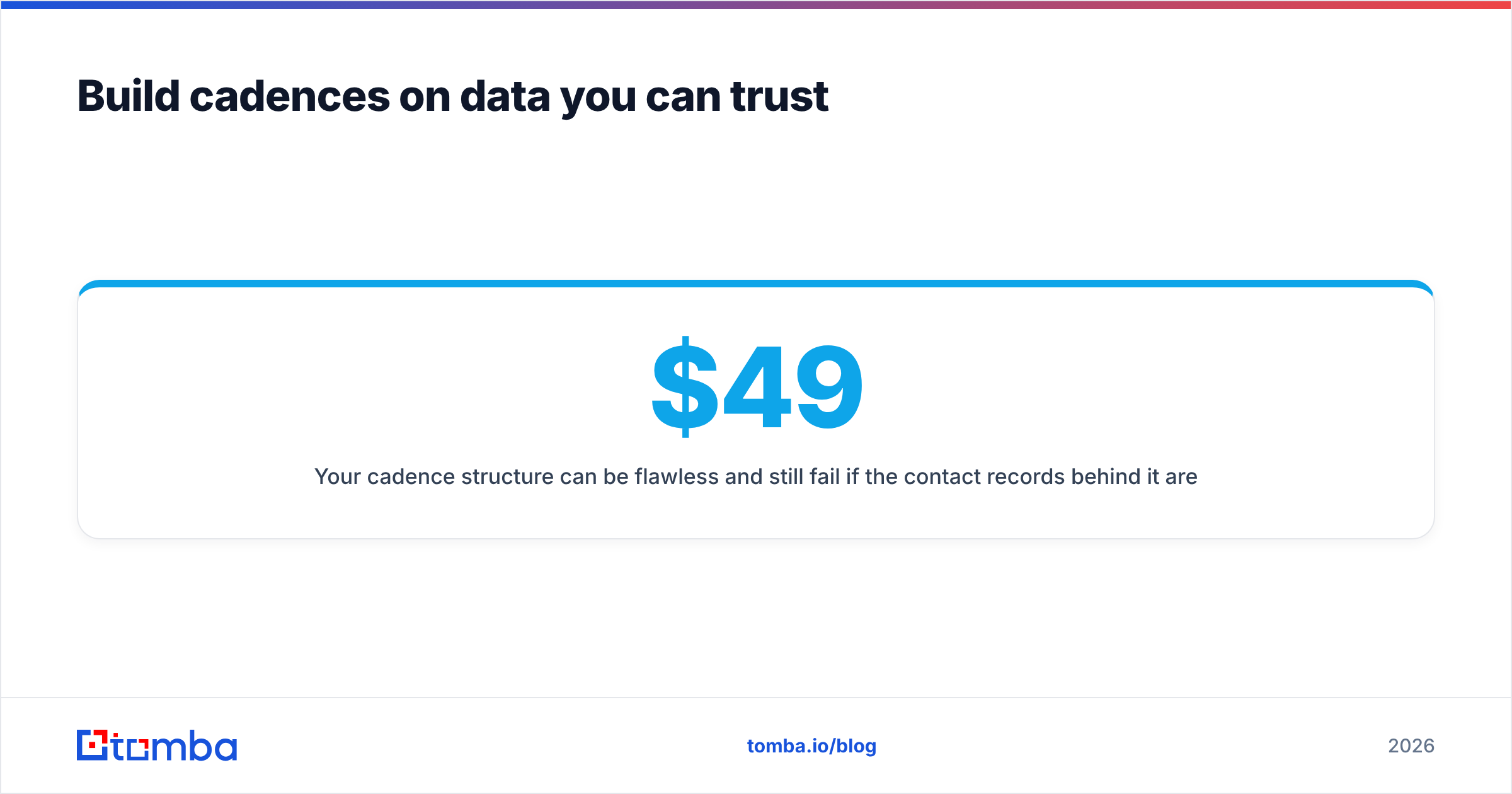
Your cadence structure can be flawless and still fail if the contact records behind it are wrong. That's the part you can fix today. Use the Tomba Email Finder to pull verified, professional email addresses by name, company, or domain — and enrich each row with the titles and direct dials your multi-channel cadence depends on. Start free with 25 searches a month, then scale into a paid plan when your pipeline does; see Tomba pricing for the Starter ($49/mo), Growth ($99/mo), and Pro ($249/mo) tiers. Get the data right, and the cadence does what it was designed to do: book meetings on repeat.
// get started
Find, verify and enrich your first contacts today
Start on the free plan with 25 searches a month, then scale when your team is ready.
Free plan · No credit card required · GDPR & CCPA
// about the author