B2B Sales Objection Handling: 12 Proven Frameworks for 2026
Objections are buying signals in disguise. Learn the frameworks, scripts, and data prep that turn "not interested" into a booked meeting in 2026.
B2B Sales Objection Handling
Most reps treat objections as the moment a deal dies. The best reps treat them as the moment a deal actually starts. When a prospect says "it's too expensive" or "we're already using a competitor," they are not closing the door — they are telling you exactly what stands between you and the signature.
This guide breaks down b2b sales objection handling into repeatable frameworks, real scripts, and the prep work that prevents most objections from ever surfacing. No theory you can't use on your next call.
TL;DR#
- Objections are buying signals. A prospect who pushes back is engaged; silence is the real killer.
- Use a framework, not improvisation. LAER, the Sandler reversal, and "Feel-Felt-Found" give you a structure under pressure.
- Most objections are preventable with better research and clean contact data before you dial.
- Price is rarely the real objection — it's usually unclear value, wrong timing, or no authority.
- Track your objections like a pipeline metric so you can coach against the ones that cost you the most revenue.
What is b2b sales objection handling?#
B2B sales objection handling is the structured process of identifying, understanding, and resolving a buyer's concerns so a deal can move forward. It's not about "overcoming" someone or winning an argument — that mindset loses complex B2B deals where five to seven stakeholders weigh in.
Think of an objection like a doctor's diagnosis. When a patient says "my back hurts," a good doctor doesn't argue that the back is fine. They ask where, how long, and what makes it worse. Objection handling works the same way: the stated objection is a symptom, and your job is to find the underlying cause before prescribing a solution.
According to HubSpot research, a large share of buyers want reps who listen rather than pitch. That single behavioral shift — diagnosing before defending — separates reps who hit quota from those who don't.
Why do objections actually happen?#
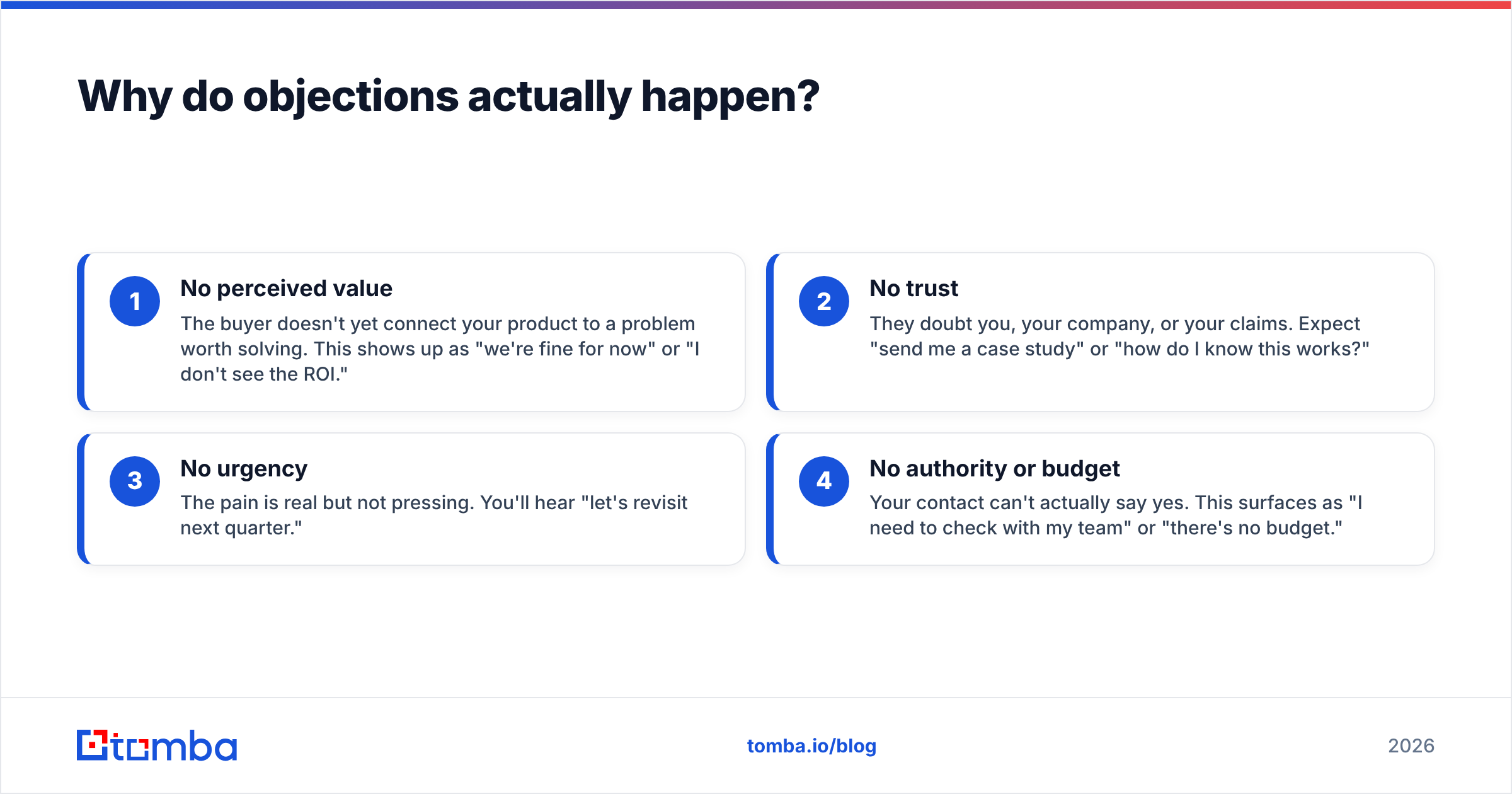
Objections almost always trace back to one of four root causes. Name the category and you'll know which framework to reach for.
- No perceived value — The buyer doesn't yet connect your product to a problem worth solving. This shows up as "we're fine for now" or "I don't see the ROI."
- No trust — They doubt you, your company, or your claims. Expect "send me a case study" or "how do I know this works?"
- No urgency — The pain is real but not pressing. You'll hear "let's revisit next quarter."
- No authority or budget — Your contact can't actually say yes. This surfaces as "I need to check with my team" or "there's no budget."
The most expensive mistake is responding to the stated objection ("too expensive") when the real one is a different category entirely (no authority). You can discount all day and still lose if the person can't sign.
What are the most common B2B sales objections?#
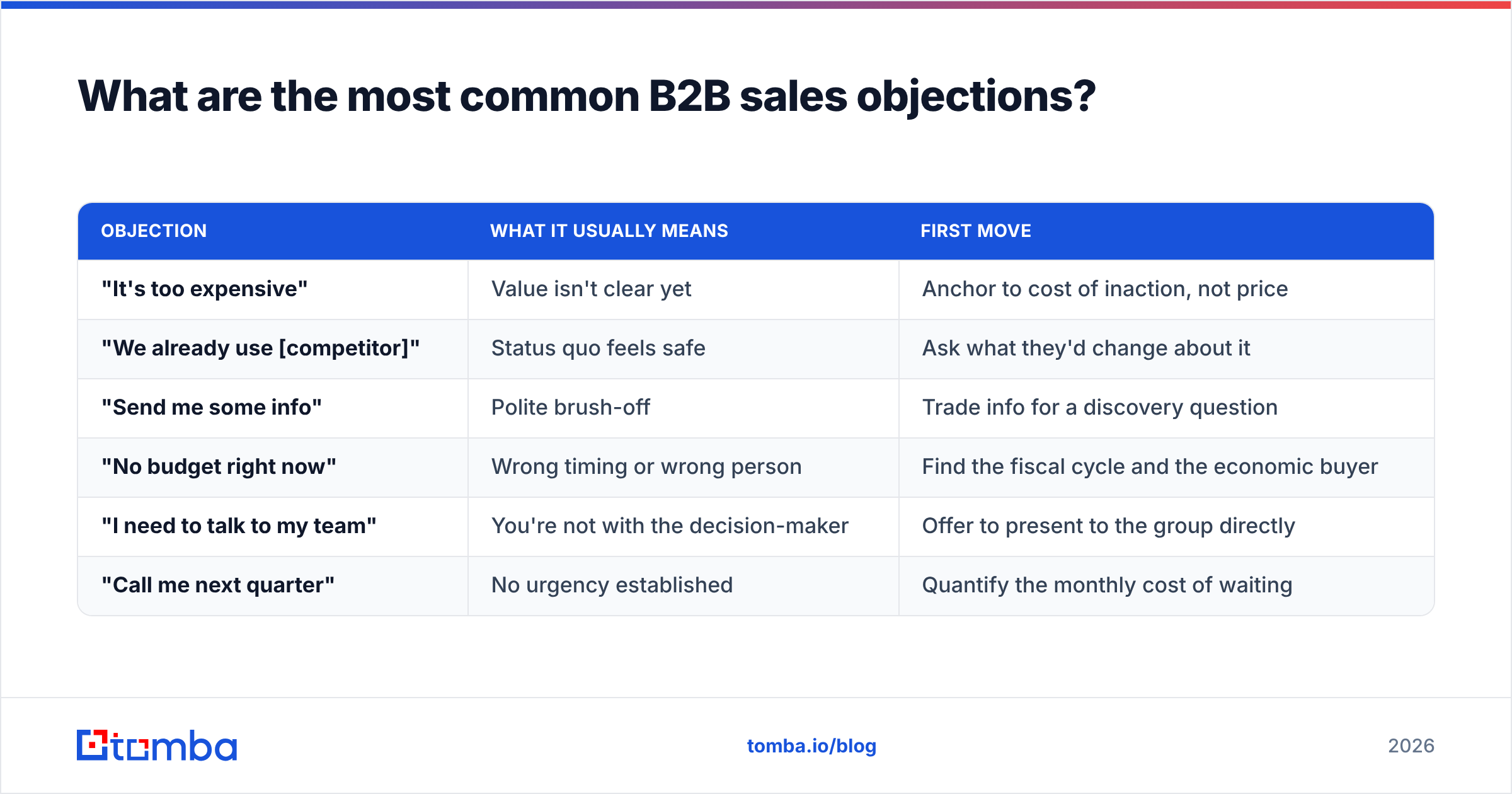
Here are the objections that show up in nearly every outbound motion, mapped to what they usually mean and a first-move response.
| Objection | What it usually means | First move |
|---|---|---|
| "It's too expensive" | Value isn't clear yet | Anchor to cost of inaction, not price |
| "We already use [competitor]" | Status quo feels safe | Ask what they'd change about it |
| "Send me some info" | Polite brush-off | Trade info for a discovery question |
| "No budget right now" | Wrong timing or wrong person | Find the fiscal cycle and the economic buyer |
| "I need to talk to my team" | You're not with the decision-maker | Offer to present to the group directly |
| "Call me next quarter" | No urgency established | Quantify the monthly cost of waiting |
Notice that none of these are solved by talking more about features. Each one needs a question that uncovers the cause before you respond.
Which objection-handling framework should you use?#
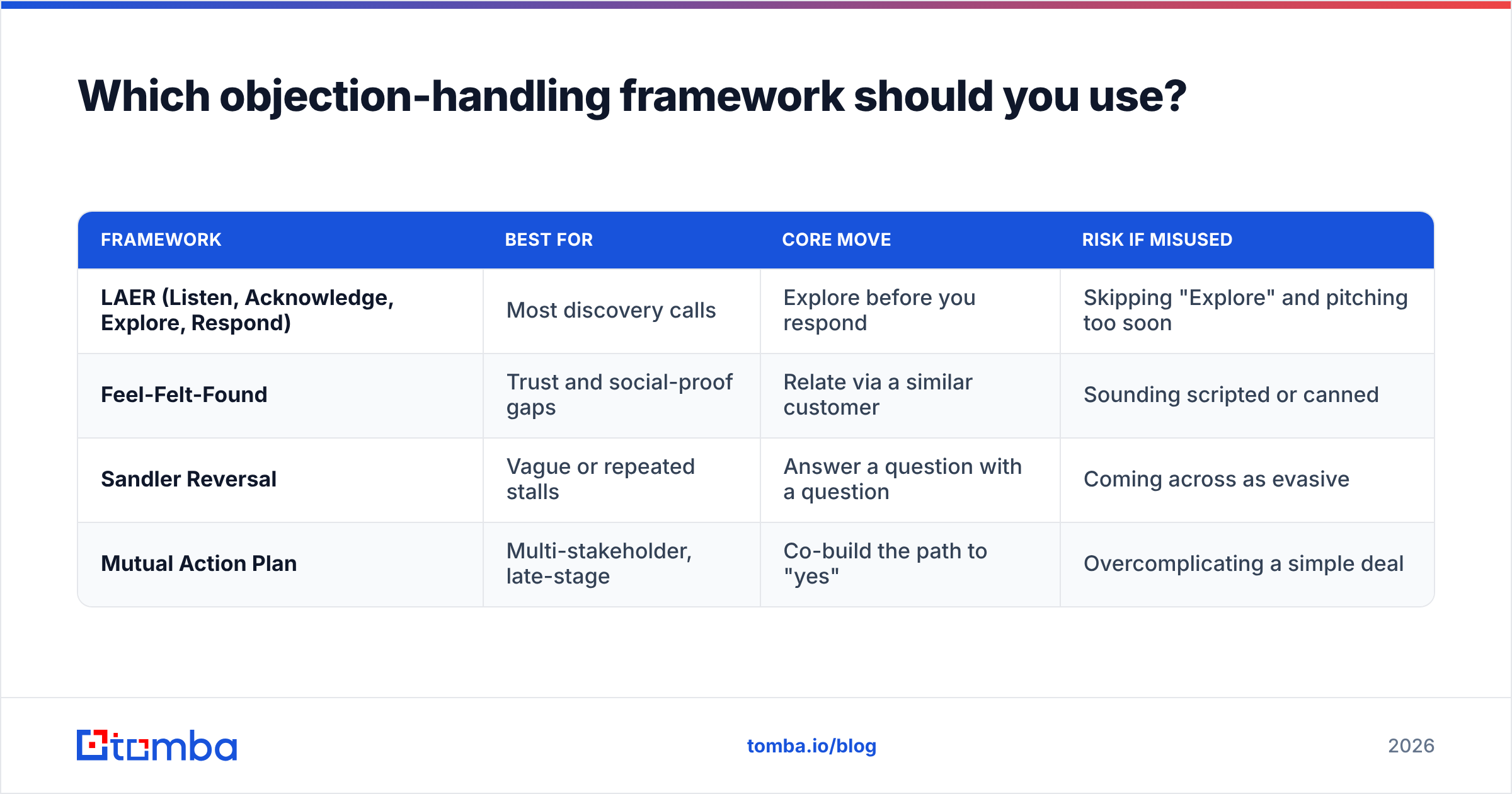
Three frameworks cover the vast majority of B2B situations. They're not mutually exclusive — strong reps blend them — but it helps to know the shape of each.
| Framework | Best for | Core move | Risk if misused |
|---|---|---|---|
| LAER (Listen, Acknowledge, Explore, Respond) | Most discovery calls | Explore before you respond | Skipping "Explore" and pitching too soon |
| Feel-Felt-Found | Trust and social-proof gaps | Relate via a similar customer | Sounding scripted or canned |
| Sandler Reversal | Vague or repeated stalls | Answer a question with a question | Coming across as evasive |
| Mutual Action Plan | Multi-stakeholder, late-stage | Co-build the path to "yes" | Overcomplicating a simple deal |
LAER is your default. You Listen fully, Acknowledge the concern without judgment, Explore with questions to find the root cause, then Respond to the actual issue. The discipline is in the Explore step — most reps jump straight from hearing an objection to defending against it.
Feel-Felt-Found shines when trust is the gap: "I understand how you feel. A VP at a similar company felt the same way about switching. What they found after 60 days was a 30% lift in reply rates." Use it sparingly so it stays genuine.
The Sandler reversal defuses stalls. When someone says "your price is high," you reply, "Compared to what?" or "Help me understand what high means for your budget." You learn more and buy time to position value.
How do you handle the "it's too expensive" objection?#
Price objections are the most common and the most misunderstood. The reflex is to discount. The better play is to reframe price as an investment against a quantified cost of inaction.
Here's a script that works:
Prospect: "Honestly, this is more than we wanted to spend."
You: "Totally fair — let's make sure the math actually works before we talk numbers. You mentioned your team manually researches 40 accounts a week. If each rep spends six hours on that, what's that costing you in selling time?"
Prospect: "...probably a full day per rep."
You: "So the question isn't whether the tool costs $99 a month — it's whether getting a full selling day back per rep is worth that. Want me to model it out for your headcount?"
You've moved the conversation from price to value per dollar. Anchoring to a measurable outcome — like a higher response rate or more booked meetings — beats any discount because it changes the frame entirely.
When you do reference pricing, be transparent. Pointing a skeptical buyer to clear, published Tomba pricing builds more trust than dancing around the number.
How do you handle "we already use a competitor"?#
This is not a rejection — it's confirmation that the buyer values the category. Your job is to surface dissatisfaction without trashing the incumbent.
Use a three-step approach:
- Affirm the choice. "Makes sense — [competitor] is a solid tool. A lot of teams start there."
- Open a gap. "Out of curiosity, if you could change one thing about it, what would it be?"
- Bridge to your strength. Only after they name a gap do you connect your differentiator to it.
The mistake reps make is launching into a feature war. Buyers tune that out instantly. The question "what would you change?" does the selling for you, because it gets the prospect articulating their own pain in their own words.
Can you prevent objections before they happen?#
Yes — and this is where most teams leave money on the table. A large fraction of objections are caused by poor targeting and bad data, not by genuine disinterest. If you're pitching the wrong person at the wrong company with a generic message, you've manufactured your own objections.
Prevention comes down to three habits:
- Research before you reach out. Know the company's recent funding, hiring, or product news so your opener is relevant. Gartner's research consistently shows that B2B buyers are deep into their own journey before they ever talk to a rep — generic outreach gets filtered out fast.
- Reach the right person. "I need to talk to my team" usually means you're not talking to the decision-maker. Verifying titles and finding the economic buyer up front kills this objection.
- Use clean, verified contact data. Nothing erodes credibility like a bounced email or a wrong number. Reaching the right inbox starts with an accurate email finder and pre-call data enrichment so you walk in informed.
Better data doesn't just reduce bounces — it raises your effective win rate by ensuring every conversation is with a qualified, reachable buyer who can actually move the deal.
How should you respond when you don't know the answer?#
You will get objections you can't immediately resolve — a technical edge case, a security requirement, a pricing exception. Bluffing destroys trust permanently. The honest move actually strengthens your position:
"Great question, and I want to give you an accurate answer rather than guess. Let me confirm with our team and get you a clear response by tomorrow morning. Does that work?"
This does three things: it signals integrity, it earns a small commitment (the follow-up), and it creates a legitimate reason for a next touch. Compare that to a confident wrong answer that surfaces during procurement and tanks the whole deal.
How do you track objections to get better over time?#
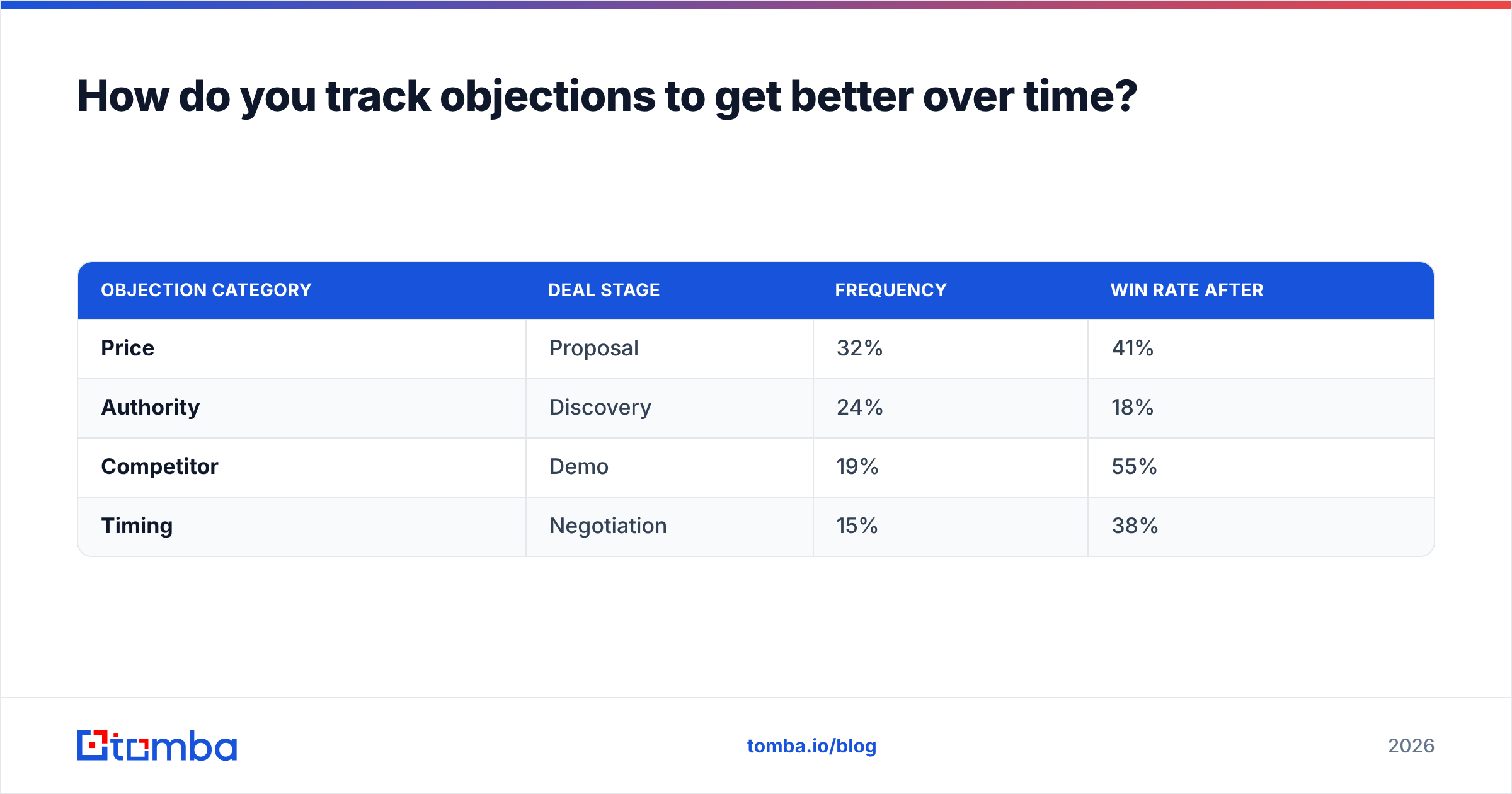
Treat objections as data, not just in-the-moment hurdles. Log every objection in your CRM with three fields: the objection category, the stage it occurred, and the outcome. Over a quarter, patterns emerge.
Maybe 40% of your stalled deals share the same objection at the same stage. That's not a rep problem — it's a messaging or targeting problem you can fix systematically. Reviewing this in your CRM turns anecdotal frustration into a coachable, fixable metric.
A simple objection log might look like this:
| Objection category | Deal stage | Frequency | Win rate after |
|---|---|---|---|
| Price | Proposal | 32% | 41% |
| Authority | Discovery | 24% | 18% |
| Competitor | Demo | 19% | 55% |
| Timing | Negotiation | 15% | 38% |
In this example, the "Authority" objection has both high frequency and low post-objection win rate — a clear signal to fix qualification earlier in the funnel rather than fighting it late.
What are the biggest objection-handling mistakes?#
Avoid these and you'll already be ahead of most reps:
- Interrupting. Let the prospect finish completely. The full objection often contains the answer.
- Getting defensive. Tone matters more than words. Stay curious, not combative.
- Discounting reflexively. Every unearned discount trains buyers to push harder and devalues your product.
- Talking past the close. Once you've resolved the objection and they agree, stop selling and ask for the next step.
- One-size-fits-all rebuttals. Memorized comebacks sound robotic. Frameworks give you structure; your own words give you authenticity.
Frequently asked questions#
How many times should I address the same objection? If a prospect raises the same concern three times after you've genuinely resolved it, it's usually a smokescreen for a deeper issue — often budget or authority. Ask directly: "It feels like there's something else holding this back. What's the real concern?"
Is it ever okay to walk away from a deal? Yes. A "no" that frees you to pursue a better-fit account is more valuable than a drawn-out maybe. Disqualifying fast is a skill, not a failure.
Should I send objection rebuttals in writing? For factual objections (security, integrations, pricing tiers), a clear written follow-up helps. For emotional or trust-based objections, a live conversation almost always works better.
Turn objections into booked meetings#
The single biggest lever in b2b sales objection handling isn't a clever rebuttal — it's reaching the right person with the right context before the conversation even starts. Half the objections you dread come from talking to the wrong contact at the wrong account.
Fix that at the source. Tomba's Email Finder helps you find and verify the decision-maker's professional email by name, company, or domain — so every conversation begins with a qualified, reachable buyer instead of a guess. Start free with 25 searches a month, then scale on the Starter plan at $49/mo as your pipeline grows. Better data in means fewer objections out.
// get started
Find, verify and enrich your first contacts today
Start on the free plan with 25 searches a month, then scale when your team is ready.
Free plan · No credit card required · GDPR & CCPA
// about the author