The B2B Sales Pitch in 2026: Framework, Examples, Templates
A modern B2B sales pitch is research-led, buyer-centric, and short. Here is the framework, real examples, and a comparison of pitch styles that win in 2026.
A B2B sales pitch is no longer a polished monologue you deliver at a prospect. In 2026 it is a short, research-led conversation that earns the next meeting. The reps who win open with the buyer's problem, prove they did their homework, and ask for one small commitment. Everyone else still leads with their feature list and wonders why reply rates keep falling.
This guide breaks down what a modern B2B sales pitch actually is, the framework that holds up across cold email, calls, and demos, and the data work that makes any pitch land before you say a word.
TL;DR#
- A B2B sales pitch is a structured, buyer-centric argument — not a product tour. Lead with a relevant problem, not your feature list.
- The best pitches are short. Cold outreach should earn a reply in under 90 words; a discovery pitch should talk less than 40% of the call.
- Personalization beats polish. A pitch built on real research and accurate contact data outperforms a slick generic script every time.
- Use a repeatable framework (Hook → Problem → Insight → Proof → Ask) so you can test and improve it instead of reinventing it per rep.
- Garbage data kills good pitches. Verified emails, direct dials, and enriched context decide whether your pitch is ever heard.
What is a B2B sales pitch?#
A B2B sales pitch is the concise case you make to a business buyer for why a conversation about your solution is worth their time. Notice that the goal is the conversation, not the close. In complex B2B deals with multiple stakeholders and long cycles, no single pitch closes the deal — each one advances it to the next stage.
Think of it like a movie trailer. A trailer does not show you the whole film; it shows you just enough tension and payoff that you buy a ticket. A good pitch does the same: it surfaces a problem the buyer recognizes, hints at a better outcome, and makes the next step feel small and obvious.
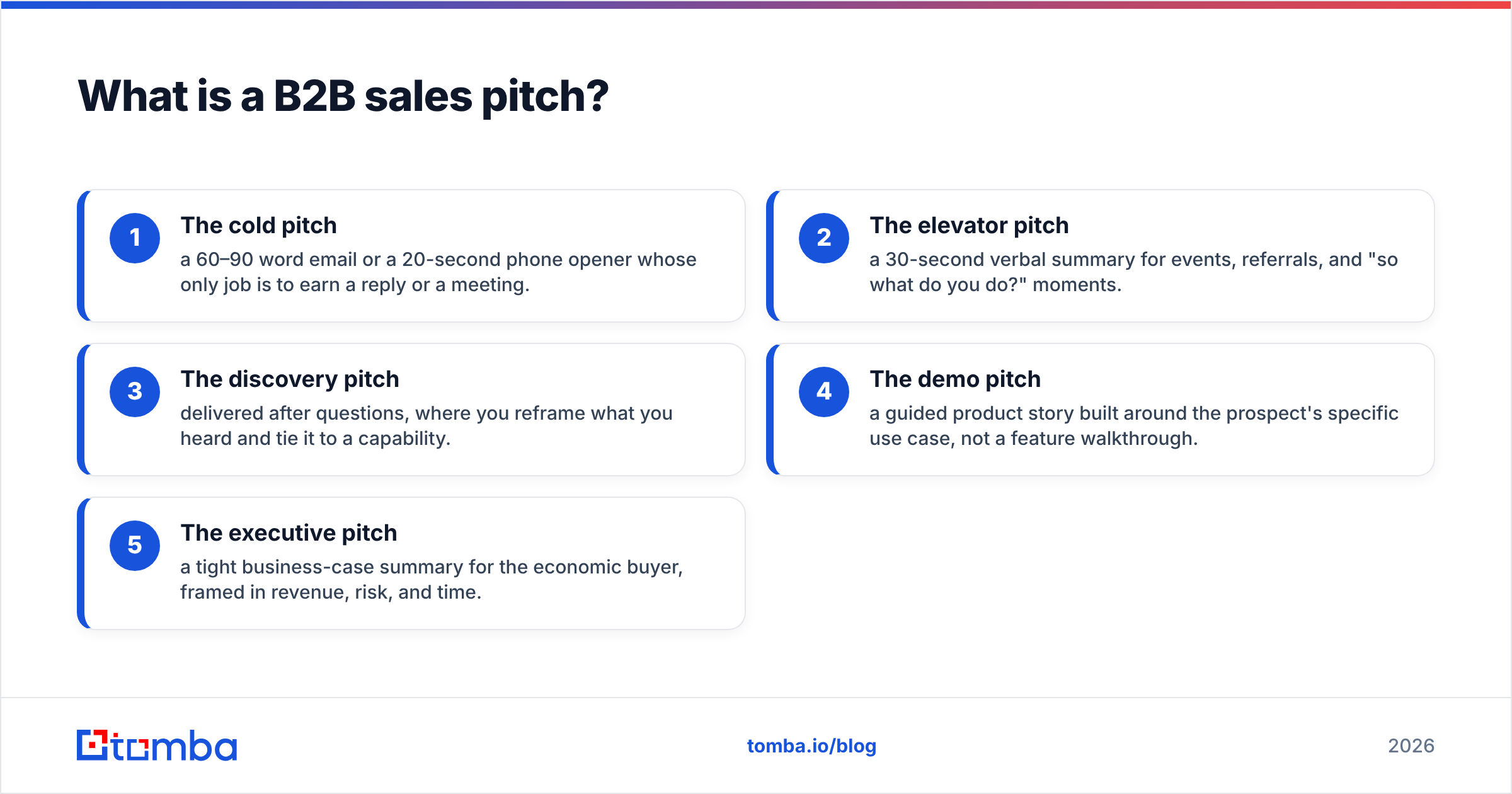
There are several pitch formats you will use depending on the channel:
- The cold pitch — a 60–90 word email or a 20-second phone opener whose only job is to earn a reply or a meeting.
- The elevator pitch — a 30-second verbal summary for events, referrals, and "so what do you do?" moments.
- The discovery pitch — delivered after questions, where you reframe what you heard and tie it to a capability.
- The demo pitch — a guided product story built around the prospect's specific use case, not a feature walkthrough.
- The executive pitch — a tight business-case summary for the economic buyer, framed in revenue, risk, and time.
Each format uses the same underlying argument. What changes is length and emphasis.
What makes a B2B sales pitch work in 2026?#
Relevance. That is the entire answer, and it is harder than it sounds. Buyers now receive dozens of templated messages a day, and pattern-matching to "this is a blast" takes them about two seconds. According to HubSpot's sales research, personalization and timing consistently separate the outreach that gets answered from the outreach that gets deleted.
A pitch works when it does four things:
- It is about them, not you. The first sentence should reference the prospect's role, company, industry trigger, or a problem specific to their segment — never your company's founding story.
- It earns the right to continue. You show one piece of insight they did not already have, or did not expect a vendor to know.
- It lowers the cost of saying yes. "A 15-minute call Thursday" converts better than "a demo," because the commitment is smaller.
- It is provable. A specific outcome from a comparable company beats an adjective every time. "Cut SDR research time 40%" beats "powerful and easy to use."
The mistake most teams make is optimizing the wrong layer. They rewrite the script when the real problem is they are pitching the wrong person, at a bad time, with a guessed email address. Fixing the message cannot fix bad targeting.
What is the best B2B sales pitch framework?#
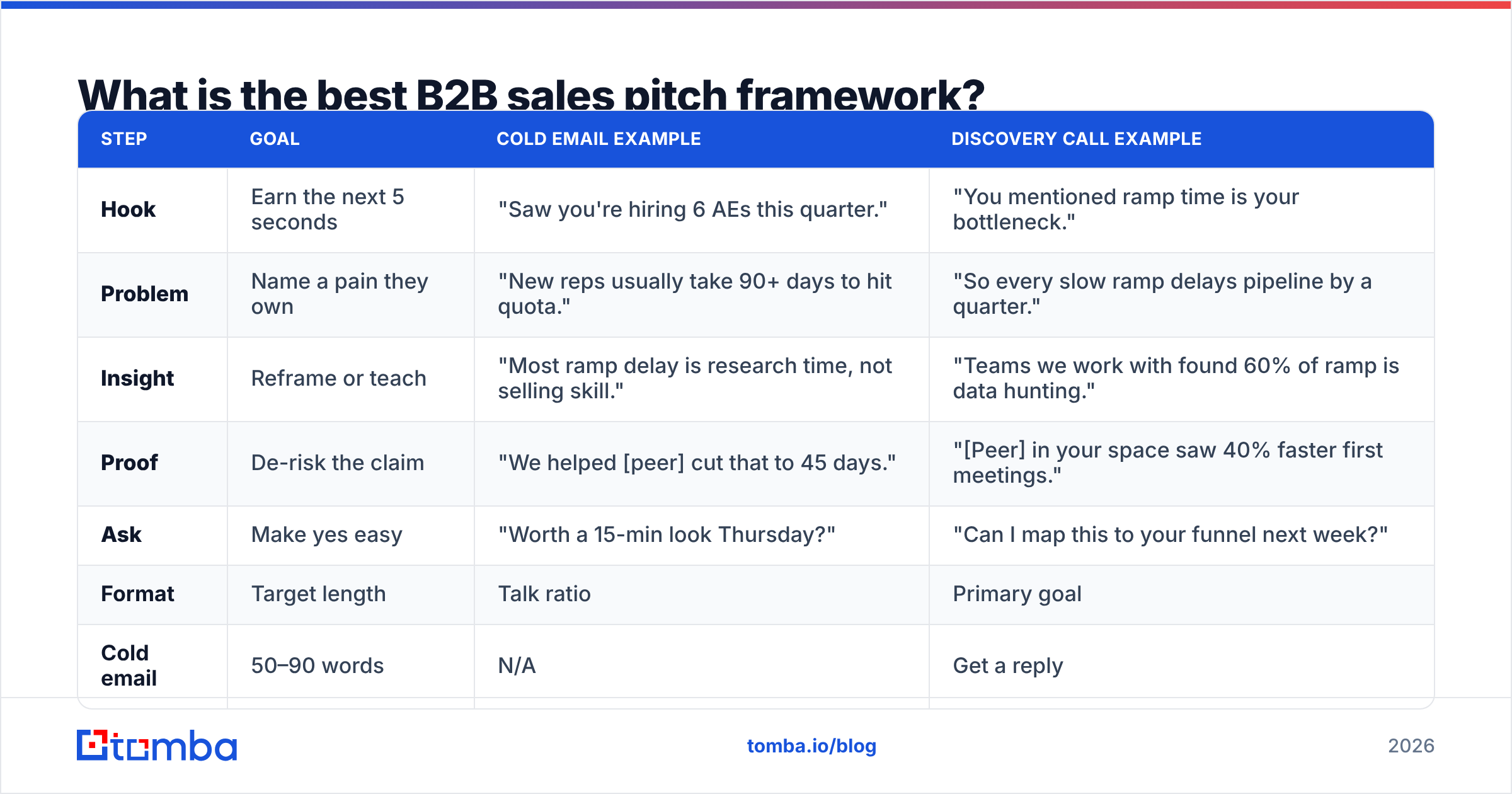
Use Hook → Problem → Insight → Proof → Ask. It is short enough to memorize, flexible enough to fit any channel, and structured enough to test one piece at a time.
| Step | Goal | Cold email example | Discovery call example |
|---|---|---|---|
| Hook | Earn the next 5 seconds | "Saw you're hiring 6 AEs this quarter." | "You mentioned ramp time is your bottleneck." |
| Problem | Name a pain they own | "New reps usually take 90+ days to hit quota." | "So every slow ramp delays pipeline by a quarter." |
| Insight | Reframe or teach | "Most ramp delay is research time, not selling skill." | "Teams we work with found 60% of ramp is data hunting." |
| Proof | De-risk the claim | "We helped [peer] cut that to 45 days." | "[Peer] in your space saw 40% faster first meetings." |
| Ask | Make yes easy | "Worth a 15-min look Thursday?" | "Can I map this to your funnel next week?" |
The discipline this framework forces is order. Reps instinctively want to start with Proof ("We're the leader in...") and Insight ("Our platform uses AI to..."). But proof means nothing before the buyer agrees they have the problem. Lead with the Hook and Problem; hold your product until the Ask.
How long should each pitch format be?#
| Format | Target length | Talk ratio | Primary goal |
|---|---|---|---|
| Cold email | 50–90 words | N/A | Get a reply |
| Phone opener | 20–30 seconds | You ≤ 50% | Earn permission to continue |
| Elevator pitch | ~30 seconds | You 100% | Spark a follow-up question |
| Discovery pitch | 3–5 minutes total | You ≤ 40% | Confirm fit, book next step |
| Demo pitch | 15–20 minutes | You ≤ 60% | Tie features to their use case |
If you remember one number, make it the talk ratio. Gong-style conversation research repeatedly shows that top performers talk less and ask more. A pitch is not a speech; it is a setup for a question.
What are real B2B sales pitch examples?#
Here is the difference between a weak and a strong cold pitch, same product, same prospect.
Weak (product-first):
Hi Sarah, I'm reaching out from Acme, the leading sales-intelligence platform trusted by 5,000+ companies. We offer email finding, verification, and enrichment with industry-leading accuracy. Do you have 30 minutes this week for a demo of our full suite?
This is about Acme. It asks for a large commitment. It proves nothing relevant.
Strong (buyer-first, framework-driven):
Hi Sarah — saw RevOps is rolling out a new outbound motion this quarter. The usual snag isn't the sequence, it's reps burning hours on stale contact data. We helped [Peer Co] verify and enrich their list so SDRs spent that time selling instead. Worth a 15-min look at whether the same gap exists in your funnel?
The second version follows Hook → Problem → Insight → Proof → Ask in 70 words, and the ask is small. You can adapt the same skeleton for a call by slowing it down and inserting questions after the Problem.
For verbal openers, swap statements for permission: "I know I'm an interruption — can I take 30 seconds to say why I called, and you tell me if it's relevant?" That single line respects the buyer's time and consistently outperforms diving straight into a script. If phone is your main channel, building a clean list with a phone finder for direct dials matters more than the script itself.
Why does data decide whether your pitch lands?#
Because a perfect pitch sent to the wrong address is a tree falling in an empty forest. Before you obsess over wording, three data problems quietly destroy most B2B pitches:
- Wrong person. You pitched a champion who can't sign and ignored the economic buyer.
- Bad contact. The email bounced, or the "direct dial" was a defunct switchboard.
- No context. You had nothing specific to anchor your Hook, so you defaulted to generic.
Each of these is a data gap, not a copywriting gap. Fixing them is where the real lift comes from.
A reliable workflow looks like this: find the right stakeholders with domain search, confirm reachability with an email verifier so you protect sender reputation, and layer in firmographic and role context with data enrichment so every Hook is specific. That context is what turns "Hi {{first_name}}" into "Saw you're hiring 6 AEs this quarter."
This is also why bounce-heavy lists hurt more than they look. Every bounce chips at your email response rate and your domain reputation, which means even your good pitches start landing in spam. Clean data is not a nice-to-have — it is the delivery layer underneath the message.
How do you personalize a B2B sales pitch at scale?#
Personalize the trigger, templatize the structure. The trap teams fall into is believing personalization means writing every email from scratch (too slow) or that mail-merge tokens count as personalization (buyers see through it instantly). The middle path scales.
Build your pitch in three layers:
- The fixed skeleton — your Hook → Problem → Insight → Proof → Ask structure never changes.
- The segment layer — write Problem, Insight, and Proof variants per persona or industry. A RevOps leader and a VP Sales have different pains; you need maybe 5–8 segment variants, not 500.
- The signal layer — one genuinely personal line in the Hook, drawn from a hiring post, funding round, product launch, or LinkedIn activity.
Only the signal layer requires per-prospect effort, and tools can surface most of those signals for you. To research efficiently, pull buying-committee contacts directly from a company's site using an email finder, then enrich each record so your segment routing is automatic. The result is a pitch that feels handwritten and a rep who still hits volume.
A quick gut check before you hit send: would this exact pitch be obviously wrong if you pasted it to a different prospect? If not, it is not personalized — it is just spelled with their name.
How should you handle objections inside the pitch?#
Pre-empt the predictable ones, and treat the rest as buying signals. In B2B, the same three objections surface constantly: "we already use someone," "no budget right now," and "send me some info." A strong pitch defuses these before they are spoken.
- For "we already use X": acknowledge it in your Insight. "Most teams already have a data tool — the gap is usually verification, not finding." You reframe from rip-and-replace to fill-a-gap.
- For "no budget": anchor on cost of inaction, not price. "Every month of slow ramp is a quarter of delayed pipeline" reframes the spend.
- For "just send info": counter with a small synchronous ask. "Happy to — and it'll be more useful if I send the 2 things relevant to your funnel. 10 minutes to find out which?"
When a real objection lands mid-call, do not argue. Ask a question that gets the buyer to elaborate. "When you say budget's tight — is it timing, or are you not convinced this is a priority yet?" The answer tells you whether to nurture or to disqualify, and disqualifying fast is its own form of winning. Tracking which objections kill deals also feeds directly into improving your win rate over time.
What metrics tell you a pitch is working?#
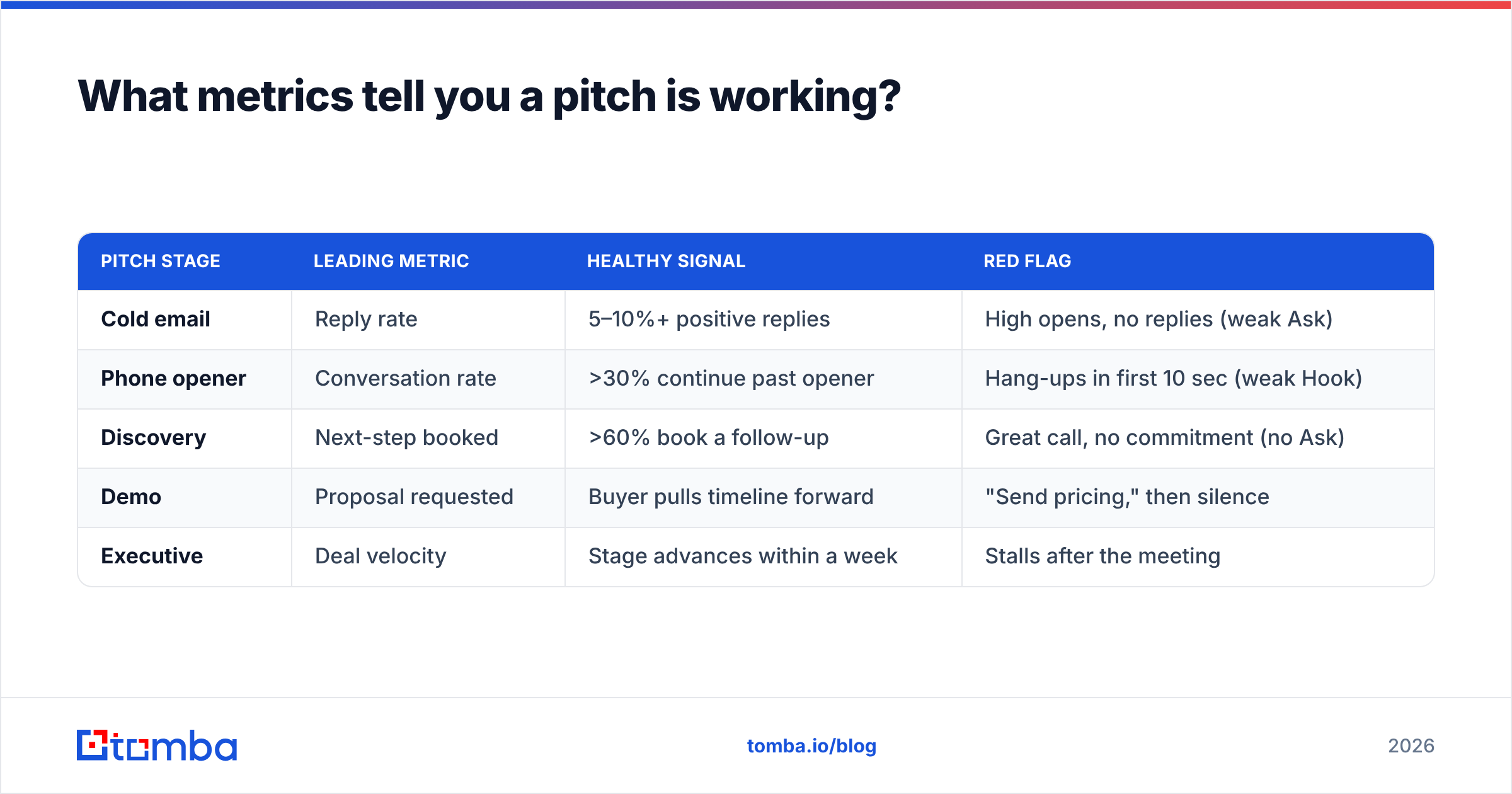
Match the metric to the format. A cold email and a demo pitch fail in completely different ways, so a single "conversion" number hides more than it reveals.
| Pitch stage | Leading metric | Healthy signal | Red flag |
|---|---|---|---|
| Cold email | Reply rate | 5–10%+ positive replies | High opens, no replies (weak Ask) |
| Phone opener | Conversation rate | >30% continue past opener | Hang-ups in first 10 sec (weak Hook) |
| Discovery | Next-step booked | >60% book a follow-up | Great call, no commitment (no Ask) |
| Demo | Proposal requested | Buyer pulls timeline forward | "Send pricing," then silence |
| Executive | Deal velocity | Stage advances within a week | Stalls after the meeting |
Read these as a diagnostic chain. High open rates with no replies means your subject and Hook work but your Ask is too heavy. Lots of "send me info" means your Insight isn't landing as differentiated. Demos that go quiet usually mean you pitched features instead of the buyer's use case. The metric tells you which step of the framework to fix — you don't have to guess.
B2B sales pitch comparison: which style wins?#
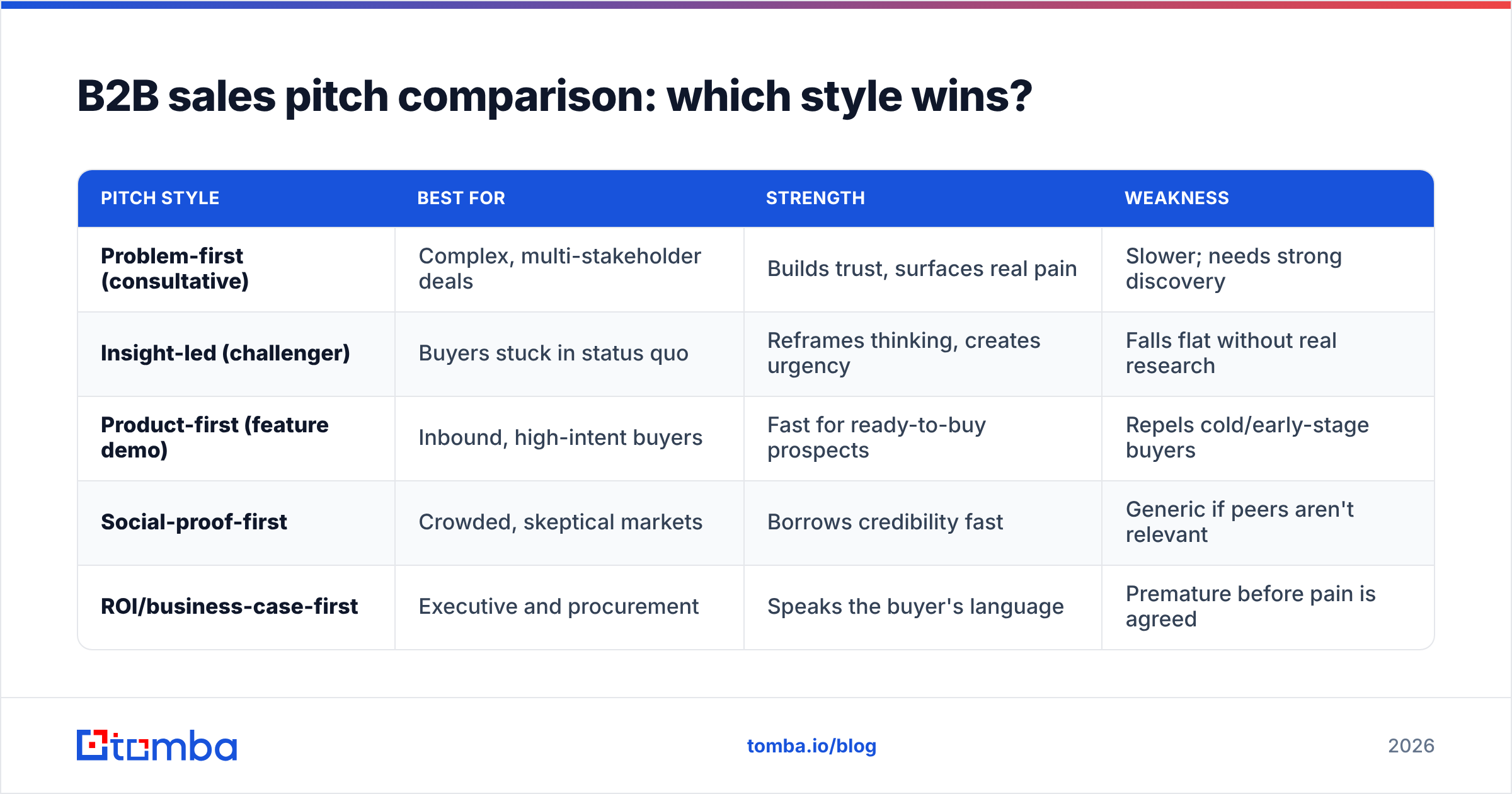
There is no universal best style, but there is a best style per context. Here is how the common approaches compare.
| Pitch style | Best for | Strength | Weakness |
|---|---|---|---|
| Problem-first (consultative) | Complex, multi-stakeholder deals | Builds trust, surfaces real pain | Slower; needs strong discovery |
| Insight-led (challenger) | Buyers stuck in status quo | Reframes thinking, creates urgency | Falls flat without real research |
| Product-first (feature demo) | Inbound, high-intent buyers | Fast for ready-to-buy prospects | Repels cold/early-stage buyers |
| Social-proof-first | Crowded, skeptical markets | Borrows credibility fast | Generic if peers aren't relevant |
| ROI/business-case-first | Executive and procurement | Speaks the buyer's language | Premature before pain is agreed |
For most outbound, lead problem-first to open and shift ROI-first as you near the economic buyer. Reserve product-first for genuinely high-intent inbound — pitching features to a cold prospect is the fastest way to get ignored, a pattern G2's buyer-behavior data reflects again and again.
How do you build and test a pitch system, not a script?#
Treat your pitch like a product: version it, measure it, and improve one variable at a time. A script is static; a system compounds.
A practical rollout:
- Document the skeleton so every rep uses Hook → Problem → Insight → Proof → Ask.
- Build a segment library — variants per persona, stored where reps actually work (CRM, sequencer).
- Standardize the data step so no pitch goes out on unverified contacts.
- Track the stage metric from the table above, not vanity opens.
- A/B one element per cycle — change only the Hook this week, only the Ask next week, so you know what moved the number.
The teams that improve fastest are not the ones with the most creative writers. They are the ones who removed guesswork: same framework, clean data, one tracked change at a time.
Sharpen your pitch with better data#
The strongest B2B sales pitch in the world still needs to reach a real person who can act on it. Before you rewrite another script, fix the layer underneath it: find the right buying-committee contacts, verify they are reachable, and enrich each record so every Hook is specific and every Ask lands in a real inbox.
Tomba Email Finder gives you accurate, verified professional emails by name, company, or domain — so your research-led pitch reaches the decision-maker instead of bouncing. Start on the free tier (25 searches/month), then scale on the Starter plan at $49/mo as your outbound grows; see full Tomba pricing for higher-volume plans. Build the pitch on a foundation of clean data, and the framework above does the rest.
// get started
Find, verify and enrich your first contacts today
Start on the free plan with 25 searches a month, then scale when your team is ready.
Free plan · No credit card required · GDPR & CCPA
// about the author