B2B Sales Promotion: 9 Tactics That Drive Pipeline in 2026
A practical guide to B2B sales promotion in 2026: nine tactics that accelerate deals without torching margin, plus a framework for picking the right incentive.
TL;DR
- A B2B sales promotion is a time-boxed incentive — a discount, bundle, trial extension, or added service — designed to push a stalled deal across the line or pull demand forward.
- The best promotions create urgency without training buyers to wait for the next discount. Margin discipline matters more in B2B than in B2C.
- The nine tactics below range from price-based (volume tiers, annual prepay) to value-based (onboarding credits, pilot programs) — value-based usually wins on retention.
- Promotions only work if they reach the right accounts. A 20% offer sent to bad-fit contacts just burns margin and inbox reputation.
- Match the incentive to the deal stage: top-of-funnel promos generate leads, late-stage promos close them. Using the wrong one wastes both.
What is a B2B sales promotion?#
A B2B sales promotion is a temporary, conditional incentive that lowers the perceived cost or raises the perceived value of buying now instead of later. Think of it like a closing-time push at a restaurant: the kitchen offers a dessert on the house not because the food is worth less, but because filling the last table tonight beats an empty one.
The difference between B2B and B2C promotions is the buyer. In B2C, a coupon nudges one person who decides in seconds. In B2B, you're moving a buying committee — a champion, an economic buyer, procurement, and sometimes legal — through a process that can take months. So a B2B promotion has to do two jobs at once: give your champion ammunition to fight internally, and give the economic buyer a reason to sign before the quarter ends.
That's why blunt discounting often backfires. Cut 30% to close one deal and you've just told every future prospect that your list price is fiction, and you've taught your own reps that discounting is the path of least resistance.
Why do B2B sales promotions fail?#
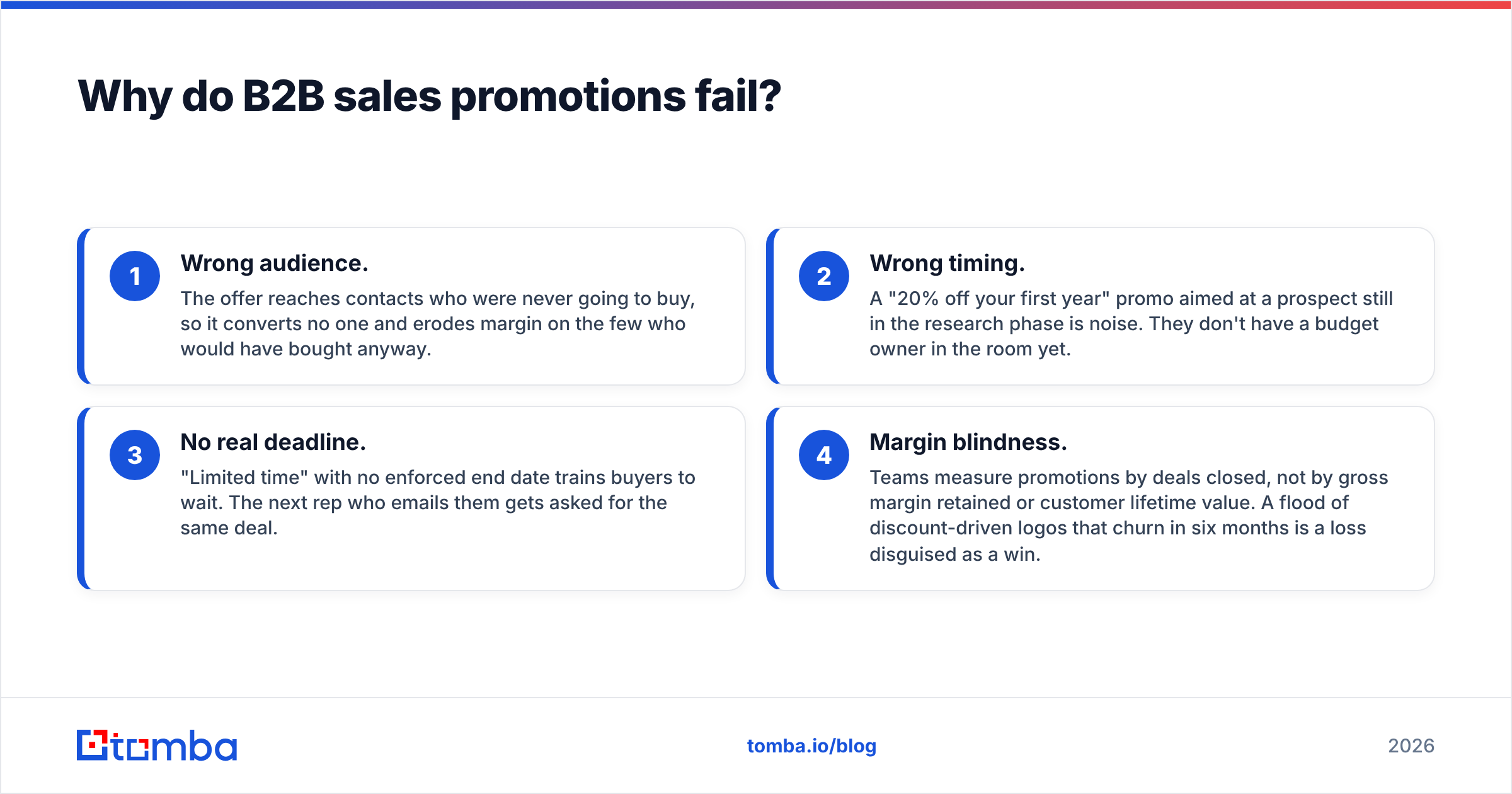
Most promotions fail for one of four reasons, and none of them is "the discount wasn't big enough."
- Wrong audience. The offer reaches contacts who were never going to buy, so it converts no one and erodes margin on the few who would have bought anyway.
- Wrong timing. A "20% off your first year" promo aimed at a prospect still in the research phase is noise. They don't have a budget owner in the room yet.
- No real deadline. "Limited time" with no enforced end date trains buyers to wait. The next rep who emails them gets asked for the same deal.
- Margin blindness. Teams measure promotions by deals closed, not by gross margin retained or customer lifetime value. A flood of discount-driven logos that churn in six months is a loss disguised as a win.
The fix for the first two is data, not creativity. You cannot run a precise promotion on a sloppy list. Before any campaign, clean and enrich your target accounts — verify the emails, confirm the decision-maker, and segment by fit. Tools like the Tomba Email Finder and an email verifier exist precisely so your offer lands in a real inbox owned by a real buyer, not a catch-all that nukes your sender reputation.
What are the main types of B2B sales promotion?#
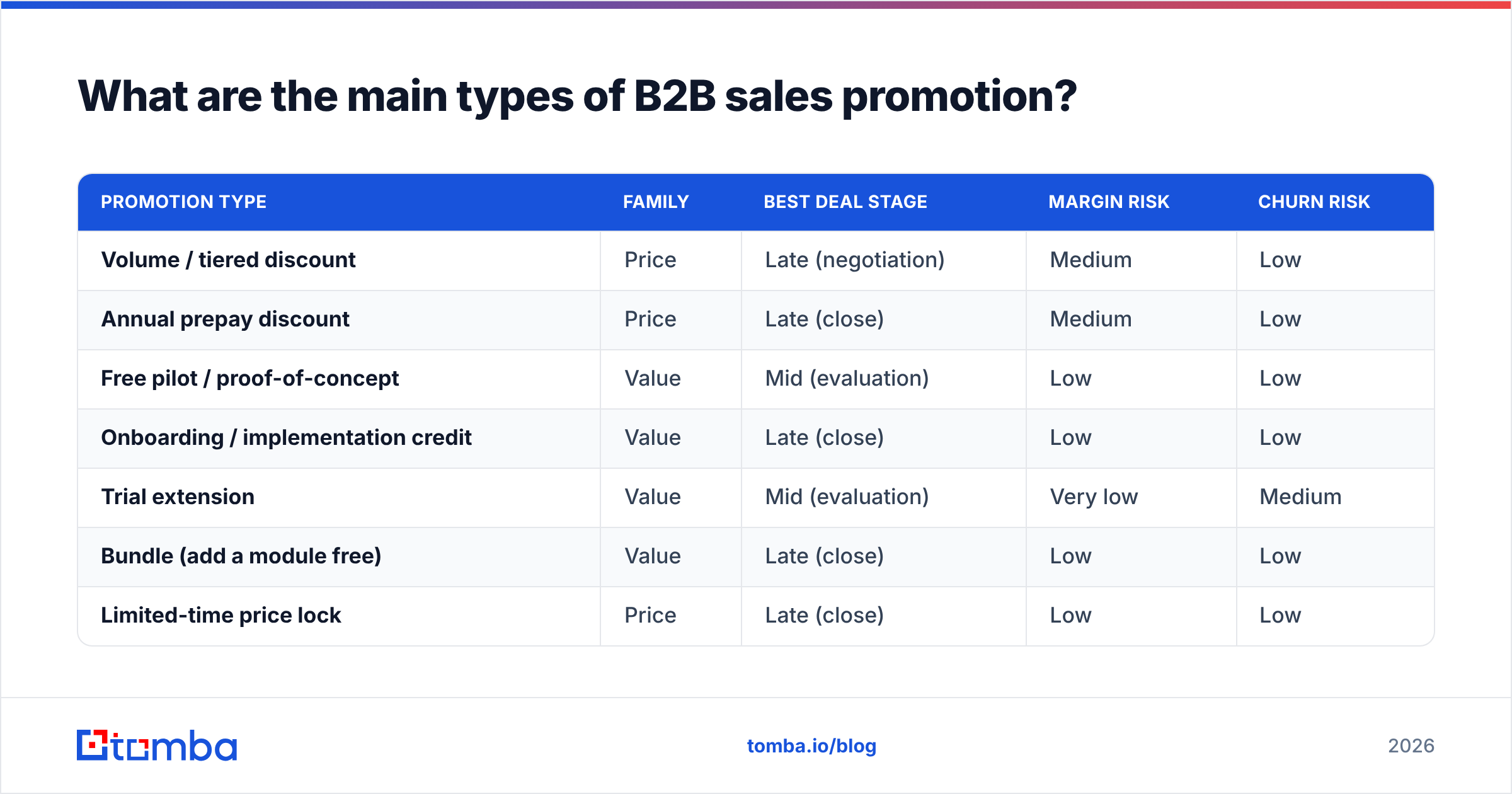
Promotions split into two families: price-based (you give up margin directly) and value-based (you add something that costs you less than its perceived worth). Value-based promotions are almost always the better long-term play because they protect your price integrity.
| Promotion type | Family | Best deal stage | Margin risk | Churn risk |
|---|---|---|---|---|
| Volume / tiered discount | Price | Late (negotiation) | Medium | Low |
| Annual prepay discount | Price | Late (close) | Medium | Low |
| Free pilot / proof-of-concept | Value | Mid (evaluation) | Low | Low |
| Onboarding / implementation credit | Value | Late (close) | Low | Low |
| Trial extension | Value | Mid (evaluation) | Very low | Medium |
| Bundle (add a module free) | Value | Late (close) | Low | Low |
| Limited-time price lock | Price | Late (close) | Low | Low |
| Referral / partner incentive | Value | Post-sale | Low | Very low |
| Seasonal / end-of-quarter offer | Either | Late (close) | High | Medium |
Read the table as a menu, not a ranking. The right row depends on where the deal sits and what's actually blocking it. A stalled evaluation needs a pilot, not a discount. A deal stuck in procurement needs an annual prepay incentive that makes the CFO's math easier.
Which 9 B2B sales promotion tactics actually work in 2026?#
Here are the nine tactics worth your time, with the situation each one solves.
- Tiered volume discounts. Reward larger commitments with better per-unit pricing. This expands deal size instead of shrinking it — the discount is conditional on the buyer spending more, so your margin percentage drops while gross profit rises.
- Annual prepay incentives. Offer two months free (roughly 16% off) for paying annually instead of monthly. You trade a modest discount for cash up front and a full year of locked-in retention.
- Free pilots and proof-of-concept programs. For complex products, let a prospect run a scoped 30-day pilot with their real data. The cost to you is support time; the payoff is a buyer who has already integrated you before signing.
- Onboarding or implementation credits. Waive setup fees or grant migration credits. This removes a real switching cost — often the single biggest objection — without touching your recurring price.
- Strategic bundling. Include a premium module free for the first year. The marginal cost of an extra seat or feature is near zero, but the perceived value can be hundreds per month.
- Limited-time price locks. Let buyers lock today's price for 24 or 36 months before a planned increase. This rewards signing now and gives procurement a defensible reason to move.
- End-of-quarter close incentives. Time-boxed offers tied to your fiscal calendar create genuine urgency — but cap the discount and enforce the deadline, or you'll train the market to wait.
- Referral and expansion incentives. Give existing customers account credit for every qualified referral that closes. Referred deals close faster and churn less, so this is among the cheapest pipeline you can buy.
- Account-based micro-offers. Tailor a small, specific incentive to a single high-value account — a custom integration, dedicated onboarding, or a co-marketing slot. Precision beats blanket discounting on enterprise deals.
Notice how few of these are "just take money off." The strongest tactics either grow the deal or remove friction. For the mechanics of building urgency without sounding desperate, our guide on outbound sales strategy pairs well with this list — wait, that's an alternative; instead see how a clean B2B database feeds the targeting these tactics depend on.
How do you target a B2B sales promotion to the right accounts?#
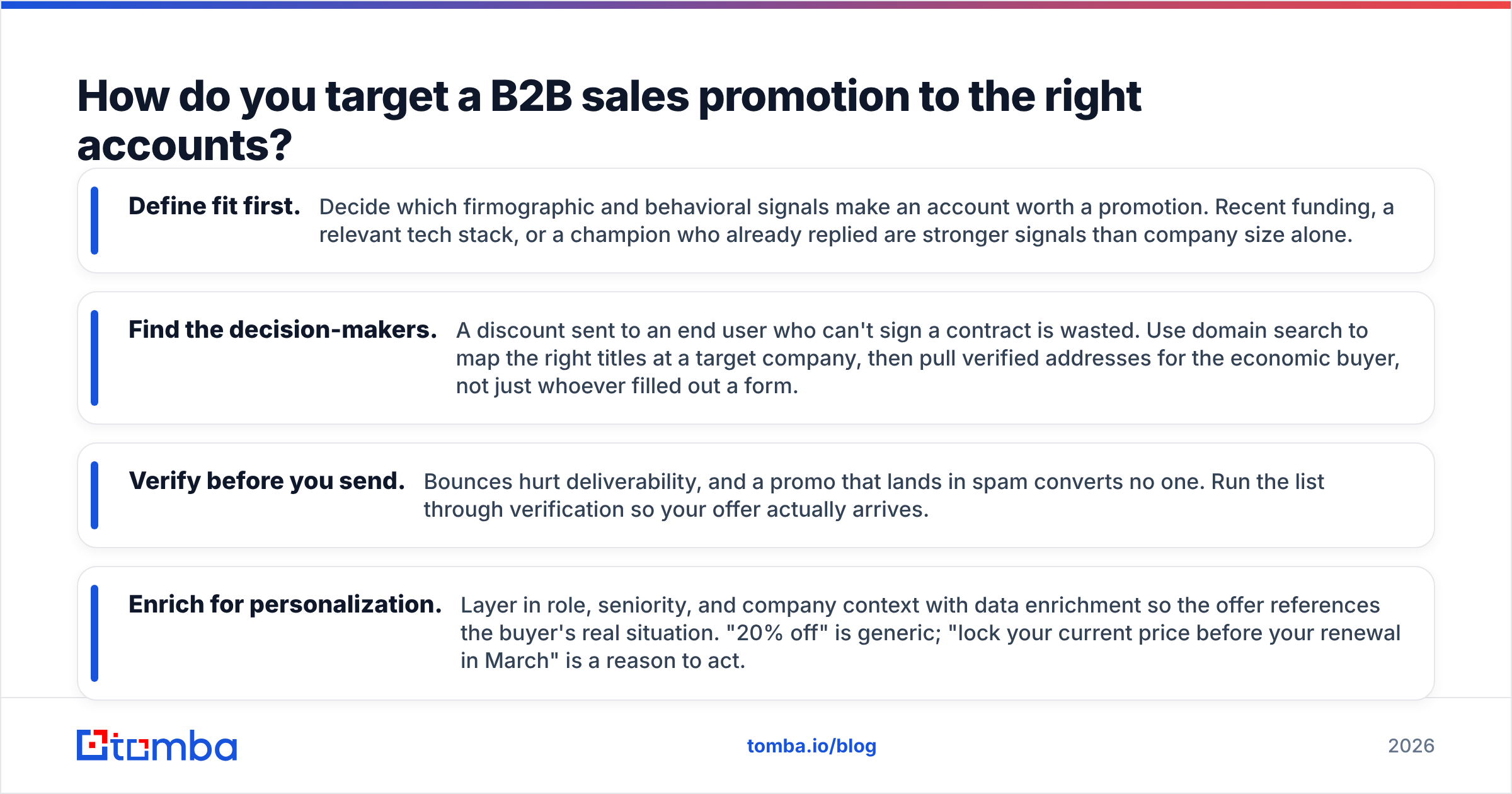
A promotion is only as good as the list it hits. The sequence is always: define fit, find the people, verify the contact, then send the offer.
- Define fit first. Decide which firmographic and behavioral signals make an account worth a promotion. Recent funding, a relevant tech stack, or a champion who already replied are stronger signals than company size alone.
- Find the decision-makers. A discount sent to an end user who can't sign a contract is wasted. Use domain search to map the right titles at a target company, then pull verified addresses for the economic buyer, not just whoever filled out a form.
- Verify before you send. Bounces hurt deliverability, and a promo that lands in spam converts no one. Run the list through verification so your offer actually arrives.
- Enrich for personalization. Layer in role, seniority, and company context with data enrichment so the offer references the buyer's real situation. "20% off" is generic; "lock your current price before your renewal in March" is a reason to act.
This targeting layer is what separates a promotion from a fire sale. According to HubSpot's sales research, personalization and timing drive response far more than raw discount depth — and you can only personalize at scale if your underlying data is accurate.
How do you measure whether a B2B sales promotion worked?#
Measure margin and retention, not just deals closed. A promotion that books revenue while destroying lifetime value is a failure that looks like a success on the leaderboard.
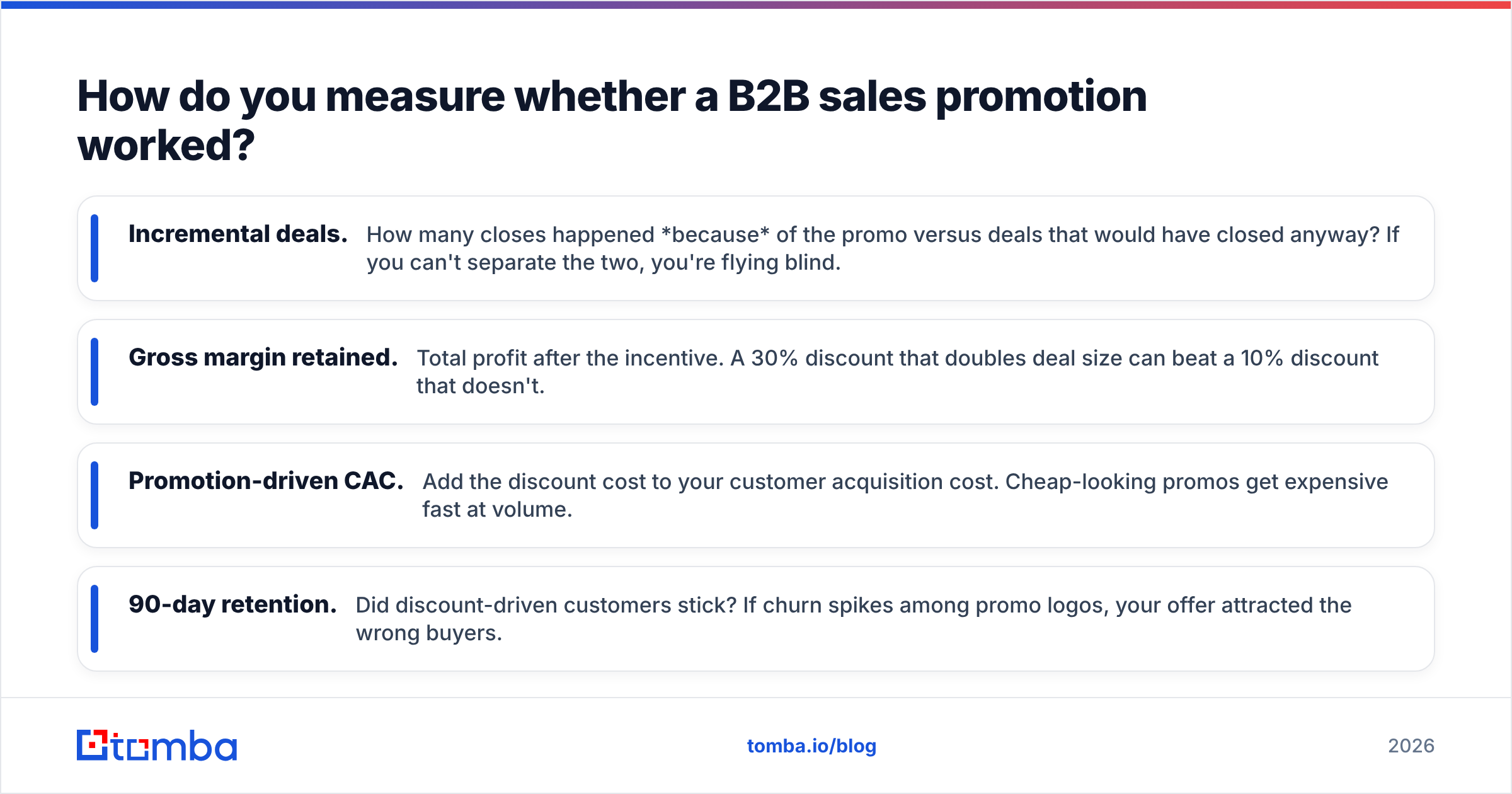
Track these four numbers for every promotion:
- Incremental deals. How many closes happened because of the promo versus deals that would have closed anyway? If you can't separate the two, you're flying blind.
- Gross margin retained. Total profit after the incentive. A 30% discount that doubles deal size can beat a 10% discount that doesn't.
- Promotion-driven CAC. Add the discount cost to your customer acquisition cost. Cheap-looking promos get expensive fast at volume.
- 90-day retention. Did discount-driven customers stick? If churn spikes among promo logos, your offer attracted the wrong buyers.
Independent reviews on platforms like G2 consistently show that B2B buyers weigh fit and onboarding quality over headline price — another argument for value-based promotions over deep discounts. Keep a simple before-and-after dashboard and compare promo cohorts against your baseline. If you need help benchmarking response rates, the Tomba pricing page outlines plans that scale with the list sizes these campaigns require.
Is a discount always the best B2B sales promotion?#
No — a discount is usually the last tool you should reach for. It's the easiest to grant and the hardest to take back. Once a buyer sees a lower number, that number becomes their anchor forever.
Lead with value. A free pilot, an onboarding credit, or a bundled module gives the buyer a reason to act while keeping your price list intact. Reserve price cuts for genuine constraints — a procurement mandate, a competitive displacement, or a strategic logo you'd take at a loss for the case study. And when you do discount, make it conditional (on volume, on term length, on a fast close) so the buyer earns it rather than expects it.
The discipline is simple to state and hard to practice: every promotion should have a defined audience, a real deadline, a measured margin impact, and a clear job in the funnel. Skip any one of those and you're not running a promotion — you're leaking money on a schedule.
Closing: power your promotions with accurate contact data#
Even the smartest promotion fails if it never reaches a real decision-maker. Before you launch your next campaign, build the list properly: find the right buyers, confirm their emails are valid, and enrich each contact so the offer feels personal instead of mass-blasted. The Tomba Email Finder gives you verified, decision-maker-level contact data by name, company, or domain — start on the free tier (25 searches a month) and scale into the $49/mo Starter plan when your promotions start filling pipeline. Precise targeting is what turns a discount into a deal.
// get started
Find, verify and enrich your first contacts today
Start on the free plan with 25 searches a month, then scale when your team is ready.
Free plan · No credit card required · GDPR & CCPA
// about the author