B2B Sales Tactics for 2026: 12 Plays That Win Deals
The B2B sales tactics that actually move pipeline in 2026 — account targeting, multi-channel outreach, and follow-up systems, with a tactic-by-tactic breakdown you can run this quarter.
Most "B2B sales tactics" lists are recycled motivation. This one is a playbook you can run this quarter, with the trade-offs spelled out so you know which plays fit a 5-person startup versus a 50-rep revenue team.
TL;DR
- The highest-leverage B2B sales tactic in 2026 isn't a new channel — it's tighter targeting. Fewer, better-fit accounts beat a bigger list every time.
- Multi-channel sequences (email + phone + LinkedIn) outperform single-channel by a wide margin, but only when the data behind them is accurate.
- Follow-up is where most pipeline dies: roughly 80% of deals need five or more touches, yet most reps stop after two.
- Discovery and qualification frameworks (MEDDIC, SPIN) raise win rates more than any clever closing line.
- Clean contact data is the foundation under all of it — verified emails and direct dials decide whether your tactics ever reach a human.
What counts as a B2B sales tactic in 2026?#
A B2B sales tactic is a repeatable action that moves a specific deal forward — not a vague strategy. Strategy is "win mid-market manufacturing accounts." A tactic is "call the VP of Ops within an hour of a website demo request, then send a one-line recap email referencing their tech stack."
The distinction matters because tactics are testable. You can measure reply rate, connect rate, and meeting-booked rate on each one, then double down on what works. In 2026 the winning teams treat tactics like product experiments: small, instrumented, and ruthlessly cut when the numbers don't hold.
Three forces shape what works now:
- Buyers self-educate first. Gartner has long reported that B2B buyers spend only about 17% of the purchase journey actually talking to suppliers. Your tactics have to add insight, not just pitch.
- Inboxes are crowded and filtered. Generic blasts land in spam. Relevance and email deliverability decide whether you're even seen.
- Data decays fast. Roughly 30% of B2B contact data goes stale each year as people change jobs. A tactic built on a bad email or dead phone number fails before it starts.
Which B2B sales tactics actually move pipeline?#
Here is the short list worth your time, ranked by leverage for most teams.
- Account targeting and ICP discipline. Define your Ideal Customer Profile by firmographics, tech stack, and trigger events — then say no to everything else. A tight ICP is the multiplier on every downstream tactic.
- Trigger-based outreach. Reach out when something changed: a funding round, a new hire in your buyer role, a tech-stack switch, or expansion into a new market. Timing beats volume.
- Multi-channel sequencing. Combine email, phone, and LinkedIn touches across 2–3 weeks. Each channel covers the others' blind spots.
- Insight-led discovery. Lead calls with a relevant observation or benchmark, not a feature list. Use a framework (SPIN, MEDDIC) to structure questions.
- Systematic follow-up. Build a defined cadence so no opportunity goes dark. Most revenue hides in touches 3 through 8.
- Social proof and referrals. A warm intro or a relevant case study shortens cycles more than any cold tactic.
The thread connecting all six: they only work if you reach the right person. That's why prospecting hygiene — accurate contacts — sits underneath the entire list.
How do these B2B sales tactics compare?#
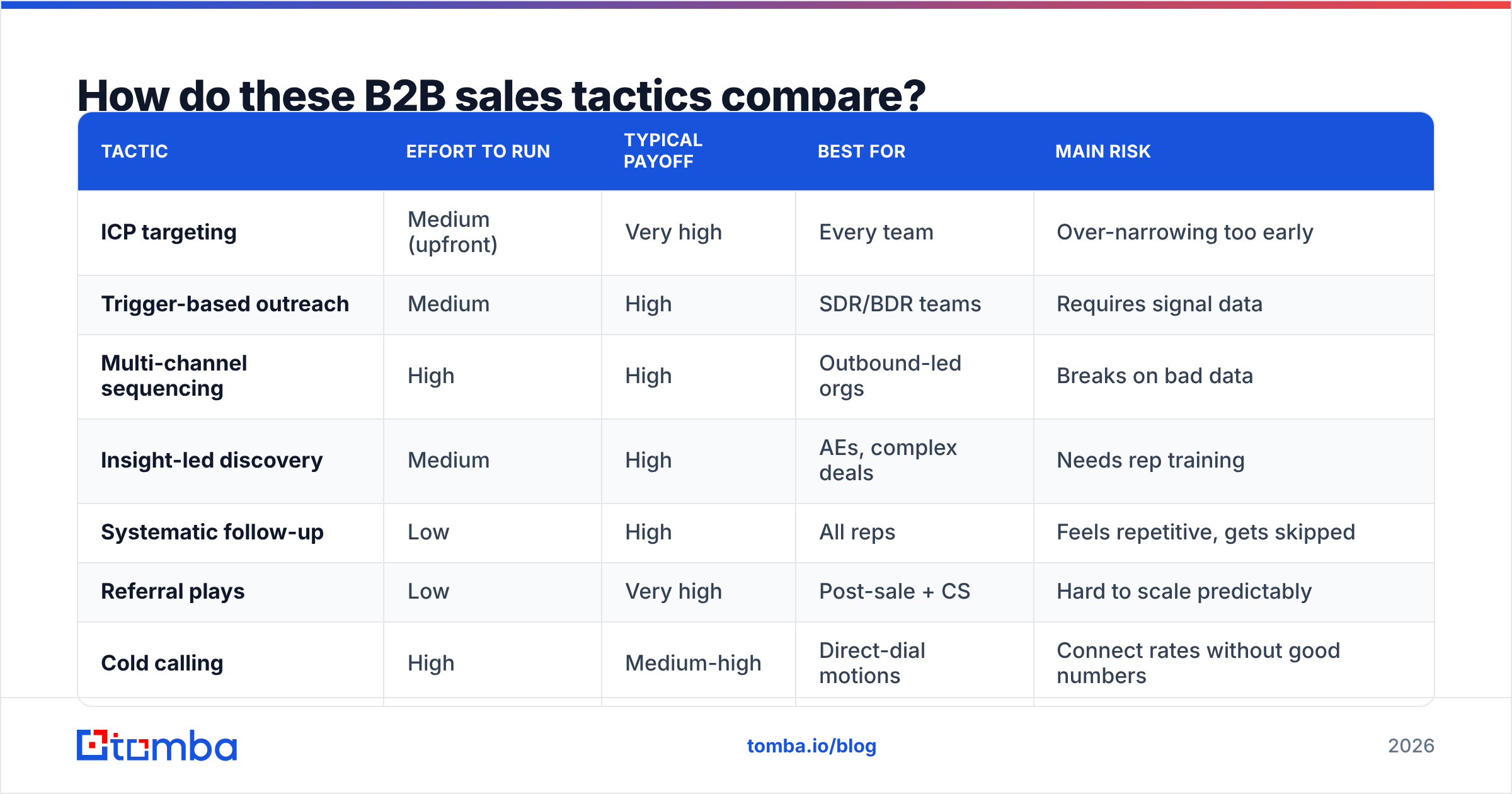
Different tactics carry different effort, payoff, and risk. Use this table to pick where to invest first based on your team size and motion.
| Tactic | Effort to run | Typical payoff | Best for | Main risk |
|---|---|---|---|---|
| ICP targeting | Medium (upfront) | Very high | Every team | Over-narrowing too early |
| Trigger-based outreach | Medium | High | SDR/BDR teams | Requires signal data |
| Multi-channel sequencing | High | High | Outbound-led orgs | Breaks on bad data |
| Insight-led discovery | Medium | High | AEs, complex deals | Needs rep training |
| Systematic follow-up | Low | High | All reps | Feels repetitive, gets skipped |
| Referral plays | Low | Very high | Post-sale + CS | Hard to scale predictably |
| Cold calling | High | Medium-high | Direct-dial motions | Connect rates without good numbers |
Notice that the two lowest-effort plays — follow-up and referrals — carry some of the highest payoff. If you do nothing else this quarter, fix those two.
Why does account targeting beat volume?#
Because every wasted touch costs the same as a good one, but returns nothing. Targeting is the cheapest way to raise your hit rate.
Think of it like fishing. You can drag a net across the whole lake and exhaust yourself, or you can find where the fish actually feed and cast there. The net feels productive — lots of motion — but the targeted cast fills the boat. Spray-and-pray outreach is the net: high activity, low yield, and it burns your domain reputation in the process.
A disciplined ICP does three things at once:
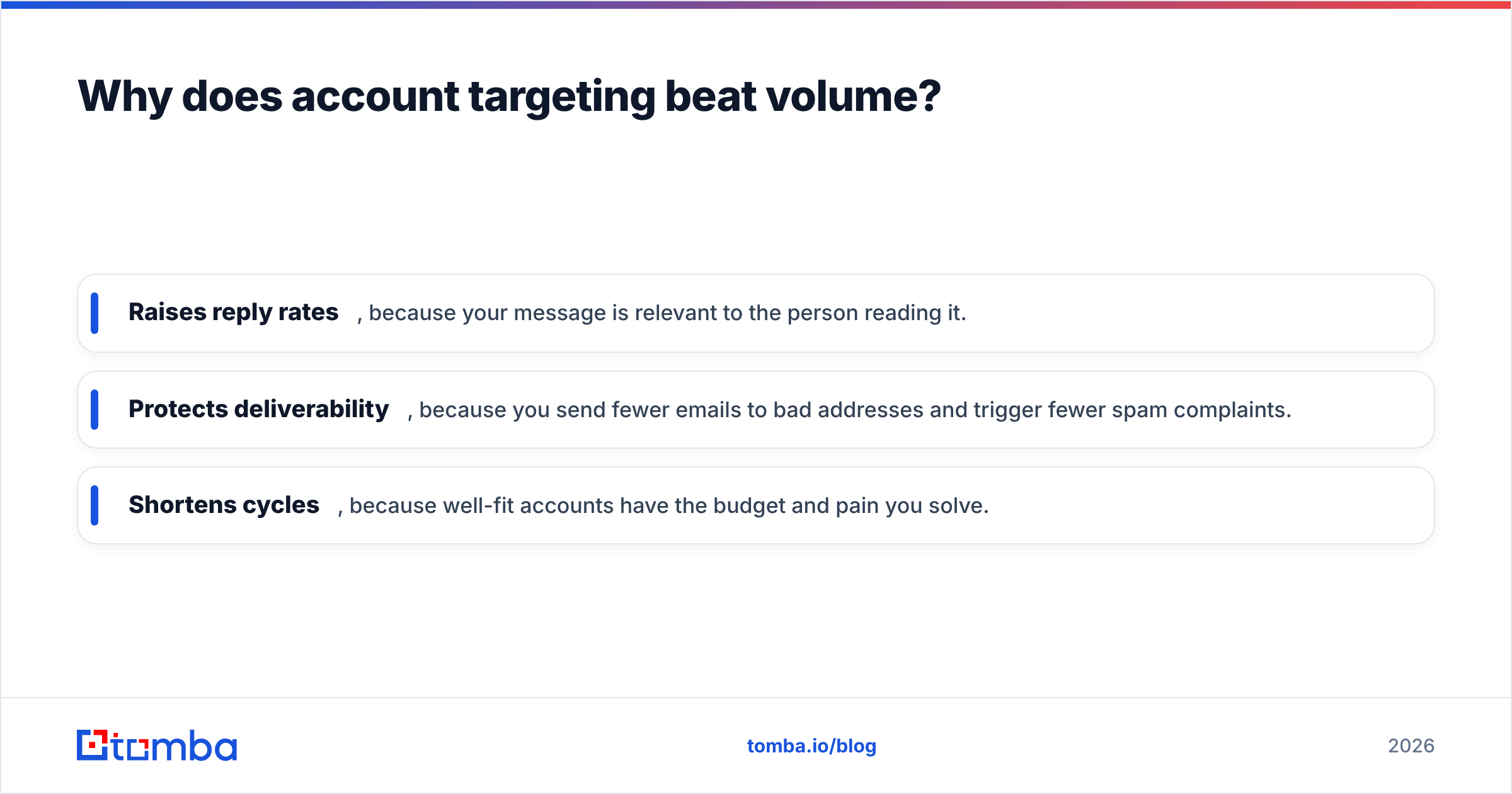
- Raises reply rates, because your message is relevant to the person reading it.
- Protects deliverability, because you send fewer emails to bad addresses and trigger fewer spam complaints.
- Shortens cycles, because well-fit accounts have the budget and pain you solve.
To build the target list, start from your best existing customers, extract the common firmographics, then find lookalike companies. A domain search turns a list of target company websites into the actual decision-makers and their email patterns, so you move from "companies I want" to "people I can contact" without manual digging. Layer in trigger data — hiring, funding, tech changes — and you have a prioritized queue instead of a flat spreadsheet.
How do you build a multi-channel sequence that works?#
Map touches across email, phone, and LinkedIn over 14–21 days, and make each touch reference the last. The goal is presence without nagging.
A proven 21-day structure:
- Day 1 — Email: Short, trigger-based, one clear ask. No pitch deck.
- Day 2 — LinkedIn: Connection request or a comment on their recent post. No pitch.
- Day 4 — Phone: Reference the email. If voicemail, keep it under 20 seconds.
- Day 7 — Email: New angle — a customer result or a relevant stat, not "just bumping this."
- Day 11 — Phone + LinkedIn message: Same day, different channel.
- Day 16 — Email: Case study matched to their industry.
- Day 21 — Breakup email: "Should I close your file?" These get surprisingly high reply rates.
Two things make or break it. First, direct dials — a sequence with a switchboard number instead of a mobile collapses at the phone step. A phone finder gets you the direct line so calls connect to the buyer, not a receptionist. Second, deliverability: verify every address before the first send so bounces stay under 2% and your domain reputation survives the campaign.
What makes B2B discovery calls convert?#
Lead with insight, then ask questions that let the buyer talk themselves into the problem. The rep who diagnoses outperforms the rep who pitches.
The SPIN structure still holds up: Situation, Problem, Implication, Need-payoff. The trick is spending most of your airtime on Implication — helping the buyer quantify what the problem costs them. A prospect who says out loud "this is costing us two deals a quarter" is selling themselves.
For complex, multi-stakeholder deals, layer MEDDIC on top to qualify hard: Metrics, Economic buyer, Decision criteria, Decision process, Identify pain, Champion. HubSpot's sales blog and the user reviews on G2 are useful for pressure-testing which framework fits your motion before you standardize on one.
A practical tip: never run discovery without knowing who else is in the room. Use data enrichment to map the buying committee — titles, seniority, and reporting lines — before the call so you're not blindsided by a hidden economic buyer in week three.
Why is follow-up the most underused tactic?#
Because it feels unrewarding, so reps quit early — and that's exactly why it works for the few who don't. Industry data has long shown most B2B sales require five or more follow-ups, while a large share of reps stop after one or two. The gap between those two numbers is pure, uncontested pipeline.
Make follow-up a system, not a willpower test:
- Automate the cadence in your CRM or sequencer so the next touch is always scheduled.
- Vary the value each time — a resource, a stat, a customer story — so you're never just "checking in."
- Track response rate by touch number so you know where prospects actually re-engage.
- Set a clean exit. A breakup message after the last touch frees you to reallocate effort and often revives the deal.
The teams that win on follow-up aren't more persistent by personality. They've removed the decision from the rep and baked it into the workflow.
What tools support these B2B sales tactics?#
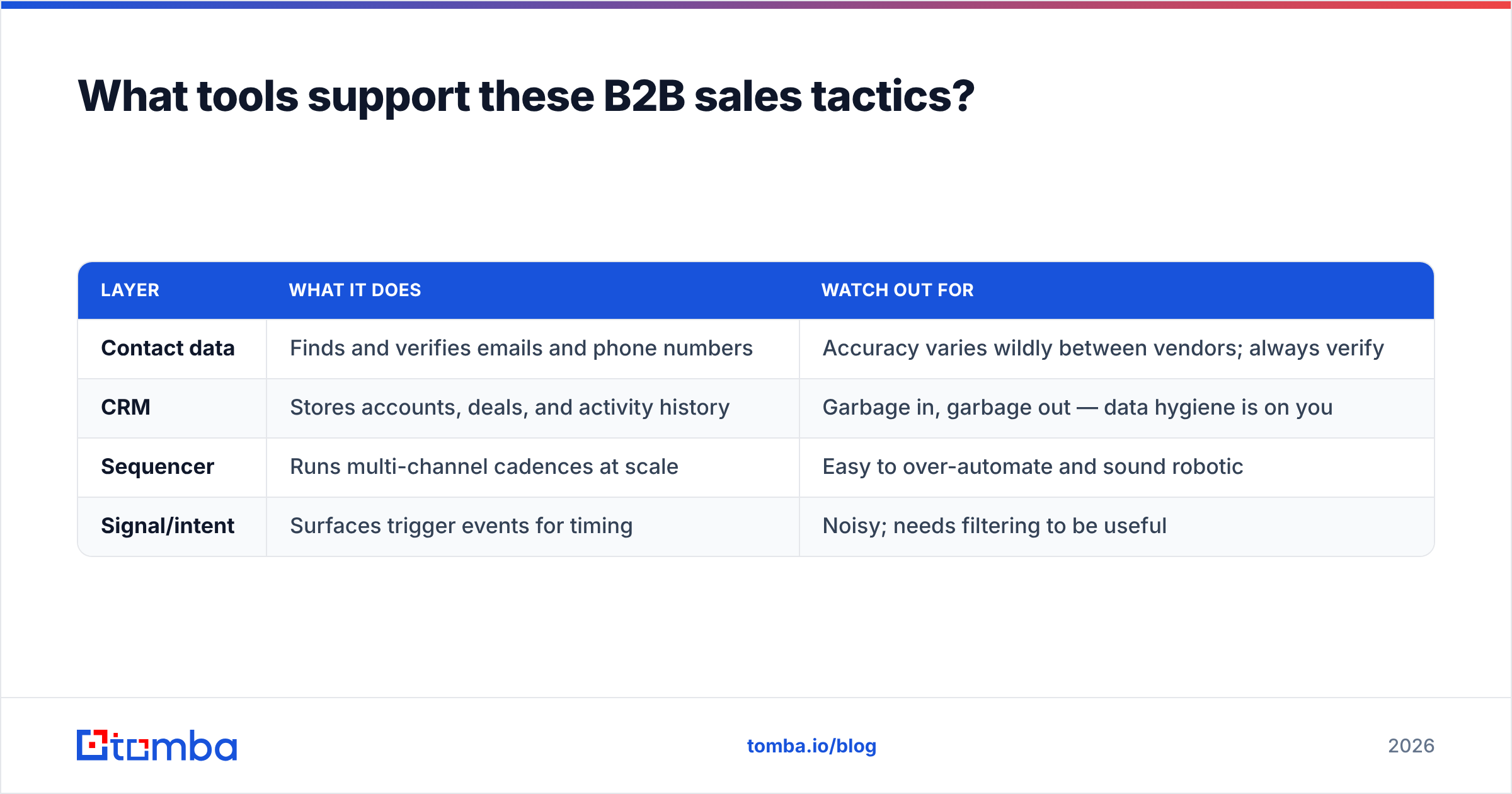
Tactics need three layers of tooling: data, execution, and measurement. Here's how the categories map, with honest trade-offs.
| Layer | What it does | Watch out for |
|---|---|---|
| Contact data | Finds and verifies emails and phone numbers | Accuracy varies wildly between vendors; always verify |
| CRM | Stores accounts, deals, and activity history | Garbage in, garbage out — data hygiene is on you |
| Sequencer | Runs multi-channel cadences at scale | Easy to over-automate and sound robotic |
| Signal/intent | Surfaces trigger events for timing | Noisy; needs filtering to be useful |
The data layer is where most teams underinvest and pay for it later. Salesforce's State of Sales research consistently shows reps lose meaningful selling time to manual data work and bad records. Every tactic above — targeting, sequencing, calling, follow-up — degrades the moment your contact data is wrong.
That's the case for fixing the foundation first. Before you optimize subject lines or call scripts, make sure you're reaching real, current people. Tools like the email verifier keep bounce rates low and protect the sender reputation your whole outbound motion depends on. You can check current Tomba pricing to see where verification and finding fit your budget.
How should you sequence these tactics this quarter?#
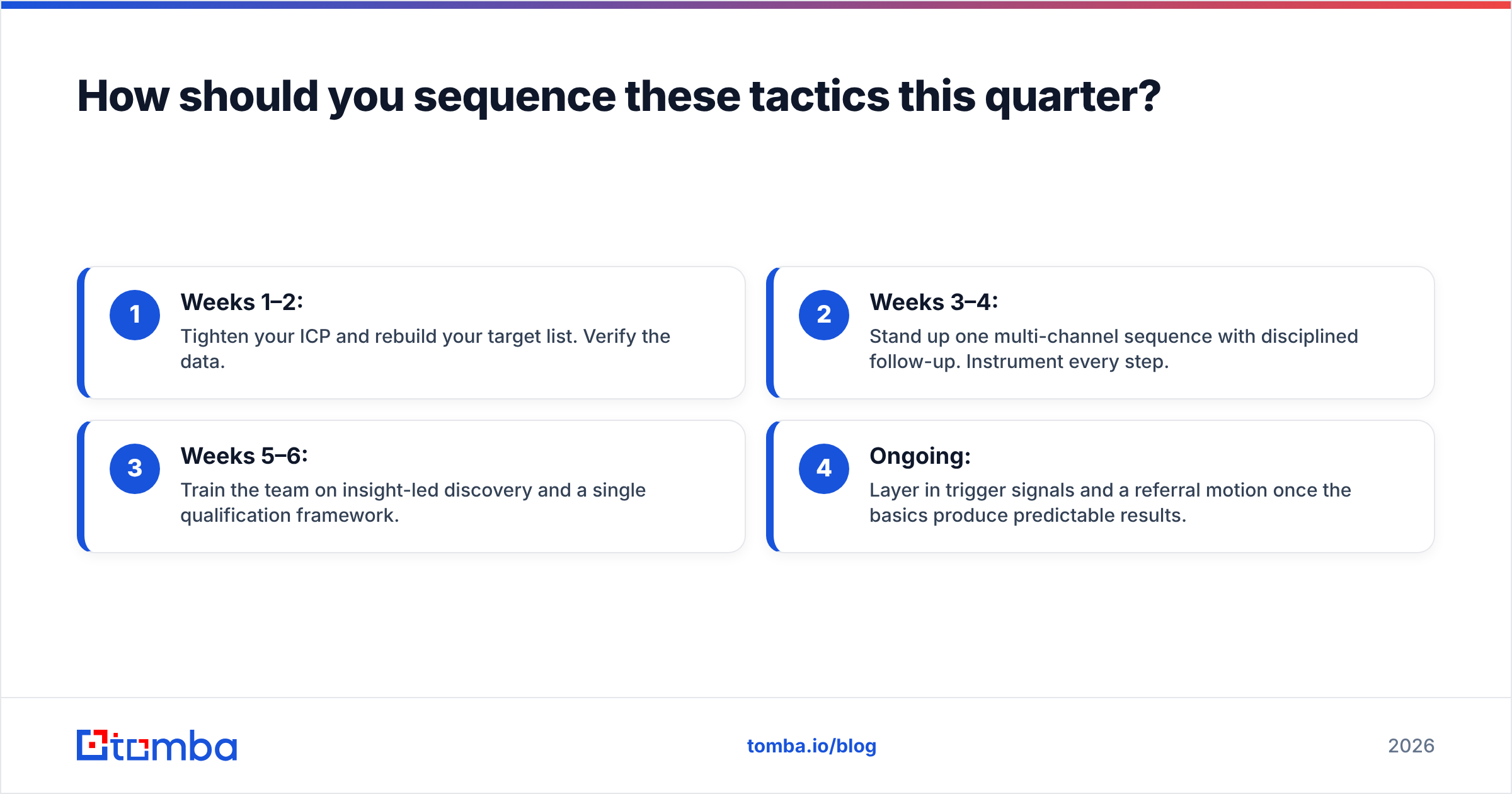
Don't try all twelve at once. Stack them in dependency order so each builds on a solid base:
- Weeks 1–2: Tighten your ICP and rebuild your target list. Verify the data.
- Weeks 3–4: Stand up one multi-channel sequence with disciplined follow-up. Instrument every step.
- Weeks 5–6: Train the team on insight-led discovery and a single qualification framework.
- Ongoing: Layer in trigger signals and a referral motion once the basics produce predictable results.
This order works because targeting and clean data make every later tactic cheaper to run. Reverse it — fancy sequences on a stale list — and you'll burn your domain and your reps' confidence in the same month.
The bottom line#
The B2B sales tactics that win in 2026 are not exotic. They're targeting, multi-channel persistence, real discovery, and follow-up that doesn't quit — all sitting on top of accurate contact data. Master the unglamorous foundation and the clever stuff finally gets a chance to work.
Start where the leverage is highest and the effort is lowest: make sure every name on your list is a real, reachable person. The Tomba Email Finder turns target companies and names into verified professional emails so your sequences reach buyers instead of bouncing — the prerequisite for every other tactic on this page. Run your targeting through it first, and the rest of your playbook starts paying off.
// get started
Find, verify and enrich your first contacts today
Start on the free plan with 25 searches a month, then scale when your team is ready.
Free plan · No credit card required · GDPR & CCPA
// about the author