B2B Sales Triggers in 2026: How to Spot and Act on Buying Signals
A practical guide to B2B sales triggers in 2026: the events that signal buying intent, how to track them, and how to turn each one into booked meetings.
TL;DR
- A B2B sales trigger is a specific event — a funding round, a new hire, a tech swap — that signals a prospect is more likely to buy right now.
- Trigger-based outreach beats spray-and-pray because you reach accounts during a window when the pain is fresh and budget is moving.
- The highest-value triggers in 2026 are leadership changes, funding, hiring spikes, technology adoption, and product/expansion announcements.
- You need three layers: a signal source, an enrichment step to get the right contact, and a fast outreach play tied to the specific event.
- Tools like Tomba close the gap between "I saw a signal" and "I have the decision-maker's verified email."
What are B2B sales triggers?#
A B2B sales trigger is an event that changes a company's situation enough to create a buying need — and gives you a credible reason to reach out today instead of next quarter.
Think of it like fishing. Casting a random list is like dropping a line into an empty pond and hoping. A trigger is the splash that tells you exactly where the fish are feeding. When a company raises a Series B, hires its first VP of Marketing, or migrates off a competitor's tool, the water moves. Your job is to be the first credible vendor at that spot.
The mechanics are simple: an event happens, the event creates or exposes a pain, and a budget-holder becomes briefly receptive. Most reps ignore the timing entirely and send the same pitch to everyone. Trigger selling flips that — you let the buyer's calendar set yours.

Why do trigger events outperform cold lists?#
Because relevance and timing are the two variables you can actually control, and triggers move both at once.
A static list ages the moment you buy it. People change jobs, companies pivot, and the pain you assumed is rarely the pain that's burning today. According to HubSpot's sales research, the strongest predictor of a reply is whether the message connects to something happening in the buyer's world right now. Triggers are that "something."
There's a compounding effect too. When you open with a specific event — "Congrats on the Denver office" or "Saw you're hiring six SDRs" — you signal that you did homework, which raises trust before you've made a single claim. That lifts both open and reply rates, and it shortens the qualification conversation because the prospect already has the relevant context loaded.
The catch: a trigger is only useful if you can act fast and reach the right person. A funding announcement is public to every competitor at the same time. The rep who enriches the account and sends a tailored message within 48 hours wins the window. That's where most teams leak — they spot the signal but can't find a verified contact quickly enough.
What are the highest-value B2B sales triggers in 2026?#
Not every event is worth chasing. The best triggers share three traits: they're recent, they map to a clear pain, and they tend to free up budget. Here are the categories that consistently convert.
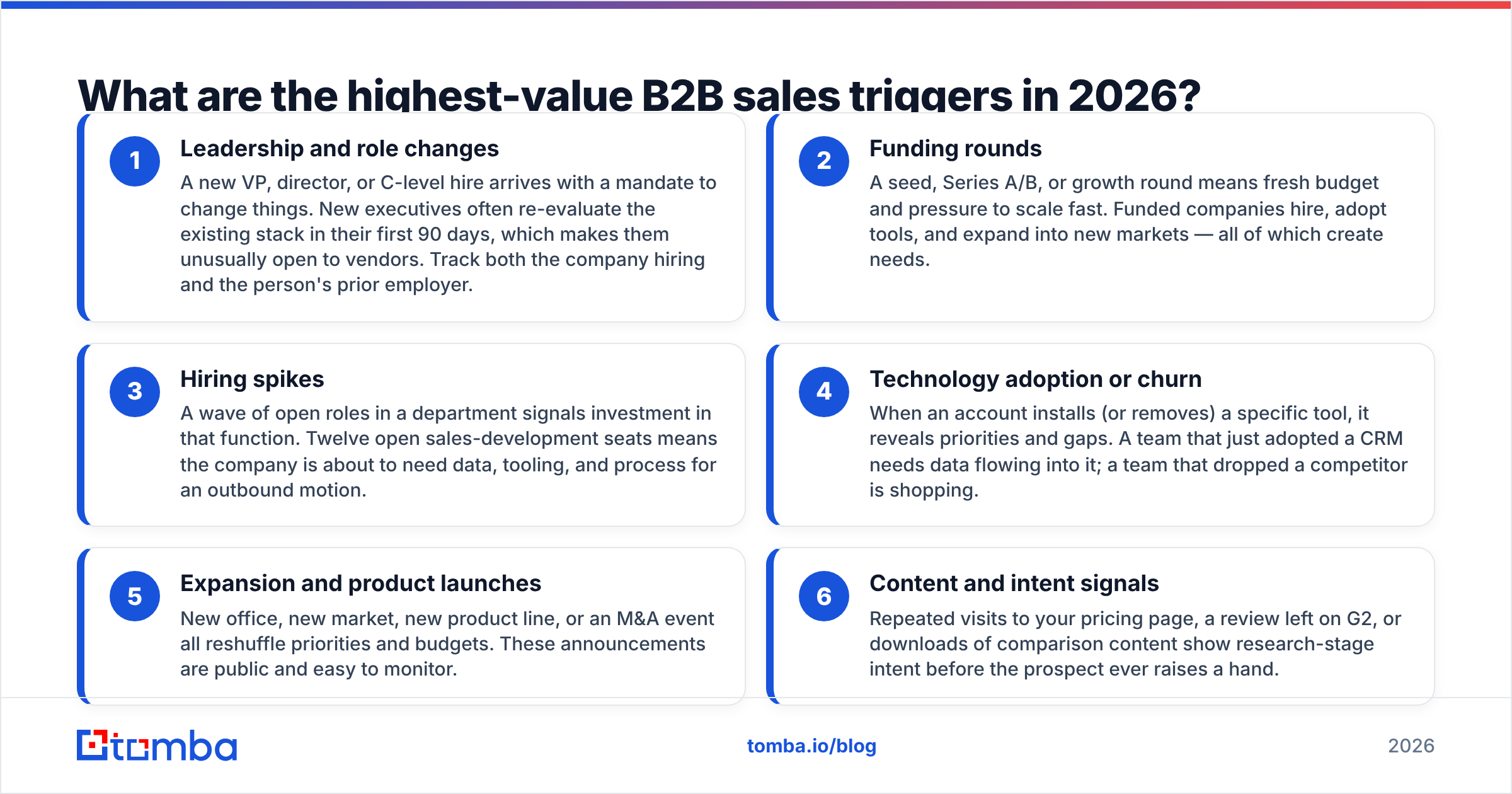
- Leadership and role changes — A new VP, director, or C-level hire arrives with a mandate to change things. New executives often re-evaluate the existing stack in their first 90 days, which makes them unusually open to vendors. Track both the company hiring and the person's prior employer.
- Funding rounds — A seed, Series A/B, or growth round means fresh budget and pressure to scale fast. Funded companies hire, adopt tools, and expand into new markets — all of which create needs.
- Hiring spikes — A wave of open roles in a department signals investment in that function. Twelve open sales-development seats means the company is about to need data, tooling, and process for an outbound motion.
- Technology adoption or churn — When an account installs (or removes) a specific tool, it reveals priorities and gaps. A team that just adopted a CRM needs data flowing into it; a team that dropped a competitor is shopping.
- Expansion and product launches — New office, new market, new product line, or an M&A event all reshuffle priorities and budgets. These announcements are public and easy to monitor.
- Content and intent signals — Repeated visits to your pricing page, a review left on G2, or downloads of comparison content show research-stage intent before the prospect ever raises a hand.
Gartner's B2B buying research notes that buyers spend the majority of their journey doing independent research before they talk to sales. Trigger signals are how you find them during that research, not after a competitor already booked the demo.
How do trigger-based and traditional prospecting compare?#
The difference shows up in every downstream metric — list size, reply rate, and the cost of each booked meeting.
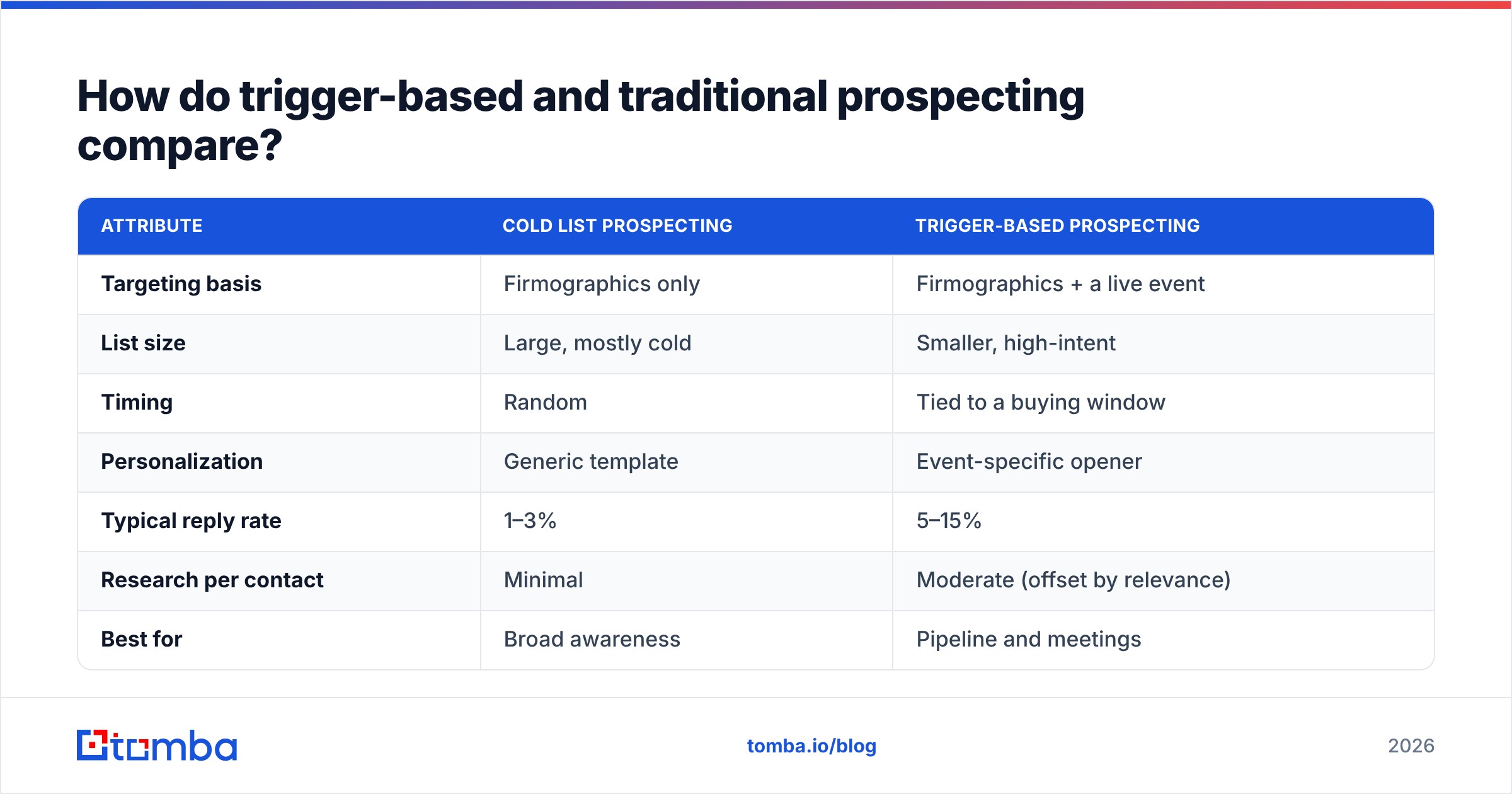
| Attribute | Cold list prospecting | Trigger-based prospecting |
|---|---|---|
| Targeting basis | Firmographics only | Firmographics + a live event |
| List size | Large, mostly cold | Smaller, high-intent |
| Timing | Random | Tied to a buying window |
| Personalization | Generic template | Event-specific opener |
| Typical reply rate | 1–3% | 5–15% |
| Research per contact | Minimal | Moderate (offset by relevance) |
| Best for | Broad awareness | Pipeline and meetings |
| Data freshness needed | Low | High — signals decay fast |
The trade-off is real: trigger selling needs fresher data and a faster workflow. You're trading list volume for hit rate. For most B2B teams chasing booked meetings rather than impressions, that trade pays off — a smaller list that converts at 10% beats a giant one that converts at 1%.
How do you build a sales-trigger workflow?#
Three layers, in order: detect the signal, enrich the account, then act on it fast. Skip any layer and the system breaks.
Layer 1 — Detect. Pick a handful of trigger types that match your ICP and wire up sources for each. Job boards and LinkedIn for hiring and role changes, funding databases and press feeds for capital events, and review sites for intent. If a competitor's customers are your best prospects, a website visitor identification layer can surface anonymous accounts already researching you.
Layer 2 — Enrich. A signal names a company, not a person. You still need the specific decision-maker and a verified way to reach them. This is the step that quietly kills most trigger programs — the rep finds a funding announcement, then loses two days hunting for the VP of Sales' email. A domain search returns the people and patterns behind a company in seconds, and an email finder turns a name plus domain into a verified address. For phone-first motions, a phone finder adds direct dials.
Layer 3 — Act. Speed and specificity decide the outcome. Reach out within 48 hours, lead with the trigger, and connect it to one concrete outcome. Don't bury the event in paragraph three — make it the first line. Then enrich the rest of the account (data enrichment fills in title, seniority, and company size) so your message routes to the right seniority with the right angle.

The teams that win treat these three layers as one pipeline, not three disconnected tools. The moment a trigger fires, enrichment and outreach should follow automatically or with one click — not a manual handoff that adds days.
How should you write outreach for each trigger?#
Match the message to the event, and keep the ask small. A trigger earns you attention; a relevant, low-friction ask earns you the reply.
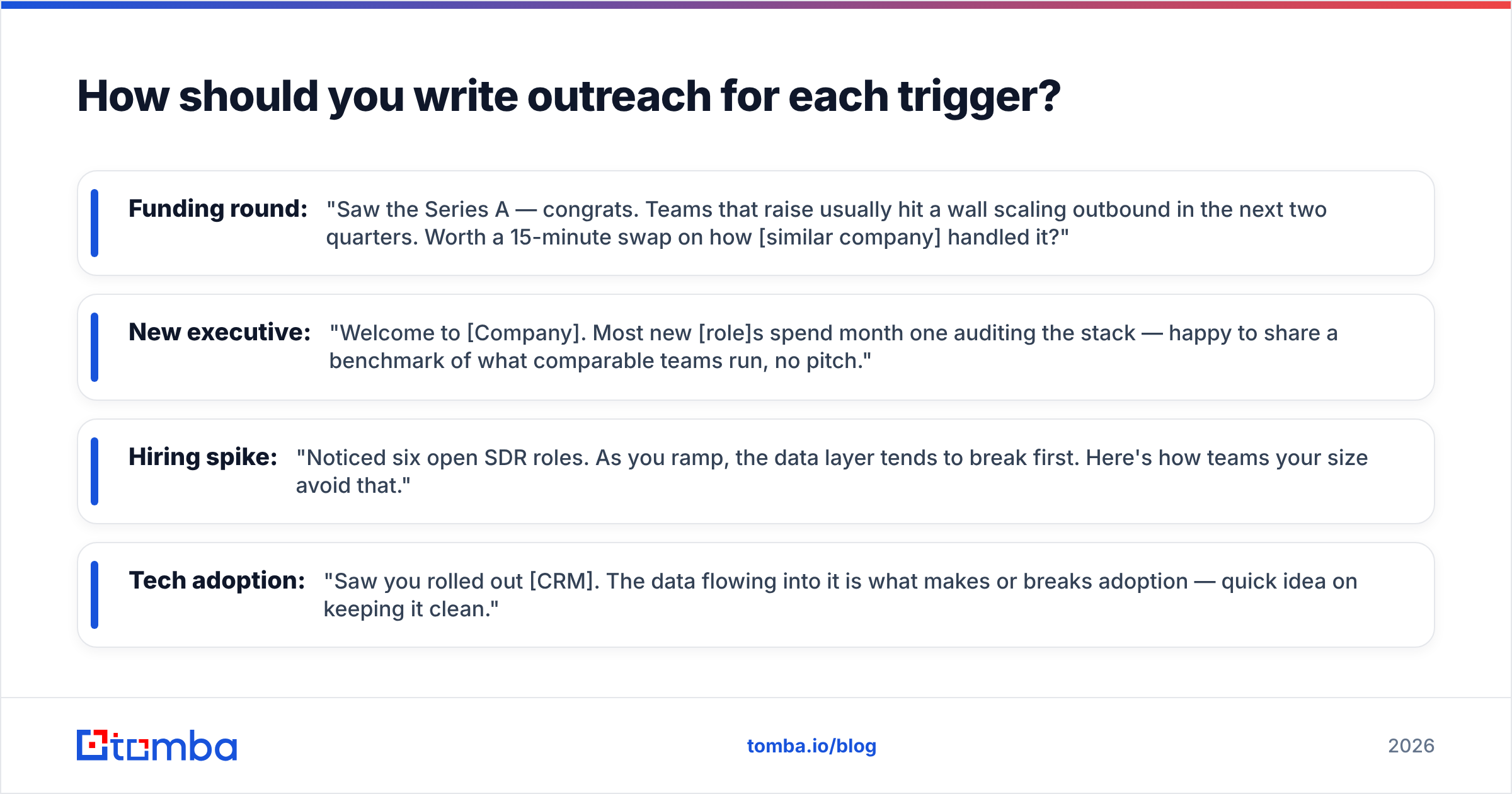
- Funding round: "Saw the Series A — congrats. Teams that raise usually hit a wall scaling outbound in the next two quarters. Worth a 15-minute swap on how [similar company] handled it?"
- New executive: "Welcome to [Company]. Most new [role]s spend month one auditing the stack — happy to share a benchmark of what comparable teams run, no pitch."
- Hiring spike: "Noticed six open SDR roles. As you ramp, the data layer tends to break first. Here's how teams your size avoid that."
- Tech adoption: "Saw you rolled out [CRM]. The data flowing into it is what makes or breaks adoption — quick idea on keeping it clean."
Notice the pattern: name the event, state the predictable pain, offer one specific, low-commitment next step. No feature dumps. The trigger does the persuading; your job is to be relevant and brief.
Strong subject lines and a tight first sentence carry most of the weight here. If your response rate is flat, the opener is usually the culprit — it's generic when it should be event-specific.
What mistakes kill trigger-based selling?#
Most failures come from treating triggers as a list source instead of a timing system.
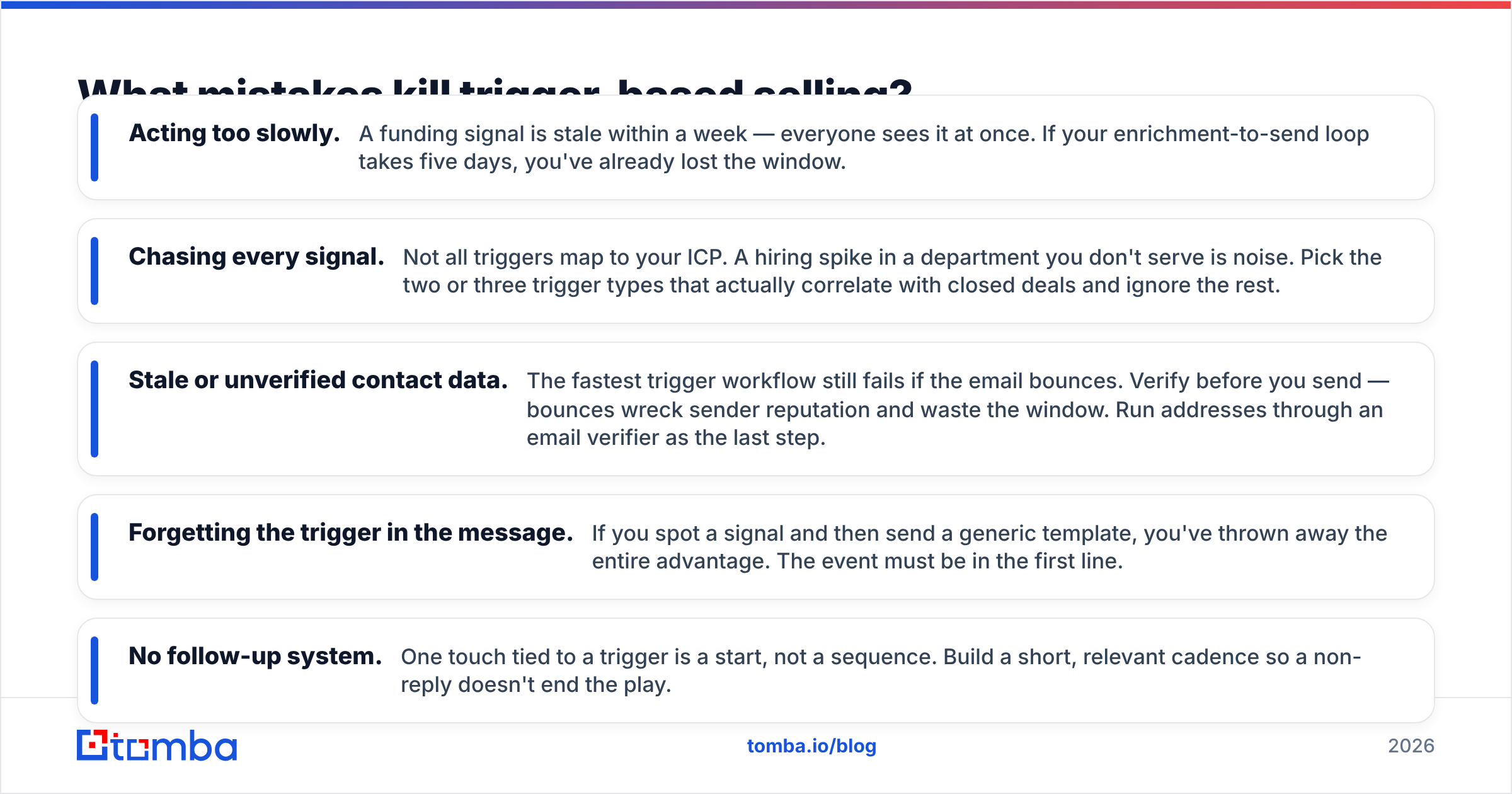
- Acting too slowly. A funding signal is stale within a week — everyone sees it at once. If your enrichment-to-send loop takes five days, you've already lost the window.
- Chasing every signal. Not all triggers map to your ICP. A hiring spike in a department you don't serve is noise. Pick the two or three trigger types that actually correlate with closed deals and ignore the rest.
- Stale or unverified contact data. The fastest trigger workflow still fails if the email bounces. Verify before you send — bounces wreck sender reputation and waste the window. Run addresses through an email verifier as the last step.
- Forgetting the trigger in the message. If you spot a signal and then send a generic template, you've thrown away the entire advantage. The event must be in the first line.
- No follow-up system. One touch tied to a trigger is a start, not a sequence. Build a short, relevant cadence so a non-reply doesn't end the play.
How do you measure whether triggers are working?#
Track reply rate and meetings booked per trigger type, not just in aggregate — then double down on the signals that convert.
Tag every trigger-sourced contact by event category in your CRM. After a few weeks you'll see that, say, leadership changes book meetings at 3x the rate of funding rounds for your offer. That's your signal to reallocate effort. Watch time-to-touch too: if your best-converting trigger also has your slowest response time, fixing the workflow is worth more than adding new signal sources.
The point of measurement is ruthless focus. Triggers are abundant; your team's hours are not. Let the data tell you which two or three events deserve a fast, well-built play, and let everything else go.
Which Tomba tool fits trigger-based prospecting?#
Start with the Tomba Email Finder. The hardest part of trigger selling isn't spotting the event — those are increasingly public. It's collapsing the gap between "I saw the signal" and "I have the decision-maker's verified email" before the window closes. Feed it a name and a company domain and you get a verified, deliverable address in seconds, so your funding or new-hire message lands while the trigger is still hot.
Pair it with domain search to map the buying committee behind any triggered account, data enrichment to route messages to the right seniority, and the built-in email verifier to protect your sender reputation. Plans start free with 25 searches a month, and paid tiers begin at $49/mo — see full Tomba pricing to match a plan to your volume. Spot the signal, find the person, send before your competitors finish their coffee.
// get started
Find, verify and enrich your first contacts today
Start on the free plan with 25 searches a month, then scale when your team is ready.
Free plan · No credit card required · GDPR & CCPA
// about the author