B2B Target Market Analysis: A 2026 Framework That Works
A practical 2026 framework for B2B target market analysis: define your ICP, size the market, score segments, and turn the output into a prioritized prospecting list.
TL;DR
- B2B target market analysis is the process of defining who you sell to, how many of them exist, and which segments to chase first — before you spend a dollar on outreach.
- Start with a data-backed Ideal Customer Profile (ICP), then size the market with TAM/SAM/SOM, then score segments on fit and reachability.
- The output is not a slide deck. It is a prioritized, contactable list your reps can work this quarter.
- Most teams fail at the last mile: they define a beautiful ICP and then can't actually find the companies and people who match it.
- This guide walks the full framework and shows where enrichment and an email finder turn analysis into pipeline.
What is B2B target market analysis?#
B2B target market analysis is the disciplined work of identifying the specific set of companies and buyers most likely to buy from you, and then ranking them by value and winnability.
Think of it like fishing. Spray-and-pray outbound is dumping bait across the whole lake and hoping. Target market analysis is reading the water first — knowing which species you want, where they school, and what they bite — so you cast where the fish actually are. Technically, it combines firmographic data (industry, size, revenue), technographic data (tools they run), and behavioral signals (hiring, funding, intent) into a profile you can act on.
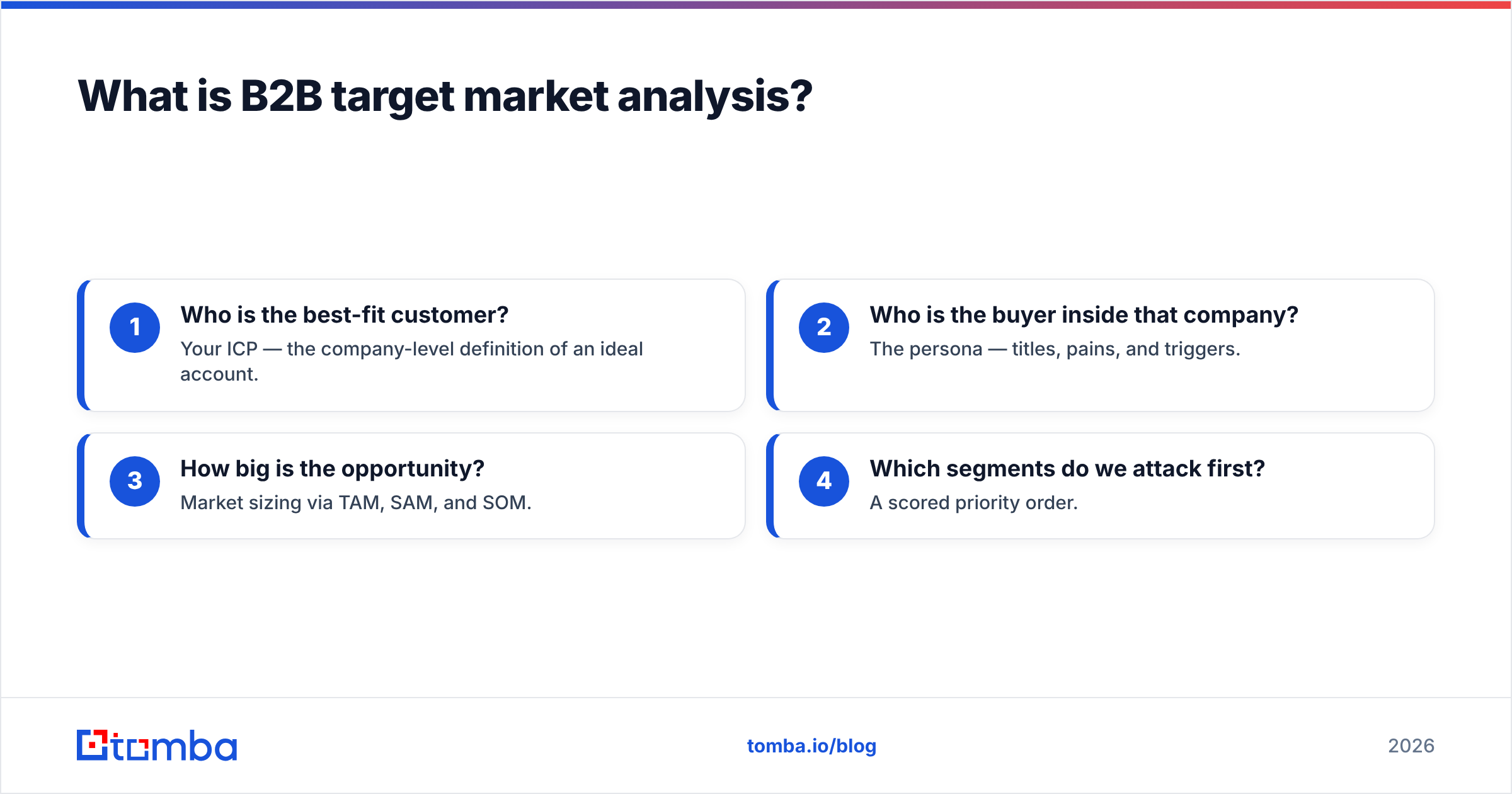
The analysis answers four questions in order:
- Who is the best-fit customer? Your ICP — the company-level definition of an ideal account.
- Who is the buyer inside that company? The persona — titles, pains, and triggers.
- How big is the opportunity? Market sizing via TAM, SAM, and SOM.
- Which segments do we attack first? A scored priority order.
Skip any one of these and the others wobble. A perfect ICP with no sizing leaves you blind to ceiling risk. Great sizing with no persona leaves reps emailing the wrong job titles.
Why does target market analysis matter in 2026?#
Because list quality, not list size, now decides who hits quota. Inbox providers got stricter, buyers got more skeptical, and a generic blast to 50,000 unscreened contacts burns your domain reputation faster than it books meetings.
A focused analysis pays off in three measurable ways:
- Higher reply rates. Relevance drives replies. A message that names a buyer's real pain outperforms a templated blast many times over.
- Lower cost per opportunity. You stop paying — in credits, in rep hours, in sender reputation — to reach accounts that were never going to buy.
- Faster cycles. Well-qualified accounts move through the funnel with less friction because the fit was real from the first touch.
Gartner's research on the B2B buying journey shows buyers spend only a sliver of their time with any single vendor's sales reps, so the few touches you get must land on the right accounts with the right message. Target market analysis is how you earn those touches.
How do you build a B2B Ideal Customer Profile (ICP)?#
Build your ICP from evidence, not aspiration. The single biggest mistake is writing an ICP that describes the customer you wish you had instead of the one who actually renews, expands, and refers.
Work in this order:
- Pull your best 20–30 closed-won accounts. Filter for short sales cycles, high retention, and healthy margins — not just logo size.
- Find the shared firmographics. Industry, employee count, revenue band, geography, business model (B2B vs B2C).
- Layer technographics. What CRM, cloud, or category tools do they run? A website tech stack checker surfaces this quickly.
- Add trigger signals. Recent funding, leadership hires, expansion, or a job posting that implies your pain.
- Write the negative profile too. Document who is a bad fit. This is what keeps reps from chasing shiny-but-doomed deals.
Validate the draft ICP against closed-lost and churned accounts. If your "ideal" attributes also describe the customers who left, those attributes aren't predictive — they're noise.
What's the difference between an ICP and a buyer persona?#
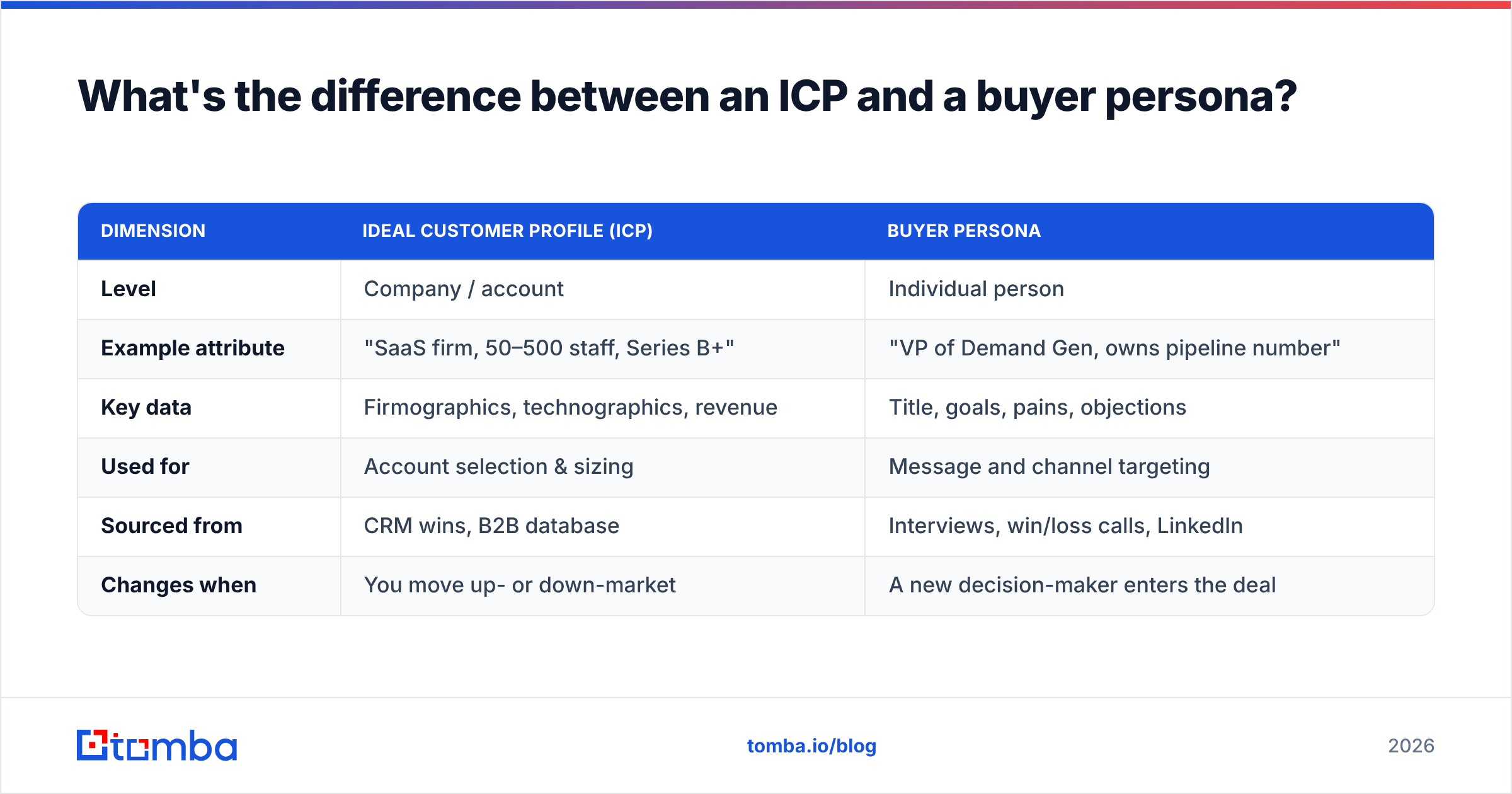
The ICP describes the company; the persona describes the human. You need both, and confusing them is why outreach misfires.
| Dimension | Ideal Customer Profile (ICP) | Buyer Persona |
|---|---|---|
| Level | Company / account | Individual person |
| Example attribute | "SaaS firm, 50–500 staff, Series B+" | "VP of Demand Gen, owns pipeline number" |
| Key data | Firmographics, technographics, revenue | Title, goals, pains, objections |
| Used for | Account selection & sizing | Message and channel targeting |
| Sourced from | CRM wins, B2B database | Interviews, win/loss calls, LinkedIn |
| Changes when | You move up- or down-market | A new decision-maker enters the deal |
A practical rule: the ICP gets the account onto your list; the persona decides what you say and who you say it to once it's there. Most enterprise deals involve a buying group of several stakeholders, so plan for multiple personas per ICP account — economic buyer, champion, and technical evaluator at minimum.
How do you size your B2B market (TAM, SAM, SOM)?#
Size the market in three nested layers so you know both the ceiling and the realistic near-term target.
- TAM (Total Addressable Market): every company that could conceivably use your product. The whole lake.
- SAM (Serviceable Available Market): the slice of TAM your product, pricing, and geography can actually serve. The part of the lake you're licensed to fish.
- SOM (Serviceable Obtainable Market): the share of SAM you can realistically win in the next 12–18 months given your team and budget. The fish you'll actually land this season.
Use bottom-up sizing wherever possible. Top-down ("1% of a $40B market") is easy to fabricate and easy for a CFO to dismiss. Bottom-up multiplies a real count of target accounts by your average contract value:
SOM = (# of accounts matching ICP in your territory)
      × (realistic win rate)
      × (average annual contract value)
To get that account count credibly, you need an actual list of companies matching your ICP — which is where a domain search and enrichment come in. Counting from a real, filterable database beats guessing from an analyst report.
How do you segment and prioritize the market?#
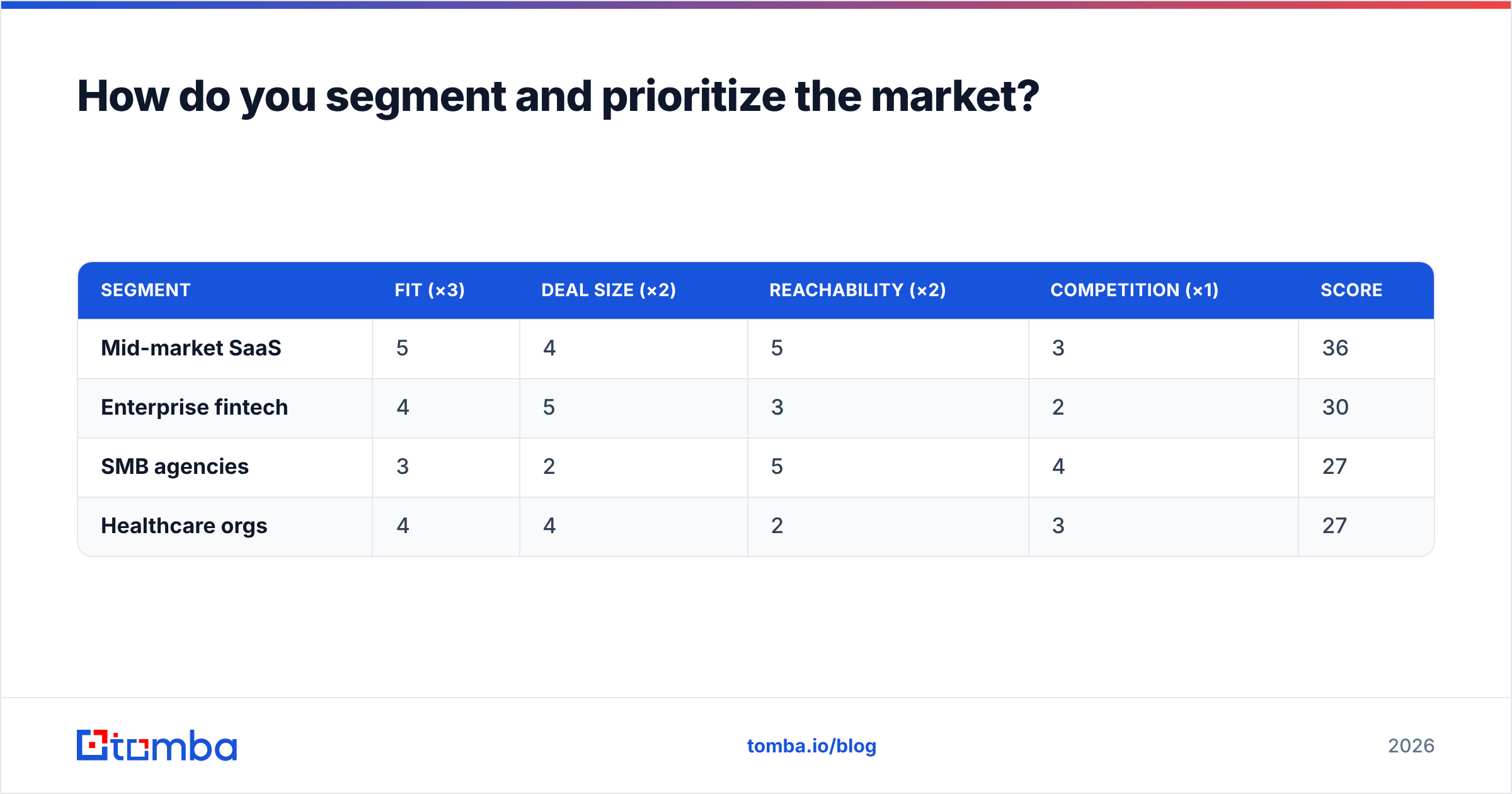
Score each candidate segment on two axes — fit (how well they match your ICP) and reachability (how easily you can find and contact the buyer) — then sequence your effort from the top.
A simple weighted model works well. Rate each segment 1–5 on the criteria below, weight them, and rank:
| Segment | Fit (×3) | Deal size (×2) | Reachability (×2) | Competition (×1) | Score |
|---|---|---|---|---|---|
| Mid-market SaaS | 5 | 4 | 5 | 3 | 36 |
| Enterprise fintech | 4 | 5 | 3 | 2 | 30 |
| SMB agencies | 3 | 2 | 5 | 4 | 27 |
| Healthcare orgs | 4 | 4 | 2 | 3 | 27 |
The highest score is your beachhead — the segment you concentrate on until you own it, before expanding. "Reachability" deserves real weight here: a segment can be a perfect fit on paper and still be a poor first target if the buyers are unlisted, gatekept, or scattered across catch-all domains you can't verify. Run sample lookups before you commit a quarter to a segment.
Which tools do you need for the analysis?#
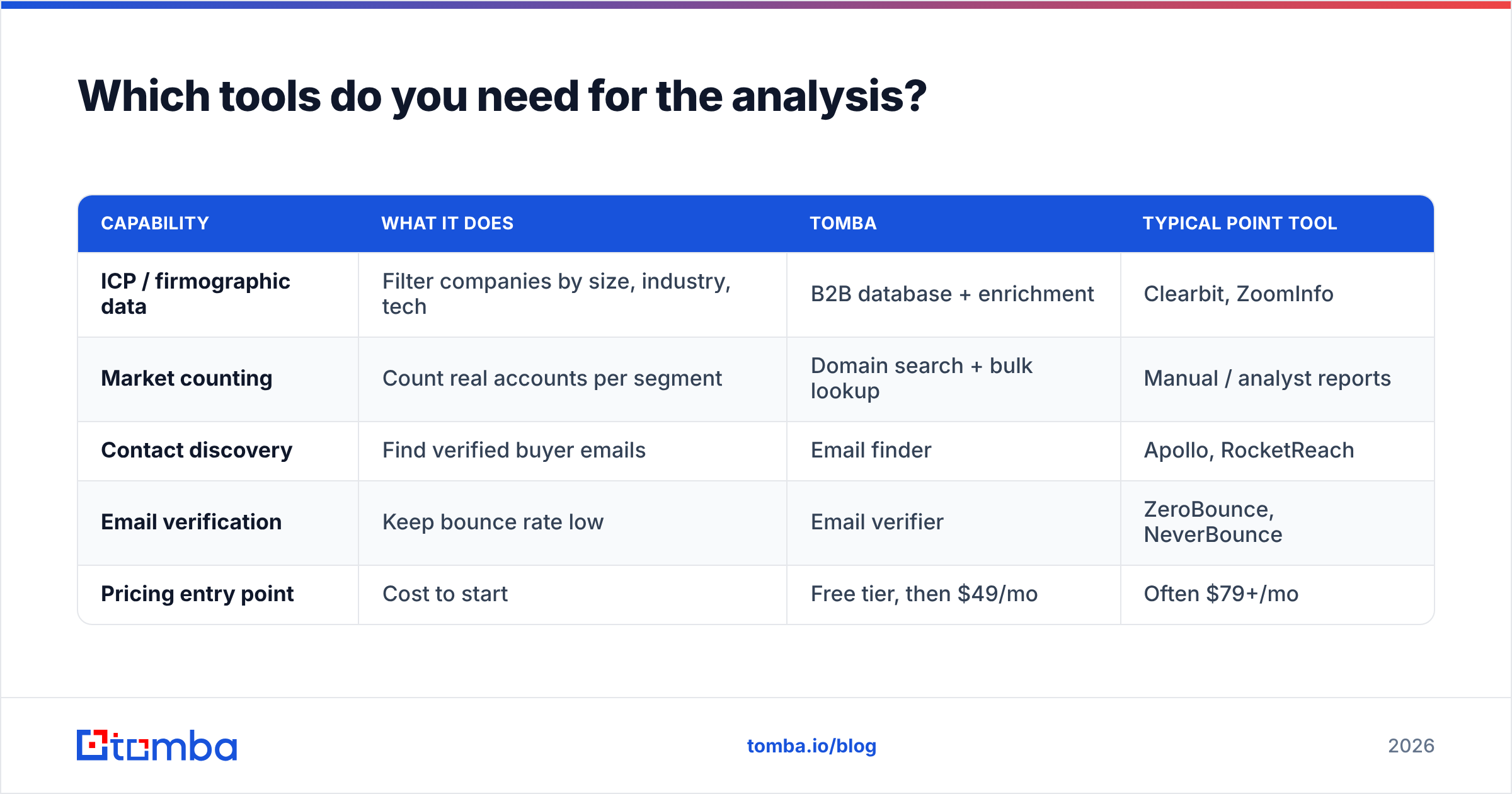
You need three capability layers: data to define the market, sizing to scope it, and contact discovery to act on it. Many platforms cover one layer well and leave you stitching the rest together.
| Capability | What it does | Tomba | Typical point tool |
|---|---|---|---|
| ICP / firmographic data | Filter companies by size, industry, tech | B2B database + enrichment | Clearbit, ZoomInfo |
| Market counting | Count real accounts per segment | Domain search + bulk lookup | Manual / analyst reports |
| Contact discovery | Find verified buyer emails | Email finder | Apollo, RocketReach |
| Email verification | Keep bounce rate low | Email verifier | ZeroBounce, NeverBounce |
| Pricing entry point | Cost to start | Free tier, then $49/mo | Often $79+/mo |
Tomba's starter plan runs $49/mo with a free tier of 25 searches to test fit before you commit — see full Tomba pricing for the Growth ($99/mo) and Pro ($249/mo) tiers. The point isn't that one vendor wins every category; it's that consolidating data, counting, and contact discovery in one workflow removes the export-import friction that kills most analyses before they reach a rep's screen.
For broader vendor research, cross-check categories on G2 and read methodology notes on HubSpot's market research resources — both are solid neutral starting points before you trust any single tool's data claims.
How do you turn the analysis into pipeline?#
Convert the scored segments into a working list, then verify it before anyone hits send. This is the step that separates a strategy deck from revenue.
- Export the target accounts for your top one or two segments from your ICP filters.
- Find the buyers. Use a domain search to pull contacts by role at each account, then narrow to your persona titles.
- Verify every email. Run the list through an email verifier so invalid and risky addresses never touch your sending domain.
- Enrich for personalization. Pull the firmographic and trigger data each rep needs to write a relevant first line.
- Set a feedback loop. Track reply and win rates by segment, then feed the winners back into the ICP. Target market analysis is a living model, not a one-time project.
A quick honesty check: if your bounce rate climbs above the low single digits, your list-building outran your verification. Slow down and clean before you scale.
Common mistakes to avoid#
- Aspirational ICPs. Defining the market you want instead of the one your data shows. Validate against churned accounts.
- Top-down-only sizing. "We'll get 1% of a huge market" is a guess, not a plan. Count real accounts.
- No negative profile. Without a clear "who we don't sell to," reps waste cycles on bad-fit deals.
- Analysis with no contact layer. A flawless segment you can't reach is a hobby, not a pipeline.
- Set-and-forget. Markets shift. Re-run the analysis at least twice a year, or whenever you change pricing or move market tiers.
Frequently asked questions#
How often should I redo my target market analysis? Revisit the ICP and segment scores every two quarters, and immediately after any pricing change, product launch, or move up- or down-market.
What's the minimum data I need to start? Your last 20–30 closed-won accounts and their firmographics. That's enough to draft a v1 ICP you can refine with enrichment data.
Can a small team do this without expensive data subscriptions? Yes. Start on a free or starter tier, validate your ICP on a small segment, and scale spend only once reply and win rates prove the fit.
Put your analysis to work#
A target market analysis is only as good as the list it produces. Once you've defined your ICP, sized your segments, and picked your beachhead, the Tomba Email Finder turns that definition into verified, contactable buyers — find professional emails by domain, name, or company, verify them in the same workflow, and hand reps a clean list instead of a slide deck. Start free with 25 searches, then scale on the $49/mo Starter plan when the segment proves out. Define the market, then go win it.
// get started
Find, verify and enrich your first contacts today
Start on the free plan with 25 searches a month, then scale when your team is ready.
Free plan · No credit card required · GDPR & CCPA
// about the author