BDR Cold Call Script: Templates That Book Meetings (2026)
A proven BDR cold call script framework for 2026 — opener, value prop, objection handling, and close, plus templates you can steal and adapt today.
(title rendered separately)
Cold calling is not dead — bad cold calling is. The difference between a BDR who books three meetings a day and one who gets hung up on forty times in a row almost always comes down to two things: the quality of the list and the structure of the script. This guide gives you both, with a full BDR cold call script you can copy, adapt, and start dialing today.
TL;DR#
- A high-performing BDR cold call script has five parts: opener, permission, value hook, discovery, and a clear ask for the meeting.
- Lead with a pattern interrupt and earn 30 seconds before you pitch — never open with "How are you today?"
- Objections are signals, not stop signs. Prepare two-line rebuttals for the four you hear most: "not interested," "send me an email," "no budget," and "we already use someone."
- Your script is only as good as your data. Wrong numbers and dead contacts kill connect rates faster than any wording mistake.
- Track talk-to-meeting ratio per script version and iterate weekly. Small opener tweaks move booking rates more than rewriting the whole call.
What makes a BDR cold call script actually work?#
The best cold call script wins back time, not just words. Think of it like a recipe a line cook follows during a dinner rush: it is not there to make you sound robotic, it is there so you never freeze when a prospect throws you a curveball. You internalize the structure, then improvise the seasoning.
A working BDR cold call script does three jobs at once. It respects the prospect's time, it makes the relevance obvious in the first 10 seconds, and it moves toward one outcome — a booked meeting. Everything that does not serve those three jobs is filler, and filler is where prospects hang up.
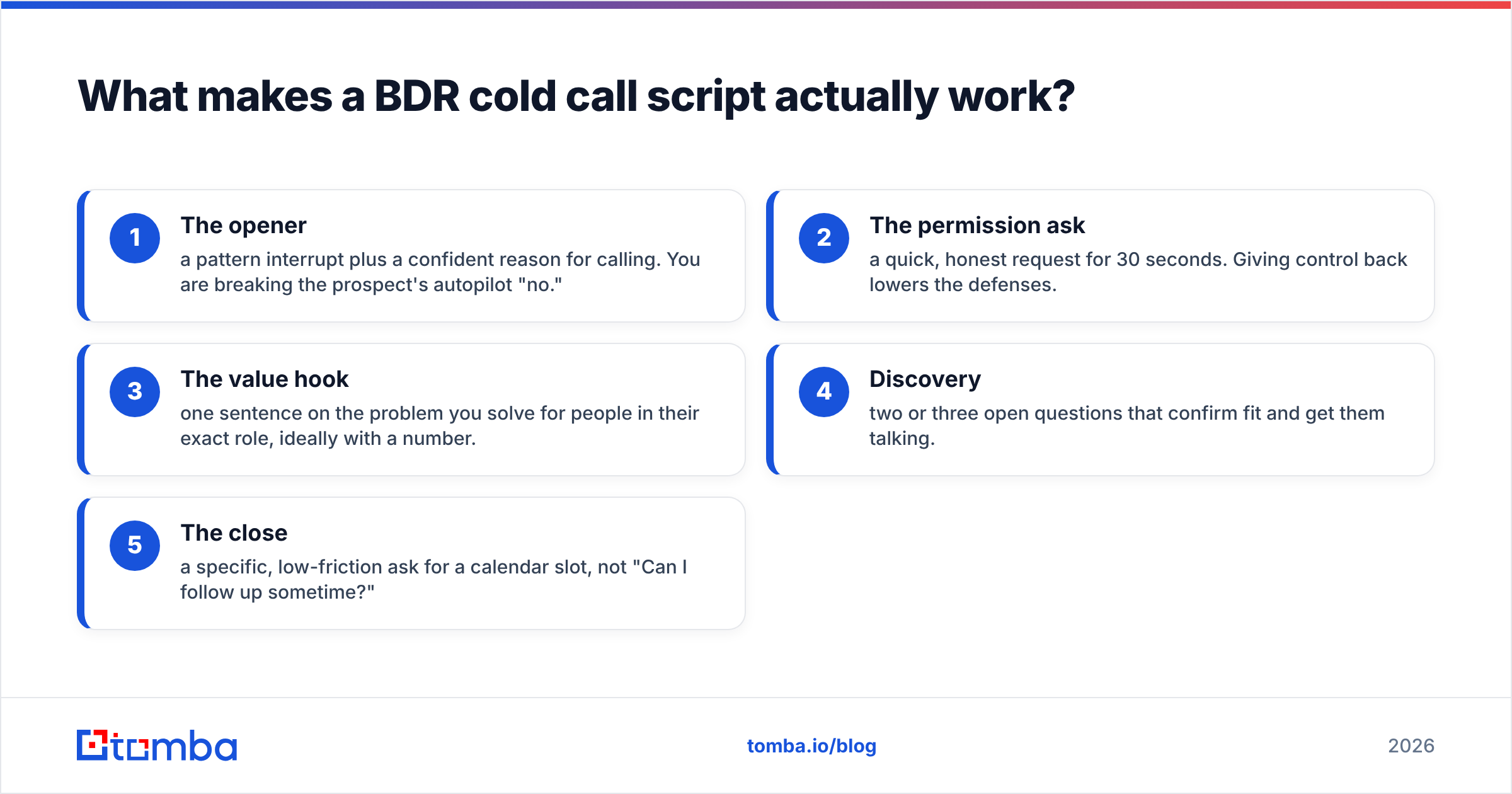
Here is the five-part anatomy every strong script follows:
- The opener — a pattern interrupt plus a confident reason for calling. You are breaking the prospect's autopilot "no."
- The permission ask — a quick, honest request for 30 seconds. Giving control back lowers the defenses.
- The value hook — one sentence on the problem you solve for people in their exact role, ideally with a number.
- Discovery — two or three open questions that confirm fit and get them talking.
- The close — a specific, low-friction ask for a calendar slot, not "Can I follow up sometime?"
)
Notice what is missing: no monologue, no feature dump, no "I just wanted to reach out." The script is a frame, and inside that frame you stay human.
What is the best cold call opener for a BDR?#
Earn the next 30 seconds — that is the only job of your opener. You are not selling the product in line one; you are selling the right to keep talking.
The strongest pattern in 2026 is the permission-based opener. It sounds like this:
"Hi Sarah, this is Alex from Tomba. I know I'm an interruption to your day — can I take 30 seconds to tell you why I called, and you can decide if it's worth continuing?"
Almost nobody says no to that, because you named the elephant (you are a cold caller) and handed them control. Compare that to the openers that get you hung up on instantly: "How are you today?" telegraphs a pitch, and "Did I catch you at a bad time?" gives an easy exit.
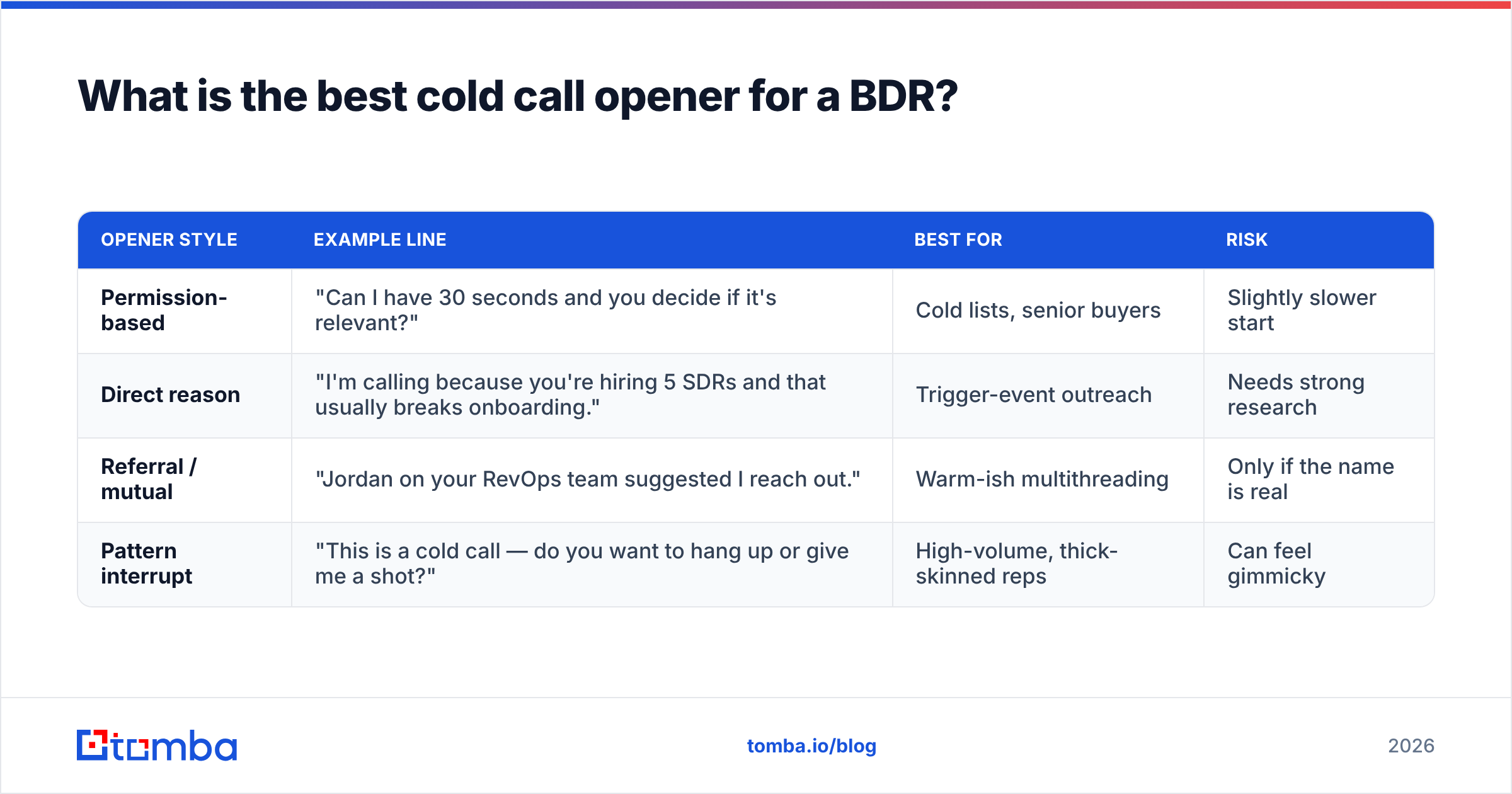
Here are three opener styles BDRs use, with the tradeoffs:
| Opener style | Example line | Best for | Risk |
|---|---|---|---|
| Permission-based | "Can I have 30 seconds and you decide if it's relevant?" | Cold lists, senior buyers | Slightly slower start |
| Direct reason | "I'm calling because you're hiring 5 SDRs and that usually breaks onboarding." | Trigger-event outreach | Needs strong research |
| Referral / mutual | "Jordan on your RevOps team suggested I reach out." | Warm-ish multithreading | Only if the name is real |
| Pattern interrupt | "This is a cold call — do you want to hang up or give me a shot?" | High-volume, thick-skinned reps | Can feel gimmicky |
Whatever you choose, deliver it with a calm, slightly slower pace. Rushing signals nervousness, and nervousness signals "this person will waste my time."
How do you structure the value hook?#
State the problem before the product. A prospect does not care that your platform has "AI-powered enrichment." They care that their reps waste two hours a day chasing bad contact data.
Use the format: role + problem + proof point. For example:
"Most BDR teams I talk to are dialing lists where 1 in 4 numbers is wrong, so reps burn the morning on dead air instead of conversations. We usually get connect rates back up within the first week."
That single sentence does the heavy lifting. It signals you understand their world, it quantifies the pain, and it implies a result without overpromising. Keep your hook under 15 seconds. If you have to take a breath in the middle, it is too long.
This is also where data quality quietly decides your fate. You can have a flawless hook, but if you are dialing a disconnected line or the prospect left the company eight months ago, the script never gets a chance. That is why top teams pair their scripts with a clean source of B2B phone numbers and verified contacts before a single dial — the call only matters if a real human picks up.
How do you handle the four most common cold call objections?#
Treat objections as requests for more information, not rejections. Most are reflexes — the prospect is busy and "not interested" is the fastest way off the phone. Your job is to stay calm, acknowledge, and reframe in two lines.
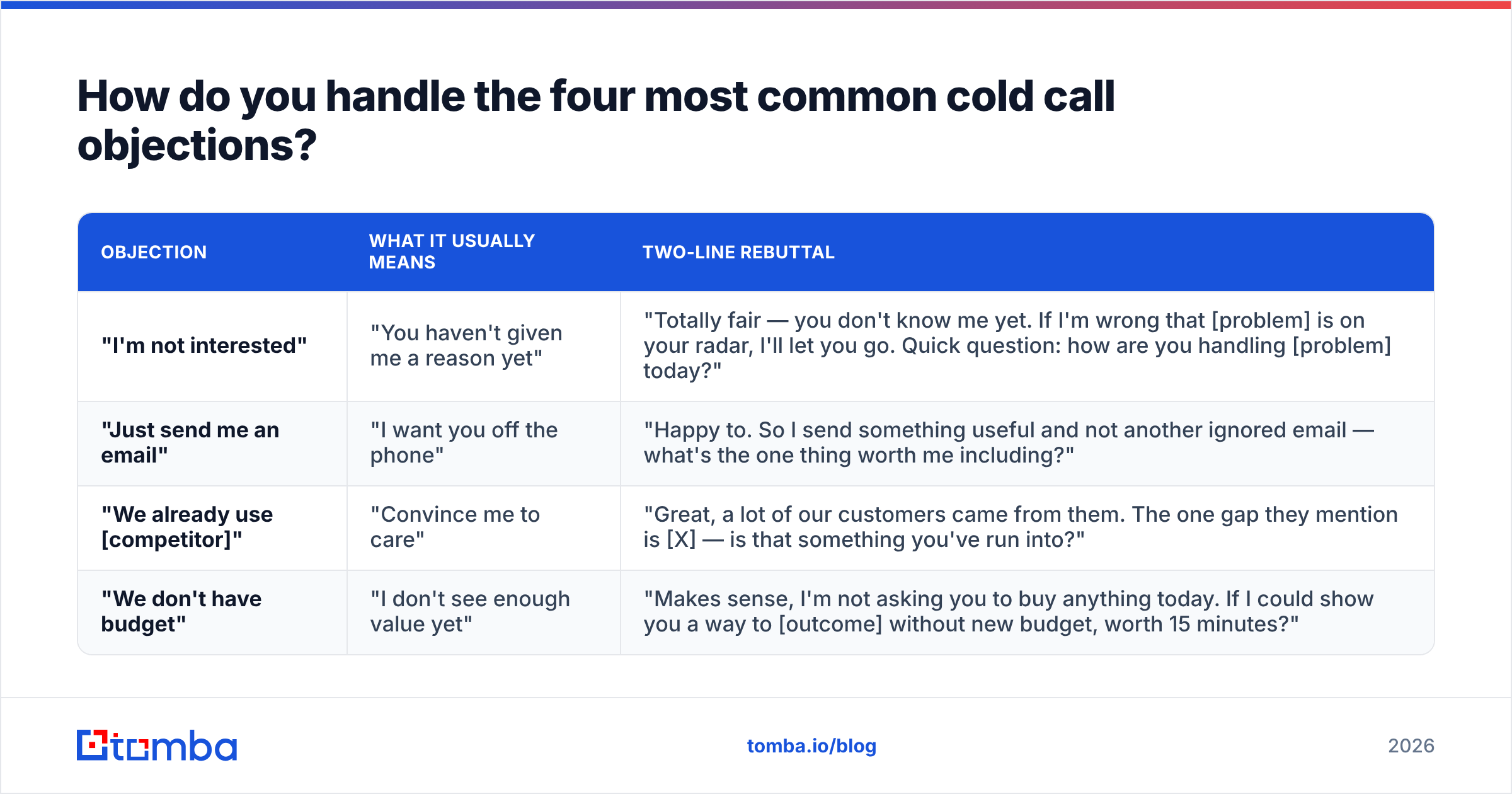
Here is a rebuttal table you can tape to your monitor:
| Objection | What it usually means | Two-line rebuttal |
|---|---|---|
| "I'm not interested" | "You haven't given me a reason yet" | "Totally fair — you don't know me yet. If I'm wrong that [problem] is on your radar, I'll let you go. Quick question: how are you handling [problem] today?" |
| "Just send me an email" | "I want you off the phone" | "Happy to. So I send something useful and not another ignored email — what's the one thing worth me including?" |
| "We already use [competitor]" | "Convince me to care" | "Great, a lot of our customers came from them. The one gap they mention is [X] — is that something you've run into?" |
| "We don't have budget" | "I don't see enough value yet" | "Makes sense, I'm not asking you to buy anything today. If I could show you a way to [outcome] without new budget, worth 15 minutes?" |
The pattern is always the same: acknowledge ("fair," "makes sense"), do not argue, then ask a question that pulls them back into the conversation. Never let an objection end on your statement — end on their answer.
)
One more rule: get through two objections, then ask for the meeting anyway. Persistence inside a respectful frame is what separates booked calendars from "I'll try back next quarter."
What does a full BDR cold call script look like?#
Below is a complete, copy-ready script. Read it out loud, then rewrite it in your own voice — a script you cannot say naturally is worse than no script.
Opener (permission-based):
"Hi [Name], this is [You] from [Company]. I'll be honest, this is a cold call — can I have 30 seconds to explain why, and you can tell me to get lost after?"
Value hook (role + problem + proof):
"I work with [titles] at [company type], and the pattern I keep seeing is [specific problem with a number]. We usually help fix that in [timeframe]. Is that something on your plate right now?"
Discovery (pick two):
"How are you handling [problem] today?"
"What happens when [pain] hits — who feels it first?"
"If you could wave a wand and fix one thing about [area], what would it be?"
The close (specific ask):
"Based on what you said, it's worth a proper 15 minutes — not a pitch, just to see if this fits. Do you have Thursday at 10, or is Friday morning better?"
Notice the close offers two specific times, not "when works for you?" Constrained choices book more meetings than open invitations because they remove the work of picking.
For phone-heavy teams, see our deeper playbook on building a cold calling and phone sales cadence, and if email is part of your sequence, the same discipline applies to your cold email templates — structure first, personalization second.
How do you measure and improve a cold call script?#
Track talk-to-meeting ratio per script version, then change one variable at a time. If you rewrite the opener, the hook, and the close all at once, you will never know which change moved the number.
Watch these four metrics weekly:
- Connect rate — are you reaching live humans? If this is low, the problem is your list and your dialing windows, not your words.
- Pitch rate — what percentage of connects let you get past the opener? This grades your opener directly.
- Conversation rate — how many turn into a real two-way exchange? This grades your hook and discovery.
- Meeting rate — booked calendar slots per connect. This is the only number leadership remembers.
According to widely cited research from groups like Gong and HubSpot, successful cold calls tend to run longer and feature more prospect talk-time than failed ones — proof that discovery questions, not monologues, win meetings. Use call recordings to spot where prospects drop off, and A/B two opener variants over a 100-dial sample before you commit.
If your connect rate is the bottleneck, the fix is upstream of the script entirely. Refreshing your list with verified mobile and direct numbers — using a phone finder and pairing it with accurate data enrichment — will lift more booked meetings than any opener rewrite. You can also reach decision-makers by email first using an email finder to multithread the account before you ever pick up the phone.
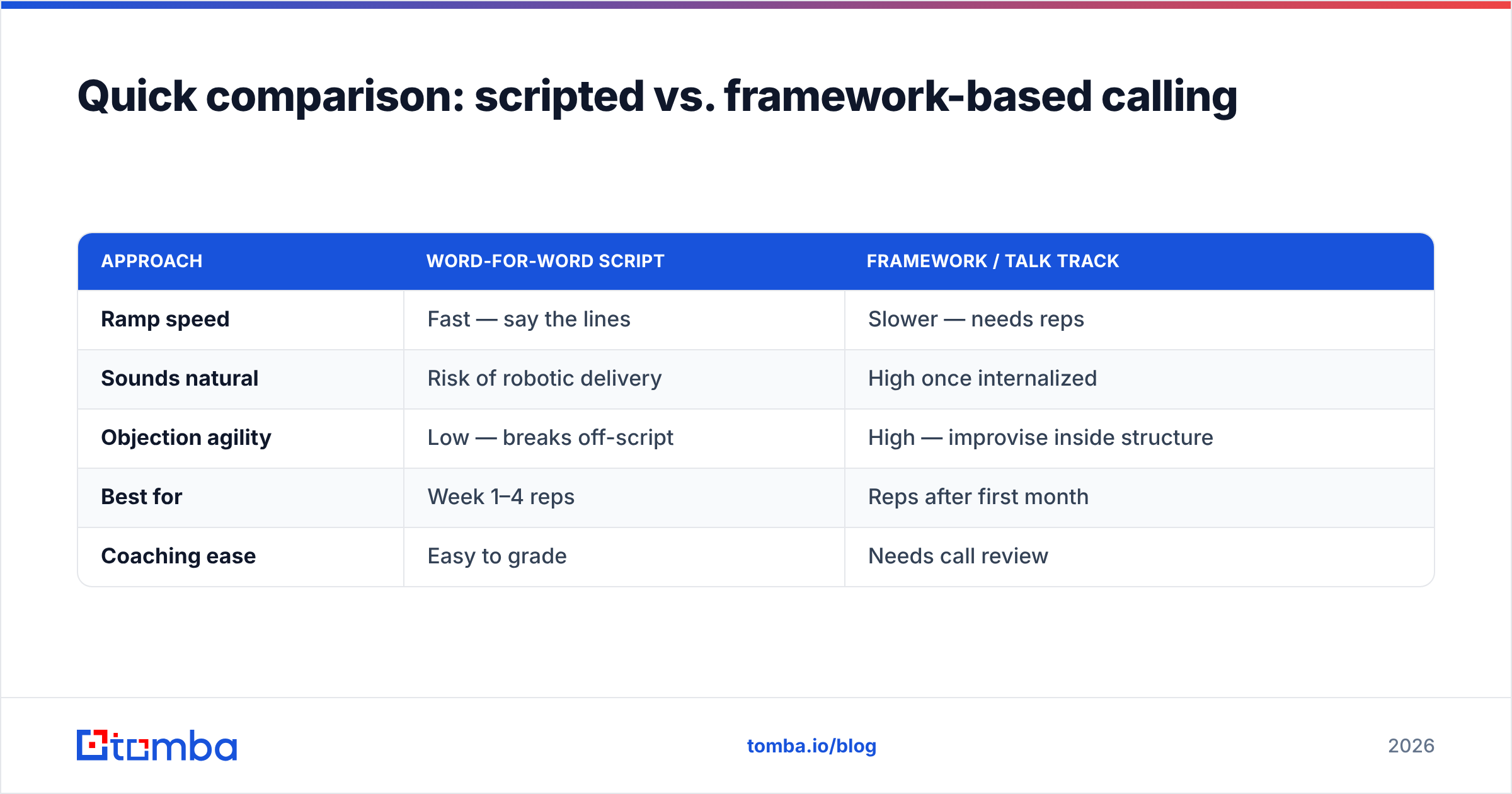
Quick comparison: scripted vs. framework-based calling#
New reps often ask whether to memorize a word-for-word script or learn a flexible framework. The honest answer depends on tenure.
| Approach | Word-for-word script | Framework / talk track |
|---|---|---|
| Ramp speed | Fast — say the lines | Slower — needs reps |
| Sounds natural | Risk of robotic delivery | High once internalized |
| Objection agility | Low — breaks off-script | High — improvise inside structure |
| Best for | Week 1–4 reps | Reps after first month |
| Coaching ease | Easy to grade | Needs call review |
Start new BDRs on a tight script for the first month so they build confidence and muscle memory, then graduate them to the framework so they can adapt in real time. The goal is not to escape the script — it is to outgrow needing to read it.
Common mistakes that kill cold call scripts#
Even a great script fails when reps fall into these traps:
- Pitching before earning attention. If you launch into features in line two, you have lost. Earn the 30 seconds first.
- Talking past the close. Once they say yes to a meeting, stop selling and book the time. Reps talk themselves out of more meetings than they realize.
- Reading without listening. A script you recite while ignoring the prospect's tone is worse than silence. Match their pace.
- Dialing bad data. No script survives a wrong number. Clean, verified contacts are the foundation, not an afterthought.
- Never iterating. The script that worked last quarter decays. Review recordings, cut dead lines, and keep what books meetings.
Final word: your script is half the equation#
A strong BDR cold call script gives you structure, confidence, and a repeatable path to the meeting. But the most polished opener in the world means nothing if the person on the other end never picks up — or picks up and turns out to be the wrong contact entirely. Connect rate is won upstream, with accurate phone numbers and verified contacts, long before you dial.
That is where Tomba fits. Use the Tomba Email Finder to build clean, accurate contact lists by company and role, then enrich those records with verified direct numbers so every dial has a real chance of becoming a conversation. Start free with 25 searches a month, and when you are ready to scale your outbound motion, the Starter plan is $49/mo — see full Tomba pricing for team-level volume. Better data, better calls, more meetings on the calendar.
// get started
Find, verify and enrich your first contacts today
Start on the free plan with 25 searches a month, then scale when your team is ready.
Free plan · No credit card required · GDPR & CCPA
// about the author