The Real Benefits of Cold Calling in 2026 (Backed by Data)
Email gets ignored, but a live phone conversation still closes deals. Here are the real benefits of cold calling in 2026 — and how to make every dial count.
Cold calling was supposed to be dead by now. Every year a new "outbound is over" think-piece declares the phone obsolete, and every year the reps hitting quota are the ones still picking it up. The benefits of cold calling haven't disappeared — they've just gotten harder to see under a pile of automated sequences and AI-written emails that all sound the same.
This guide breaks down what cold calling actually delivers in 2026, where it beats email and social, and how to dial in a way that respects both your time and your prospect's.
TL;DR — Why Cold Calling Still Earns Its Place#
- Speed of feedback. A call gives you a yes, no, or "not now" in 90 seconds. Email can take two weeks of follow-ups to tell you nothing.
- Higher-quality conversations. Tone, objections, and real pain surface on a live call in ways no reply-to-thread ever captures.
- It's less crowded than the inbox. Buyers get 100+ cold emails a week and a handful of calls. Scarcity is leverage.
- Better discovery and qualification. You learn budget, timing, and authority in one conversation instead of guessing from open rates.
- Garbage in, garbage out. The single biggest driver of call results is data quality — accurate numbers and verified contacts beat volume every time.
What Are the Real Benefits of Cold Calling?#
The short version: cold calling compresses the sales cycle by replacing assumptions with answers. Everything else is a consequence of that.
Think of email as mailing a letter and cold calling as knocking on the door. The letter is convenient and scalable, but you have no idea if anyone read it, agreed with it, or threw it away. The knock is uncomfortable for ten seconds — and then you're either having a conversation or you're not. There's no ambiguity, no "maybe they'll circle back next quarter."
Here are the concrete benefits that keep the phone in every serious outbound playbook:
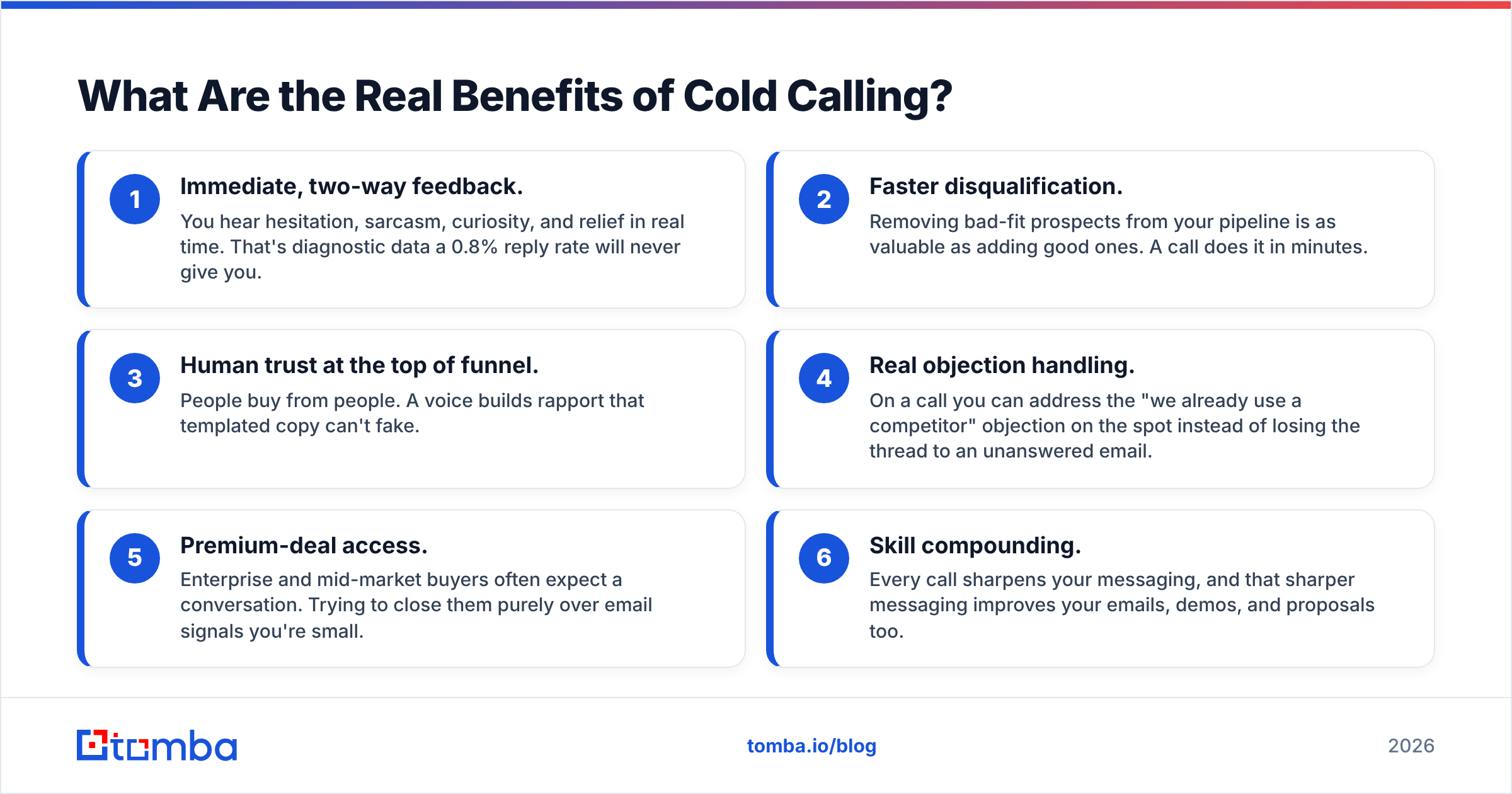
- Immediate, two-way feedback. You hear hesitation, sarcasm, curiosity, and relief in real time. That's diagnostic data a 0.8% reply rate will never give you.
- Faster disqualification. Removing bad-fit prospects from your pipeline is as valuable as adding good ones. A call does it in minutes.
- Human trust at the top of funnel. People buy from people. A voice builds rapport that templated copy can't fake.
- Real objection handling. On a call you can address the "we already use a competitor" objection on the spot instead of losing the thread to an unanswered email.
- Premium-deal access. Enterprise and mid-market buyers often expect a conversation. Trying to close them purely over email signals you're small.
- Skill compounding. Every call sharpens your messaging, and that sharper messaging improves your emails, demos, and proposals too.
Is Cold Calling Better Than Cold Email?#
Neither wins outright — they win together. But they have very different strengths, and pretending one replaces the other is how teams leave pipeline on the table. Cold email scales reach; cold calling converts intent. The smartest outbound motions sequence them so a call follows an opened email, or an email recaps a call.
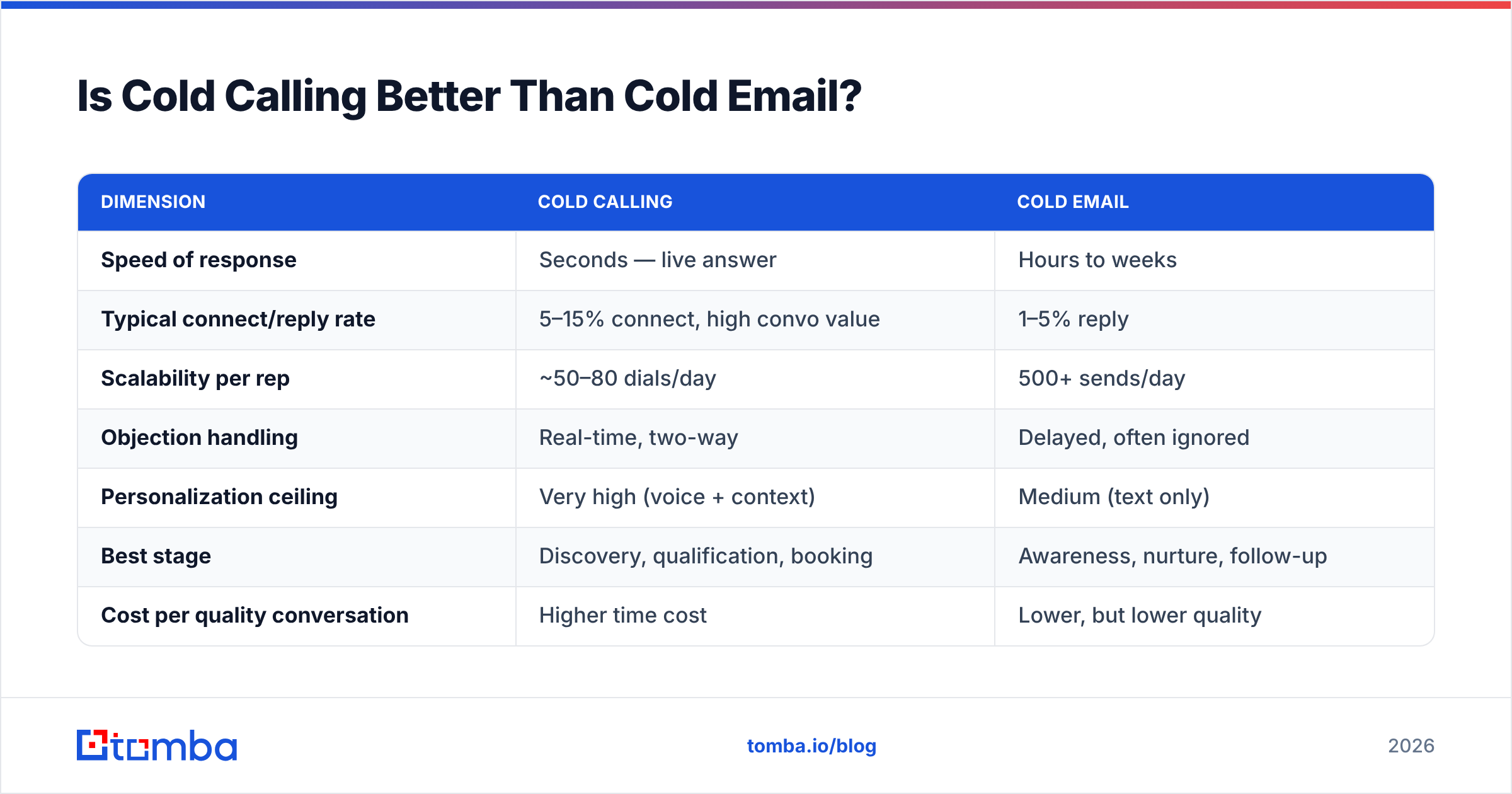
Here's how the two channels stack up on the dimensions that actually affect revenue:
| Dimension | Cold Calling | Cold Email |
|---|---|---|
| Speed of response | Seconds — live answer | Hours to weeks |
| Typical connect/reply rate | 5–15% connect, high convo value | 1–5% reply |
| Scalability per rep | ~50–80 dials/day | 500+ sends/day |
| Objection handling | Real-time, two-way | Delayed, often ignored |
| Personalization ceiling | Very high (voice + context) | Medium (text only) |
| Best stage | Discovery, qualification, booking | Awareness, nurture, follow-up |
| Cost per quality conversation | Higher time cost | Lower, but lower quality |
The pattern most high-performing teams land on: email to warm and earn permission, then call to qualify and book. According to HubSpot's sales research, multi-channel outreach consistently outperforms any single channel — and the phone is the channel that turns a name on a list into a conversation about budget.
Why Does Cold Calling Get a Bad Reputation?#
Cold calling isn't hated because it doesn't work. It's hated because most of it is done badly. Reps blast through unverified lists, read robotic scripts, ignore the prospect's first three words, and pitch before they qualify. That's not cold calling — that's spam with a dial tone.
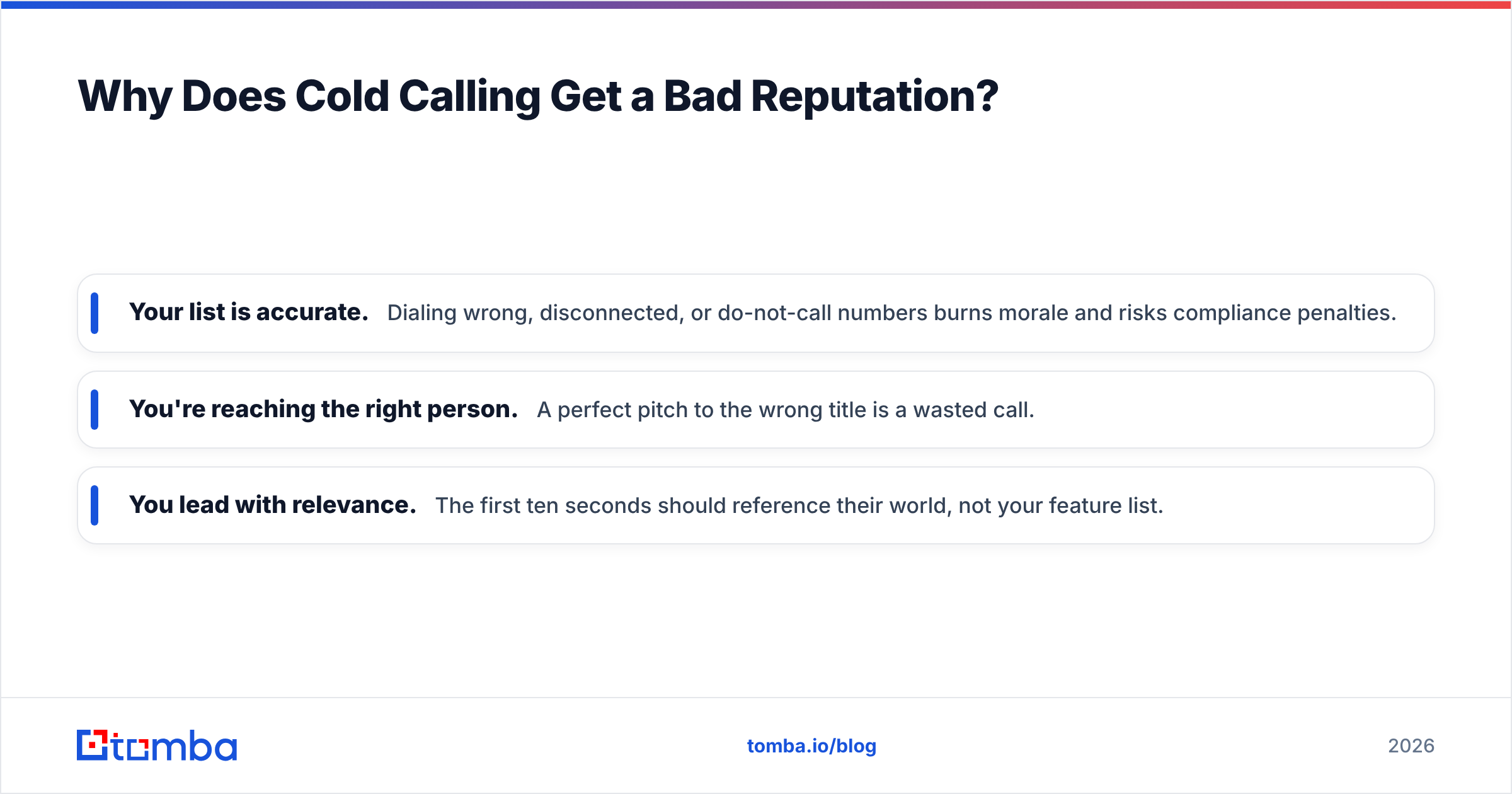
The benefits only show up when three things are true:
- Your list is accurate. Dialing wrong, disconnected, or do-not-call numbers burns morale and risks compliance penalties.
- You're reaching the right person. A perfect pitch to the wrong title is a wasted call.
- You lead with relevance. The first ten seconds should reference their world, not your feature list.
That first point is where most teams quietly bleed productivity. If a third of your numbers are wrong, a third of your day is gone before you say a word. This is exactly why pairing a dialer with reliable contact data matters so much — a verified phone finder and phone validator keep your reps talking to real humans instead of voicemail robots and dead lines.
How Do You Maximize the Benefits of Cold Calling in 2026?#
Treat cold calling as a precision instrument, not a numbers cannon. More dials into bad data just produces more rejection faster. The goal is more conversations per hour, and that starts long before you pick up the phone.
1. Build a clean, verified call list. Start with accurate contact data. Pull direct dials and decision-maker details, then confirm they're current. Combining a phone finder with an email verifier lets you cross-check that the person, company, and contact info all line up before you spend a single minute dialing.
2. Research the trigger, not just the title. A funding round, a new hire, a product launch, or a tech-stack change gives you a reason to call today. Reps who open with a relevant trigger book meetings at multiples of those who open with "How are you today?"
3. Lead with a permission-based opener. "I know I'm calling out of the blue — can I have 30 seconds to tell you why, and you can decide if it's worth continuing?" Respecting their time disarms the reflexive brush-off.
4. Qualify before you pitch. Ask two or three questions that reveal pain, timing, and authority. If they're not a fit, thank them and move on — that's a win, not a loss.
5. Track and improve your response rate. Log connect rates, conversation rates, and meetings booked per 100 dials. The metric tells you whether your problem is the list, the opener, or the offer.
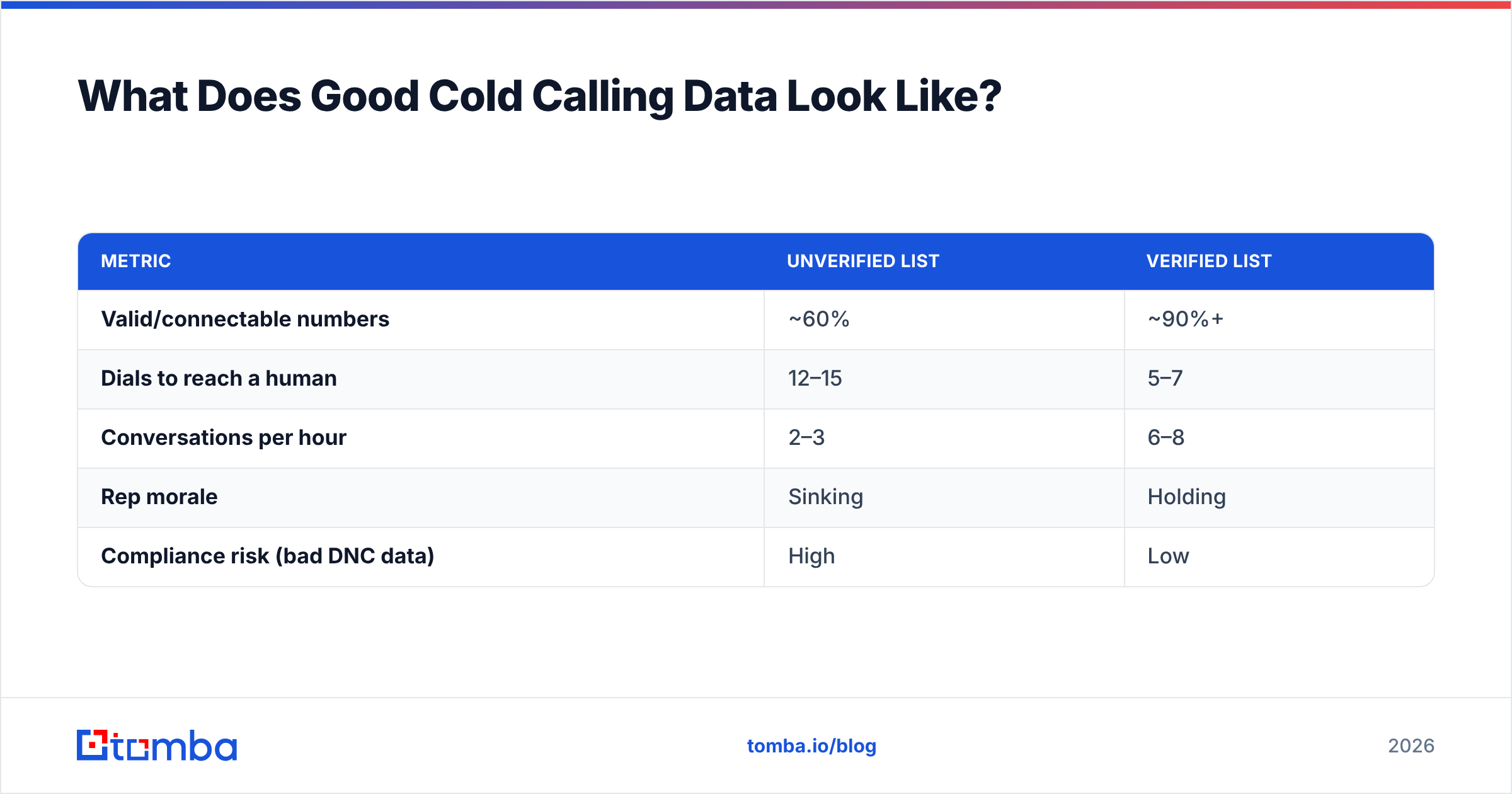
What Does Good Cold Calling Data Look Like?#
Data quality is the multiplier on every other benefit. You can have a world-class opener and a perfect product, but if the number rings out to a fax machine from 2014, none of it matters. Reviews on G2 consistently show that sales-intelligence tools live or die on accuracy, not feature count.
Here's a simple before-and-after of what cleaning your list does to a typical SDR's day:
| Metric | Unverified List | Verified List |
|---|---|---|
| Valid/connectable numbers | ~60% | ~90%+ |
| Dials to reach a human | 12–15 | 5–7 |
| Conversations per hour | 2–3 | 6–8 |
| Rep morale | Sinking | Holding |
| Compliance risk (bad DNC data) | High | Low |
The math is brutal in the best way: cutting your wasted dials roughly doubles your live conversations without adding a single hour to the day. That's the difference between a team that dreads the phone and one that books meetings on it.
If you're running outbound at scale, layering data enrichment on top of your finder fills in titles, company size, and direct lines so your reps prioritize the accounts most likely to convert. Garbage lists make cold calling feel like punishment. Clean lists make it feel like a skill.
When Should You Pick Up the Phone Instead of Sending an Email?#
Reach for the phone when the cost of being slow is high or the deal is big enough to deserve a human. Specifically:
- High-intent triggers — a demo request went cold, a trial is expiring, or a champion just changed jobs.
- Enterprise and mid-market accounts where a single deal justifies the time investment.
- Complex products that are easier to explain in two minutes of conversation than in five paragraphs of text.
- Stalled deals where email threads have gone silent and you need a real answer.
- Re-engagement of closed-lost opportunities, where a warm voice outperforms another ignored sequence.
Send the email instead when you're nurturing a large top-of-funnel list, sharing collateral, or following up to document what was said on a call. The two channels aren't rivals — they're a relay team. Salesforce's own sales playbooks describe the same cadence: orchestrate channels around buyer behavior rather than betting everything on one.
Does Cold Calling Still Have a Future?#
Yes — arguably a stronger one than five years ago. As inboxes drown in AI-generated email and deliverability tightens, the relative value of a real conversation goes up, not down. When everyone automates the easy channel, the harder channel becomes the differentiator. The reps who can hold a confident, relevant, human conversation will keep winning the deals that automation alone can't close.
The future of cold calling isn't more dials. It's better-targeted dials backed by accurate data, sharper triggers, and reps who treat each call as a conversation rather than a recitation. The phone rewards preparation, and preparation starts with knowing exactly who you're calling and why.
The Bottom Line#
The benefits of cold calling — speed, signal, trust, and qualification — are real and durable, but they only show up when your data is clean and your approach is human. Volume into bad lists is the fastest way to convince a team that "cold calling doesn't work." Verified contacts, smart triggers, and respectful openers are how you prove it still does.
Want every dial to land on a real decision-maker instead of a dead line? Start with better data. Use the Tomba Email Finder to identify the right contacts, pair it with the phone finder and phone validator to confirm their direct numbers, and check the Tomba pricing plans — starting free with 25 searches a month, then $49/mo Starter when you're ready to scale. Dial smarter, talk to more humans, and let cold calling do what it's always done best: turn strangers into pipeline.
// get started
Find, verify and enrich your first contacts today
Start on the free plan with 25 searches a month, then scale when your team is ready.
Free plan · No credit card required · GDPR & CCPA
Get the Tomba newsletter
Product and data updates
// about the author