Benefits of Outbound Sales: Why It Still Wins in 2026
Inbound fills the funnel slowly. Outbound lets you pick the accounts, control the timing, and book pipeline this quarter. Here are the real benefits of outbound sales in 2026.
Outbound sales is the practice of starting the conversation yourself — reaching out to specific companies and people who fit your ideal customer profile, instead of waiting for them to find you. In 2026, with inbound channels crowded and ad costs climbing, the benefits of outbound sales come down to one thing: control. You decide who to talk to, when, and what to say.
TL;DR#
- Predictable pipeline. Outbound is a math problem you can tune — activity in, meetings out — so you can forecast and scale revenue on purpose, not by luck.
- You pick the accounts. Instead of taking whatever inbound sends you, you target the exact companies and titles that close fastest and pay the most.
- Faster market feedback. Talk to 50 buyers this week and you learn what messaging, pricing, and pain points land — far quicker than waiting for content to rank.
- Lower cost per opportunity at scale. Once your motion works, each rep produces a repeatable number without buying more ads.
- It compounds with inbound. Outbound warms accounts that later convert through marketing, lifting your whole funnel.
What is outbound sales, exactly?#
Outbound sales is seller-initiated revenue. A rep (or an automated sequence) identifies a target account, finds the right contact, and reaches out cold — by email, phone, LinkedIn, or all three — to start a buying conversation. The opposite is inbound, where a prospect raises their hand first by downloading content, requesting a demo, or filling out a form.
Think of inbound like fishing with a net you've left in the water: you catch whatever swims in, on its schedule. Outbound is spearfishing — you choose the fish, aim, and go get it. Both feed you, but only one lets you decide tonight's dinner.
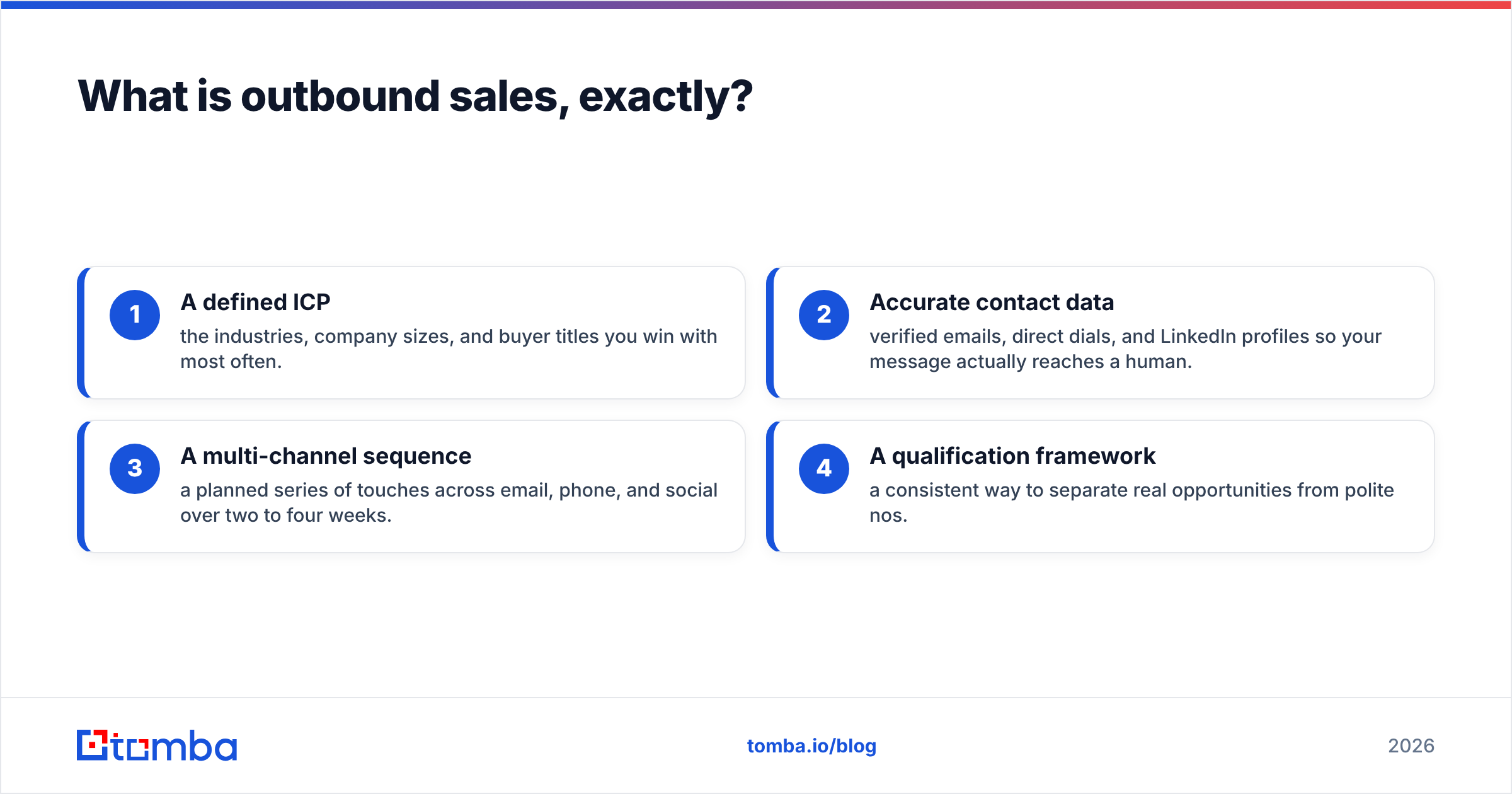
A modern outbound motion has four moving parts:
- A defined ICP — the industries, company sizes, and buyer titles you win with most often.
- Accurate contact data — verified emails, direct dials, and LinkedIn profiles so your message actually reaches a human.
- A multi-channel sequence — a planned series of touches across email, phone, and social over two to four weeks.
- A qualification framework — a consistent way to separate real opportunities from polite nos.
Miss any one of those and the motion leaks. The data layer is where most teams bleed the most, which is why a reliable email finder and email verifier sit at the center of any serious outbound stack.
What are the main benefits of outbound sales?#
The headline benefit is predictability. Inbound depends on factors you don't fully control: search rankings, ad auctions, referral timing. Outbound is a controllable input-output system. If 100 well-targeted emails reliably produce 3 meetings and 1 closed deal, then you know exactly what 1,000 emails — or ten reps — will produce. That turns revenue from a hope into a plan.
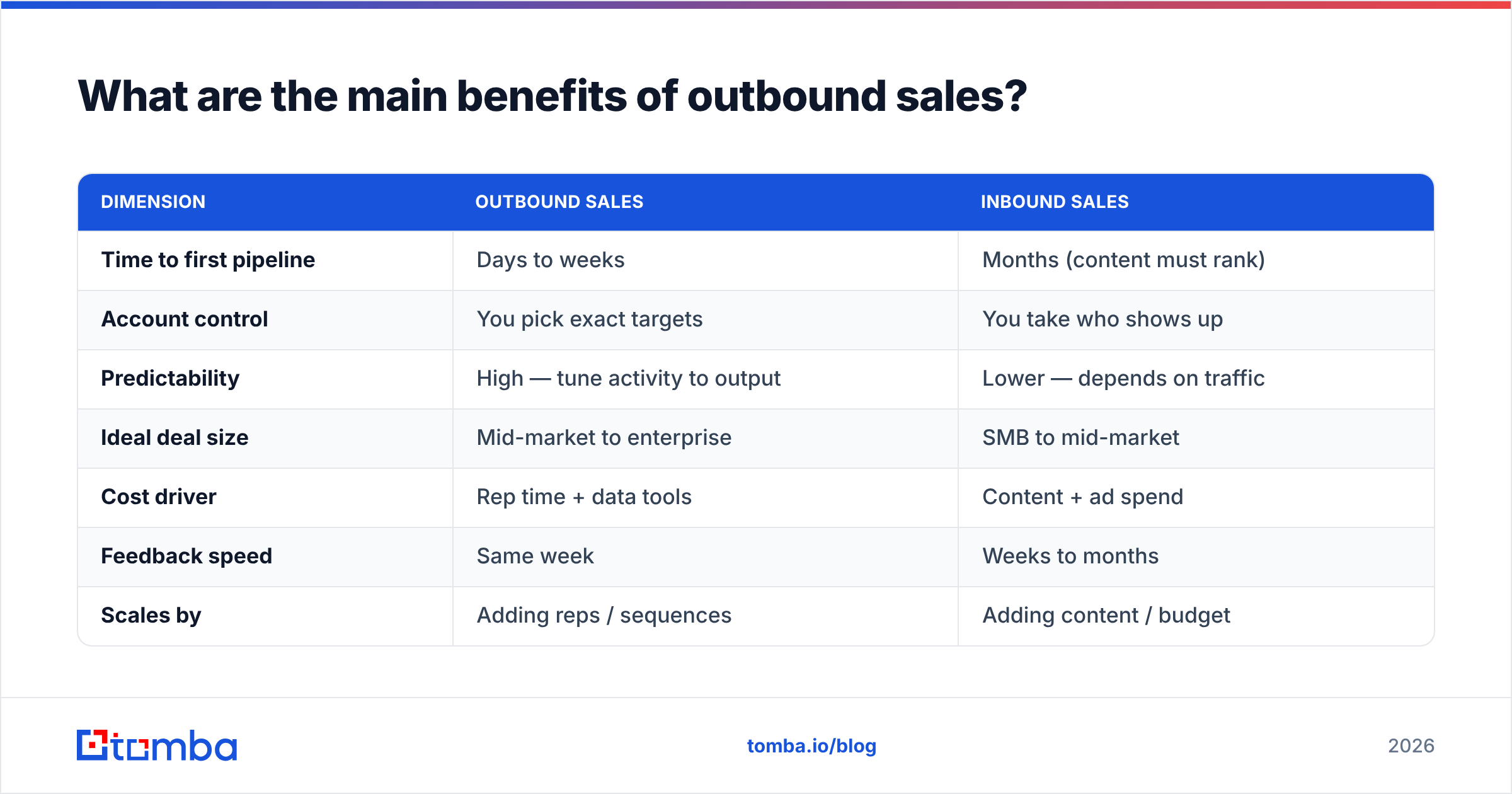
Here's how the core advantages stack up against inbound.
| Dimension | Outbound sales | Inbound sales |
|---|---|---|
| Time to first pipeline | Days to weeks | Months (content must rank) |
| Account control | You pick exact targets | You take who shows up |
| Predictability | High — tune activity to output | Lower — depends on traffic |
| Ideal deal size | Mid-market to enterprise | SMB to mid-market |
| Cost driver | Rep time + data tools | Content + ad spend |
| Feedback speed | Same week | Weeks to months |
| Scales by | Adding reps / sequences | Adding content / budget |
Beyond predictability, four benefits matter most:
- Target precision. You can go after the 200 accounts that look exactly like your best customer instead of waiting for them to stumble onto your site. That precision lifts win rates and average deal size.
- Speed to revenue. A new SEO article can take six months to rank. A new outbound sequence can book a meeting tomorrow. When you need pipeline this quarter, outbound is the only lever that moves fast.
- Direct market intelligence. Every cold call and reply is free research. You hear the real objections, the competitor names, and the words buyers use — intelligence you feed straight back into your messaging and product.
- Repeatability you own. Inbound performance can swing when Google updates its algorithm. Your outbound playbook is an asset you control, document, and hand to the next rep.
Is outbound sales better than inbound?#
Neither is universally "better" — they solve different problems, and the best go-to-market teams run both. But outbound wins decisively in specific situations.
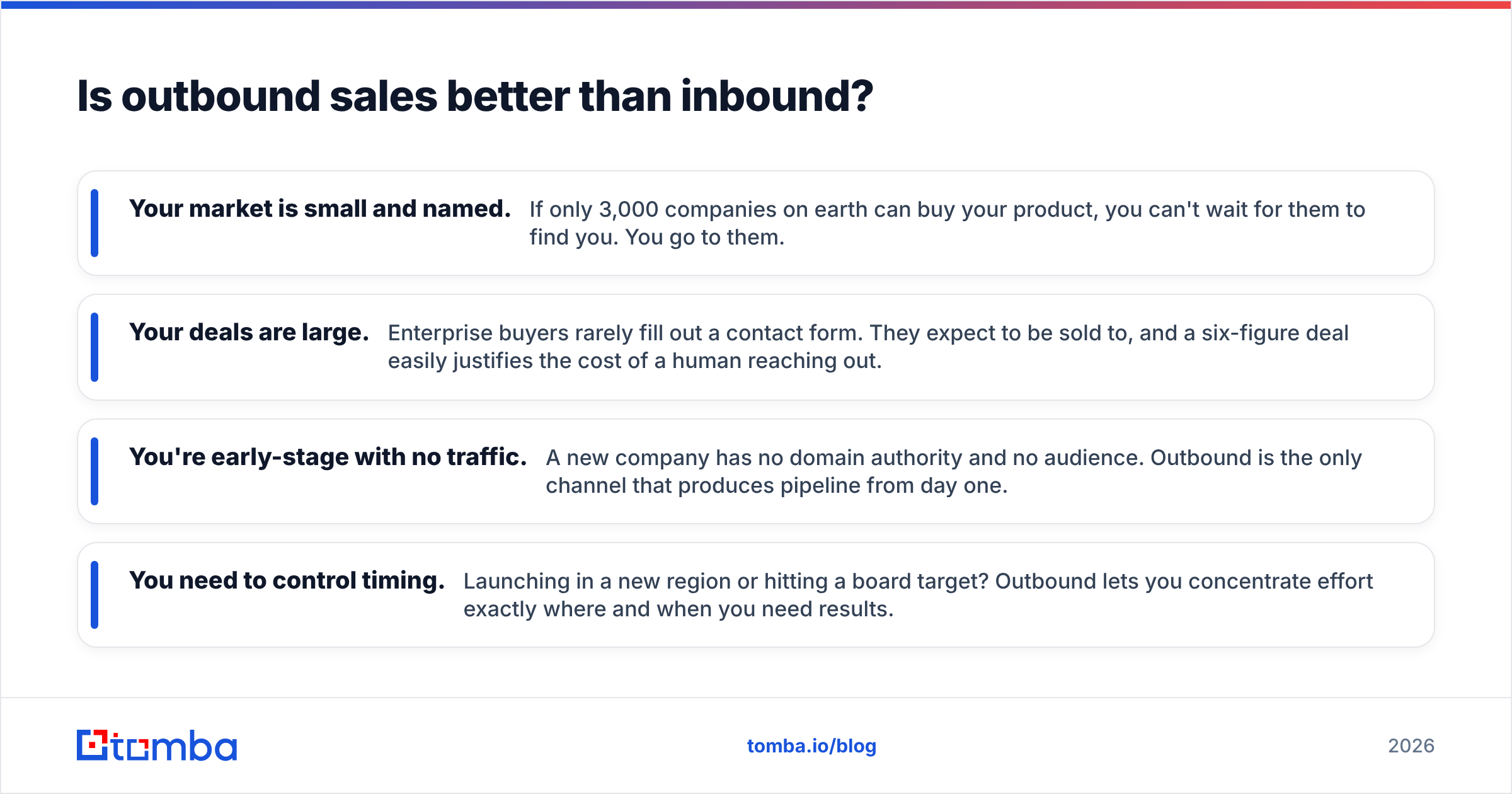
Outbound is the stronger choice when:
- Your market is small and named. If only 3,000 companies on earth can buy your product, you can't wait for them to find you. You go to them.
- Your deals are large. Enterprise buyers rarely fill out a contact form. They expect to be sold to, and a six-figure deal easily justifies the cost of a human reaching out.
- You're early-stage with no traffic. A new company has no domain authority and no audience. Outbound is the only channel that produces pipeline from day one.
- You need to control timing. Launching in a new region or hitting a board target? Outbound lets you concentrate effort exactly where and when you need results.
Inbound earns its keep for high-volume, lower-ACV products where educating a broad audience at scale is cheaper than dialing them one by one. According to HubSpot's research on sales, buyers increasingly self-educate before talking to a rep — which is exactly why outbound and inbound work best as a loop, not a rivalry. Your content makes your cold outreach more credible; your outreach surfaces the objections your content should answer.
The honest answer most RevOps leaders land on: use inbound to capture demand and outbound to create it.

How do you actually capture these benefits?#
The benefits above are real, but they're conditional. Outbound rewards teams that get the fundamentals right and punishes spray-and-pray. Here's the sequence that turns the theory into pipeline.
1. Nail your ICP before you send anything. List the attributes of your ten best customers — industry, headcount, tech stack, trigger events — and build your target list against those filters. A tight list of 300 perfect-fit accounts beats 5,000 random ones every time.
2. Get the data right. Bounced emails and wrong numbers don't just waste time — they wreck your sender reputation and protect your domain's email deliverability. Find verified contacts with domain search, confirm them with verification, and only then load your sequence. Clean data is the single highest-leverage fix in most failing outbound programs.
3. Sequence across channels. A single cold email rarely lands. Plan six to eight touches over two to four weeks across email, phone, and LinkedIn. Each channel covers for the others — the prospect who ignores email might pick up the phone.
4. Personalize the opener, template the rest. Buyers can smell a mail merge. Spend your personalization budget on the first line and the relevance of the offer; standardize the structure so reps stay efficient.
5. Measure the funnel, not just sends. Track contacts reached, reply rate, meeting rate, and opportunity rate. When you know your conversion at each step, you know exactly which stage to fix — and what to expect when you add a rep.
6. Feed learnings back in weekly. Outbound's intelligence benefit only pays off if someone acts on it. Review objections and winning subject lines every week and update the playbook.
Do this and the benefits compound: better data lifts reply rates, better sequencing lifts meeting rates, and tighter targeting lifts deal size — all at once.
What does outbound sales cost — and is the ROI worth it?#
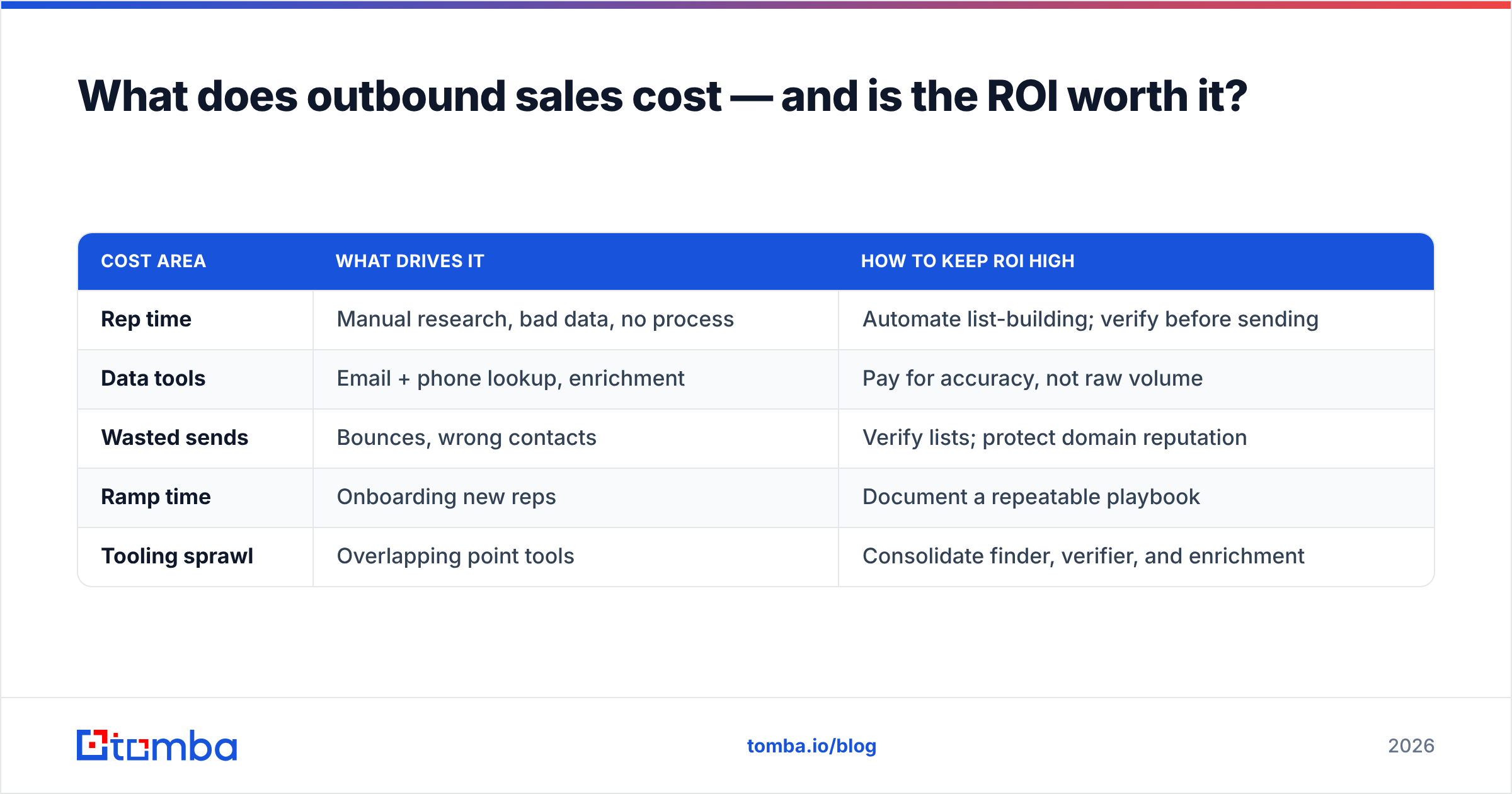
Outbound has real costs: rep salaries, data and sequencing tools, and the ramp time before a new rep is productive. But the unit economics improve as the motion matures, because your biggest expense — rep time — gets more efficient with better data and sharper playbooks.
| Cost area | What drives it | How to keep ROI high |
|---|---|---|
| Rep time | Manual research, bad data, no process | Automate list-building; verify before sending |
| Data tools | Email + phone lookup, enrichment | Pay for accuracy, not raw volume |
| Wasted sends | Bounces, wrong contacts | Verify lists; protect domain reputation |
| Ramp time | Onboarding new reps | Document a repeatable playbook |
| Tooling sprawl | Overlapping point tools | Consolidate finder, verifier, and enrichment |
The ROI math is straightforward once you know your numbers. If a rep costs you $8,000 a month fully loaded and books 8 meetings that close 2 deals worth $15,000 each, you're turning $8,000 into $30,000 in new revenue every month — before that customer renews. The leverage point is conversion efficiency, and conversion efficiency starts with reaching real inboxes. That's why teams obsess over data accuracy: a 10-point swing in deliverability changes the entire model.
For a deeper benchmark of where outbound fits in modern go-to-market, the analysts at Gartner's sales research consistently find that buyers want fewer, more relevant seller interactions — which is the entire premise of doing outbound well rather than at volume.
Common myths about the benefits of outbound#
"Outbound is dead." It isn't — bad outbound is dead. Generic blasts to unverified lists never worked well and work worse now. Targeted, well-researched outreach to the right person at the right account converts as well as it ever has.
"It doesn't scale." It scales differently than inbound. You scale by adding reps and refining sequences, and because the output per rep is predictable, the scaling is more reliable than betting on content rankings.
"Email reputation makes it too risky." Reputation risk comes from sending junk to bad addresses. Verify your list, warm your domain, and keep bounce rates low, and you protect your sender reputation while still sending at volume.
"AI replaced it." AI made outbound faster — better research, drafting, and routing — but a human still closes the mid-market and enterprise deals that justify the channel. AI is the accelerant, not the replacement.
Getting started: your first outbound sprint#
If you want proof before you commit, run a two-week sprint. Pick 100 accounts that match your best customers. Find and verify the right contact at each. Build a six-touch sequence across email and phone. Send it, track every step of the funnel, and review what you learned.
That single sprint will tell you your reply rate, your meeting rate, and your cost per opportunity — the three numbers that decide whether to scale. Most teams are surprised how quickly targeted outbound produces a booked meeting compared to the months inbound takes to ramp.
The whole motion lives or dies on contact accuracy. Start your first sprint with the Tomba Email Finder: find verified, professional email addresses by company, domain, or name, confirm them before you send, and protect your deliverability from the first touch. Pair it with the free tier to test, then scale on a Tomba plan that grows with your team — Starter at $49/mo when you're ready to run real volume. Pick the accounts, reach the right people, and turn outbound from a guess into a plan.
// get started
Find, verify and enrich your first contacts today
Start on the free plan with 25 searches a month, then scale when your team is ready.
Free plan · No credit card required · GDPR & CCPA
// about the author