Best B2B Marketing Tactics in 2026: A Practical Playbook
The best B2B marketing tactics in 2026 are not louder campaigns — they are tighter data, intent signals, and account-level execution. Here is the working playbook.
You can buy more ads, hire more SDRs, and publish more blog posts — and still miss pipeline. The teams winning B2B in 2026 are not doing more; they are doing the right few things on top of clean data. This is the working playbook.
TL;DR#
- The best B2B marketing tactics in 2026 are data-led: intent signals, account-based execution, and enriched contact records beat volume every time.
- Demand capture (people already searching) outperforms cold demand creation on payback period — fund both, but measure them separately.
- Most "marketing" problems are actually data problems: bad emails, missing phone numbers, stale firmographics. Fix the foundation first.
- A tight tech stack (intent + enrichment + CRM + outbound) matters more than any single channel.
- Attribution is shifting from last-click to pipeline-influenced; report on sourced and influenced revenue.
What counts as a "tactic" in B2B marketing in 2026?#
A tactic is a repeatable play that moves a named account closer to a buying decision. That is the bar. "Post on LinkedIn" is an activity; "identify accounts showing surge intent, enrich the buying committee, and run a coordinated email-plus-LinkedIn touch in 72 hours" is a tactic.
The difference matters because B2B buying has changed. Gartner research has repeatedly shown buyers spend only about 17% of their journey talking to any vendor's sales team — the rest is independent research across review sites, peers, and search. Your job is to be present, credible, and easy to act on during that 83% you cannot see.
So the best tactics share three traits: they target accounts not anonymous traffic, they trigger on signals not calendars, and they depend on accurate contact data to execute.
Which B2B marketing tactics actually drive pipeline?#
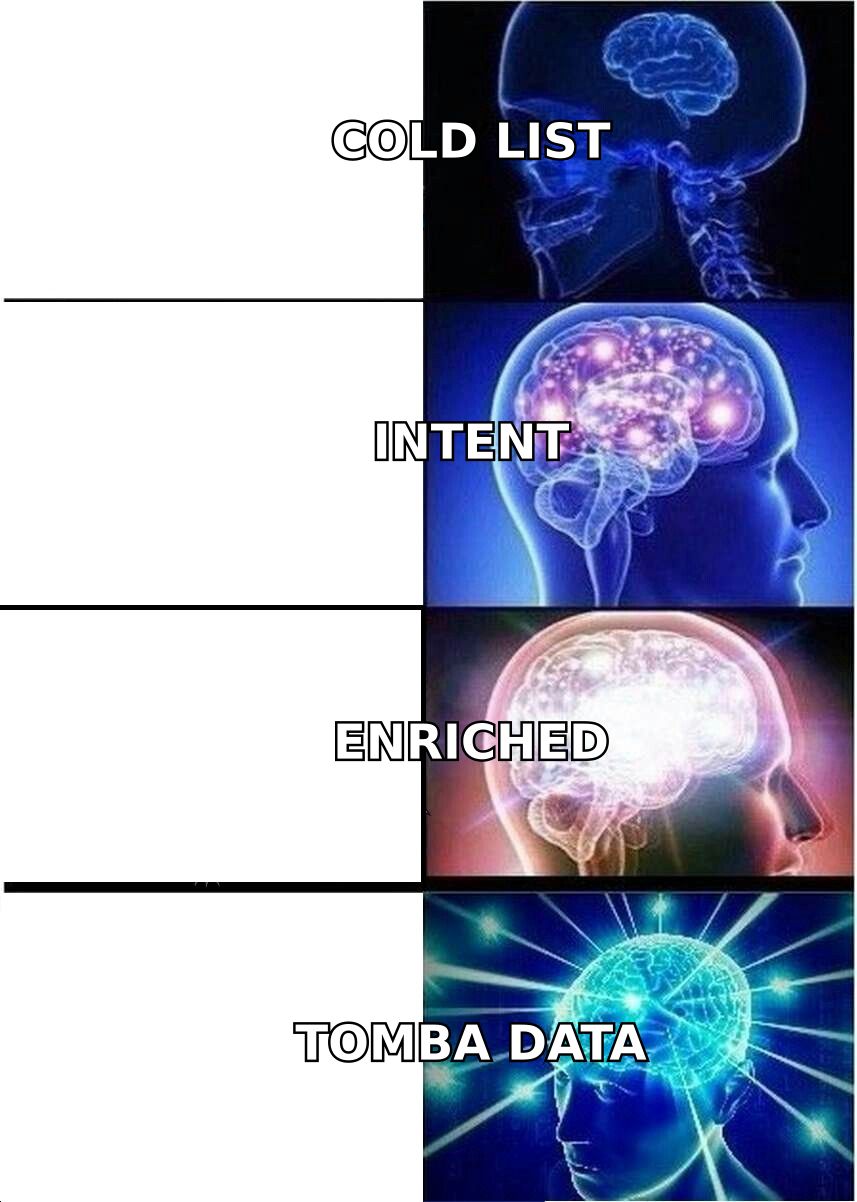
Here are the plays carrying their weight in 2026, ordered by how directly they convert to pipeline.
- Demand capture (bottom-funnel search + retargeting). Capture buyers already searching for your category. Highest intent, shortest payback. This is where your branded search, comparison pages, and high-intent landing pages live.
- Account-based marketing (ABM). Pick a finite list of fit accounts, then coordinate ads, email, and sales touches against the whole buying committee. Best for higher ACV deals.
- Intent-triggered outbound. Watch for third-party intent surges and website visits, then reach out within days while the problem is top-of-mind.
- Content-led demand creation. Educational content, point-of-view pieces, and original data that build category authority over months. Slow payback, compounding return.
- Partner and community co-marketing. Borrow trust from adjacent vendors, communities, and creators your buyers already follow.
- Lifecycle and reactivation email. The cheapest pipeline you own — re-engaging closed-lost and dormant contacts with new proof points.
Notice tactics 2, 3, and 6 collapse the moment your contact data is wrong. You cannot run ABM against a buying committee you cannot reach, and intent means nothing if you email a bounced address. That is why data is the first investment, not the last.
How do the top tactics compare?#
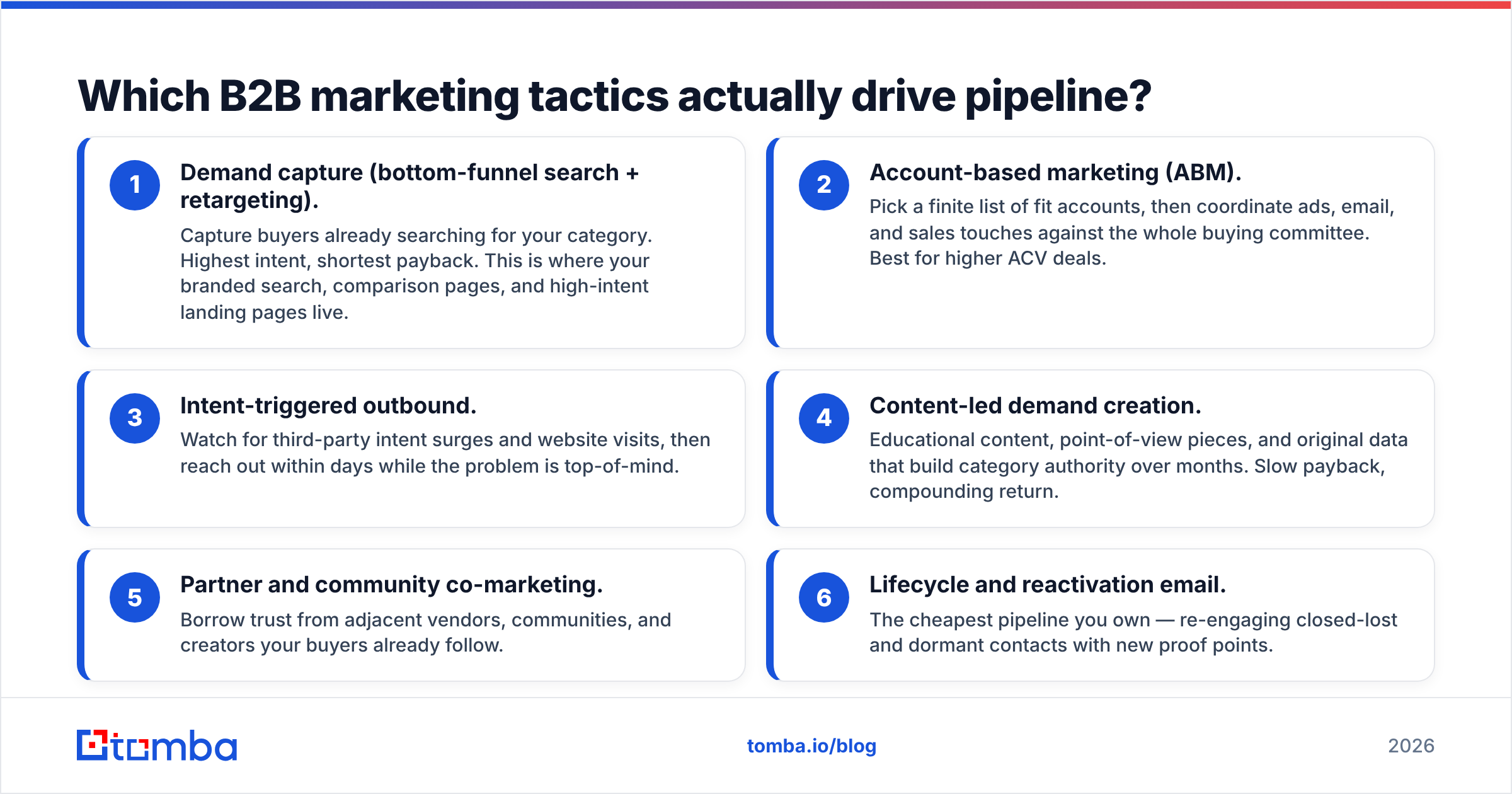
Use this to decide where to put the next dollar based on your deal size, sales cycle, and how much you can spend before you see return.
| Tactic | Best for | Payback speed | Data dependency | Primary KPI |
|---|---|---|---|---|
| Demand capture (search/retargeting) | Existing category demand | Fast (weeks) | Medium | Pipeline per spend |
| Account-based marketing | High ACV, named accounts | Medium (1-2 quarters) | Very high | Account engagement → opps |
| Intent-triggered outbound | Mid-market, defined ICP | Fast (weeks) | Very high | Reply → meeting rate |
| Content-led demand creation | Category leadership | Slow (2-4 quarters) | Low | Organic pipeline influence |
| Partner / community | Trust-gated markets | Medium | Medium | Sourced opps from partners |
| Lifecycle / reactivation | Existing DB | Very fast (days) | High | Reactivated pipeline |
The pattern is hard to miss: the fastest, most controllable tactics lean hardest on accurate contact and account data. Which brings us to the part most teams skip.
Why is clean data the foundation of every B2B tactic?#
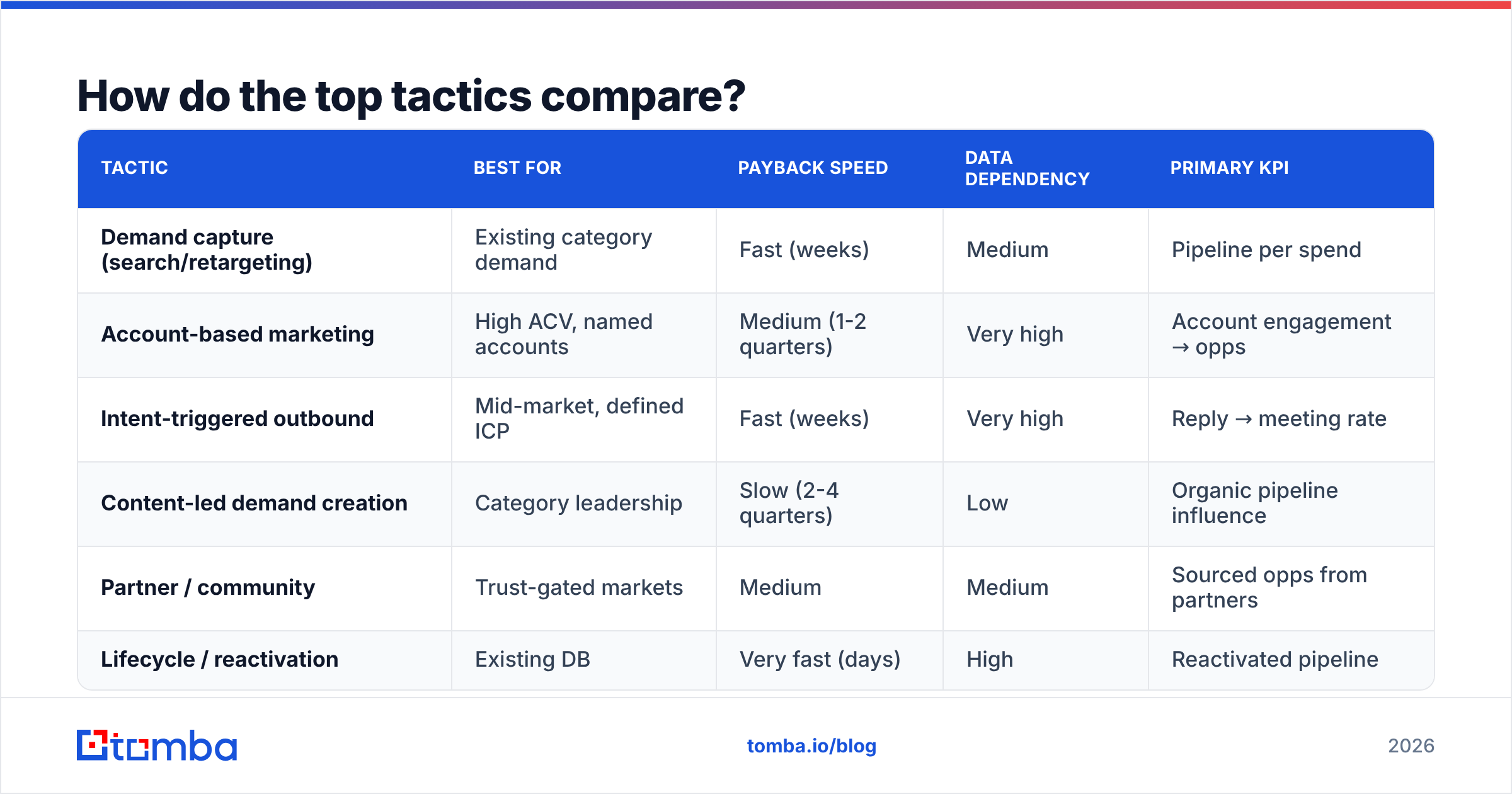
Because every tactic above is a function of reach × relevance × accuracy, and accuracy is the multiplier you control most directly. A brilliant ABM play sent to 40% invalid emails is a 60% play at best — and your sender reputation pays for the bounces.
Three data layers underpin modern B2B marketing:
- Identity: who is the account and who sits on the buying committee. This is firmographic and contact data — names, titles, verified work emails, and direct dials.
- Signal: what are they doing right now — third-party intent, website visits, hiring changes, funding.
- State: where are they in your funnel — owned CRM data that has to stay deduplicated and current.
If identity is broken, signal and state cannot help you. This is why teams that "just need more leads" usually need better leads first. Start by making sure the contacts you already have are reachable: run them through an email verifier before any send, and backfill missing fields with data enrichment so segmentation actually works.
When you are building net-new lists for ABM or outbound, a domain search lets you pull the verified contacts at a target company in one pass, instead of guessing email formats one prospect at a time. Good data accuracy is not a nice-to-have line item; it is the difference between a tactic that compounds and one that quietly burns your domain reputation.
How do you actually run an intent-to-outreach play?#
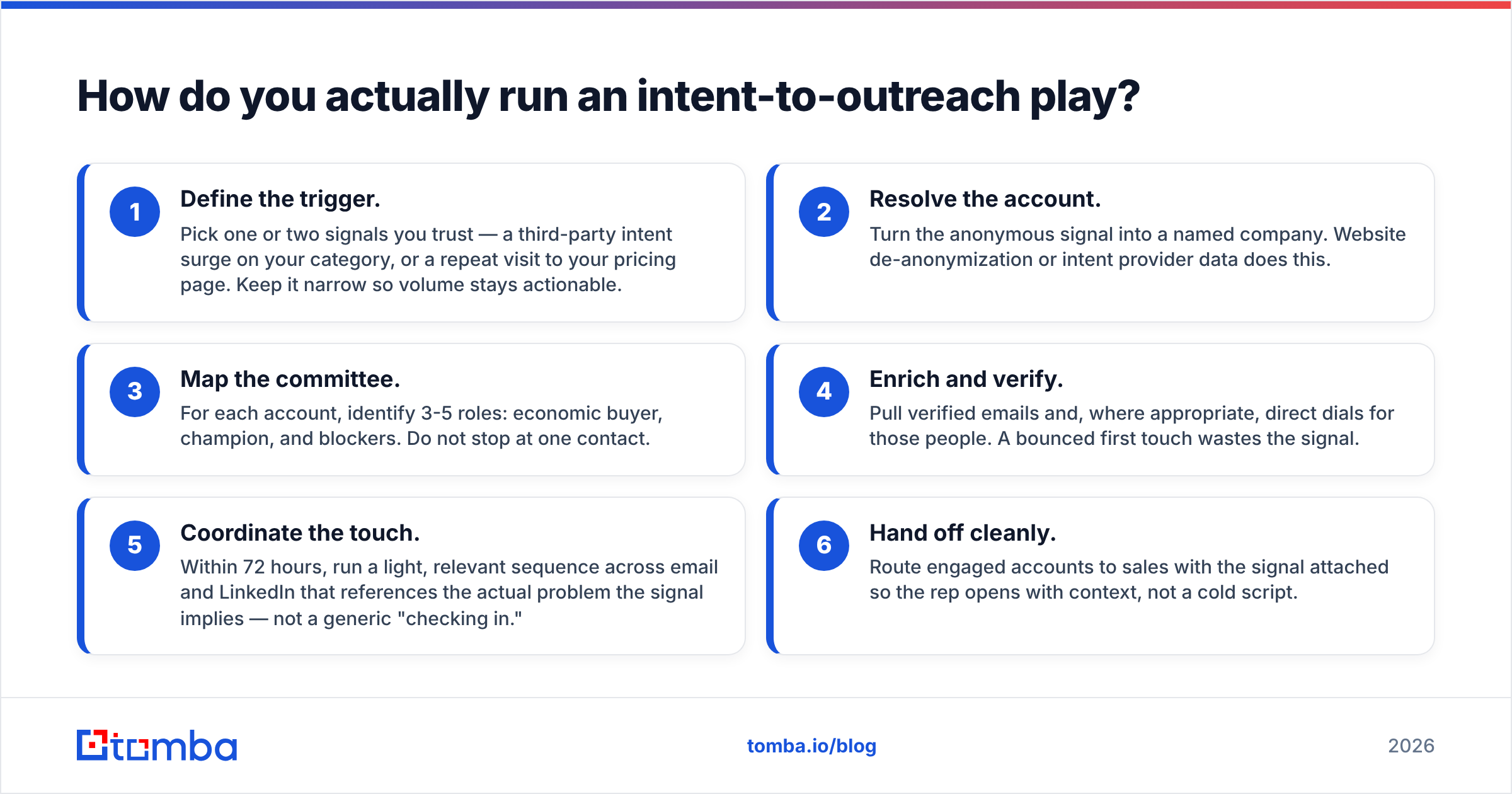
This is the highest-leverage tactic for most mid-market teams, so here is the concrete sequence.
- Define the trigger. Pick one or two signals you trust — a third-party intent surge on your category, or a repeat visit to your pricing page. Keep it narrow so volume stays actionable.
- Resolve the account. Turn the anonymous signal into a named company. Website de-anonymization or intent provider data does this.
- Map the committee. For each account, identify 3-5 roles: economic buyer, champion, and blockers. Do not stop at one contact.
- Enrich and verify. Pull verified emails and, where appropriate, direct dials for those people. A bounced first touch wastes the signal.
- Coordinate the touch. Within 72 hours, run a light, relevant sequence across email and LinkedIn that references the actual problem the signal implies — not a generic "checking in."
- Hand off cleanly. Route engaged accounts to sales with the signal attached so the rep opens with context, not a cold script.
The make-or-break steps are 3 and 4. The whole play depends on reaching real humans at the account, which is again a data exercise. For the contact layer, the Tomba Email Finder finds and verifies professional emails by name and domain, and a phone finder adds the direct-dial channel when email gets crowded.
What does a lean 2026 B2B marketing stack look like?#
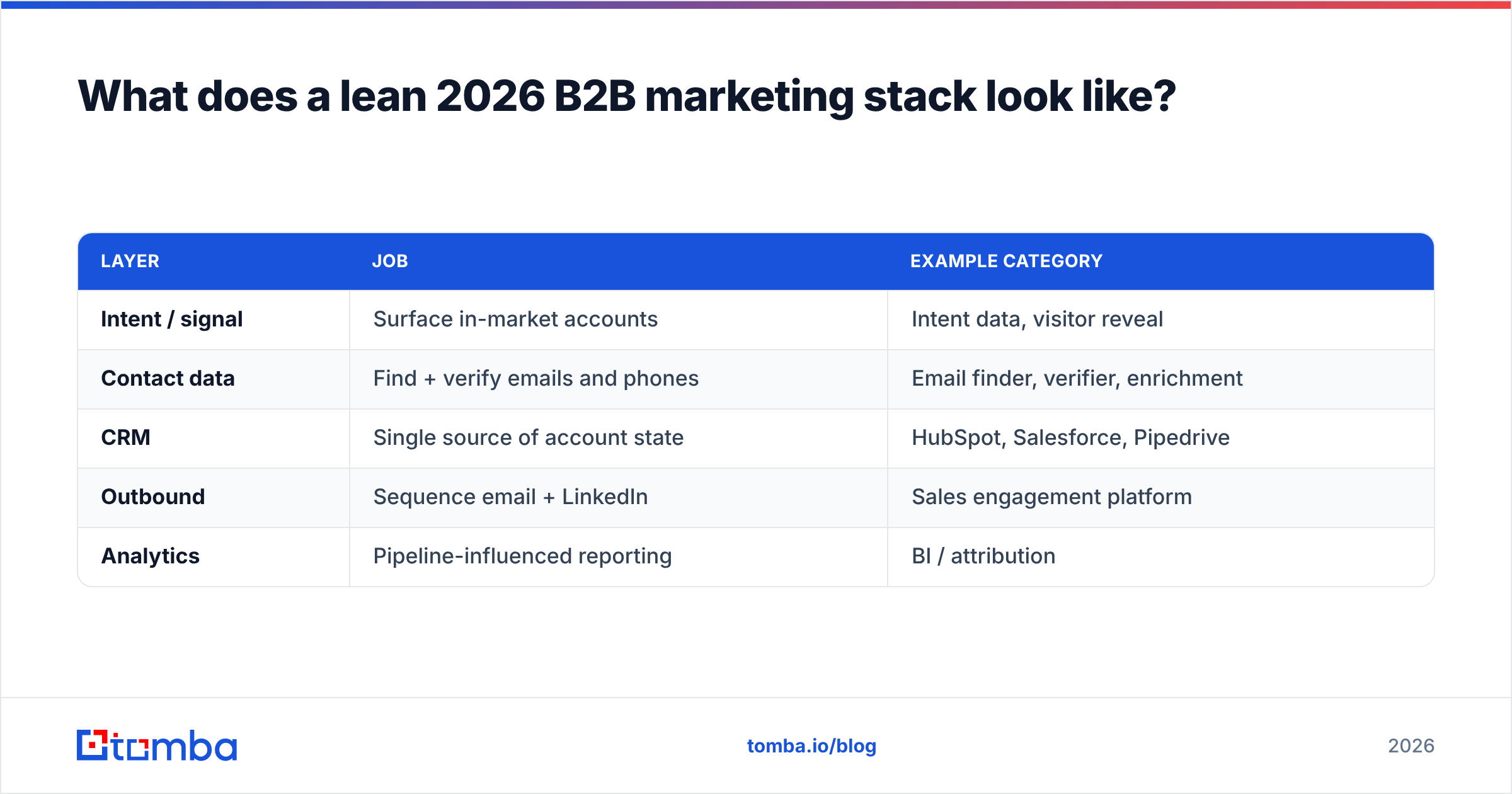
You do not need 30 tools. You need one capable tool per job and clean handoffs between them. A practical stack:
| Layer | Job | Example category |
|---|---|---|
| Intent / signal | Surface in-market accounts | Intent data, visitor reveal |
| Contact data | Find + verify emails and phones | Email finder, verifier, enrichment |
| CRM | Single source of account state | HubSpot, Salesforce, Pipedrive |
| Outbound | Sequence email + LinkedIn | Sales engagement platform |
| Analytics | Pipeline-influenced reporting | BI / attribution |
The integration glue matters as much as the tools. If your contact data does not flow into the CRM automatically, reps work from stale records and the whole stack degrades. Look for native connections — for example, pushing verified contacts straight into your CRM via a HubSpot integration or Salesforce integration so enrichment happens at the point of capture, not in a quarterly cleanup project.
For independent validation of which tools fit your size and budget, cross-check categories on G2 rather than trusting any single vendor's homepage — including this one.
Which tactics are overrated heading into 2026?#
A few plays still get budget they no longer earn:
- Spray-and-pray cold email. Mailbox providers tightened authentication and engagement filtering. Large unverified sends now hurt deliverability faster than they generate replies. Verify, warm up, and segment — or do not send.
- Gated PDFs as the primary CTA. Buyers resent the form wall. Ungate the asset, capture intent through behavior and de-anonymization instead, and reserve forms for genuine high-intent moments like demos.
- Vanity MQL targets. A marketing-qualified lead that sales never works is a cost, not an asset. Align on a marketing qualified lead definition that sales actually accepts, and report on accepted leads and pipeline, not raw MQL counts.
- Chasing every channel. Three channels run well beat eight run poorly. Concentrate.
The throughline: tactics that ignore data quality or buyer trust are decaying. Tactics that respect both are compounding.
How should you measure the best B2B marketing tactics?#
Move from last-click to a two-number model: sourced pipeline (marketing originated the account) and influenced pipeline (marketing touched an open deal). Report both, because B2B deals have many touches and crediting only the last one rewards the wrong tactics.
Practical guardrails:
- Track pipeline per dollar by tactic, not leads per dollar. Leads are cheap; qualified pipeline is the scarce thing.
- Watch reply-to-meeting rate on outbound as your data-quality canary. If it drops, your contact accuracy or targeting slipped before your copy did.
- Measure time-to-first-touch on signals. Intent decays in days; a slow follow-up is a wasted spend.
- Review deliverability metrics monthly. Bounce rate and spam complaints are leading indicators of data rot.
If you want a deeper benchmark on the email side, the response-rate numbers in this response rate reference give you realistic targets to grade your sequences against.
A 90-day action plan#
If you only do one thing per month:
- Month 1 — Fix the foundation. Audit and verify your existing database, enrich missing fields, and agree on ICP plus a shared lead definition with sales.
- Month 2 — Launch one signal play. Stand up a single intent-to-outreach motion against a narrow trigger, with committee mapping and verified contacts.
- Month 3 — Double down and report. Kill the weakest channel, reinvest in the best-performing tactic, and ship a sourced-plus-influenced pipeline dashboard.
That sequence works because each month compounds the last. Clean data makes the signal play work; the signal play gives you the proof to defend budget in month three.
Start with the data layer#
The fastest improvement to almost any B2B marketing program is not a new channel — it is reaching the right people with confidence. Before you scale ads, sequences, or ABM, make sure your contact data is complete and verified.
The Tomba Email Finder lets you find and verify professional email addresses by name, company, or domain, with verification built in so your tactics fire against real, reachable buyers. The free tier (25 searches/month) is enough to test it on a target account list today; paid plans start at $49/month, with full Tomba pricing covering bulk enrichment and API access as you scale. Build the data foundation first, and every tactic in this playbook works harder.
// get started
Find, verify and enrich your first contacts today
Start on the free plan with 25 searches a month, then scale when your team is ready.
Free plan · No credit card required · GDPR & CCPA
// about the author