Best Businesses to Cold Call in 2026: A Ranked B2B Guide
Not every industry picks up the phone. Here are the best businesses to cold call in 2026, ranked by reachability, deal size, and buying urgency.
Cold calling is not dead. Calling the wrong businesses is. The reps who still book meetings off the phone in 2026 win because they pick industries that answer, have budget, and feel pain that a phone call can solve this quarter. This guide ranks the best businesses to cold call, shows you why they convert, and explains how to feed your dialer with contact data that actually connects.
TL;DR#
- The best businesses to cold call share three traits: they answer unknown numbers, they have real budget authority on the line, and they feel time-sensitive pain.
- Top verticals in 2026: local home services, B2B SaaS mid-market, staffing and recruiting, commercial real estate, insurance and financial services, and healthcare practices.
- Avoid: enterprise tech buyers, government procurement, and anyone behind a hard gatekeeper layer — they cost 5x the dials for the same meeting.
- Data beats charisma. A great script against a bad list loses to an average script against verified direct dials.
- Build your call list with a phone finder and an email finder so every dial has a name, a role, and a backup channel.
What makes a business worth cold calling?#
The conclusion first: a business is worth cold calling when the cost to reach a decision-maker is low and the value of a closed deal is high. Everything else is detail.
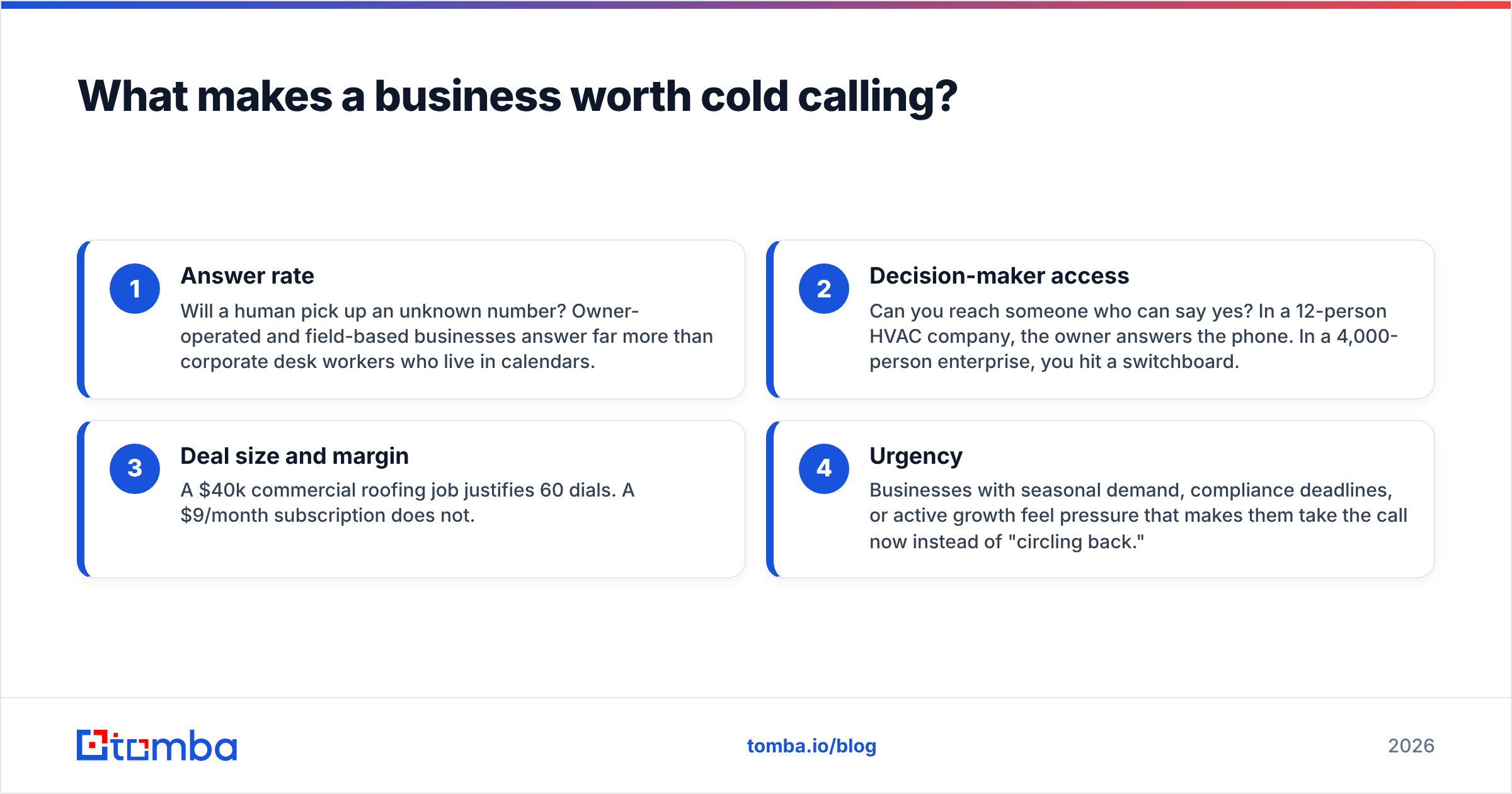
Think of cold calling like fishing. You can be the best caster in the world, but if you drop your line in a pond with no fish, you go home empty. Industry selection is choosing the pond. Here are the four factors that decide whether the pond is stocked:
- Answer rate — Will a human pick up an unknown number? Owner-operated and field-based businesses answer far more than corporate desk workers who live in calendars.
- Decision-maker access — Can you reach someone who can say yes? In a 12-person HVAC company, the owner answers the phone. In a 4,000-person enterprise, you hit a switchboard.
- Deal size and margin — A $40k commercial roofing job justifies 60 dials. A $9/month subscription does not.
- Urgency — Businesses with seasonal demand, compliance deadlines, or active growth feel pressure that makes them take the call now instead of "circling back."
Which industries are the best businesses to cold call in 2026?#
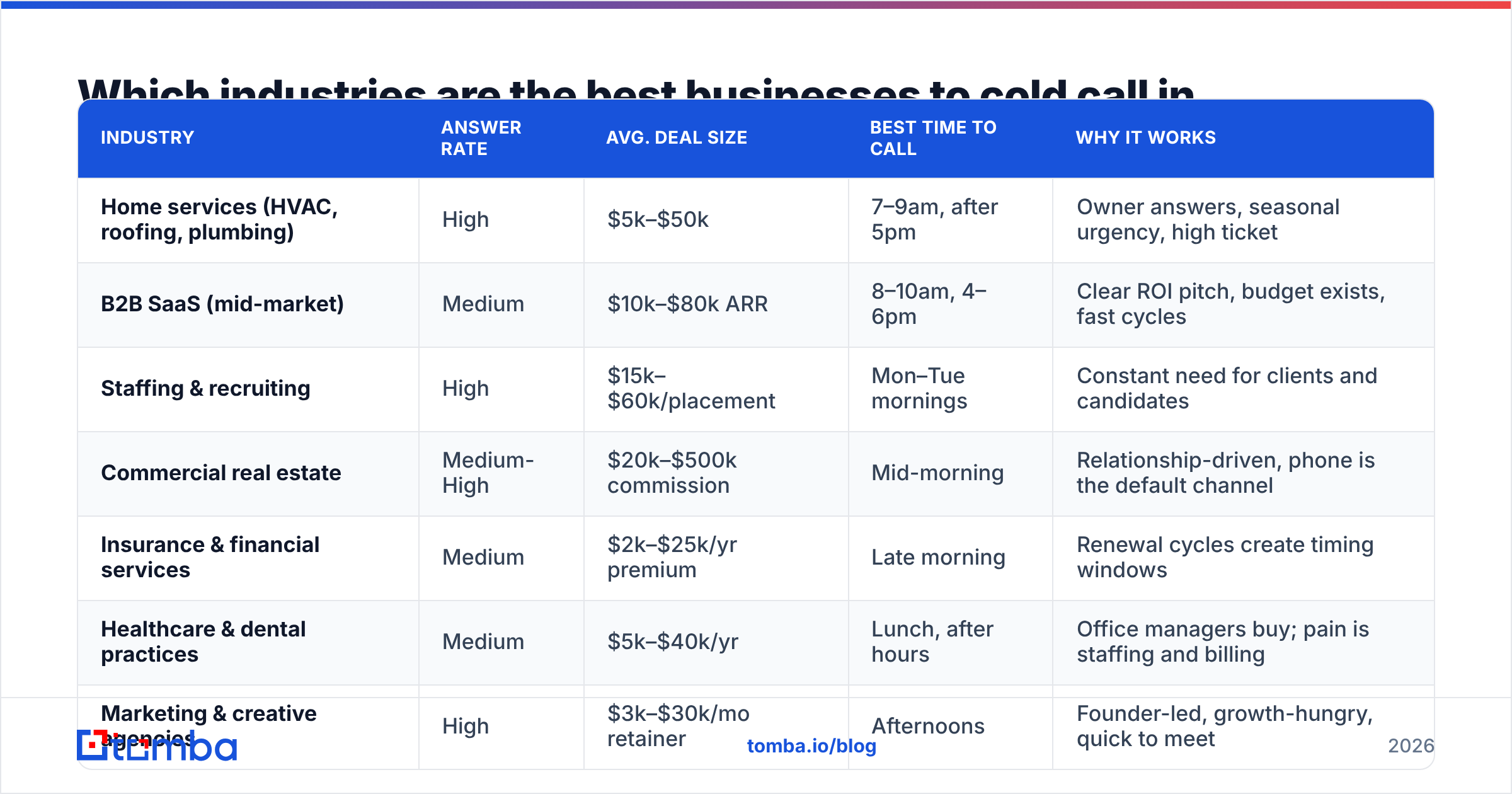
Below is the ranked shortlist. Each scores high on the four factors above, and each is reachable by phone without a 9-layer gatekeeper.
| Industry | Answer rate | Avg. deal size | Best time to call | Why it works |
|---|---|---|---|---|
| Home services (HVAC, roofing, plumbing) | High | $5k–$50k | 7–9am, after 5pm | Owner answers, seasonal urgency, high ticket |
| B2B SaaS (mid-market) | Medium | $10k–$80k ARR | 8–10am, 4–6pm | Clear ROI pitch, budget exists, fast cycles |
| Staffing & recruiting | High | $15k–$60k/placement | Mon–Tue mornings | Constant need for clients and candidates |
| Commercial real estate | Medium-High | $20k–$500k commission | Mid-morning | Relationship-driven, phone is the default channel |
| Insurance & financial services | Medium | $2k–$25k/yr premium | Late morning | Renewal cycles create timing windows |
| Healthcare & dental practices | Medium | $5k–$40k/yr | Lunch, after hours | Office managers buy; pain is staffing and billing |
| Marketing & creative agencies | High | $3k–$30k/mo retainer | Afternoons | Founder-led, growth-hungry, quick to meet |
1. Home services#
Home services tops nearly every list of the best businesses to cold call because the owner is often the person who answers. There is no executive assistant screening calls at a 15-truck plumbing company. The work is seasonal, the jobs are large, and a single closed contract for software, financing, or lead-gen pays for months of dialing.
2. B2B SaaS (mid-market)#
Mid-market SaaS companies (50–500 employees) sit in the sweet spot. They are large enough to have budget and a VP who owns a number, but small enough that you can actually reach that VP. They also understand ROI math instantly, which shortens your pitch. If your offer saves an hour a day per rep, you do not have to explain why that matters.
3. Staffing and recruiting#
Staffing firms live and die on the phone, so they respect a good cold call. They have two buyers inside one prospect — the firm needs client companies and it needs candidates — which doubles your reasons to call. Demand is structural: every quarter someone needs to hire.
4. Commercial real estate#
CRE brokers expect the phone. The entire industry runs on outreach, so your call does not feel out of place. Deal values are enormous, and even a low close rate produces strong revenue per booked meeting.
Which businesses should you avoid cold calling?#
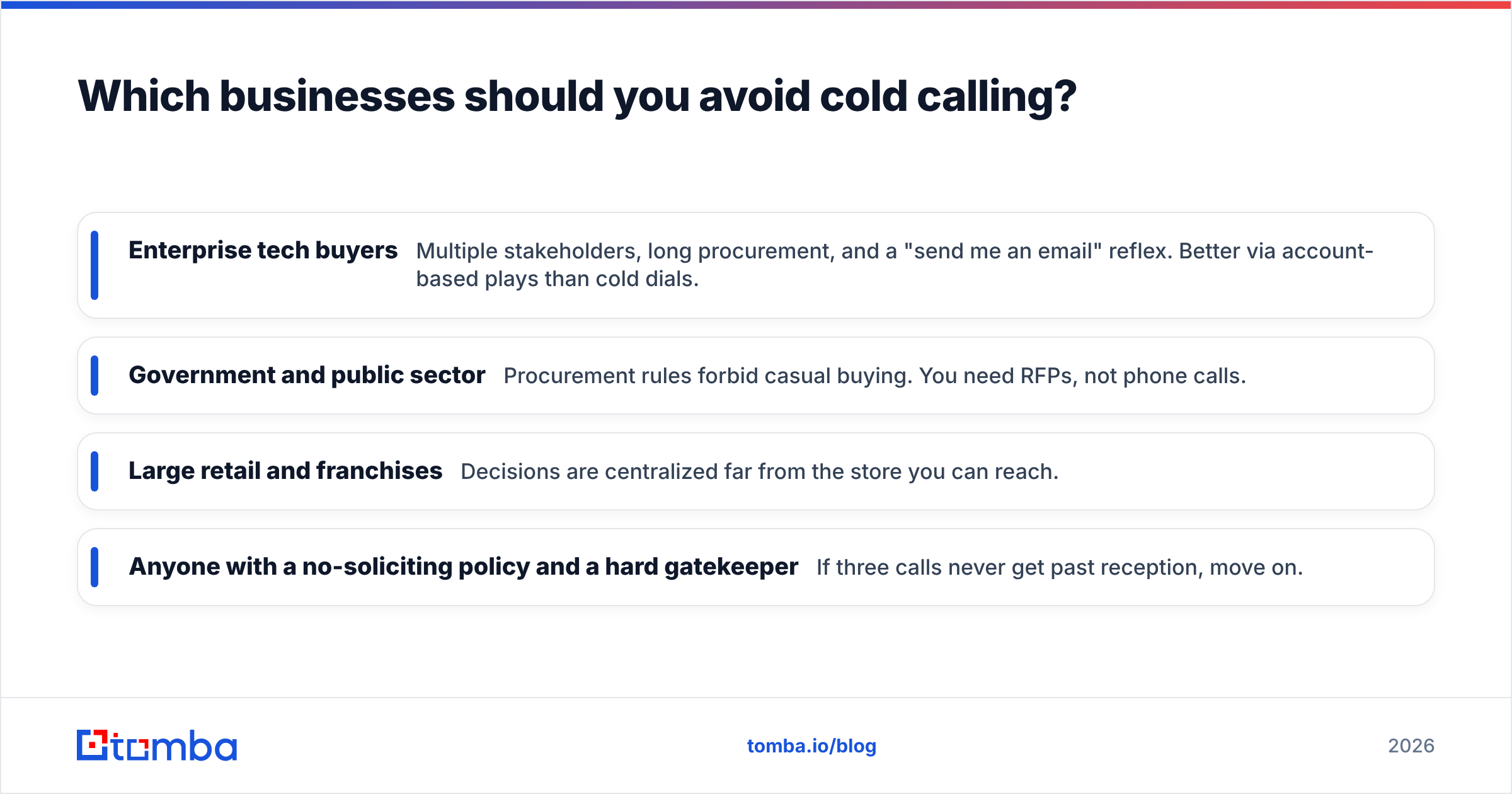
Just as important as the green list is the red list. These verticals burn dials:
- Enterprise tech buyers — Multiple stakeholders, long procurement, and a "send me an email" reflex. Better via account-based plays than cold dials.
- Government and public sector — Procurement rules forbid casual buying. You need RFPs, not phone calls.
- Large retail and franchises — Decisions are centralized far from the store you can reach.
- Anyone with a no-soliciting policy and a hard gatekeeper — If three calls never get past reception, move on.
According to HubSpot's sales research, persistence and timing drive connect rates more than raw call volume — which is exactly why picking reachable industries matters more than dialing harder.
How do you build a call list for these businesses?#
Here is the part most "best industries" articles skip: the industry is only half the equation. You still need the right person and a number that rings. A perfect target list with bad contact data is a stack of busy signals.
Build your list in four steps:
- Define the firmographic filter — industry, company size, and region that match the verticals above.
- Find the decision-maker — owner, VP of Sales, office manager, or whoever holds budget for your offer.
- Get the direct dial and the email — use a phone finder for mobile and direct numbers, and pair it with email verification so your follow-up does not bounce.
- Enrich and dedupe — run data enrichment to fill missing titles and remove duplicates before they hit your dialer.
You can pull a whole company's contacts at once with domain search, then verify the best matches. The goal is simple: every row in your list should have a name, a role, a verified email, and a phone number before you make the first dial.
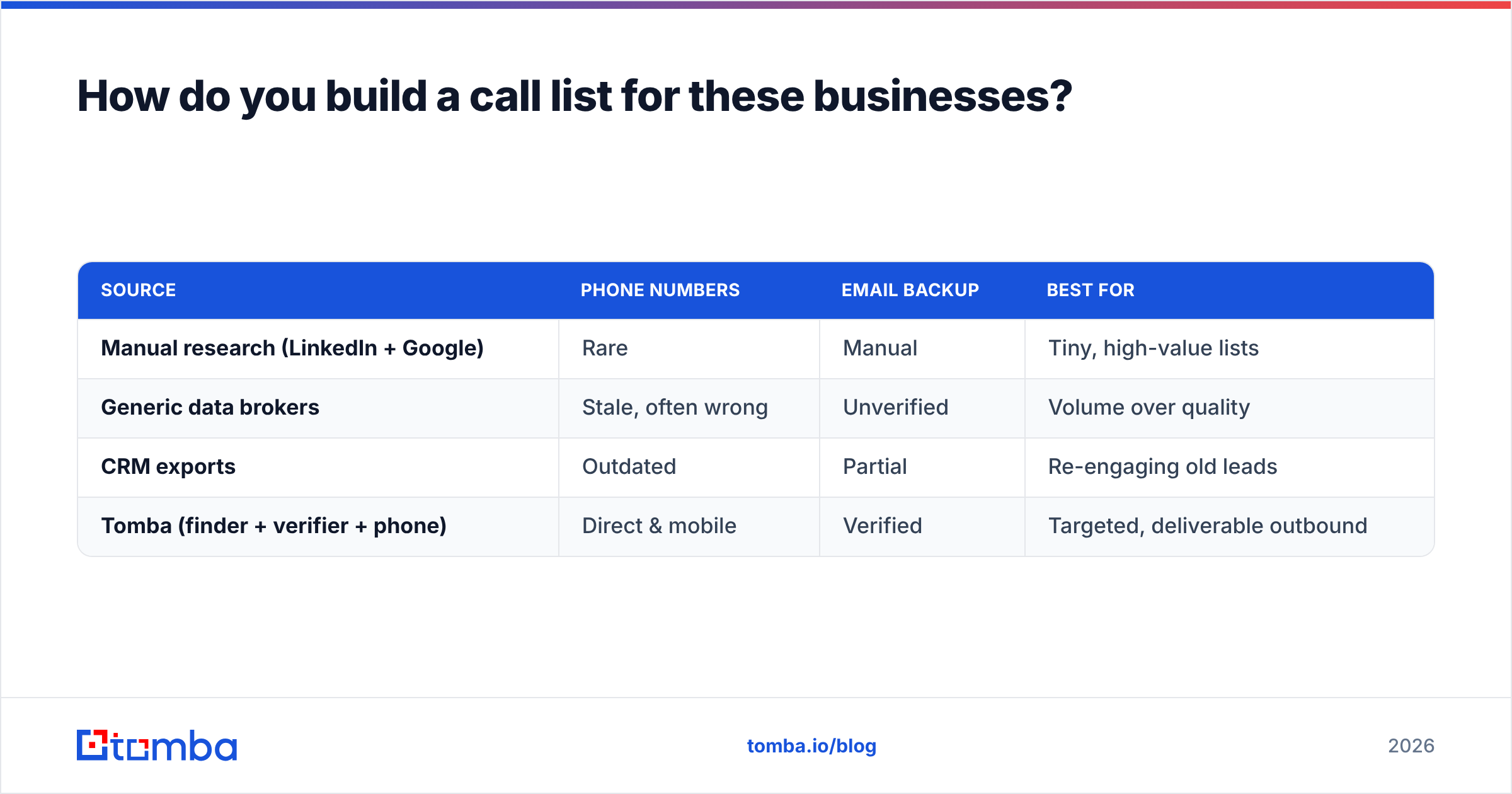
Cold call data sources compared#
| Source | Phone numbers | Email backup | Best for |
|---|---|---|---|
| Manual research (LinkedIn + Google) | Rare | Manual | Tiny, high-value lists |
| Generic data brokers | Stale, often wrong | Unverified | Volume over quality |
| CRM exports | Outdated | Partial | Re-engaging old leads |
| Tomba (finder + verifier + phone) | Direct & mobile | Verified | Targeted, deliverable outbound |
What does the phone-plus-email approach look like in practice?#
Cold calling works best as part of a sequence, not a solo act. Pair every dial with an email and a touch on LinkedIn so you are present where the buyer actually responds. A reliable response rate comes from showing up more than once, on more than one channel.
A simple multi-touch rhythm for the verticals above:
- Day 1: Call. If no answer, leave a 12-second voicemail and send a one-line email referencing why you called.
- Day 2: LinkedIn connection with a short, specific note.
- Day 4: Second call at a different time of day.
- Day 6: Value email — a case study or number relevant to their industry.
- Day 9: Final call and a polite break-up message.
This is where verified contact data pays off twice: the phone number powers the calls, and the verified email powers the follow-ups that catch the 80% of prospects who do not pick up on attempt one.
How do you write a cold call script for these industries?#
Match the script to the buyer. A roofing owner and a SaaS VP want different things in the first ten seconds.
A field-based owner (home services, trades) responds to:
"Hi [Name], it's [You] from [Company]. I'll be quick — I work with [region] roofing crews who want more booked jobs without buying more leads. Worth two minutes, or did I catch you on a roof?"
A corporate buyer (SaaS, finance) responds to a sharper ROI hook:
"Hi [Name], [You] from [Company]. I'll keep it to 20 seconds — we help mid-market sales teams cut prospecting time by about a third. If that's relevant, can I share how? If not, I'll get off the phone."
Both open with respect for time and lead with a specific, industry-relevant outcome. Generic scripts ("How are you today?") get hung up on across every vertical. For more frameworks, vendor-neutral guides like Salesforce's cold calling resources and peer reviews on G2 are worth studying before you finalize yours.
How do you measure whether a vertical is working?#
Track three numbers per industry so you can double down on what converts:
- Connect rate — dials that reach a live decision-maker. Below 8% means your data or your timing is off, not your pitch.
- Conversion to meeting — connects that book a next step. This tells you if the vertical actually has the pain you assumed.
- Revenue per dial — total pipeline divided by dials. The metric that ends every debate about which pond to fish.
Run each green-list industry for two weeks, hold the script roughly constant, and let revenue per dial pick your winners. The best businesses to cold call for your offer may rank slightly differently than this list — but they will always be the ones where reachable people feel real pain.
The bottom line#
The best businesses to cold call in 2026 are owner-operated, budget-holding, and urgency-driven: home services, mid-market SaaS, staffing, commercial real estate, insurance, healthcare practices, and growth-stage agencies. Pick two or three, measure revenue per dial, and concentrate your hours where the phone still gets answered.
But none of it matters without contact data that connects. Start by building a verified, enriched call list with the Tomba Email Finder and pair it with the phone finder so every prospect has a name, a role, a verified email, and a number that rings. Check current Tomba pricing — the free tier gives you 25 searches a month to test your first target list before you commit. Choose the right pond, fill it with the right data, and cold calling pays again.
// get started
Find, verify and enrich your first contacts today
Start on the free plan with 25 searches a month, then scale when your team is ready.
Free plan · No credit card required · GDPR & CCPA
// about the author