Best Competitive Intelligence Tools in 2026: Top 12 Compared
A neutral, hands-on breakdown of the best competitive intelligence tools in 2026 — what each does well, where it falls short, and how to pick the right stack.
Competitive intelligence used to mean a junior analyst with 40 browser tabs and a spreadsheet that broke every Monday. In 2026 it means a stack of specialized tools that watch your rivals' pricing, hiring, traffic, messaging, and tech choices automatically — and feed it back to product, sales, and marketing before a deal slips. The hard part is no longer gathering data. It is choosing which of the dozens of platforms actually earns a line in your budget.
TL;DR — The Short Version#
- The best competitive intelligence tools split into four jobs: win/loss and sales enablement (Klue, Crayon), market and traffic analytics (Similarweb, SEMrush), firmographic and signal data (ZoomInfo, Crunchbase), and contact-level enrichment that makes the intel actionable (Tomba, Clearbit).
- No single tool covers everything. Most teams run two or three: one battlecard platform, one web-analytics source, and one data layer to enrich the accounts those tools surface.
- Klue and Crayon lead for sales-facing battlecards; Similarweb wins for traffic and digital strategy; ZoomInfo is the heavyweight (and priciest) for firmographics.
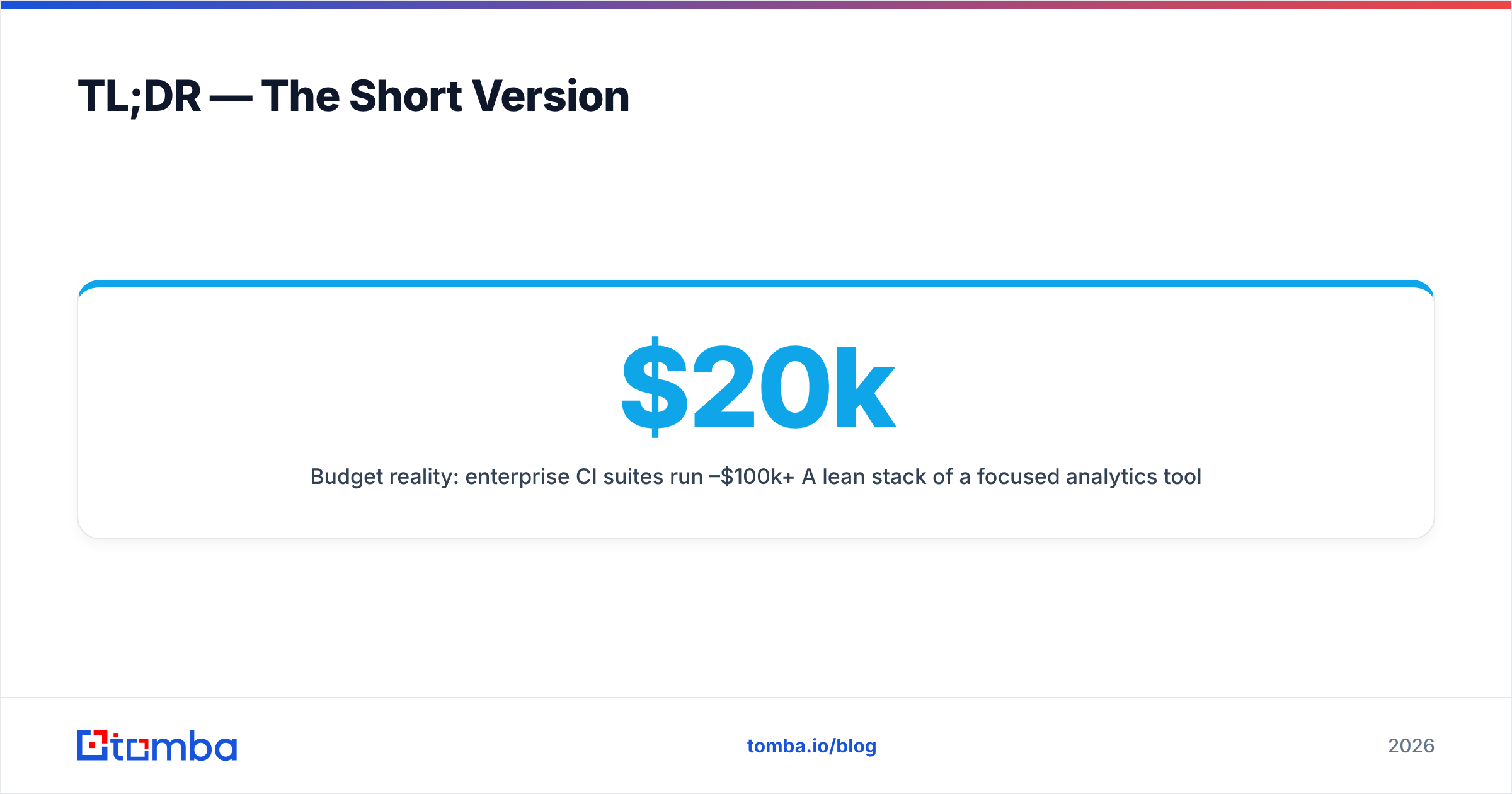
- Budget reality: enterprise CI suites run $20k–$100k+/year. A lean stack of a focused analytics tool plus a data enrichment layer can cover 80% of the need for a fraction of that.
- Pick by the decision you're trying to win — pricing changes, displacement deals, or category positioning — not by feature-list length.
What Are Competitive Intelligence Tools?#
Competitive intelligence tools are software that collects, structures, and distributes information about your competitors and your market so your team can make faster, better-informed decisions. Think of it like a coach reviewing game film: the raw footage (a competitor's new landing page, a pricing tweak, a hiring spree) is meaningless until someone tags it, clips the important moments, and hands your reps a play for next quarter.
In practice these tools span a wide range. Some watch public web signals; others tap licensed B2B databases; a few focus purely on packaging intel into battlecards your sales team reads inside the CRM.
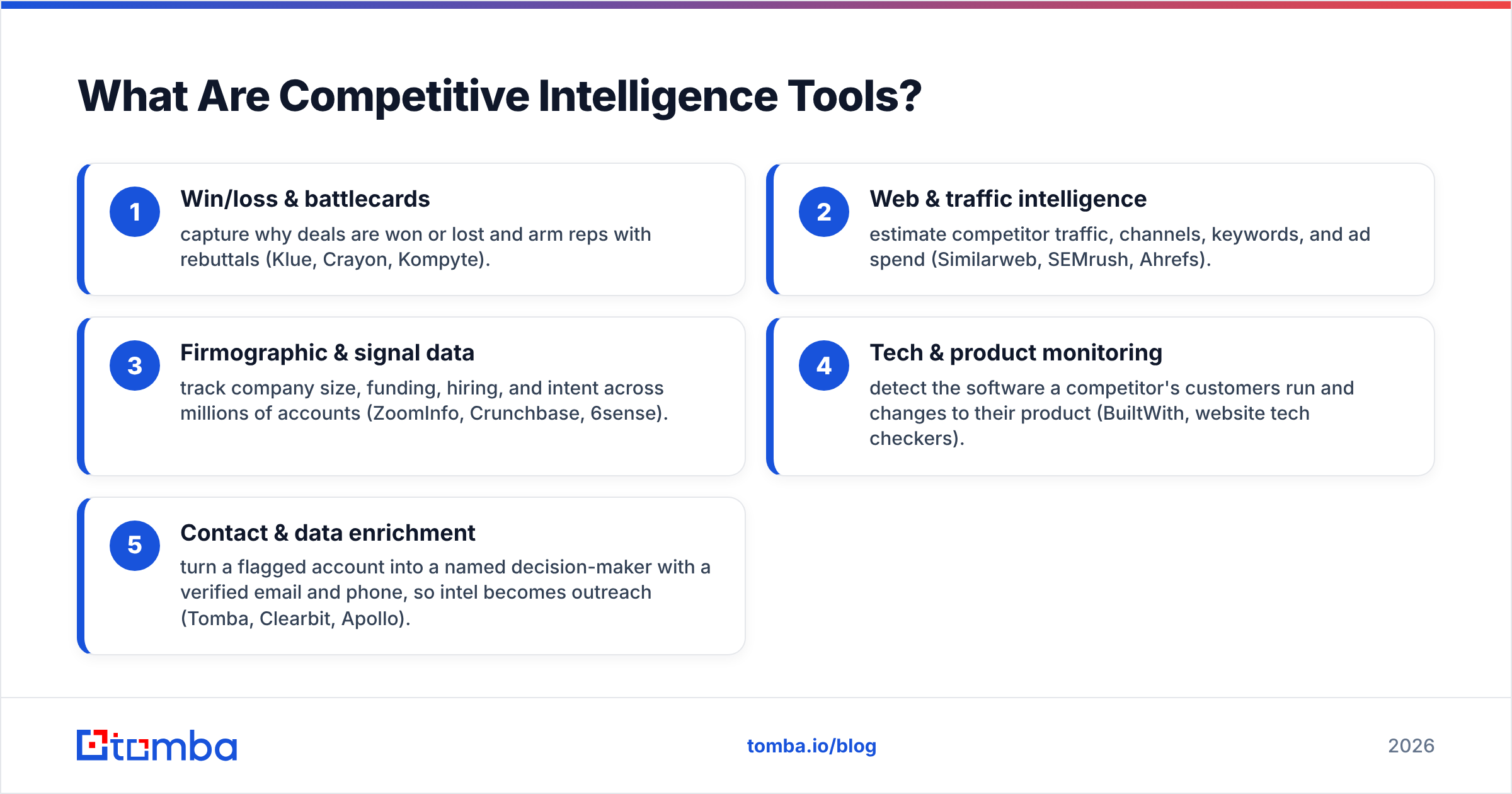
The category breaks down into five core jobs. When you evaluate the best competitive intelligence tools, map each candidate to the job you actually need filled:
- Win/loss & battlecards — capture why deals are won or lost and arm reps with rebuttals (Klue, Crayon, Kompyte).
- Web & traffic intelligence — estimate competitor traffic, channels, keywords, and ad spend (Similarweb, SEMrush, Ahrefs).
- Firmographic & signal data — track company size, funding, hiring, and intent across millions of accounts (ZoomInfo, Crunchbase, 6sense).
- Tech & product monitoring — detect the software a competitor's customers run and changes to their product (BuiltWith, website tech checkers).
- Contact & data enrichment — turn a flagged account into a named decision-maker with a verified email and phone, so intel becomes outreach (Tomba, Clearbit, Apollo).
That last layer is the one most CI buyers underestimate. Knowing a competitor just lost a logo is interesting; knowing the email of the VP who churned is a pipeline.

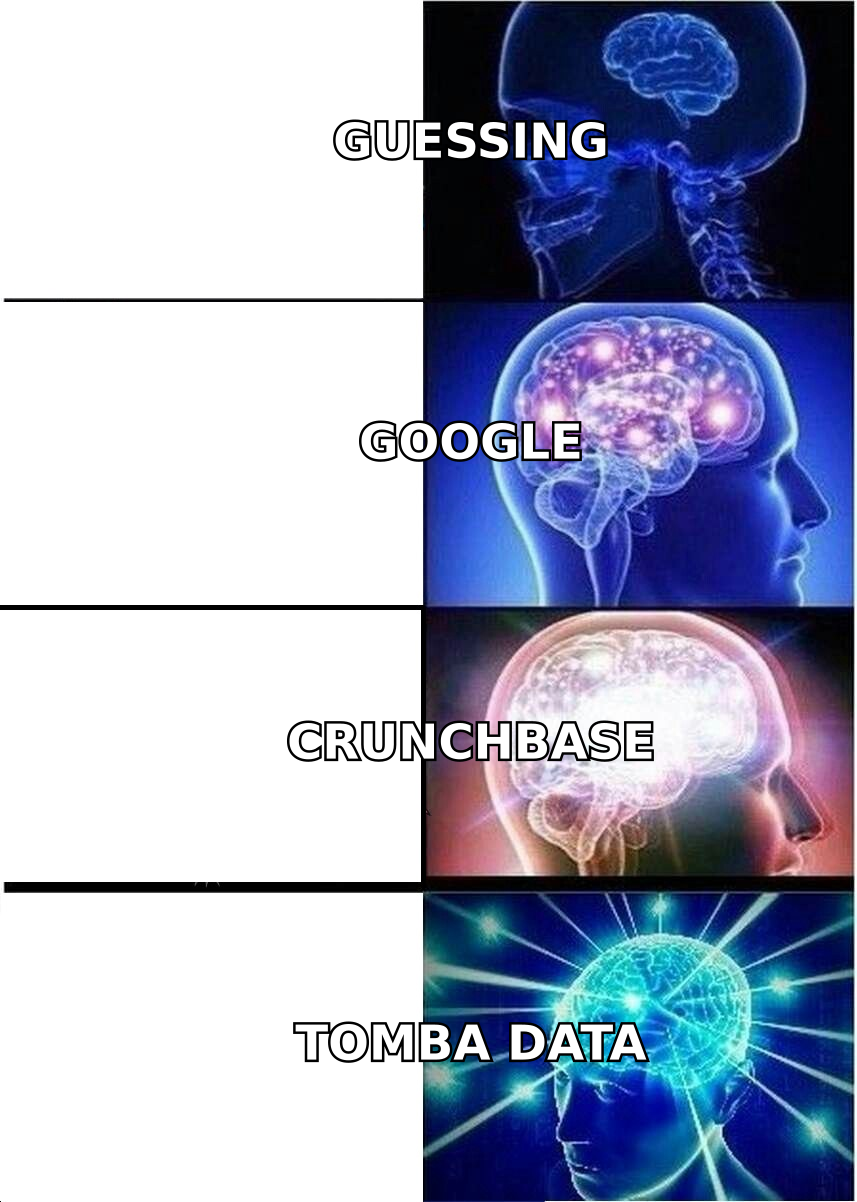
Ignore the brain — kidding. Here is the real escalation most teams climb:
Why Do You Need a Competitive Intelligence Stack in 2026?#
Because your competitors ship faster than your sales notes update. According to Gartner, buyers now spend the majority of their journey researching independently before they ever talk to a rep — which means by the time a deal reaches your pipeline, the prospect has already compared you to three alternatives. If your team can't speak to those alternatives credibly, you lose on confidence, not product.
A working CI stack pays for itself in three concrete ways:
- Higher win rates on competitive deals. Reps armed with current battlecards close displacement deals more often. This is the single most-cited ROI metric for tools like Klue and Crayon.
- Faster pricing and positioning reactions. When a rival drops a price or launches a feature, you hear about it in days, not at the next quarterly review.
- Smarter outbound targeting. When a competitor raises a round or churns a customer, that's a buying signal — and a reason to reach out now.
The catch: intelligence you can't act on is trivia. That's why the enrichment layer matters. A traffic-analytics tool can tell you a competitor's customer base is growing; only a data enrichment workflow turns "their customers are X-type companies" into a list of named contacts you can email this week.
What Are the Best Competitive Intelligence Tools? (Comparison Table)#
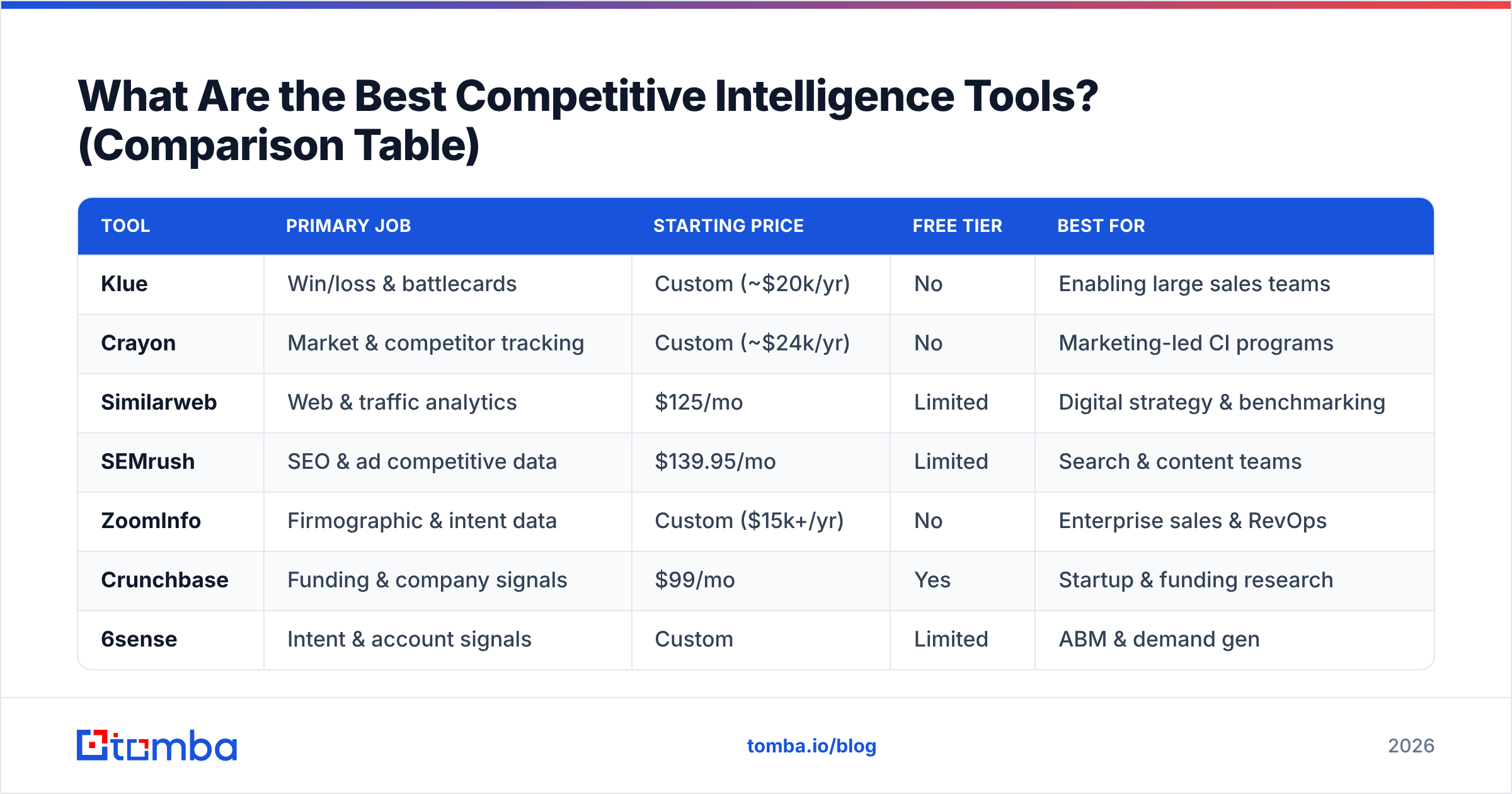
Here's how the leading platforms compare across the attributes that actually drive a buying decision. Pricing reflects publicly available 2026 entry points; enterprise quotes vary widely.
| Tool | Primary job | Starting price | Free tier | Best for |
|---|---|---|---|---|
| Klue | Win/loss & battlecards | Custom (~$20k/yr) | No | Enabling large sales teams |
| Crayon | Market & competitor tracking | Custom (~$24k/yr) | No | Marketing-led CI programs |
| Similarweb | Web & traffic analytics | $125/mo | Limited | Digital strategy & benchmarking |
| SEMrush | SEO & ad competitive data | $139.95/mo | Limited | Search & content teams |
| ZoomInfo | Firmographic & intent data | Custom ($15k+/yr) | No | Enterprise sales & RevOps |
| Crunchbase | Funding & company signals | $99/mo | Yes | Startup & funding research |
| 6sense | Intent & account signals | Custom | Limited | ABM & demand gen |
| Tomba | Contact data & enrichment | $49/mo | Yes (25/mo) | Turning intel into outreach |
Two things stand out. First, the battlecard and firmographic leaders are almost all "call us" pricing, which means real budget commitment and procurement cycles. Second, the analytics and enrichment tools — Similarweb, Crunchbase, Tomba — publish transparent pricing and offer entry points a single team can expense without a committee.
Which Competitive Intelligence Tool Is Right for Your Team?#
The answer depends on which decision you're trying to win. Here's how to match the category to your situation.
If your bottleneck is competitive sales deals: Start with Klue or Crayon. Both pull competitor signals and package them into battlecards that live where reps work. Klue leans harder into sales enablement and win/loss; Crayon leans into broad market monitoring for marketing teams. Check current user sentiment on G2 before committing — the two trade the top spot regularly.
If your bottleneck is understanding market and channel strategy: Similarweb is the reference standard for traffic estimation, audience overlap, and channel mix. Pair it with SEMrush or Ahrefs if search and paid media are where you compete. These tools answer "where are they getting customers?" better than any battlecard platform.
If your bottleneck is account-level targeting and signals: ZoomInfo and 6sense dominate enterprise firmographic and intent data, but the price reflects it. Crunchbase is a strong, affordable alternative when funding events and company growth are your main signals.
If your bottleneck is acting on the intel you already have: This is where most stacks leak value. You've identified the accounts and the signals — now you need the people. A domain search pulls every reachable contact at a target company, and an email verifier keeps your bounce rate low so your outreach actually lands.
How Do CI Data Tools Actually Source Their Information?#
Two methods, and the difference matters for accuracy. The first is public web scraping and estimation — crawling sites, ad libraries, app stores, and traffic panels to infer competitor activity. Similarweb, SEMrush, and most monitoring tools work this way. It's broad but probabilistic; traffic estimates can be directionally right and numerically off.
The second is licensed and contributed datasets — firmographic records, verified contacts, and intent signals sourced from data partnerships and validated against live signals. ZoomInfo, Clearbit, and contact platforms like Tomba sit here. The quality question becomes: how fresh is the data, and how is it verified?
For contact data specifically, freshness is everything. A list of "decision-makers" that's 18 months stale is worse than useless — it bounces, hurts your sender reputation, and burns rep time. This is why a verification step is non-negotiable. Tools that combine sourcing with real-time validation (the model behind Tomba's data sources) avoid the slow decay that plagues static databases. If you're running competitive outreach at volume, a bulk email finder that verifies as it finds will save you from torching deliverability on a stale list.
What Does a CI Stack Cost, and Where Should You Spend?#
Conclusion first: spend big on the one job that maps to your biggest revenue lever, and stay lean everywhere else.
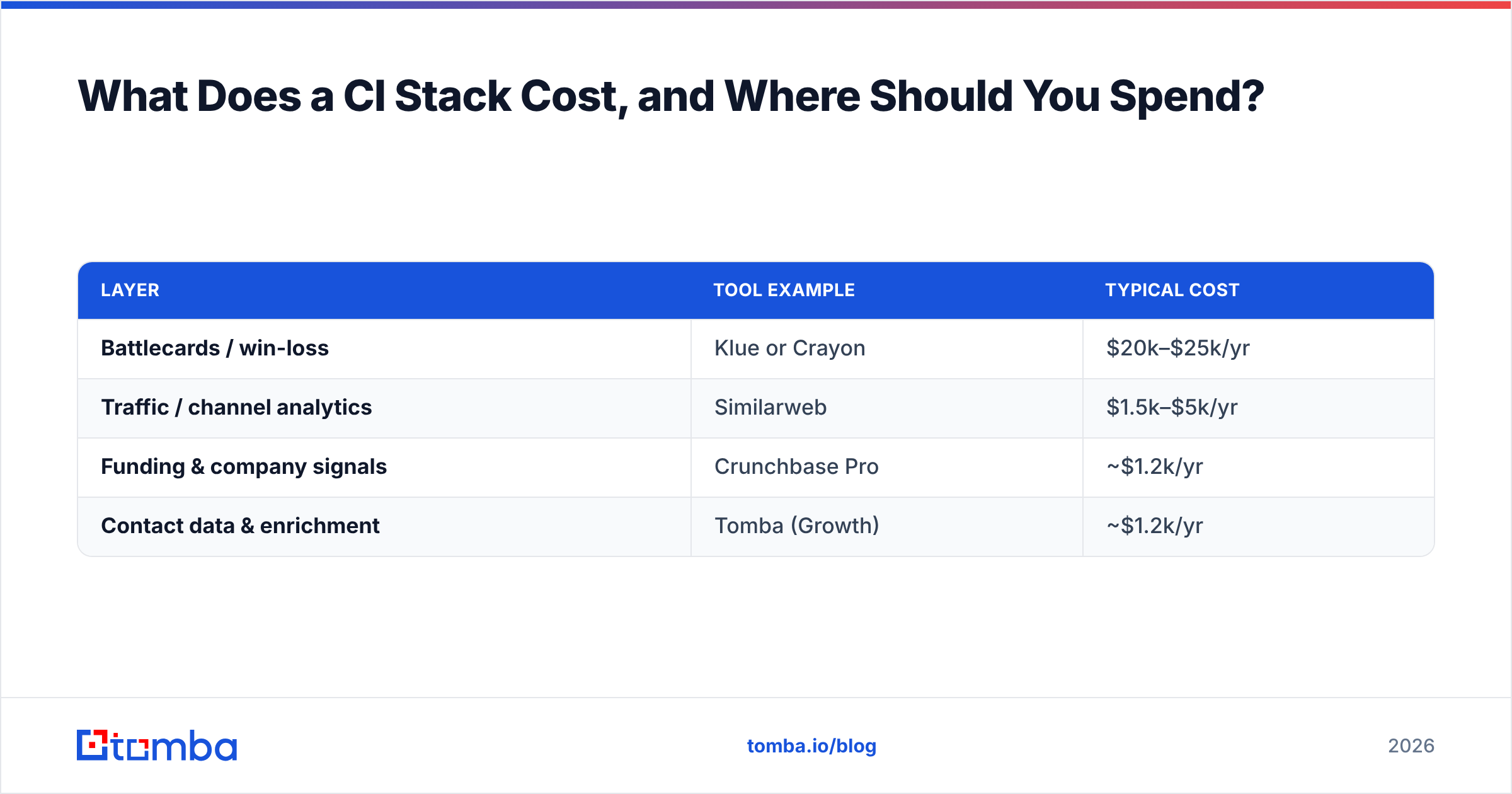
A common, sensible 2026 stack for a mid-market team looks like this:
| Layer | Tool example | Typical cost |
|---|---|---|
| Battlecards / win-loss | Klue or Crayon | $20k–$25k/yr |
| Traffic / channel analytics | Similarweb | $1.5k–$5k/yr |
| Funding & company signals | Crunchbase Pro | ~$1.2k/yr |
| Contact data & enrichment | Tomba (Growth) | ~$1.2k/yr |
That's a real CI program for under $35k/year, with the heaviest spend concentrated where it directly affects win rate. Enterprises layering in ZoomInfo and 6sense can easily push past $100k — justified only if account-based intent at scale is the core motion.
The mistake to avoid is paying enterprise prices for capabilities you'll use at 10% capacity. If your team is five reps, you don't need a six-figure intent platform; you need clean battlecards and a reliable way to reach the right people. Start with transparent-pricing tools, prove the ROI, then graduate to the heavyweight suites when the volume justifies them.
How Do You Roll Out Competitive Intelligence Without It Going Stale?#
The graveyard of CI programs is full of beautiful battlecards no one opened after month two. Three habits keep a program alive:
- Assign an owner. Intelligence with no owner decays instantly. One person (or a small CI team) must curate, validate, and distribute.
- Push, don't pull. Reps won't visit a portal. Deliver intel where they already are — Slack alerts, CRM cards, deal-room briefs. The best tools integrate directly into HubSpot or Salesforce so updates reach reps in context.
- Close the loop with outcomes. Tie battlecards to win/loss data. If a card isn't moving win rate, fix or kill it.
And tie the intel to action. When a monitoring tool flags that a competitor just lost a major account, that signal should trigger a workflow: identify the buying committee, enrich the contacts, and queue outreach. Connecting your CI tools to an enrichment pipeline via Zapier or the Tomba API is what separates a program that informs from one that drives pipeline.
The Bottom Line#
The best competitive intelligence tools in 2026 aren't a single platform — they're a deliberate stack. Choose a battlecard tool if competitive deals are your battleground, a traffic-analytics tool to understand how rivals win customers, and a data layer to track the signals that matter. But none of it produces revenue until you can act on it.
That's the gap an enrichment layer closes. Once your CI tools surface the accounts and signals worth chasing, Tomba's Email Finder turns those targets into verified, reachable decision-makers — by domain, name, or company, with verification built in so your outreach lands instead of bouncing. Start free with 25 searches a month, and connect the intelligence you already have to the people who can actually move a deal. Your competitors are already watching. Make sure you can do something about what you see.
// get started
Find, verify and enrich your first contacts today
Start on the free plan with 25 searches a month, then scale when your team is ready.
Free plan · No credit card required · GDPR & CCPA
// about the author