The Best Networks for Social Selling in 2026, Ranked
LinkedIn, X, Instagram, or YouTube? A neutral breakdown of the best networks for social selling in 2026 — ranked by intent, reach, and conversion, with a data workflow that turns engagement into pipeline.
TL;DR
- The best networks for social selling in 2026 are simply the ones your buyers already use — the right pick depends on your buyer, not on follower counts. LinkedIn still wins B2B; X leads for technical and founder-led sales; YouTube compounds trust; Instagram and TikTok suit prosumer and SMB plays.
- Engagement is not pipeline. The reps who win pair social presence with a way to move conversations off-platform into email and phone.
- LinkedIn delivers the highest intent per impression for B2B. But its native messaging is rate-limited and noisy, so exportable contact data is what scales it.
- A simple stack beats spraying yourself across six platforms: one primary network, one secondary, plus an enrichment layer.
- Below: a ranked comparison table, a per-network playbook, and the data workflow that turns likes into booked meetings.
What is social selling, really?#
Social selling is using social networks to find, research, and warm up buyers before — and instead of — a cold pitch. Think of it like being a regular at the local coffee shop versus knocking on strangers' doors. You show up, you're known, and the conversation starts at "oh, you're that person" rather than "who are you and why are you emailing me?"
Technically, it blends three things: content, engagement, and outreach. You post useful things. You comment on a prospect's posts. You send DMs and connection requests. The networks are just the venue. The deal still closes in a thread, a call, or an inbox. That is why two things matter: your choice of network and your follow-up system.
If you want the textbook definition, here is a clean primer on social selling. The rest of this post is about which venues are worth your hours in 2026.
The best networks for social selling in 2026, compared#
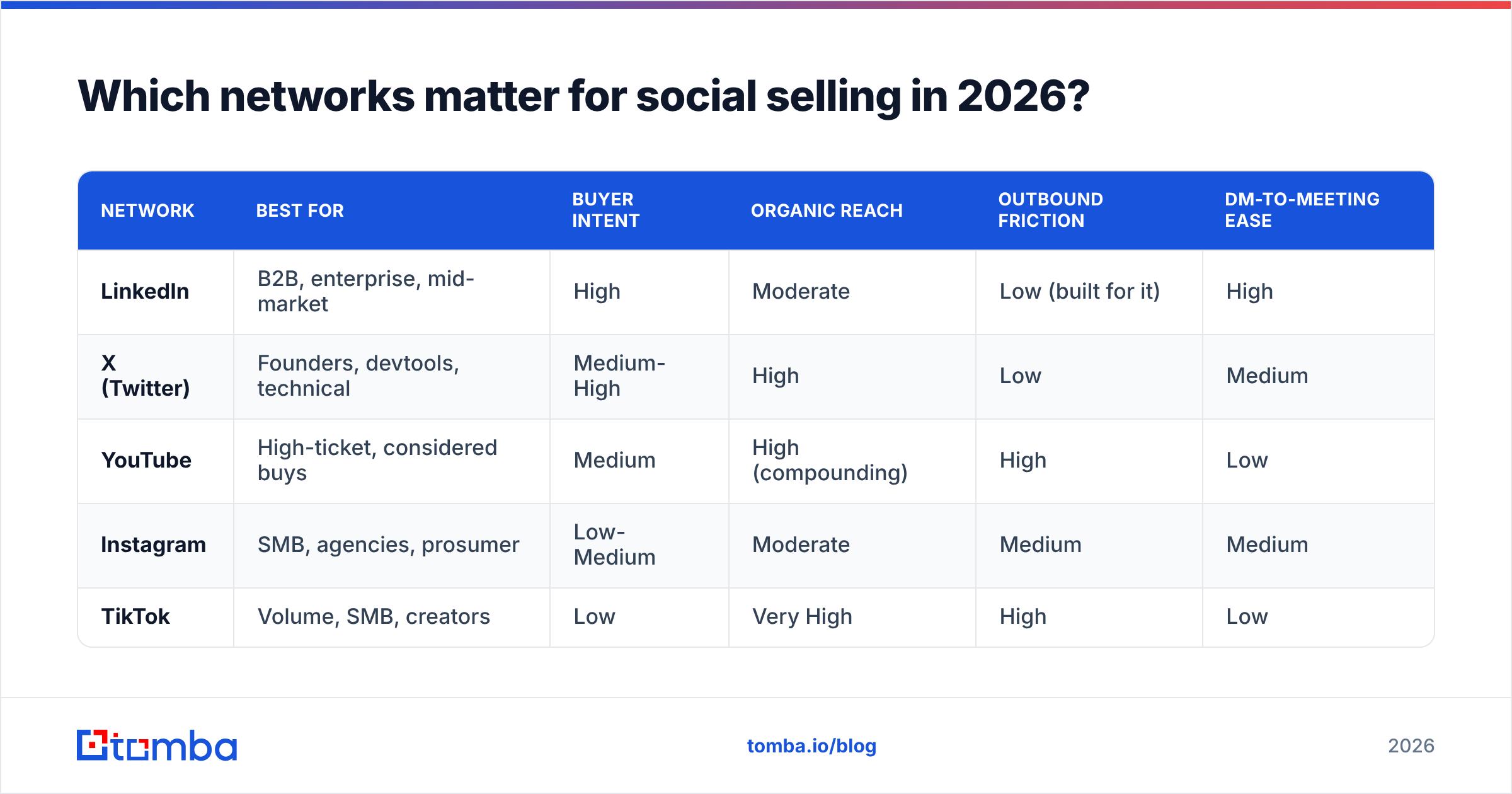
Five platforms carry almost all B2B and prosumer social selling today: LinkedIn, X (formerly Twitter), YouTube, Instagram, and TikTok. Each rewards a different behavior and reaches a different buyer.
Here is how they stack up on the attributes that actually predict pipeline:
| Network | Best for | Buyer intent | Organic reach | Outbound friction | DM-to-meeting ease |
|---|---|---|---|---|---|
| B2B, enterprise, mid-market | High | Moderate | Low (built for it) | High | |
| X (Twitter) | Founders, devtools, technical | Medium-High | High | Low | Medium |
| YouTube | High-ticket, considered buys | Medium | High (compounding) | High | Low |
| SMB, agencies, prosumer | Low-Medium | Moderate | Medium | Medium | |
| TikTok | Volume, SMB, creators | Low | Very High | High | Low |
Two columns deserve a note. Buyer intent is whether people on the platform are in a buying headspace. LinkedIn users tolerate business talk. TikTok users are there to be entertained. DM-to-meeting ease is how naturally a chat turns into a booked call without feeling forced. Reach gets you seen. Intent gets you paid.
Is LinkedIn still the best network for social selling?#
Yes — for most B2B sellers, LinkedIn remains the single best network for social selling in 2026. It is the only major platform where talking about work is the norm. Job titles, companies, and seniority are public by design.
What LinkedIn does well:
- Native intent. People expect business conversations, so a thoughtful connection note rarely feels intrusive.
- Targeting clarity. Title, company, and tenure are visible, which makes account-based plays straightforward.
- Content distribution. A single useful post can reach buyers you never directly contacted.
- Warm pathways. Commenting on a prospect's post for two weeks before reaching out genuinely changes reply rates.
Where it falls short: native messaging is throttled, InMail is expensive, and connection limits cap your weekly volume. That ceiling is exactly why serious teams export the relationship off LinkedIn. Once you have found the right person, pair their profile with a verified work email. Then the conversation can continue in a channel you control. Tools like the LinkedIn finder exist for precisely this hand-off — turning a profile you engaged with into a reachable contact.
For a deeper tactical breakdown, this guide on LinkedIn outreach covers connection-request and message sequencing in more detail.
When is X (Twitter) the better choice?#
X wins when you sell to founders, developers, marketers, or anyone who lives in public. For the right account, it has higher organic reach than LinkedIn. The barrier to a genuine reply is also lower. A smart comment on someone's thread can start a relationship in a day.
X is strongest for:
- Founder-led and devtools sales, where the buyer is active and reachable.
- Building in public, where your own posting creates inbound.
- Speed — conversations move fast and informally.
The catch is intent variance. X is a mixed crowd, and a viral post brings followers who will never buy. Treat it as top-of-funnel awareness and relationship-building. Then qualify hard before you invest sales time. Buyer-intent signals matter more here than raw follower growth — see how marketing qualified lead scoring helps separate fans from prospects.
Does YouTube belong in a social selling stack?#
YouTube is the most underrated social selling network for high-ticket and considered purchases. It is not a place for DMs; it is a place for trust that compounds. A 12-minute walkthrough you posted a year ago still books calls today, which no LinkedIn post can claim.
Use YouTube when:
- Your sales cycle is long and education-heavy.
- Buyers research extensively before talking to sales.
- You can repurpose one video into clips for X, LinkedIn, and Instagram.
The trade-off is production cost and a weak outbound path. You cannot easily message a viewer. So YouTube earns its place as a trust engine that feeds your other channels, not as a primary prospecting tool.
What about Instagram and TikTok?#
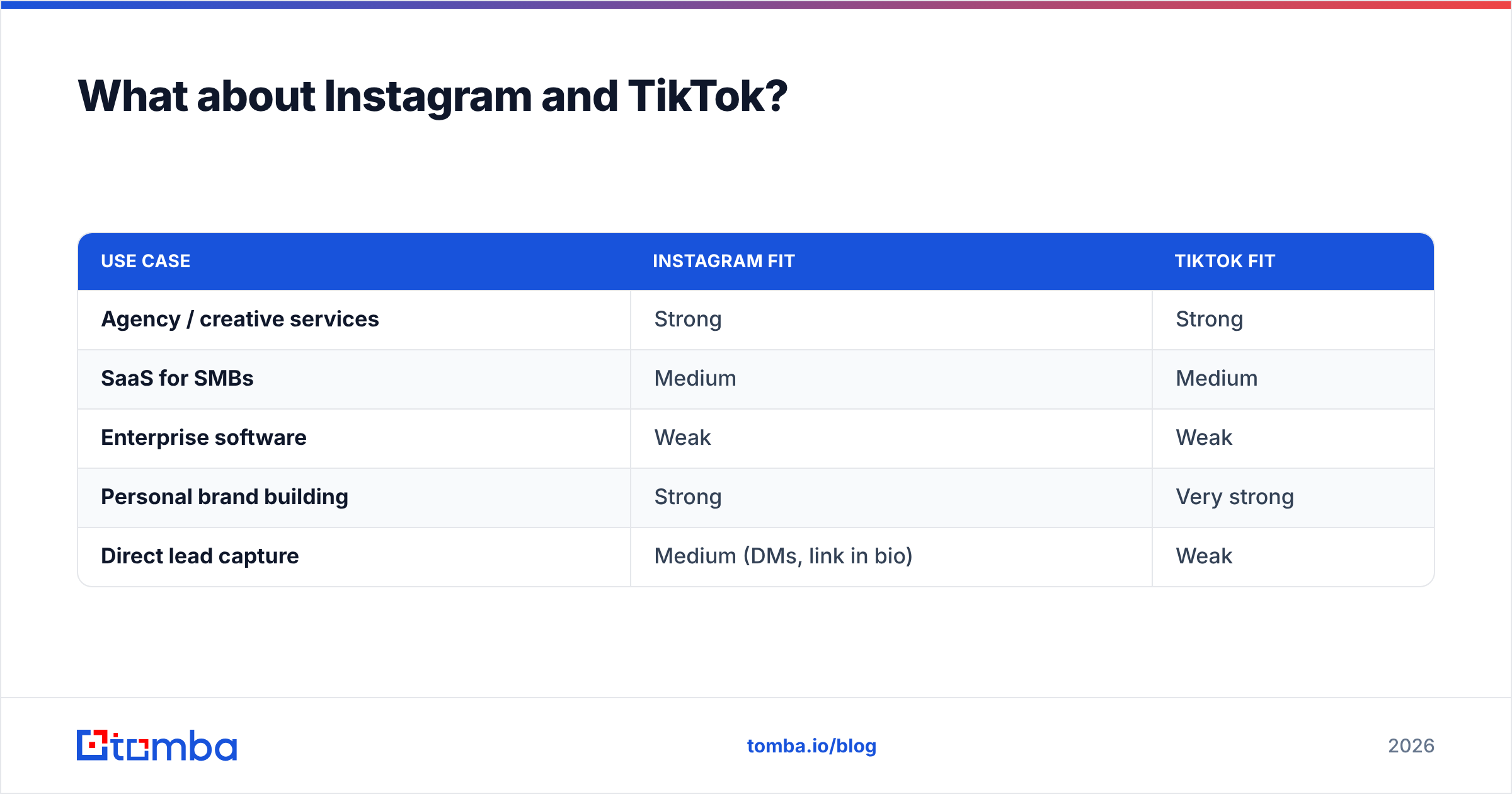
Instagram and TikTok are situational for B2B and strong for prosumer, agency, and SMB sales. They deliver enormous reach and almost no native buyer intent. That combination only works if your offer sells on emotion and visuals rather than spec sheets.
| Use case | Instagram fit | TikTok fit |
|---|---|---|
| Agency / creative services | Strong | Strong |
| SaaS for SMBs | Medium | Medium |
| Enterprise software | Weak | Weak |
| Personal brand building | Strong | Very strong |
| Direct lead capture | Medium (DMs, link in bio) | Weak |
For most B2B teams these are secondary or experimental channels. For a solo consultant or a local service business, they can be the whole game. Match the venue to the buyer, not to the hype.
How do you turn social engagement into actual pipeline?#
You move the conversation off the platform and into a channel you own. This is the step most social sellers skip, and it is the difference between a big following and a full calendar.
The realization that separates top reps from busy ones is simple: social networks rent you attention, but they own the relationship. The moment an algorithm shifts or an account gets restricted, your "pipeline" evaporates. Email and phone are assets you keep.
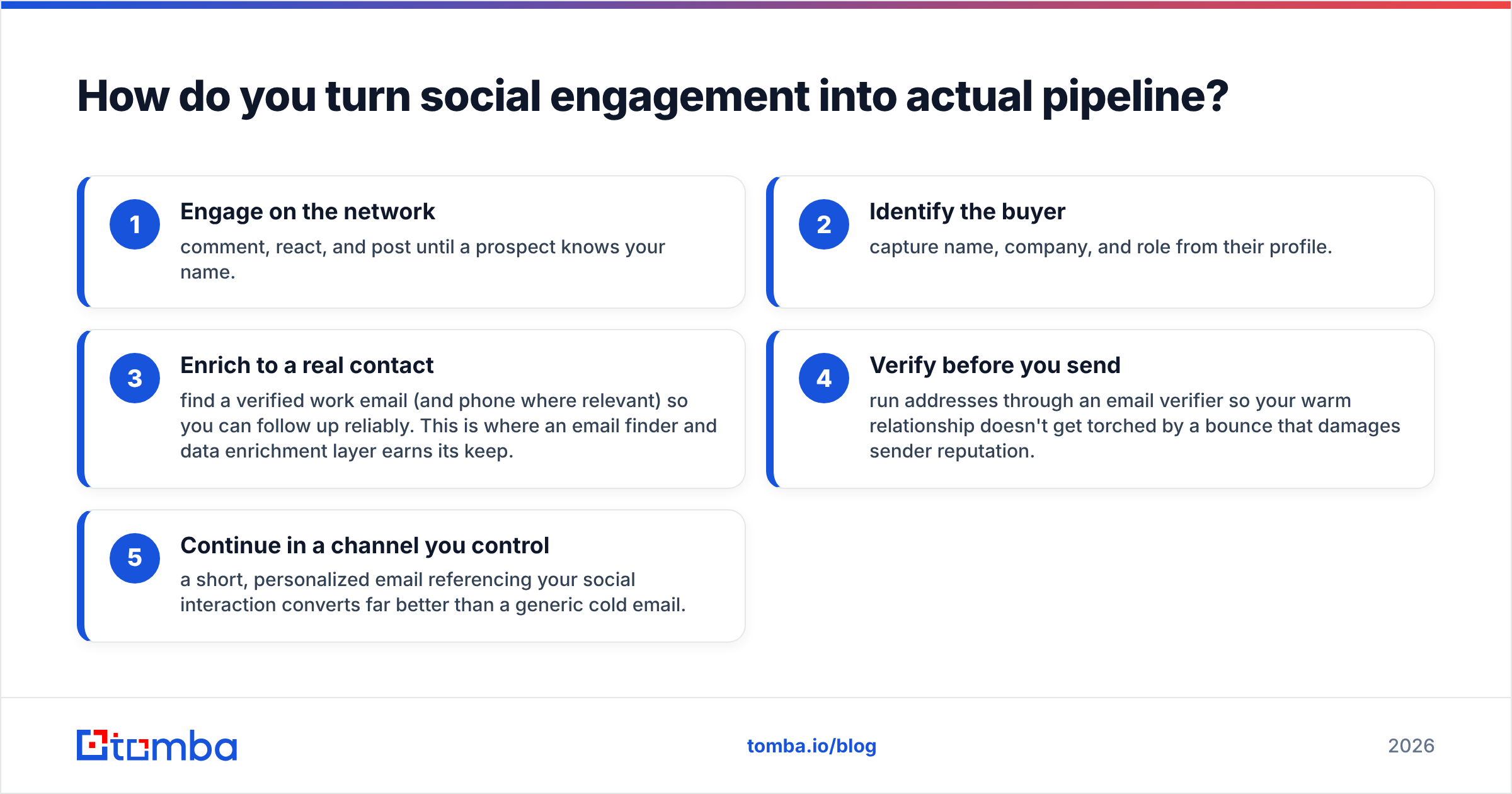
Here is the workflow that consistently works:
- Engage on the network — comment, react, and post until a prospect knows your name.
- Identify the buyer — capture name, company, and role from their profile.
- Enrich to a real contact — find a verified work email (and phone where relevant) so you can follow up reliably. This is where an email finder and data enrichment layer earns its keep.
- Verify before you send — run addresses through an email verifier so your warm relationship doesn't get torched by a bounce that damages sender reputation.
- Continue in a channel you control — a short, personalized email referencing your social interaction converts far better than a generic cold email.
The reason this matters is deliverability. A list full of guessed or stale addresses tanks your email deliverability and your domain reputation. That quietly kills every campaign after it. Verified, enriched contacts keep your sender reputation clean and your replies flowing.
How should you choose your primary network?#
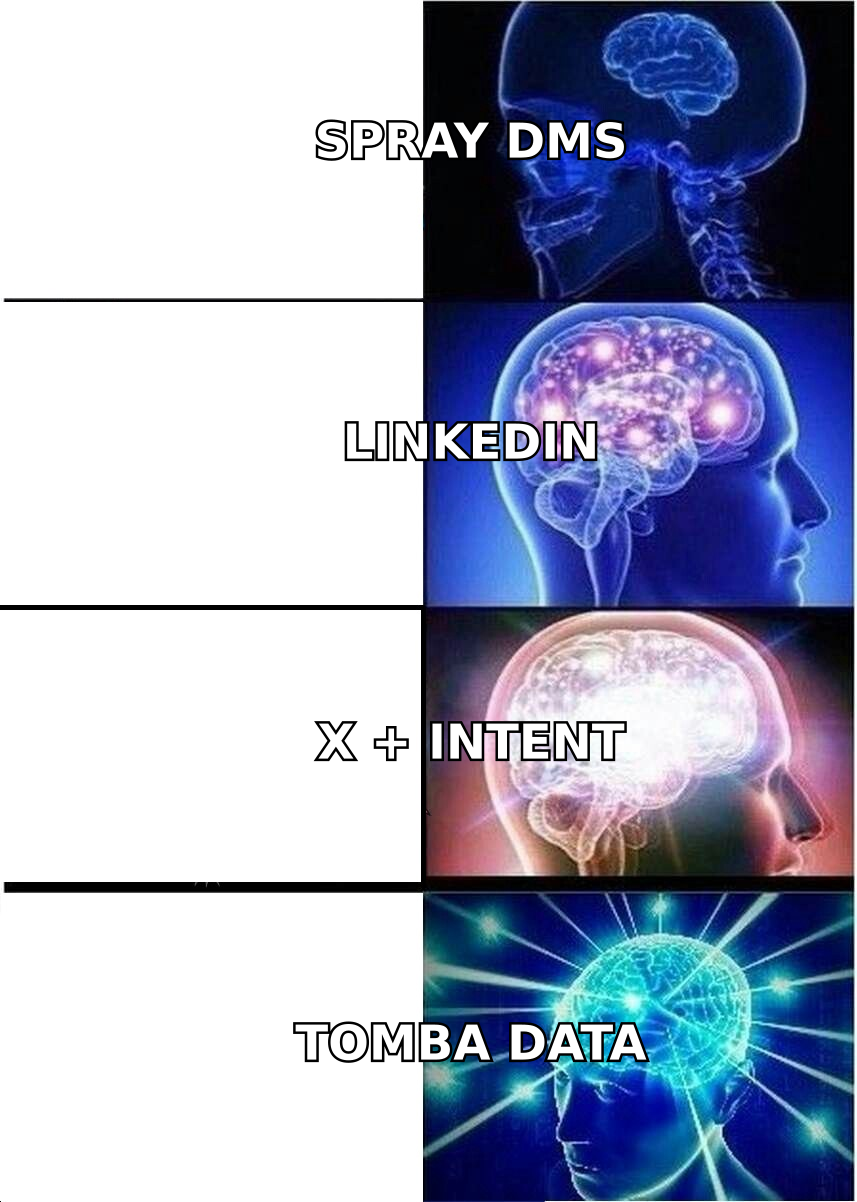
Among the best networks for social selling, pick one primary where your buyers already gather, one secondary for reach, and an enrichment layer to convert. Spreading thin across all five is the most common mistake. You end up mediocre everywhere instead of dominant somewhere.
A quick decision framework:
- Selling B2B software or services? Primary: LinkedIn. Secondary: X or YouTube.
- Selling devtools or founder-facing products? Primary: X. Secondary: LinkedIn.
- Selling high-ticket, education-heavy offers? Primary: YouTube. Secondary: LinkedIn.
- Selling to SMBs, local, or prosumer? Primary: Instagram or TikTok. Secondary: LinkedIn for credibility.
Whatever you pick, the conversion layer stays the same: identify, enrich, verify, follow up. The network changes; the data discipline doesn't.
How do the platforms compare on real social-selling ROI?#
Think of social-selling ROI as a simple formula: intent times reach, divided by effort. Then multiply by how well you convert attention into owned contact data. A platform with huge reach and no conversion path scores poorly — think TikTok for enterprise. A modest-reach, high-intent platform with a clean hand-off wins — think LinkedIn plus enrichment.
| Network | Time-to-first-meeting | Effort per meeting | Scales with automation | Best paired with |
|---|---|---|---|---|
| Fast | Medium | Yes (with export + enrichment) | Email + phone follow-up | |
| X | Fast | Low-Medium | Partially | Email follow-up |
| YouTube | Slow | High upfront | Indirectly | Retargeting + email capture |
| Medium | Medium | Limited | DM + link-in-bio capture | |
| TikTok | Slow | High | Limited | Landing page + email capture |
Notice the right-hand column. Every network's ROI improves when you add an email or phone follow-up path. That is not a coincidence — it is the structural truth of social selling. The platforms are the top of the funnel; owned contact data is the conversion engine. You can compare the cost of that engine on the Tomba pricing page, where the Free tier (25 searches/month) is enough to test the workflow before you commit.
For independent platform benchmarks and user reviews to sanity-check your own choice, G2's social selling category and HubSpot's research on social selling are both solid, vendor-neutral references.

What is the simplest stack that actually works?#
The leanest effective social selling stack has three layers: one content/engagement network, one enrichment-and-verification tool, and one outbound channel. That's it.
- Layer 1 — Presence: LinkedIn (or X), where you post and engage daily.
- Layer 2 — Data: an enrichment and verification tool that turns engaged profiles into verified emails and phone numbers.
- Layer 3 — Conversion: personalized email and phone follow-up that references your social touch.
Everything else — schedulers, analytics, CRMs — is optional polish. The two non-negotiables are showing up where buyers are and being able to reach them reliably once they notice you.
The bottom line#
The best network for social selling in 2026 is the one your buyers already use, worked deeply rather than dabbled in. For most B2B teams that's LinkedIn, with X and YouTube as strong specialist plays and Instagram or TikTok reserved for prosumer and SMB motions. But the network is only half the equation. Engagement that never leaves the platform is a hobby; engagement you convert into verified, owned contact data is a pipeline.
That conversion layer is where Tomba fits. When a prospect engages with you on LinkedIn or X, the Tomba Email Finder turns that profile into a verified, deliverable work email in seconds — so your warm social conversation continues in an inbox you control, not at the mercy of an algorithm. Start free with 25 searches a month, pair it with the built-in verifier to protect your sender reputation, and turn your social presence into booked meetings. Your followers are already paying attention; give yourself a reliable way to reach them.
// get started
Find, verify and enrich your first contacts today
Start on the free plan with 25 searches a month, then scale when your team is ready.
Free plan · No credit card required · GDPR & CCPA
// about the author