Best Open-Ended Sales Questions That Close Deals in 2026
Closed questions get you yes or no. Open-ended sales questions get you the deal. Here are 50+ field-tested prompts that surface budget, pain, and urgency in 2026.
TL;DR#
- Open-ended sales questions start with what, how, why, or "walk me through" and force prospects to explain instead of answering yes or no — they uncover budget, pain, and timing that closed questions never reach.
- The best reps spend roughly 60% of a discovery call listening, not pitching. Open questions are how you earn that ratio.
- Use a layered sequence: situation → problem → impact → vision → commitment. Each layer builds on the last.
- We've collected 50+ open-ended questions below, sorted by sales stage, plus a comparison of open vs. closed framing.
- Great questions are worthless if you call the wrong person. Build a clean contact list first with a reliable email finder so your discovery time goes to real decision-makers.
What are open-ended sales questions?#
Open-ended sales questions are prompts that can't be answered with a single word. Instead of "Do you use a CRM?" you ask "How does your team track deals today?" The first gets a yes. The second gets a story — tools, frustrations, workarounds, and the name of the person who hates the current setup.
Think of it like a doctor's appointment. A bad doctor asks "Does it hurt?" A good one asks "Tell me what's been going on." The second question gives them the symptoms they didn't know to look for. Your prospect is the same: they rarely volunteer the real problem until you create room for it.
Closed questions still have a place — they confirm facts and lock down next steps. But discovery, qualification, and objection handling all live in open territory.
)
Why do open-ended questions outperform closed ones?#
Three reasons, and they compound.
- They surface information you didn't know to ask for. A closed question can only confirm a hypothesis you already had. An open one lets the prospect lead you somewhere new — often the real reason a deal stalls.
- They shift the talk ratio. Gong's analysis of sales calls consistently shows top performers let the buyer talk more during discovery. Open questions are the mechanism. You can read more on conversation analytics at Gong's research.
- They build trust. People feel understood when they get to explain themselves. That feeling is what makes a buyer pick you over a cheaper competitor.
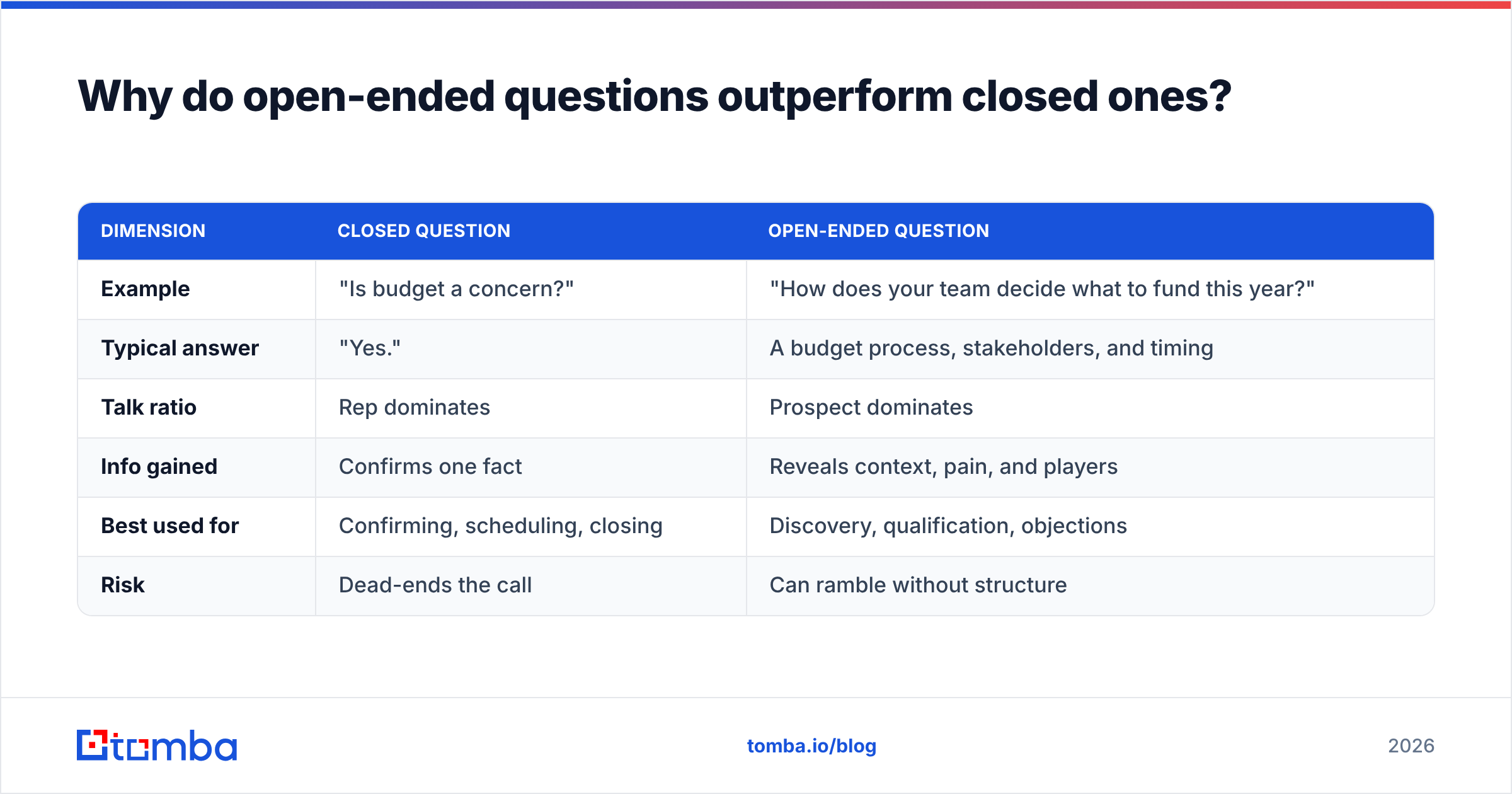
Here's the contrast in practice:
| Dimension | Closed question | Open-ended question |
|---|---|---|
| Example | "Is budget a concern?" | "How does your team decide what to fund this year?" |
| Typical answer | "Yes." | A budget process, stakeholders, and timing |
| Talk ratio | Rep dominates | Prospect dominates |
| Info gained | Confirms one fact | Reveals context, pain, and players |
| Best used for | Confirming, scheduling, closing | Discovery, qualification, objections |
| Risk | Dead-ends the call | Can ramble without structure |
The takeaway: closed questions narrow, open questions widen. You need both, but most reps under-use the wide ones.
What are the best open-ended sales questions by stage?#
Below are field-tested prompts grouped by where they fit in the cycle. Steal them verbatim or adapt the framing.
Discovery and situation questions#
These map the current state before you push toward change.
- "Walk me through how your team handles [process] today."
- "What does a typical week look like for the people who'd use this?"
- "How did you end up with your current setup?"
- "What's working well that you'd never want to lose?"
- "Who else touches this process besides your team?"
Problem and pain questions#
Now you find the friction. Pain is the fuel for any deal.
- "What's the most frustrating part of the way things work now?"
- "When this breaks, what happens next?"
- "How often does that come up in a given month?"
- "What have you already tried to fix it, and how did that go?"
- "If nothing changes, where does this leave you in six months?"
Impact and cost-of-inaction questions#
Make the pain quantifiable. A problem without a price tag rarely gets funded.
- "What's that costing you — in hours, dollars, or missed deals?"
- "How does this problem show up for your customers?"
- "Who upstairs feels this most, and what do they say about it?"
- "If you solved this tomorrow, what would change for your team?"
Vision and decision questions#
Help them picture the after-state and reveal how they buy.
- "What would 'great' look like a year from now?"
- "Walk me through how a decision like this usually gets made here."
- "Who needs to be comfortable with this before it moves forward?"
- "What's worked — or fallen apart — the last time you rolled out a tool like this?"
Objection-handling and closing questions#
Open framing defuses resistance instead of arguing with it.
- "What's giving you pause?"
- "Help me understand the hesitation — what feels risky?"
- "What would need to be true for this to be an easy yes?"
- "Where would you like to go from here?"
That last one is gold. It hands the prospect the next step instead of forcing yours.
How do you ask open-ended questions without sounding like an interrogation?#
A list of questions is a script. A conversation is a skill. The difference is sequencing and silence.
Layer your questions. Start broad, then drill into whatever the prospect cares about. If they mention a missed quarterly target, follow it — "What drove that?" — rather than marching to the next item on your sheet. This mirrors the SPIN selling structure (Situation, Problem, Implication, Need-payoff) that Neil Rackham documented; you can find the framework summarized on Wikipedia.
Shut up after you ask. The silence after a good question is uncomfortable, and that's the point. Reps who fill it rob the prospect of the chance to think out loud. Count to three before you say anything.
Mirror and label. Repeat the last few words they said, or name the emotion: "Sounds like that rollout really burned the team." It invites them to keep going.
Don't stack questions. Asking three at once lets them answer the easiest and skip the hard one. One question, then listen.
)
How do open-ended questions fit your overall sales process?#
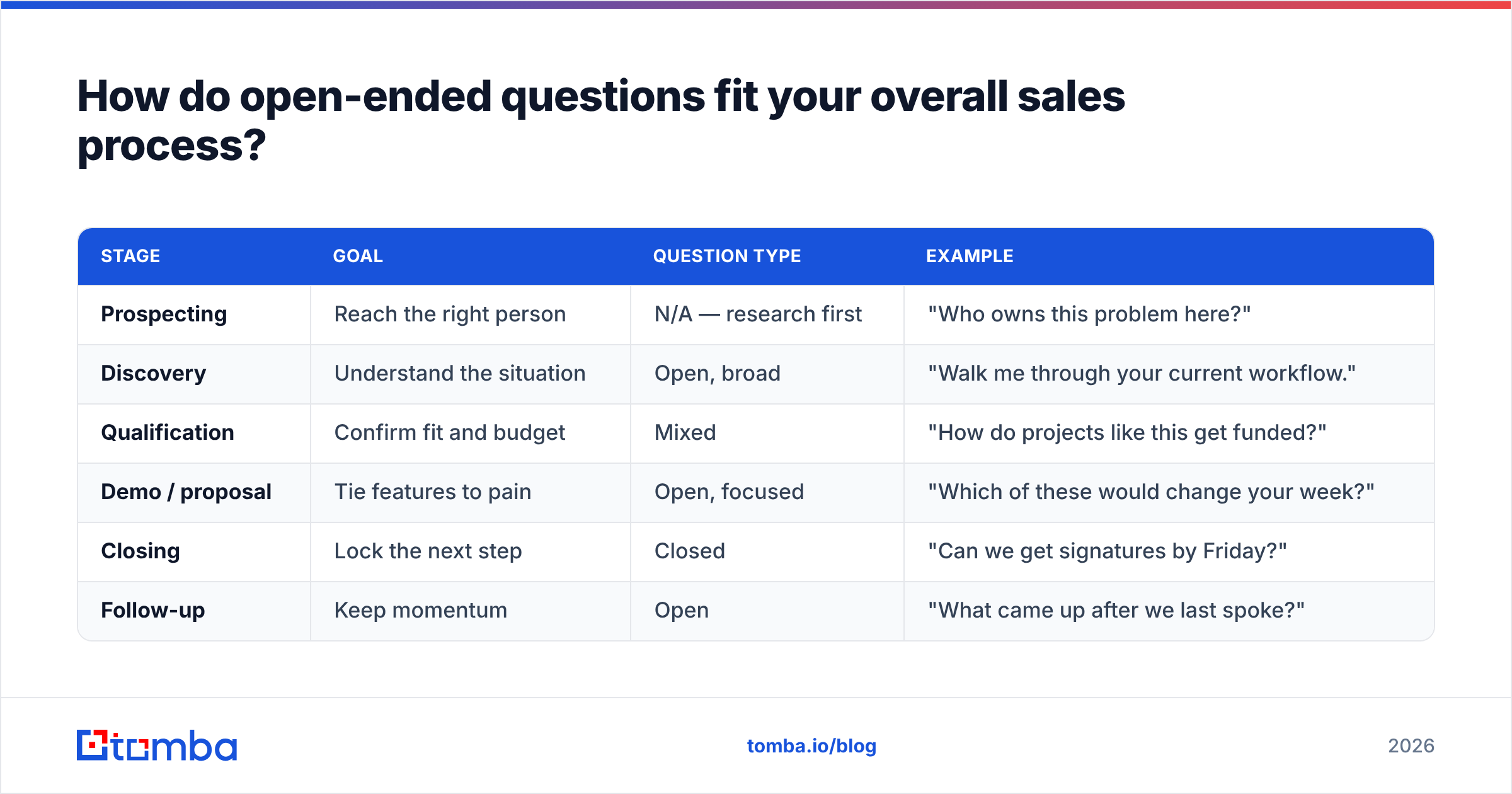
Questions are the engine, but the engine needs fuel and a chassis. Here's where they sit in a healthy sales process and pipeline:
| Stage | Goal | Question type | Example |
|---|---|---|---|
| Prospecting | Reach the right person | N/A — research first | "Who owns this problem here?" |
| Discovery | Understand the situation | Open, broad | "Walk me through your current workflow." |
| Qualification | Confirm fit and budget | Mixed | "How do projects like this get funded?" |
| Demo / proposal | Tie features to pain | Open, focused | "Which of these would change your week?" |
| Closing | Lock the next step | Closed | "Can we get signatures by Friday?" |
| Follow-up | Keep momentum | Open | "What came up after we last spoke?" |
Notice the bookends. Prospecting and follow-up are open and exploratory. Closing is deliberately closed — you want a yes there.
And notice the dependency at the top: discovery only matters if you're talking to the right person. The sharpest questions in the world are wasted on a junior contact who can't buy. That's a data problem, not a skills problem — solve it before the call, not during it. A quick domain search on the target company surfaces the roles you actually need to reach, and verifying those addresses keeps your outreach landing in real inboxes rather than bouncing.
How do you prepare so your questions land?#
Research is what separates a question that sounds generic from one that lands. "How's business?" is filler. "I saw you just opened a second location — how's the new team ramping?" earns attention.
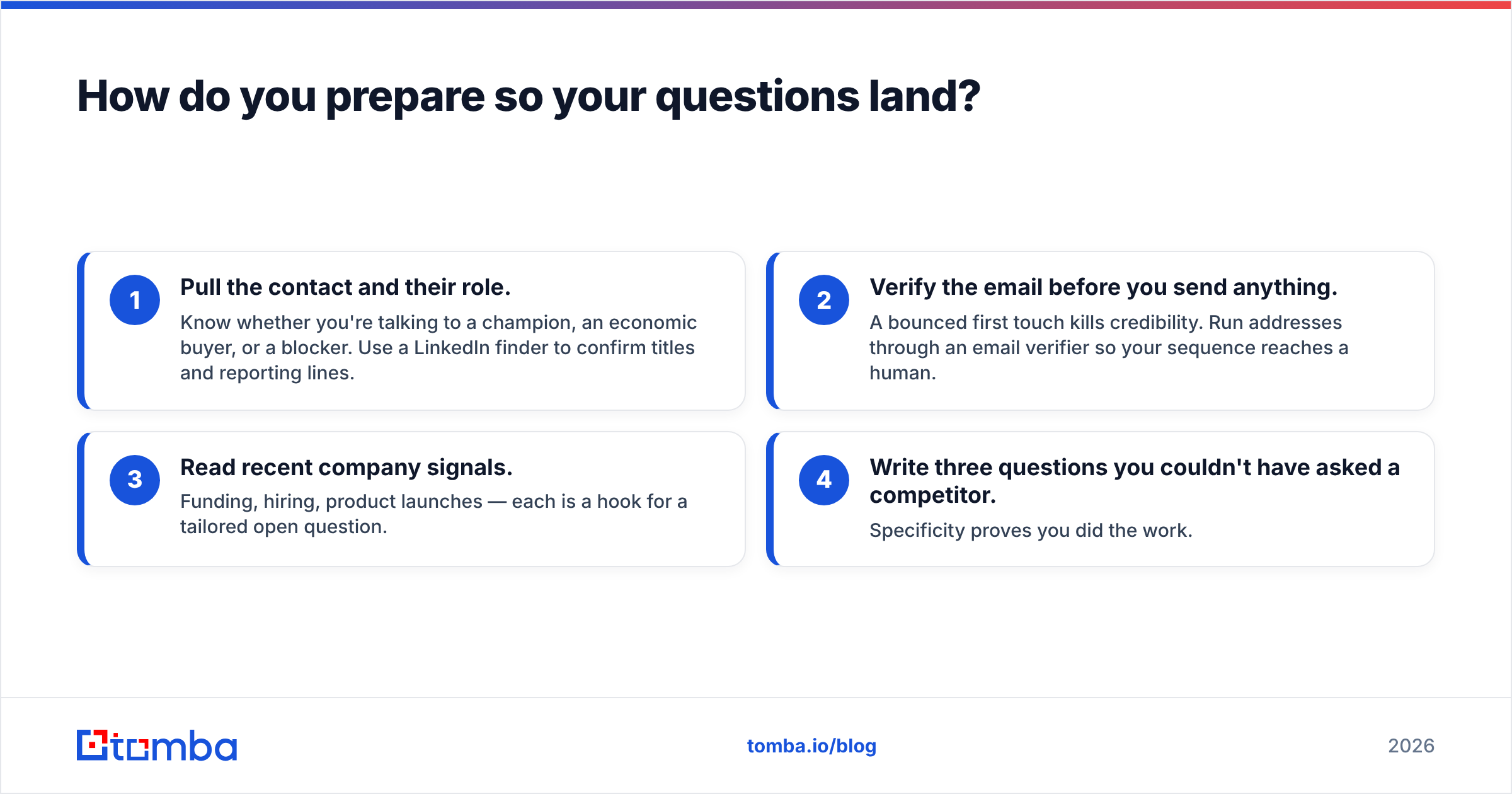
Before any call:
- Pull the contact and their role. Know whether you're talking to a champion, an economic buyer, or a blocker. Use a LinkedIn finder to confirm titles and reporting lines.
- Verify the email before you send anything. A bounced first touch kills credibility. Run addresses through an email verifier so your sequence reaches a human.
- Read recent company signals. Funding, hiring, product launches — each is a hook for a tailored open question.
- Write three questions you couldn't have asked a competitor. Specificity proves you did the work.
For teams running outreach at scale, layering enrichment data onto contacts means your reps walk into every call already knowing the org chart. That's the quiet advantage behind reps who seem to "just get it" — they prepared.
How many open-ended questions should you ask on a call?#
There's no magic number, but a useful rule: aim for 8–12 substantive open questions across a 30-minute discovery call, with plenty of follow-ups branching off each. If you're asking more than that, you're probably not listening to the answers. If you're asking fewer, you're pitching too early.
Quality beats volume. One well-timed "What's that costing you?" that uncovers a six-figure pain is worth more than twenty surface-level prompts. Track your own talk ratio with a call-recording tool and adjust — most reps are shocked at how much they talk.
Common mistakes that turn open questions into dead ends#
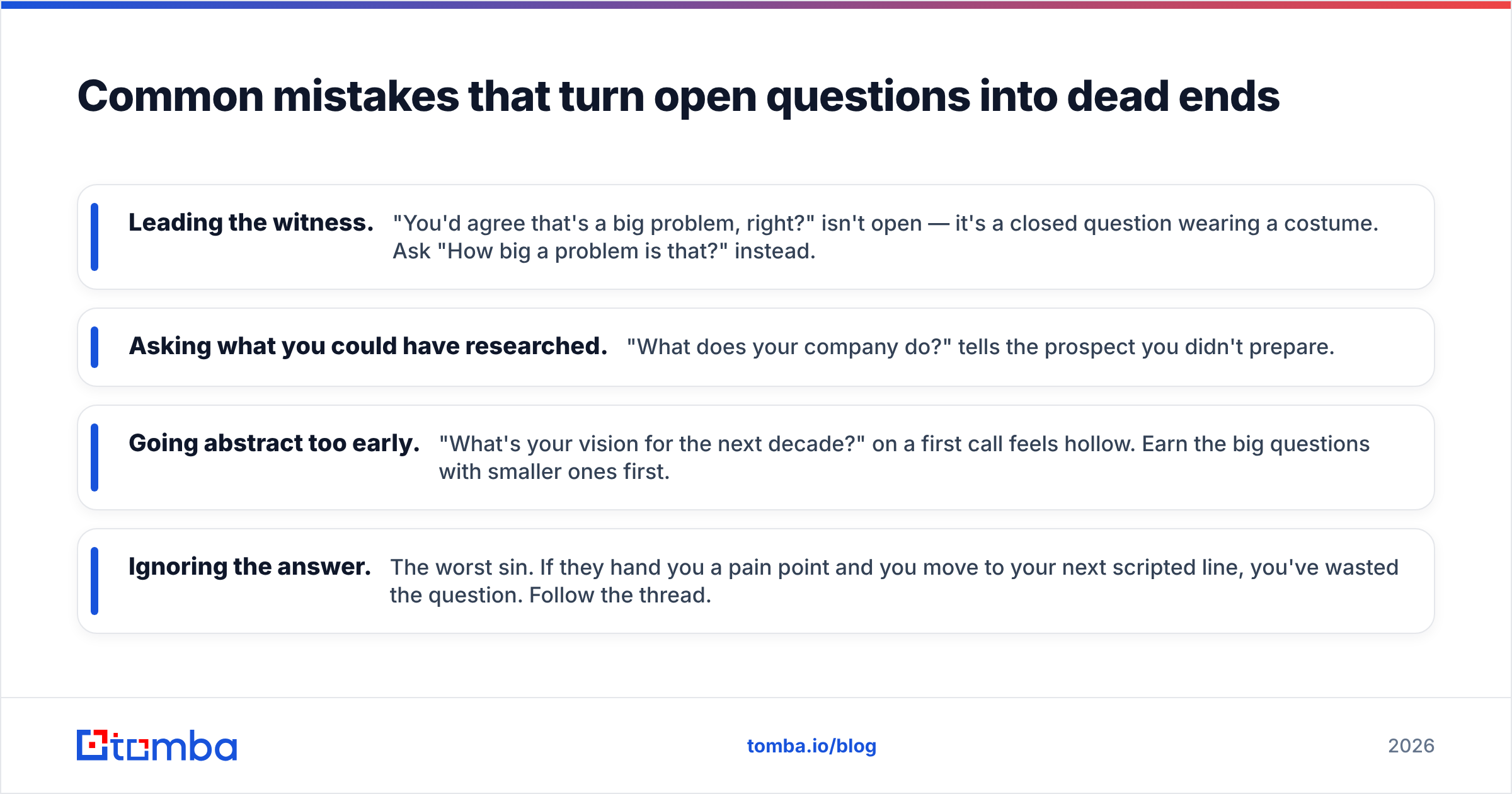
- Leading the witness. "You'd agree that's a big problem, right?" isn't open — it's a closed question wearing a costume. Ask "How big a problem is that?" instead.
- Asking what you could have researched. "What does your company do?" tells the prospect you didn't prepare.
- Going abstract too early. "What's your vision for the next decade?" on a first call feels hollow. Earn the big questions with smaller ones first.
- Ignoring the answer. The worst sin. If they hand you a pain point and you move to your next scripted line, you've wasted the question. Follow the thread.
Putting it together#
Open-ended sales questions work because they flip the dynamic: the prospect does the selling, telling you exactly what they need and why. Your job is to ask, shut up, and follow the most interesting thread. Layer your questions from situation to impact to commitment, prepare hard enough that every prompt feels personal, and reserve closed questions for confirming the close.
But none of it fires if you're aimed at the wrong inbox. The reps who consistently fill a pipeline pair sharp questioning with clean targeting — they know exactly who to ask before they ever dial. Start there: use the Tomba Email Finder to pull verified, decision-maker emails by name or domain, then spend your discovery time on people who can actually say yes. The free tier gives you 25 searches a month to test it, and paid plans start at $49/mo on the Tomba pricing page. Get the contact right, and your best questions finally get a real audience.
// get started
Find, verify and enrich your first contacts today
Start on the free plan with 25 searches a month, then scale when your team is ready.
Free plan · No credit card required · GDPR & CCPA
// about the author