Best Sales Cadence in 2026: Steps, Timing & Examples
The best sales cadence isn't a magic number of emails — it's the right mix of channels, spacing, and clean data. Here are the frameworks, timing, and templates that actually book meetings in 2026.
TL;DR
- The best sales cadence is a multi-channel sequence of 8–14 touches over 2–4 weeks that mixes email, phone, and LinkedIn — not a single channel hammered repeatedly.
- Spacing matters more than volume: front-load value, leave 2–4 business days between touches, and stop when you hit a clear "no."
- Reply rates collapse when your list is dirty. Verified, accurately matched contact data is the single biggest lever on cadence performance.
- Personalization beats automation at the top of the funnel; automation keeps the cadence consistent at the bottom.
- Below you'll find a side-by-side framework comparison, a 12-touch template, and timing rules you can copy today.
What is a sales cadence?#
A sales cadence is the scheduled sequence of touchpoints a rep uses to reach a prospect — the "when, where, and how" of outreach. Think of it like a fitness program: one workout does nothing, but a structured plan repeated over weeks produces results. A cadence does the same thing for outbound, turning scattered emails and calls into a repeatable system.
The terms "cadence" and "sequence" are used interchangeably by most teams. Both describe the same thing: a defined series of steps — email, call, LinkedIn touch, voicemail — spaced across days, with rules for what to send and when to stop. According to HubSpot's sales research, it takes an average of multiple touches to connect with a prospect, which is exactly why a one-and-done email almost never works.
The "best" sales cadence is the one matched to your buyer, your channel mix, and — critically — the quality of your contact data. A perfect sequence sent to a stale list still bounces.
What makes the best sales cadence work?#
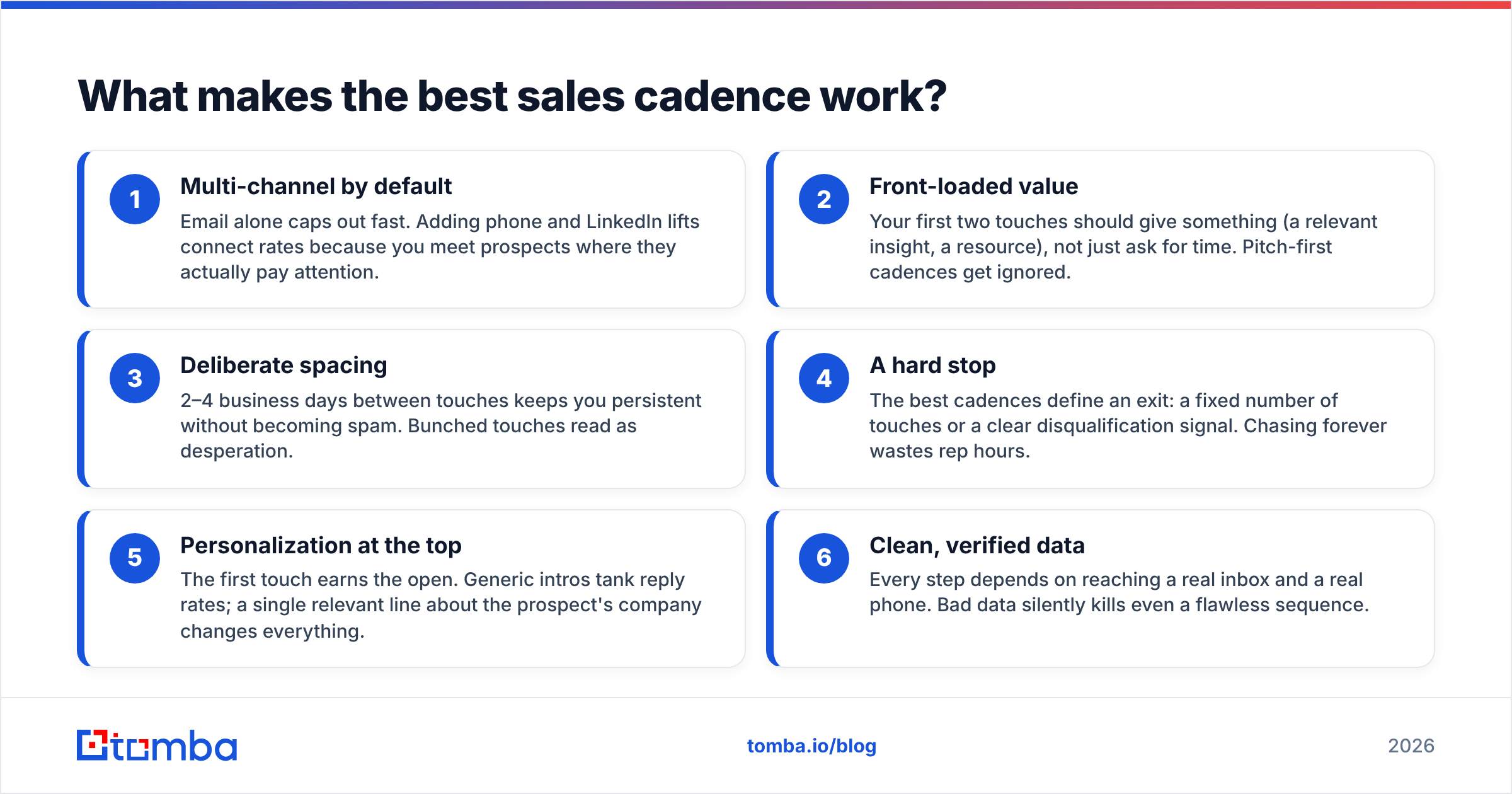
The best-performing cadences share a small set of traits. Here are the six that move the needle most:
- Multi-channel by default — Email alone caps out fast. Adding phone and LinkedIn lifts connect rates because you meet prospects where they actually pay attention.
- Front-loaded value — Your first two touches should give something (a relevant insight, a resource), not just ask for time. Pitch-first cadences get ignored.
- Deliberate spacing — 2–4 business days between touches keeps you persistent without becoming spam. Bunched touches read as desperation.
- A hard stop — The best cadences define an exit: a fixed number of touches or a clear disqualification signal. Chasing forever wastes rep hours.
- Personalization at the top — The first touch earns the open. Generic intros tank reply rates; a single relevant line about the prospect's company changes everything.
- Clean, verified data — Every step depends on reaching a real inbox and a real phone. Bad data silently kills even a flawless sequence.
That last point is the one most teams underinvest in. Before you obsess over subject lines, make sure your list is built from accurate sources — use a reliable email finder to source addresses and an email verifier to scrub them, so your carefully designed cadence actually lands.
Which sales cadence framework is best?#
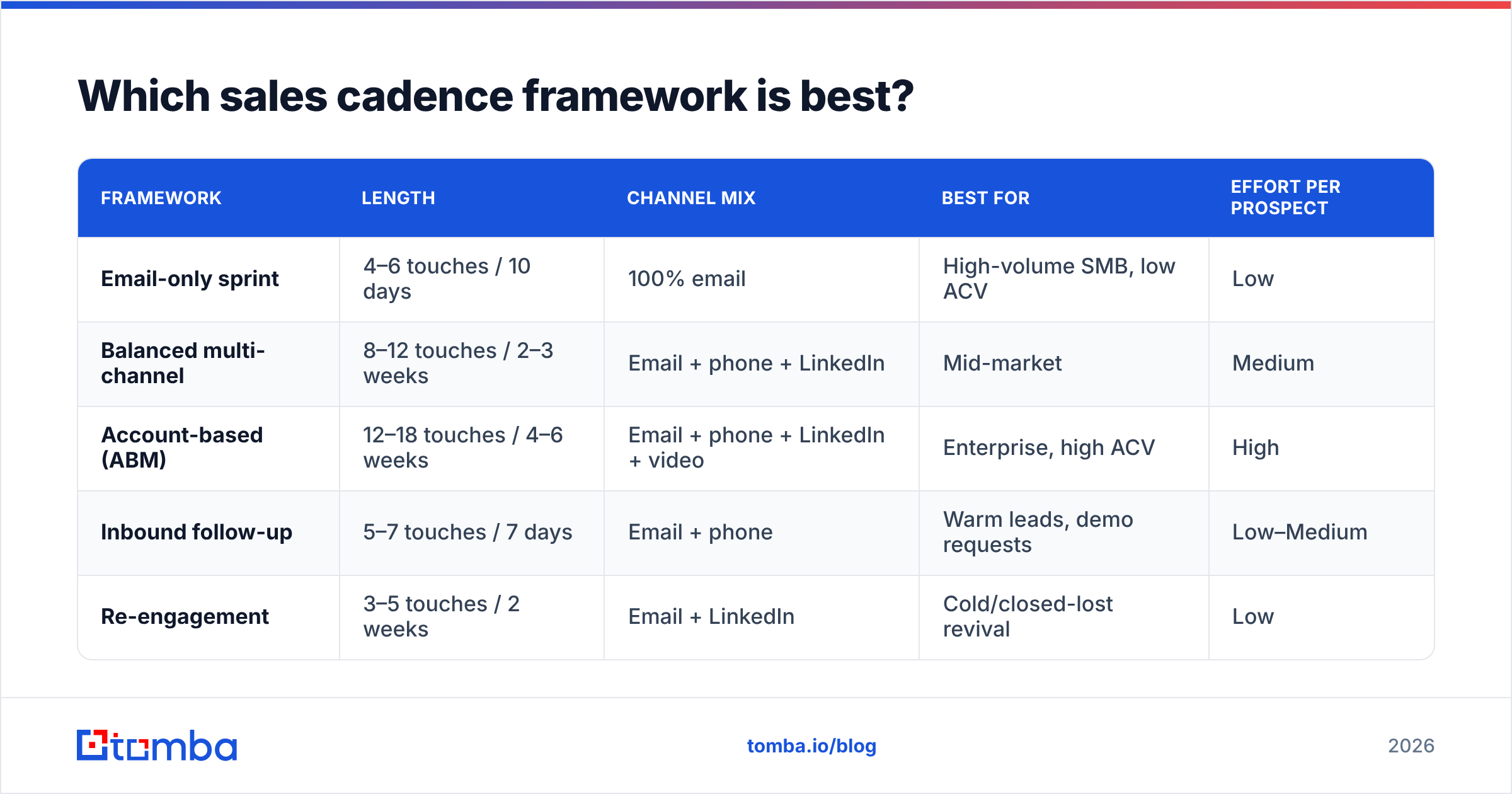
There's no single winner — the right framework depends on deal size and audience. High-volume SMB outbound rewards shorter, email-heavy cadences; enterprise outbound rewards longer, call-heavy, highly personalized ones. Here's how the common approaches compare:
| Framework | Length | Channel mix | Best for | Effort per prospect |
|---|---|---|---|---|
| Email-only sprint | 4–6 touches / 10 days | 100% email | High-volume SMB, low ACV | Low |
| Balanced multi-channel | 8–12 touches / 2–3 weeks | Email + phone + LinkedIn | Mid-market | Medium |
| Account-based (ABM) | 12–18 touches / 4–6 weeks | Email + phone + LinkedIn + video | Enterprise, high ACV | High |
| Inbound follow-up | 5–7 touches / 7 days | Email + phone | Warm leads, demo requests | Low–Medium |
| Re-engagement | 3–5 touches / 2 weeks | Email + LinkedIn | Cold/closed-lost revival | Low |
The balanced multi-channel cadence is the best default for most B2B teams in 2026 — it's long enough to break through, short enough to stay efficient, and uses the three channels that consistently outperform any single one. Scale up to ABM for your highest-value accounts and down to an email sprint for volume plays.
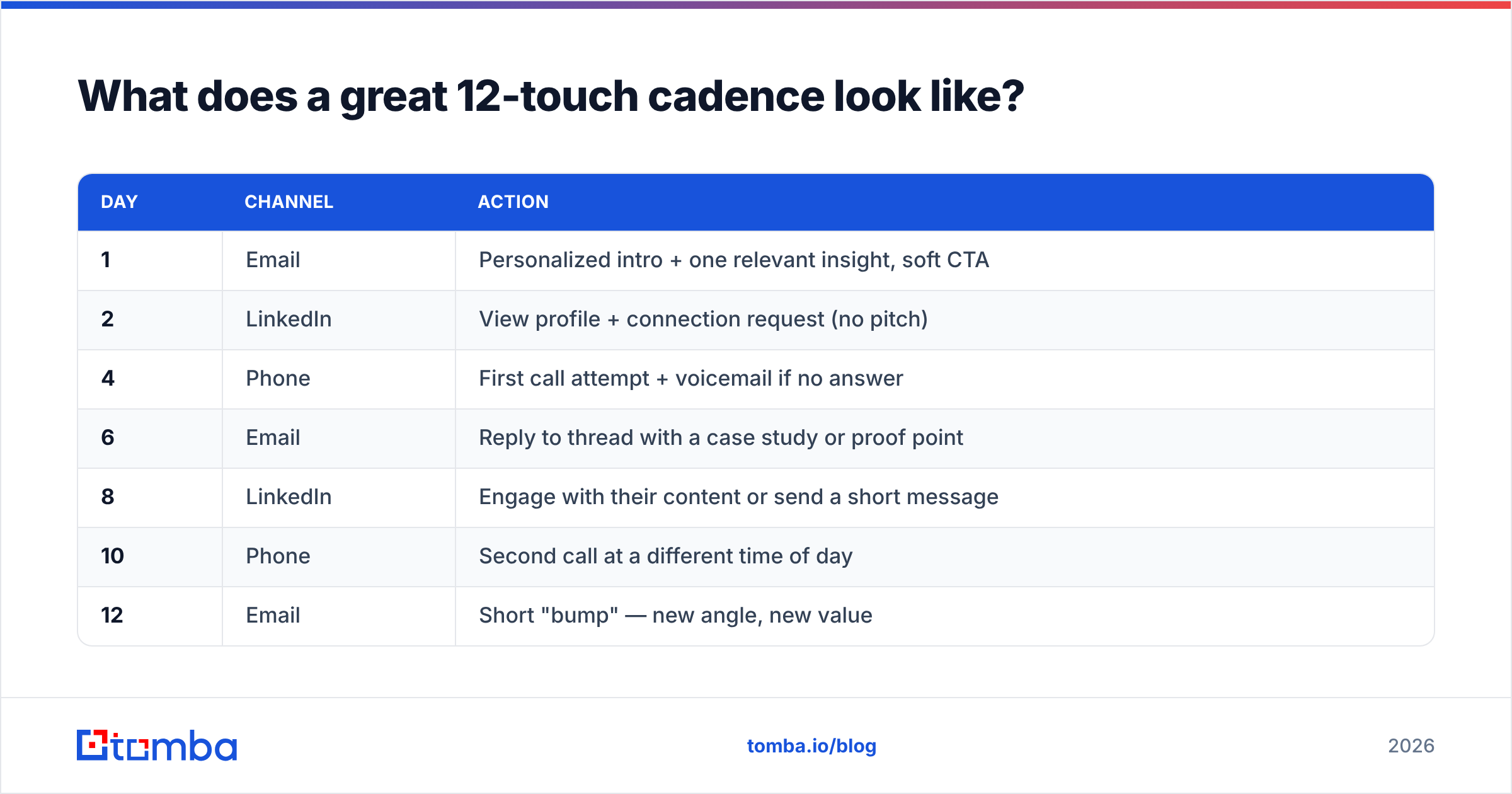
What does a great 12-touch cadence look like?#
Here's a proven balanced cadence you can adapt. It runs roughly 18 business days and mixes all three core channels:
| Day | Channel | Action |
|---|---|---|
| 1 | Personalized intro + one relevant insight, soft CTA | |
| 2 | View profile + connection request (no pitch) | |
| 4 | Phone | First call attempt + voicemail if no answer |
| 6 | Reply to thread with a case study or proof point | |
| 8 | Engage with their content or send a short message | |
| 10 | Phone | Second call at a different time of day |
| 12 | Short "bump" — new angle, new value | |
| 14 | Phone | Third call attempt |
| 16 | Break-up email with a clear, low-pressure CTA | |
| 18 | Final soft touch / leave door open |
Notice the rhythm: value-first email, social warm-up, then phone once you're not a total stranger. The cadence never sends two of the same channel back-to-back, and it ends with a graceful break-up rather than fading out. If a prospect replies at any point, they exit the cadence and move to a 1:1 conversation.
To run this at scale without manual list-building, pull contacts in batches with a bulk email finder and feed verified records straight into your CRM or sequencing tool.
How long should a sales cadence be — and how often should you touch?#
Aim for 8–14 touches spread over 2–4 weeks, with 2–4 business days between each. That window is long enough to catch prospects who were traveling or heads-down, but short enough that your message stays relevant.
A few timing rules that consistently help:
- Vary the time of day for calls. Someone who never picks up at 9 a.m. may answer at 4:30 p.m.
- Don't send touches on back-to-back days unless one is a low-effort social action. Daily emails feel like spam.
- Mid-week and early-week tend to outperform Fridays for both email opens and call connects, though you should test against your own data.
- Stop at the break-up. Continuing past a defined endpoint annoys prospects and damages your domain reputation.
That reputation point is bigger than it looks. Sending high volumes to unverified addresses drives bounces, which hurt email deliverability and can get your domain flagged. A clean list isn't just about reply rates — it protects the channel itself.
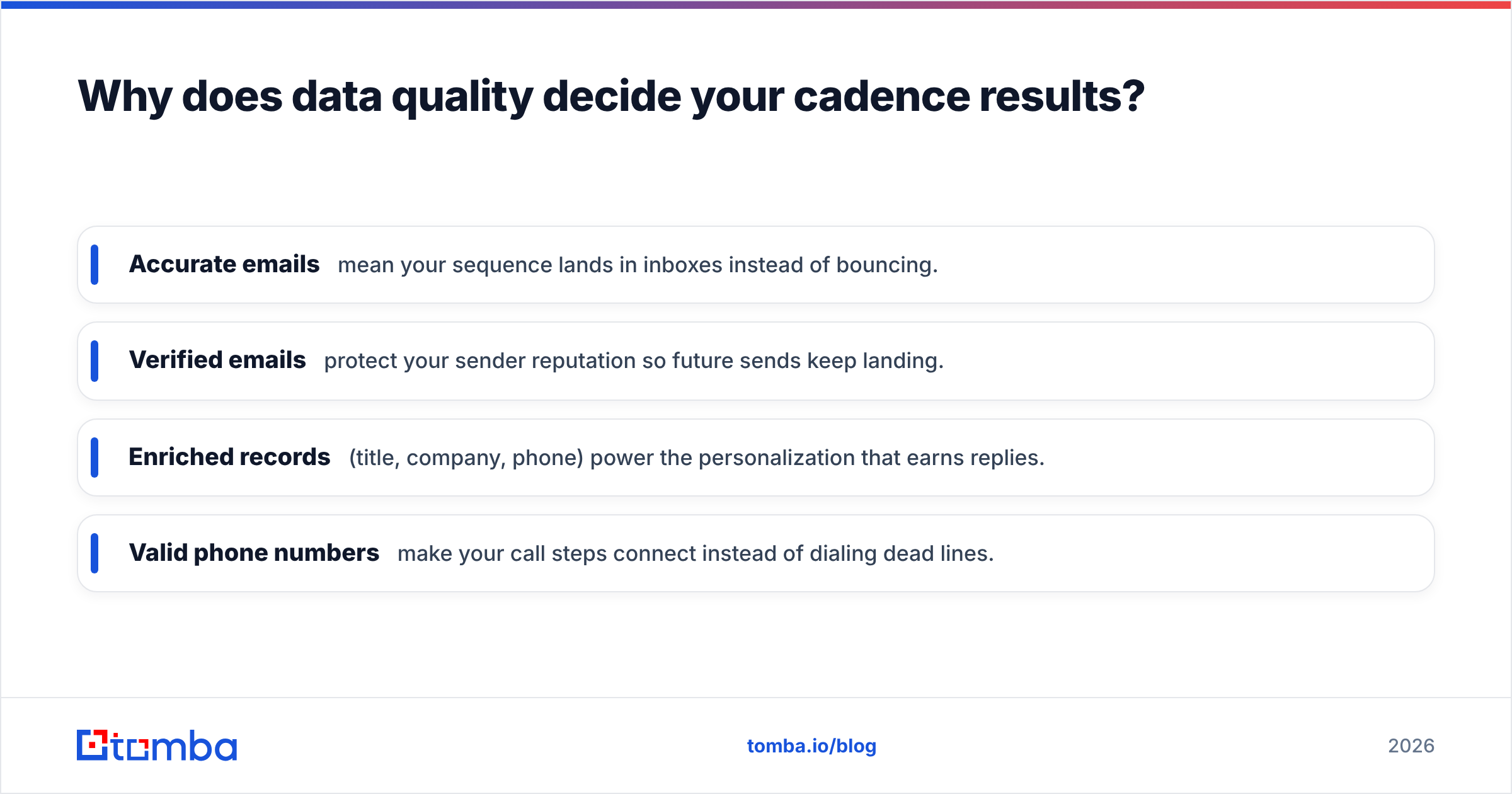
Why does data quality decide your cadence results?#
Because the best cadence in the world fails if the message never reaches a human. Reply rate is downstream of deliverability, and deliverability is downstream of data quality. You can A/B test subject lines all month, but if 20% of your list bounces, you're optimizing the wrong variable.
Here's the chain of dependencies most teams ignore:
- Accurate emails mean your sequence lands in inboxes instead of bouncing.
- Verified emails protect your sender reputation so future sends keep landing.
- Enriched records (title, company, phone) power the personalization that earns replies.
- Valid phone numbers make your call steps connect instead of dialing dead lines.
Research from G2 consistently shows B2B data decays fast — people change jobs, companies rebrand, domains shift. A list built six months ago is already partly wrong. That's why the operational best practice is to source and verify contacts as close to send time as possible, then re-enrich periodically.
This is where pairing your cadence with the right tooling pays off. Use a domain search to map every reachable contact at a target account, verify before you load the sequence, and enrich with data enrichment so each first touch can open with something specific and true.
How do you personalize a cadence without slowing down?#
Personalize the first touch and the break-up; templatize the middle. The opener earns the open and the break-up earns the last-chance reply, so those deserve a human line each. The interior touches — proof points, bumps, social engagement — can run from strong templates because by then the prospect already knows who you are.
A practical split:
- Touch 1: One custom sentence tied to a trigger (funding, hire, product launch, a post they wrote). The rest is a tight template.
- Touches 2–9: Templated value with a single dynamic field (company name, role, pain point).
- Final touch: A short, human break-up that names a specific reason you reached out.
This 80/20 approach keeps reps fast while preserving the personalization that actually drives response. Trigger data — the "why now" — comes from enrichment and intent signals, not guesswork, which is another reason your data layer and your cadence are inseparable.
What are the most common sales cadence mistakes?#
Even good teams trip on the same things. Avoid these:
- All email, no phone or social. Single-channel cadences leave connects on the table.
- Pitching in touch one. Lead with value; ask later.
- Sending to an unverified list. Bounces wreck deliverability and waste every downstream step.
- No exit criteria. Cadences that never end burn rep time and irritate prospects.
- Identical spacing and copy across segments. An enterprise CFO and an SMB founder need different rhythms and messages.
- Ignoring the data refresh. Reusing a stale list quarter after quarter guarantees declining results.
Fix the data problem first — it's the cheapest, highest-leverage change. Then tune channels, then copy, then timing. That order reflects where the biggest gains actually come from.
Best sales cadence: the bottom line#
The best sales cadence in 2026 is a balanced, multi-channel sequence of roughly 8–14 touches over 2–4 weeks, value-led at the edges, templated in the middle, with a hard stop and clean data underneath every step. Frameworks scale up to ABM for big accounts and down to email sprints for volume — but the constant across all of them is reaching a real, verified person.
Get the data layer right and a good cadence becomes a great one. Start by building accurate, deliverable contact lists with the Tomba Email Finder — find professional emails by name, domain, or company, verify them in the same workflow, and feed your sequence prospects it can actually reach. Check the Tomba pricing plans, including a free tier with 25 searches a month, and give your next cadence the clean foundation it needs to convert.
// get started
Find, verify and enrich your first contacts today
Start on the free plan with 25 searches a month, then scale when your team is ready.
Free plan · No credit card required · GDPR & CCPA
// about the author